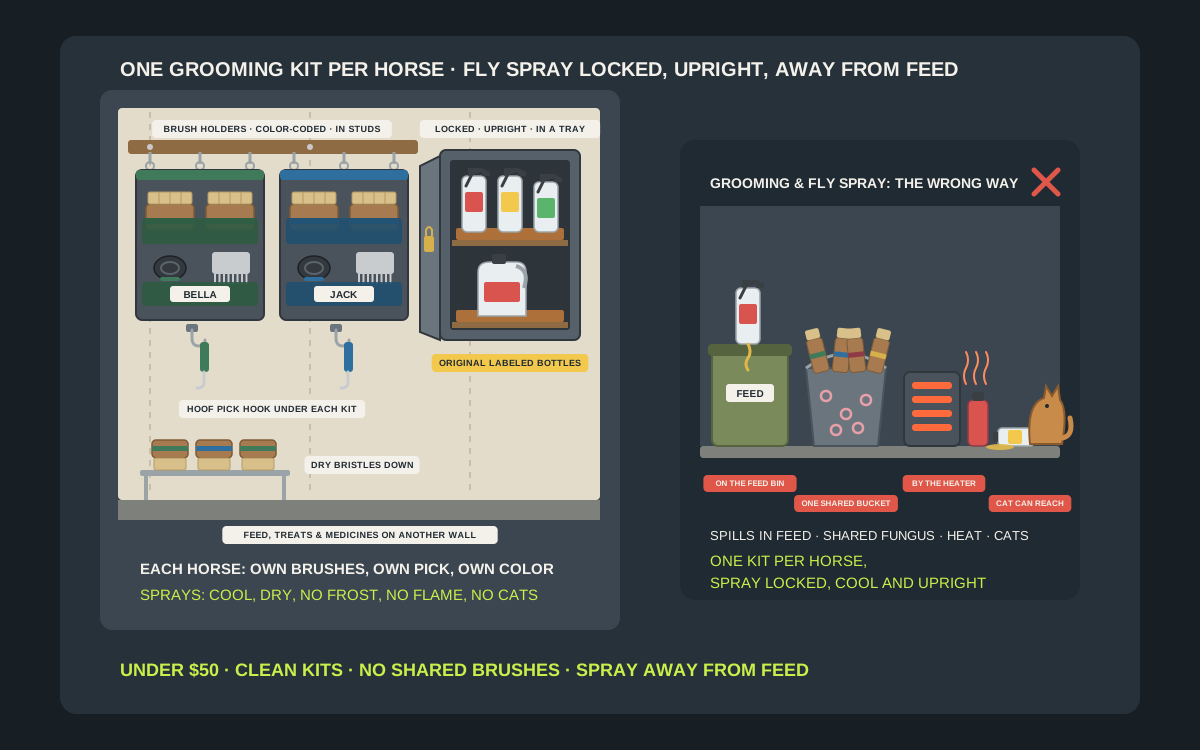
Grooming kits have a way of spreading. The curry comb ends up on the fence post, the hoof pick in a coat pocket, the body brush in the trunk of the car, and the fly spray on whatever flat surface was closest, which in a lot of garages and small barns is the lid of the feed bin. With one horse that is annoying. With two or three it becomes a health problem, because every brush gets used on every horse, and a skin fungus picked up by one of them can travel to all the others on the bristles. Fly spray brings its own set of rules. It is a pesticide, and the label on the bottle tells you exactly how to store it: in the original container, out of reach of children and pets, away from food and feed, and in many cases locked, upright and protected from heat and freezing. A small grooming and fly spray wall solves both problems for very little money. A hanging brush holder or a caddy for each horse, a hook for each hoof pick, a rack where washed brushes can dry and one locked cabinet or high, lipped shelf for the sprays cost less than a good set of brushes. This guide covers which under-$50 organizers suit grooming tools, how to give each horse its own kit, how to clean and dry brushes so they stay that way, and how to store fly spray the way the labels, the EPA and the National Pesticide Information Center describe, using advice from university extension services, equine veterinarians and the product makers themselves.
Shop horse grooming totes on Amazon
Who this is for
- Backyard horse owners who groom in the garage, a run-in shed or a small barn without a tack room
- Owners of two or more horses who want each horse to have its own brushes without a pile of mixed-up kits
- Anyone whose fly spray currently lives on the feed bin, a windowsill or the floor
- Riders who share a barn with cats, dogs or children and want the sprays out of reach
Quick answer
For most garages and small barns, the best under-$50 setup is one hanging brush holder or grooming caddy per horse, hung on hooks screwed into the studs and marked with that horse’s color, with a hook below it for the hoof pick and a small rack nearby where washed brushes dry bristles down. Fly spray goes in a separate spot: a small lockable wall cabinet, or at least a high shelf with a lip or a tray, where bottles stand upright in their original containers, away from feed, treats, medicines, heaters and anything a cat or a child can reach. Keep refill jugs low and in a tray, buy only what you will use this season, and move the sprays somewhere frost-free for the winter if your garage freezes. Check each organizer’s size and mounting against your wall and your brushes, and compare the current price on the listing before you buy.
Quick picks
- Best overall: a hanging fabric brush holder with several pockets, one per horse. World Class Equine’s BH101, for example, has two large and four brush pockets and hangs from three D-rings, so it can go on screw hooks in the studs and come off for washing.
- Best budget pick: a small plastic grooming caddy on a shelf or a heavy hook. Tough1’s Final Touches caddy is about 8 inches tall, keeps spray bottles upright and has a spring snap on the outside for a hoof pick.
- Best for hoof picks and combs: a short hook rail at shoulder height with one hook per horse, so the hoof pick and mane comb hang where you can see them and never end up in a pocket.
- Best for fly spray: a small lockable wall cabinet, with a plastic tray on the shelf to catch drips, mounted away from the feed and the heater. It matches what the labels ask for: upright, in the original container, out of reach of children and pets and preferably locked.
- Best for washing day: a folding drying rack or a wire shelf where washed brushes can dry bristles down or on their sides, the way groom Pro Equine Grooms recommends, so the wooden backs do not soak.
- Best for barns with stall walls: a portable grooming organizer that hooks over a stall wall. Tough1 and Weaver both make larger hanging organizers and baskets, though they usually cost more than $50.
Quick comparison
| Organizer | Best for | How it holds | Trade-off |
|---|---|---|---|
| Hanging fabric brush holder | One horse’s full brush kit | Pockets on a panel that hangs from D-rings or hooks | Fabric needs washing; not for sprays |
| Plastic grooming caddy | A small kit with one spray bottle | Open tub with handle, bottles stand upright | Can tip over if hung by the handle |
| Grooming tote with pockets | A kit that travels to shows | Fabric bag with inside and outside pockets | Soft sides sag on a hook |
| Hook rail for picks and combs | Hoof picks, combs, cloths | One hook per tool, screwed into studs | Small tools only |
| Lockable wall cabinet | Fly spray and other pesticides | Shelves behind a locking door | Needs studs; bigger ones top $50 |
| High shelf with a lip and tray | Sprays where a cabinet will not fit | Bottles stand in a tray on a shelf | Not locked; keep it high |
| Wire drying rack | Washed brushes and sponges | Brushes dry bristles down or on their sides | Takes floor or bench space |
| Over-the-stall organizer | Barns with stall walls | Metal hooks over a partition | Usually costs more than $50 |
Hanging brush holdersGrooming caddiesLockable wall cabinets
What to look for
One kit per horse, clearly marked
The most important feature of a grooming wall is not the organizer, it is the separation. The American Association of Equine Practitioners’ biosecurity guidelines recommend that equipment used on one horse be clearly identified, for example with a strip of color-coded tape, and that brushes and sponges that cannot be disinfected not be shared between horses. The FEI gives competitors the same advice. Whatever you buy, buy one per horse, and choose something you can mark with a color or a name.
Pockets that fit your actual brushes
A basic kit, as the University of New Hampshire Extension’s hippology materials describe it, is a curry comb, a dandy or hard brush, a body or soft brush, a mane and tail comb, a hoof pick and a grooming cloth; the University of Kentucky’s 4-H grooming module adds a shedding blade and a sponge. Lay your own kit out before you shop and check pocket sizes against the widest brush. World Class Equine lists its BH101 holder at 28 by 25 inches with two large and four brush pockets, and its BH201 at 42 by 25 inches with eight brush pockets, which is the scale you need for one or two horses.
Washable or easy to wipe out
Brushes get cleaned, so their holder should be cleanable too. Pro Equine Grooms reminds owners to wash the brush box along with the brushes, and the AAEP’s sheet for grooms describes washing grooming tools with detergent, rinsing, soaking in disinfectant, rinsing again and drying. A plastic caddy can be scrubbed and hosed; a fabric holder should come off its hooks and go in the wash. Avoid anything with deep seams that trap hair and dust.
Upright, contained storage for sprays
Fly spray labels are specific. Bonide’s fly spray label says to store the product upright, preferably in a locked area, and Farnam’s Endure label asks owners to keep it in its original container in a dry place out of reach of children and pets, away from food, pet food, seed, fertilizers and veterinary supplies. The organizer for sprays should therefore hold bottles standing up, catch drips and ideally lock. A caddy that tips over in a hook or a fabric pocket that soaks up a leak is the wrong tool.
Solid mounting for a full load
A fabric holder full of wooden brushes, a caddy with three trigger bottles in it or a refill jug on a shelf is heavier than it looks. A gallon of a water-based spray weighs roughly what a gallon of water does, a little over 8 pounds. Screw hooks, cabinets and shelves into studs, or into a board fixed across them, and keep the heaviest containers low. Adhesive hooks are fine for a single comb but not for a loaded holder that gets pulled on every day.
Height that suits the people, not the cats
Grooming tools should be easy to reach from where you tie the horse, at roughly chest height, while sprays belong higher or behind a door. The EPA’s advice for any pesticide is to store it out of reach of children and pets, in a locked cabinet if possible, and the National Pesticide Information Center suggests a well-ventilated spot that children and pets cannot get into, preferably with a latch or lock. In a barn with cats, that matters more than usual, as the section on cats below explains.
Know your grooming kit
The curry comb
Grooming starts with the curry. The University of New Hampshire Extension describes using it in a circular motion to loosen dirt and hair, and suggests skipping the head and lower legs if the horse is sensitive there; Virginia Cooperative Extension also says not to curry the lower legs or face. Most curries are rubber or plastic and get very dirty, very fast, so give the curry its own pocket or hook where it can be knocked clean against a hard surface, as Pro Equine Grooms suggests, before it goes back on the wall.
The dandy and the body brush
After the curry comes the stiff dandy brush, used with a flicking motion to lift the loosened dirt, and then the soft body brush in long, smooth strokes that bring out the oils in the coat and add shine, in UNH’s description. These two brushes usually have wooden or plastic backs, and they are the ones most often borrowed from one horse’s kit for another. A labeled pocket for each is the easiest way to keep them apart.
Mane comb, cloth and sponge
Virginia Cooperative Extension recommends combing manes and tails gently, starting at the bottom and working up. A soft grooming cloth wipes around the eyes and nostrils, and the University of Kentucky’s 4-H module adds a sponge to the list. Cloths and sponges are the hardest items to disinfect, so they need the strictest one-horse rule and a place to dry, not a damp corner of the caddy.
Hoof pick and shedding blade
UNH advises picking the feet before and after riding and at least once a day, working from heel to toe around the frog. That makes the hoof pick the most used tool in the kit and the one most likely to go missing, which is why it deserves a hook of its own. The shedding blade, a flexible metal band with a toothed edge, is a seasonal tool for loose winter hair in spring, and the 4-H module notes that its smooth side scrapes water off after a bath.
Fly spray and the other bottles
Fly sprays come as ready-to-use trigger bottles, aerosol or bag-on-valve cans and refill jugs. Farnam sells Endure, for example, in a 32-ounce trigger bottle, a 15-ounce continuous spray can and a 128-ounce refill jug. Most of them are pesticides registered with the EPA, which is why their labels carry storage instructions. Detanglers, coat sprays and shampoos can sit with the grooming kit; fly sprays and wipes belong in their own spot.
Organizer types, side by side
Hanging fabric brush holders
A brush holder is a fabric panel with a row of pockets that hangs on the wall or a stall front. World Class Equine’s BH101 holds two large items and four brushes on a 28 by 25 inch panel, and its BH201 has eight brush pockets on a 42 inch panel; both hang from three D-rings or wrap on with hook-and-loop fasteners. On a garage wall, three screw hooks in a board across the studs hold the D-rings. Because the panel comes off, it can go through the wash with the brushes.
Plastic grooming caddies
The classic budget option is a small plastic caddy with a carry handle. Tough1 describes its Final Touches caddy as about 8 inches high and 9 inches wide, with room to keep spray bottles upright and a spring snap on the outside for a hoof pick. A caddy is easy to carry to the cross-ties and easy to hose out. On the wall, it is best on a shelf or a deep bracket, not dangling by its handle, where a full bottle can tip it.
Grooming totes with pockets
A tote is a fabric bag with pockets inside and out. Tough1’s Deluxe Breakdown grooming tote, for example, measures 16 by 10 by 10 inches in 600-denier fabric and has four collapsible pockets inside. Totes are made for travel, so they suit horses that go to shows or lessons; at home, a tote hung on a hook by its handles sags and spills, so give it a shelf or a deep peg.
Hook rails for picks, combs and cloths
A short rail with several hooks, screwed into the studs, does a job no pocket does well: it shows you at a glance that every hoof pick is home. Put one hook per horse under its brush holder for the hoof pick, and one for each horse’s mane comb or cloth. Our hook rail vs individual hooks guide compares the two approaches if you are planning a longer wall.
Lockable wall cabinets for sprays
A small steel or plastic wall cabinet with a lock is the best home for fly spray. It gives you everything the labels ask for at once: upright storage, protection from sunlight, a door between the bottles and curious pets or children, and, with a plastic tray on each shelf, a way to contain a leak. Small cabinets fit under $50; larger ones usually do not, so measure your bottles and buy for the sprays you actually keep.
Over-the-stall organizers
If your horses live in stalls with 2 inch partitions, a hanging organizer that hooks over the wall puts the kit right where you groom. Tough1’s portable grooming organizer is about 30 inches high and 16 wide, with seven compartments and two metal hooks, and Weaver makes a hanging aluminum grooming basket and tack rack whose brackets fit walls from 1 to 2 1/4 inches thick. Both usually cost more than $50, and neither hangs on a flat garage wall without extra hardware, so they are a stall-barn option.
Drying racks
Brushes need a place to dry after washing day. Pro Equine Grooms suggests drying them bristles down or on their sides so water does not soak into the wooden handles, and mentions a folding laundry rack as an easy drying station. A small wire shelf or rack near the grooming wall, out of the dust, does the same job and keeps clean brushes off the floor.
One kit per horse: the biosecurity case
Why shared brushes spread skin disease
Ringworm is a fungal skin infection, not a worm, and the University of California, Davis Center for Equine Health notes that it spreads through tack and grooming equipment as well as direct contact, with an incubation period of up to three weeks. That delay is the trap: by the time one horse shows a patch, the shared brushes may already have carried it to the others. UC Davis recommends that each horse have its own equipment and that grooming tools be disinfected.
Color-code everything
The AAEP’s general biosecurity guidelines suggest clearly identifying each horse’s equipment, for example with color-coded tape. On a grooming wall, that means a strip of the same color on the brush holder or caddy, on every brush back, on the hoof pick handle and on the hook where it hangs. A brush that turns up in the wrong pocket is then obvious to anyone who uses the wall.
What can and cannot be shared
The same guidelines say that shared grooming supplies should be cleaned and disinfected between horses, and that brushes and sponges that cannot be disinfected should not be shared at all. In practice, natural bristle brushes, sponges and cloths are personal, while a plastic shedding blade or a hoof pick can be washed and disinfected if it must be shared. The simplest rule on a home wall is that nothing moves between kits.
Ointments and wound care
The AAEP sheet for grooms recommends dividing ointments into small, labeled containers rather than dipping into one shared jar for every horse. Keep each horse’s small pots in its own kit, and keep the main supply, along with other veterinary products, in a separate cabinet away from the fly spray. Our pet first aid kit wall mounts guide covers that shelf.
New arrivals and sick horses
A new horse, or one with a suspicious skin patch, gets its own kit from day one and its own spot on the wall at the end of the row. UC Davis notes that ringworm can take weeks to show, so keeping that kit separate for a few weeks is cheap insurance. Mark it with a color you will not use for anyone else.
Clean and dry the brushes
Daily: knock them clean
Pro Equine Grooms recommends banging the curry against a hard surface to knock the dirt out, and a quick flick of each brush across the curry’s teeth clears most of the hair. Doing it outside, before the brushes go back in their pockets, keeps the holder and the wall clean. A rubber mat or a block of wood under the grooming wall is a good place to do it.
Weekly: wash, soak and rinse
For a deeper clean, Pro Equine Grooms suggests a weekly wash in warm water with chlorhexidine, such as Nolvasan, or a mild horse shampoo, letting the brushes soak briefly, then rinsing them well. The AAEP’s grooms sheet describes the same sequence for grooming tools: wash with detergent, rinse, soak in a disinfectant, rinse again and dry. Wash the caddy or the brush holder at the same time, as Pro Equine Grooms points out, or clean brushes go straight back into dirt.
When there is ringworm in the barn
The Merck Veterinary Manual describes ringworm as caused by fungi such as Trichophyton and recommends cleaning contaminated equipment and surroundings, with disinfectants that are labeled as effective against those fungi. Read the label of the disinfectant you buy and follow its contact time. Fabric items such as cloths and holders go through the wash, and anything that cannot be cleaned should be replaced rather than moved to another horse’s kit.
Dry them the right way up
Wet brushes should dry bristles down or on their sides, Pro Equine Grooms says, so water does not run into the wooden backs, and a folding laundry rack makes a handy drying station. Let them dry completely before they go back into pockets or a closed caddy, where damp bristles stay damp. Sponges and cloths dry hung up, not balled in a corner.
Check the kit when you clean it
Washing day is also inventory day. Look for brushes that are worn flat, curries that are cracked and hoof picks that have gone missing, and replace them within that horse’s color. Grooming is also when you notice new lumps, scrapes and skin patches, and a clean, complete kit makes that daily check quicker.
Store fly spray the way the label says
Original container, label on
Every source agrees on this one. The EPA says to always keep pesticides in their original containers with the label, which lists directions, ingredients and first aid steps, and never to transfer them into soft drink bottles or other containers. NPIC adds that the original container is made to withstand the chemicals inside and has the right cap to protect children and pets. Farnam’s Endure label says the same, and the label for a common water-based permethrin spray adds that it should be kept away from other chemicals.
Upright, closed and in a tray
Bonide’s label says to store its fly spray upright, and Farnam asks owners who have a leaking container to place it in another container and mark it with the contents. NPIC suggests storing bottles inside a larger container that can hold a spill. A plastic tray or a shallow bin on the cabinet shelf does both jobs: it keeps bottles standing and keeps a leak off the wall and the shelf below.
Away from feed, treats and medicines
The Endure label lists exactly what fly spray should be kept away from: food, pet food, seed, fertilizers and veterinary supplies. The EPA says never to store pesticides with or near food, animal feed or medical supplies, and NPIC says to keep them away from food, feed and flames. On a garage wall, that means the spray cabinet goes on a different wall from the feed bins, the treat jar and the first aid kit, not on the shelf above them.
Locked and out of reach
Labels for several sprays, including Bonide’s and Absorbine’s UltraShield EX, say to store them in a locked place if possible. The EPA suggests a locked cabinet in a well-ventilated utility area or shed, and NPIC recommends a location children and pets cannot reach, preferably with a latch or lock. The EPA also warns that child-resistant packaging is not child-proof. A small padlocked cabinet is the simplest way to meet all of that.
Cool, dry and away from heat
The UltraShield EX label says to store it in a cool, dry place away from heat or open flame, describes the product as combustible and warns that its pressurized bag-on-valve can may burst if exposed to temperatures above 130 F. The EPA says to keep flammable liquids away from ignition sources such as a furnace, a car, a grill or a lawn mower. In a garage, that rules out the shelf above the water heater, the wall beside a space heater and the sunny window ledge.
Protect it from freezing
Cold matters too. The UltraShield EX label asks owners to protect the product from freezing and keep it above 32 F, and the permethrin water-base label also says to protect it from freezing. NPIC notes that temperature extremes can change the chemistry of some pesticides and damage their containers, and that as a general rule pesticides keep best between 40 and 90 F. Your label is the final word for each product.
Cats, dogs and fly spray
Permethrin and cats
Many horse fly sprays contain permethrin or other pyrethroids, and cats are especially sensitive to them. Cornell’s veterinary college warns that permethrin is toxic to cats, and the Equi-Spot horse label states plainly: do not use on cats, because the product could be fatal to them. Barn cats sleep on saddle pads, rub against horses and investigate anything that smells interesting, which makes a dripping bottle on a low shelf a real risk.
Keep sprays above and behind
Put the spray cabinet at a height where a cat cannot jump onto its shelf, close the door after every use and wipe up drips on the tray rather than leaving them on the shelf. Do not leave rags or wipes that have been soaked in fly spray where cats sleep. If you also keep dog flea products, keep them in a different spot and never use horse products on small animals.
Dogs and children in the barn
Dogs chew bottles and children copy adults. That is why the EPA, NPIC and the labels all say out of reach of children and pets, and why the EPA warns that child-resistant does not mean child-proof. A locking cabinet removes the guesswork, and it means a visitor’s child cannot pick up a trigger bottle while you are busy with the horse.
Using fly spray from the wall
Groom first, then spray
Fly spray labels are written with a clean coat in mind. Farnam’s Endure directions say to brush the horse thoroughly before applying, to shampoo and rinse a dirty horse and to wait until the coat is completely dry. Prozap’s directions likewise suggest grooming before application. That makes the order on your wall logical: brush kit first, at the front, and the spray cabinet next to it.
Wipe the face, wear gloves
For the face, the Endure label says to always apply as a wipe with a clean cloth or sponge, never sprayed, and to wear a rubber glove or mitt when wiping. Keep a pair of gloves and a few dedicated application cloths in the spray cabinet, labeled for that purpose, so they never end up in the grooming kit and on the next horse’s face.
Let it dry before the tack goes on
Prozap’s directions say to let the spray dry before covering the horse with tack, and a Canadian label for a similar product warns against applying it to the back right before saddling or covering the horse straight after treatment. Spray after tacking up, or wait, and keep the saddle and pads on their own wall, away from the spray. Our horse tack wall racks guide covers that wall.
Never pour leftovers down the drain
Leftover fly spray is not wash water. The Endure label says not to reuse the empty container and never to pour unused product down any indoor or outdoor drain. NPIC suggests disposing of unwanted pesticides properly rather than storing them for years, and the EPA tells owners to follow safe disposal advice when they cannot identify a product or tell how old it is.
Where the grooming wall goes in a garage or barn
Next to the tie spot
The kit should be within arm’s reach of where you tie or cross-tie the horse, so you do not walk away from it mid-groom. In a garage with a horse out back, that is often the wall closest to the door to the paddock. Leave a clear path between the horse and the car, and keep the floor in front of the wall free of buckets and hoses.
Dry, shaded and ventilated
Brushes dry best and sprays keep best in the same conditions: cool, dry and out of direct sun, with air moving. NPIC recommends a well-ventilated location for pesticides, and the EPA says to avoid places where flooding is possible or where spills could reach drains or groundwater. The low corner by the floor drain and the shelf under a leaky window are both out.
Away from the feed wall and the car
Keep the grooming and spray wall on a different wall from feed, hay and treats, and away from the parking spot, fuel cans and the lawn mower. If your garage also holds chickens’ feed and supplies, our backyard chicken supply racks guide covers that wall; keep the spray cabinet well away from it.
Beside the tack and blankets, not over them
Leather does not like fly spray drips, and blankets that hang above a spray shelf collect overspray and dust. Put the grooming wall beside the tack and blanket walls with a gap between them. Our horse blanket wall racks guide covers the turnouts, sheets and coolers.
Getting the fly spray shelf ready for winter
Take stock in the fall
By November, most horses need little or no fly spray. Look at what is left, write down what you used this season and throw out bottles that are empty, leaking, unlabeled or so old you cannot tell what they are, following the label and local disposal advice. NPIC’s advice is to keep the inventory as low as possible and buy only what you need for the season; the EPA says the same: do not stockpile.
Move it if the garage freezes
If your garage or barn drops below freezing, the products whose labels say to protect them from freezing need a frost-free home for the winter, such as a locked cabinet in a heated utility room, still away from food, feed and medicines. Bring the tray with them. In the spring, check each bottle for separation or damage before you use it, and check the label again.
Clean the grooming kits for the shedding season
Winter is a good time for a deep clean of every kit, a new strip of colored tape on each brush and a check on the shedding blades, which will be busy in spring when winter coats come out. Our fall garage cleanout guide walks through the rest of the garage.
Three sample setups
Two-car garage, one horse out back
On the wall by the paddock door, a hanging brush holder in green tape hangs from three screw hooks in a board across the studs, with a hook below for the hoof pick and another for the mane comb. To the right, a small padlocked cabinet at head height holds two trigger bottles of fly spray standing in a plastic tray, with gloves and wipes on the top shelf. A small wire rack on the workbench is the drying spot on washing day.
Small backyard barn, two horses
Each horse gets a column on the aisle wall: a brush holder or caddy, a hoof pick hook and a towel hook, one in green tape and one in blue. At the end of the aisle, away from the feed room, a lockable cabinet holds the fly sprays, with the refill jug on the bottom shelf in a bin. A folding drying rack lives on a hook beside it and comes out on Sundays.
Boarding barn plus a garage at home
The horse lives at a boarding barn, so its grooming tote travels. At home, the garage holds a shelf for the tote between visits, a hook rail for spare hoof picks and cloths, and a small locked cabinet for the backup fly spray and the refill jug. After a weekend at the barn, the tote is emptied, the brushes are washed and dried on the rack, and the kit goes back together.
How to set it up in an afternoon
- Lay out every grooming tool and spray you own, sort the tools into one kit per horse and set aside anything broken or past its date.
- Pick a color for each horse and mark every brush, hoof pick and holder with a strip of colored tape.
- Choose a dry, shaded wall near the tie spot, away from feed, treats, medicines, heaters, fuel and the car.
- Find the studs, screw a board across them if needed, and hang one brush holder or caddy shelf per horse at about chest height.
- Add one hook per horse below its kit for the hoof pick and another for the mane comb or cloth.
- Mount a small lockable cabinet, or a high shelf with a lip, in the studs on the far side of the wall for fly spray.
- Put a plastic tray on each spray shelf, stand every bottle upright in its original, labeled container and keep refill jugs on the lowest shelf.
- Set up a drying rack where washed brushes can dry bristles down, and plan a weekly washing day.
- Before winter, take stock of the sprays, dispose of old ones properly and move freeze-sensitive products to a frost-free locked spot.
Mistakes to avoid
- Using one bucket of brushes for every horse, so a skin fungus on one horse travels to all of them.
- Leaving fly spray on the lid of the feed bin, next to treats or in the first aid cabinet.
- Pouring fly spray into an unlabeled bottle or an old drink bottle to make it easier to carry.
- Storing aerosol or pressurized cans by a space heater, the water heater or a sunny window.
- Leaving fly spray in an unheated garage all winter when its label says to protect it from freezing.
- Keeping sprays on a low open shelf where barn cats, dogs or children can reach a leaking bottle.
- Hanging a grooming caddy full of bottles by its handle from a single small hook.
- Putting wet brushes straight back into a closed caddy or pocket, bristles up.
Related guides
Browse the hub: Pet gear wall mounts under $50 - all guides
- Best Horse Tack Wall Racks Under $50 for Garage & Barn (Bridles, Halters & Lead Ropes)
- Best Horse Blanket Wall Racks Under $50 for Garage & Barn (Turnout Blankets, Sheets & Coolers)
- Best Pet Grooming Tool Wall Holders Under $50
- Best Backyard Chicken Supply Wall Racks Under $50 for Garage & Shed
- Best Pet First Aid Kit Wall Mounts Under $50
- Best Dog Wash Station Wall Organizers Under $50
- Best Garage Track Rail Hooks Under $50
- Hook Rail vs Individual Hooks for Garage Walls Under $50
- How to Do a Fall Garage Cleanout with Wall Racks Under $50
FAQ
What is the best way to organize horse grooming tools in a garage?
Give each horse its own hanging brush holder or caddy, marked with a strip of colored tape, on hooks or a shelf screwed into the studs near the tie spot. Add a hook per horse for the hoof pick, and a rack where washed brushes can dry bristles down. Keep fly spray in a separate locked cabinet, away from feed.
Should each horse have its own grooming kit?
Yes. The AAEP’s biosecurity guidelines recommend clearly identifying each horse’s equipment, for example with color-coded tape, and say brushes and sponges that cannot be disinfected should not be shared. UC Davis notes that ringworm spreads on grooming equipment and can take up to three weeks to show.
How do you clean horse grooming brushes?
Knock dirt out of the curry and brushes after each use. Once a week, wash them in warm water with a mild horse shampoo or a chlorhexidine solution, let them soak briefly, rinse and dry them bristles down or on their sides. Wash the caddy or holder at the same time.
Where should fly spray be stored?
In its original, labeled container, standing upright, in a cool, dry, preferably locked place out of reach of children and pets, and away from food, feed, treats and veterinary supplies. Keep it away from heat and flames, and follow each label’s own instructions, including any warning to protect it from freezing.
Can fly spray freeze in the garage?
Yes, and several labels say to protect the product from freezing. Absorbine’s UltraShield EX label asks for storage above 32 F, and NPIC notes that temperature extremes can change some pesticides and damage containers. If your garage freezes, move those products to a frost-free locked spot for the winter.
Is horse fly spray dangerous to cats?
Many horse fly sprays contain permethrin or related pyrethroids, which are toxic to cats; the Equi-Spot horse label warns that it could be fatal to them. Never use horse products on cats, keep sprays locked or high where cats cannot reach, and clean up drips and soaked rags.
Bottom line
The best horse grooming and fly spray storage for a garage or small barn is a short, two-part wall: one color-coded brush holder or caddy per horse, with its own hoof pick hook and a rack where washed brushes dry, and a separate locked cabinet or high, lipped shelf where fly sprays stand upright in their original containers, away from feed, medicines, heat, frost and pets. Keep every kit with its own horse, wash the brushes weekly, read each spray’s label and follow it, and take stock of the sprays before winter. Lay out your kit, measure your wall, then check the size, mounting hardware and current price on the listing before you buy.