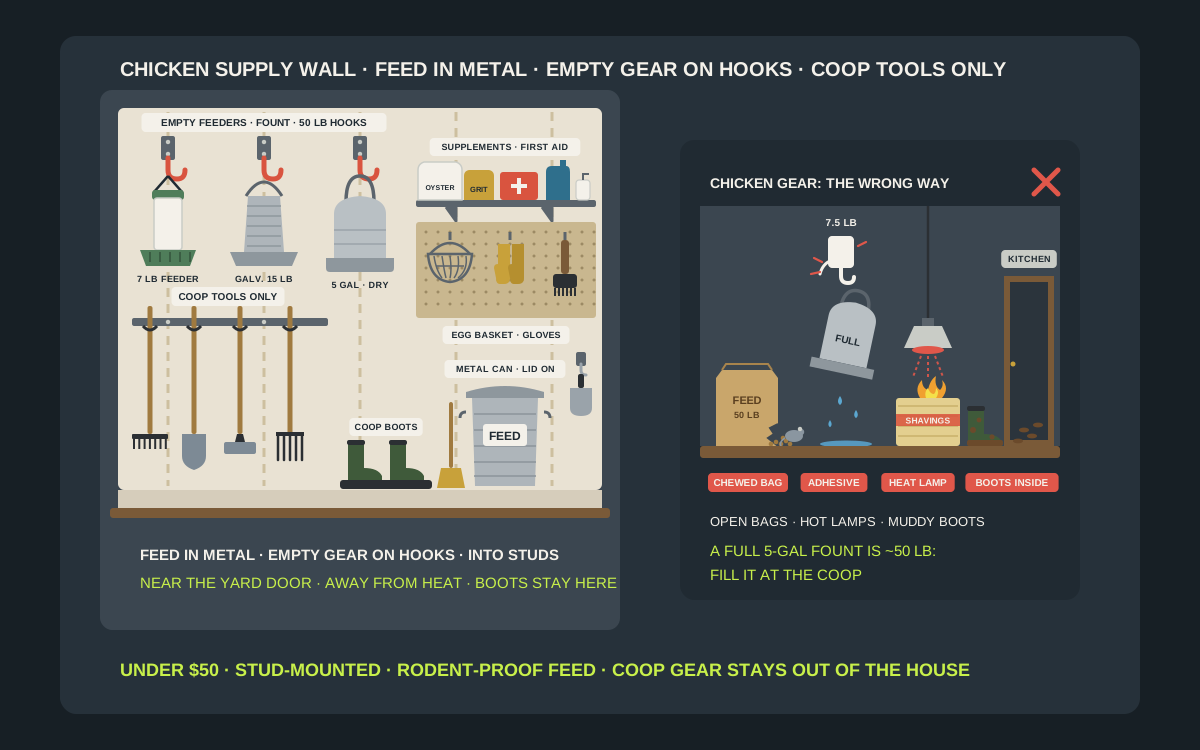
Backyard chickens come with more gear than anyone expects. There is the feed, of course, but also the hanging feeder, a waterer or two, a heater base for winter, a bale of pine shavings, a coop scraper, a rake, an egg basket, a bag of oyster shell, a jug of disinfectant and the pair of boots that should never cross the kitchen floor. Most of it ends up in a pile just inside the garage or shed door, where the feed bag gets chewed, the waterer gets kicked over and nobody can find the egg basket. A wall setup fixes that for well under $50. A few heavy-duty utility hooks screwed into the studs hold empty feeders and waterers while they dry, a long-handle rack keeps the coop tools upright, a short shelf takes the supplements and the first aid kit, and a galvanized can with a tight lid sits on the floor below for the feed. What makes it work is the part the hook package never mentions: feed belongs in metal, not on a hook; a full waterer is far heavier than it looks; and anything that touches the coop should stay in the garage or shed instead of traveling into the house. This guide covers which rack suits which supply, how to keep rodents out of the feed, and where the chicken wall belongs in a garage, a shed or a small yard.
Shop heavy-duty utility hooks on Amazon
Who this is for
- New backyard flock keepers with three to ten hens whose feeders, waterers and coop tools have taken over a corner of the garage or shed
- Gardeners and homesteaders who share one shed between garden tools and chicken chores and want the two kept apart
- Families with kids on chicken duty who need the egg basket, the boots and the hand sanitizer where they are easy to grab and hard to forget
Quick answer
For most garages and sheds, the best under-$50 chicken supply wall has three parts on one stretch of studs near the door to the yard: two or three heavy-duty utility hooks for empty feeders and waterers, a long-handle rack for the rake, shovel and coop scraper, and a short shelf for oyster shell, grit, the first aid kit and egg cartons. The feed itself stays on the floor below in a galvanized steel can with a tight lid. Behrens says its 31-gallon can holds roughly 100 lb of feed, depending on particle size. Hooks are for empty equipment only: a full 5-gallon waterer carries about 42 lb of water before you count the fount itself, so fill it at the coop, not at the wall. Keep the chore boots and coop tools on this wall and out of the house, which is what the CDC recommends for backyard poultry gear. Check the hook rating, the shelf depth and the current price on the listing before you buy.
Quick comparison
| Rack | Best for | What it holds | Trade-off |
|---|---|---|---|
| Heavy-duty utility hooks | Empty hanging feeders and waterers | Feeders by their hanger handle; founts by the carry handle once dry | Never hang a full waterer |
| Long-handle tool rack | Rake, shovel, coop scraper, manure fork | Handles stand upright in spring grips or between pegs | Needs about 2 ft of clear wall |
| Short wall shelf | Oyster shell, grit, first aid kit, disinfectant | Bags and tubs sit in shallow bins on a wipeable shelf | Keep chemicals above kid height |
| Pegboard or rail with hooks | Egg basket, gloves, brushes, small tools | Small items hang on pegs or rail hooks in one strip | Loose pegs lift out when bumped |
| Boot tray and boot pegs | Dedicated chore boots and a coop jacket | Boots dry on a tray or upside down on pegs by the door | Uses floor space by the exit |
| Metal can and scoop hook | Bagged layer feed and scratch grains | The can stands on the floor; the scoop hangs right above it | The can itself is extra to the wall budget |
Galvanized feed cans with lidsLong-handle tool racksSteel pegboard kits
What to look for
Feed goes in metal, not on the wall
The heaviest and most valuable thing on a chicken shelf is the feed, and it does not belong on a hook or in its paper bag on a shelf. Meyer Hatchery recommends keeping feed unopened in its original bag inside an airtight, rodent- and insect-proof container, and says metal trash cans with tight-fitting or locking lids are best, because determined rodents can chew through thick plastic over time. The University of Maine Cooperative Extension gives the same advice to small poultry keepers: a covered, rodent-proof metal garbage can, out of direct sunlight. So build the wall around the can instead of trying to lift the feed onto it. The can stands on the floor beneath the shelf, the scoop hangs on a hook just above it, and the wall holds everything else.
Hooks rated for empty gear, with a wide margin
Feeders and waterers are light when empty and surprisingly heavy when full. Tractor Supply lists the Harris Farms 15-lb galvanized hanging feeder at 2.2 lb empty, and Little Giant’s 5-gallon double-wall galvanized fount weighs about 8 lb. Water weighs roughly 8.3 lb a gallon, though, so the same fount full is close to 50 lb, and Little Giant says plainly that it is not a hanging waterer and must sit on the ground or floor. A screwed-in steel utility hook rated around 50 lb, such as Rubbermaid’s FastTrack utility hooks, carries an empty feeder or fount with plenty to spare and shrugs off the bump of hanging something still damp. Adhesive hooks are the wrong match: Command’s Jumbo Utility Hook is rated at 7.5 lb, and its indoor strips are made for about 50°F to 105°F, a range many sheds and garages leave for months at a time.
Cool, dry and off the floor
Moisture ruins feed and rusts metal gear. Meyer Hatchery advises storing feed inside, off the ground, in a cool, dark, dry place, ideally at a stable 60°F or less, and notes that mold growth is most likely once humidity reaches 60 to 65 percent. Purina Canada puts it in terms of time: pelleted feeds are best used within 60 days in summer and 90 days in winter, because heat and humidity shorten shelf life. That rules out the wall next to the water heater, the dryer vent or a sunny west window. It also argues for a can with a raised bottom, or a couple of scraps of lumber under it, so the base never sits in the puddle from wet boots. Feeders and waterers should go up only once they are dry inside and out.
Washable surfaces for washable gear
Everything on a chicken wall gets dusty, and some of it gets droppings on it. Choose racks and shelves you can wipe down: coated steel hooks, a steel or plastic shelf, a metal or sealed-wood tool rack. Bare particleboard swells and stains the first time a dripping waterer touches it. The CDC says to clean poultry equipment outdoors, never inside the house, and to scrub off debris first, because most disinfectants only work on surfaces that are already clean. A wall that wipes clean in a minute makes that routine much easier to stick to.
Everything visible, nothing buried
A chicken supply wall works when you can see at a glance what is running low. The University of Maine extension recommends marking and rotating feed so the oldest is used first, and buying feed in amounts you will use before it gets old. The same habit helps with oyster shell, grit, bedding and first aid supplies. Open shelves, labeled bins and hooks beat a closed cabinet here: you notice the half-empty grit bag before the flock does, and the egg basket is always in the same place when the kids head out to collect.
Know what you are storing
Feed and treats
Most layer feed comes in 50-lb bags; Purina’s Layena pellets, a common choice, are sold that way. A bag that size is too heavy for a wall shelf and too tempting to mice to sit anywhere in its paper bag, which is why it goes into a galvanized can. Behrens lists approximate feed capacities for its steel cans: about 32 lb in the 10-gallon can, about 75 lb in the 20-gallon and about 100 lb in the 31-gallon, depending on particle size. A 20-gallon can takes one 50-lb bag with room to spare. If you also buy scratch grains or treats, give them their own smaller can with a lid instead of leaving the bag open on the shelf.
Feeders
Hanging feeders come in plastic and galvanized steel. Harris Farms makes a 7-lb plastic hanging feeder it rates for 5 to 15 birds, a 25-lb version for 25 to 50, and a galvanized 15-lb hanging feeder that is 15.5 inches tall and 12 inches across, with a carry handle that doubles as the hanger. In use they hang in the coop or run. In the garage they hang empty on a hook between deep cleanings, or a spare waits there for the next batch of chicks. A 12-inch-wide feeder needs a hook that reaches at least 6 inches out from the wall, or it presses against the wall and hangs crooked.
Waterers
Waterers are the bulkiest piece of chicken gear. Little Giant’s double-wall galvanized founts come in 2-, 3-, 5- and 8-gallon sizes; the 5-gallon is 15.25 inches across and 15.25 inches tall. Little Giant notes that metal founts can be used in winter on an electric heater base, and that they are not hanging waterers. In storage, take the fount apart, let both pieces dry upside down on a shelf or a boot tray, then hang the assembled fount by its carry handle on a deep hook. Plastic waterers are lighter, but they can split if they freeze with water inside, so empty and dry them before they go up.
Bedding
Pine shavings are the usual coop bedding, and they come compressed. Tractor Supply’s flake pine shavings, for example, come in a 22-lb bag that is 2.5 cubic feet compressed and expands to about 8 cubic feet, enough to cover roughly 32 square feet at 3 inches deep. A bale like that goes on a pallet or a low, strong shelf, not on hooks, and well away from any heater, heat lamp or cord, because dry shavings burn easily.
Cleaning tools
A coop needs a scraper or hoe for the droppings board, a rake or manure fork, a flat shovel and a stiff brush, plus a bucket for scrubbing. These are the tools the CDC has in mind when it says to clean poultry equipment outdoors with a brush, warm water and soap before any disinfectant goes on. Give them their own rack instead of mixing them into the garden-tool wall, so the manure fork never ends up in the vegetable bed.
Eggs, supplements and first aid
The rest is small and easy to lose: the egg basket, clean egg cartons, oyster shell and grit, a poultry first aid kit, gloves and a bottle of hand sanitizer. These belong at chest height on a shelf or a strip of pegboard right by the door, where they get grabbed on the way out to the coop instead of forgotten.
Six parts of a chicken supply wall
Utility hooks for empty feeders and waterers
Screw two or three coated steel utility hooks into the studs at about head height, one stud bay apart, so a 12- to 15-inch feeder or fount can hang from each without bumping its neighbor. Hang feeders by their own hanger handle and dry founts by the carry handle. A boot tray or a drip tray on the floor below catches the last drops from anything that went up slightly damp. This is also where a spare feeder lives between flocks, and where the heater base hangs, cord loosely coiled, from spring until the first freeze.
A long-handle rack for coop tools
A wall-mounted rack with spring grips or pegs keeps the rake, shovel, scraper and manure fork upright, each handle in its own slot. Two feet of wall is enough for four or five tools. Put it next to the door you use for chores, and keep these tools for the coop only. Washington State’s Department of Health advises flock owners not to share tools and equipment with neighbors, and the same thinking applies at home: chicken tools stay with the chickens. Our guide to hanging brooms and garden tools covers rack styles and spacing in more detail.
A shelf for supplements, first aid and disinfectant
A short steel or plastic shelf, around 10 to 12 inches deep, on brackets screwed into the studs, holds the oyster shell and grit, the first aid kit, the disinfectant, spare gloves and a stack of clean egg cartons. Set bags and tubs in shallow bins so spills stay in the bin, and keep disinfectants and any bird medications on the top shelf, above kid height, with the labels facing out. If you clean with a diluted bleach solution, as the CDC mentions, mix only what you need that day and keep the jug closed and upright.
Pegboard or a rail for the small stuff
Egg baskets, brushes, a hand trowel, a headlamp for dark winter evenings, scissors and twine all hang well on a strip of pegboard or a short rail. Steel pegboard wipes clean better than hardboard in a dusty shed. Use locking pegs or peg clips, because a basket lifted on and off twice a day will eventually pull a loose peg out with it.
Boot tray and boot pegs by the door
The CDC recommends setting aside a pair of shoes worn only for poultry chores and keeping them outside the house. In practice that means a boot tray and a couple of pegs by the garage or shed door: boots come off on the way back in, dry on the tray, and never cross the kitchen floor. Add a hook for a chore jacket and a pump bottle of hand sanitizer on the shelf above. The CDC suggests keeping sanitizer near the coop for times when soap and water are not handy, and washing with soap and running water as soon as you can.
Galvanized can and scoop hook for feed
Stand the feed can on the floor directly under the shelf and hang the scoop on a hook just above it, so nobody leaves the scoop buried in the feed or lying on the floor collecting dust. Pour the bag in, or set the unopened bag inside the can as Meyer Hatchery suggests, and keep the lid fully seated. Behrens’ standard 31-gallon can has a tight-fitting lid but not a locking one, so a bungee cord stretched over the lid between the side handles helps keep raccoons out. Behrens makes 6- and 10-gallon cans with locking lids for smaller amounts. USDA’s Defend the Flock program suggests keeping a broom at feed storage areas so spills get cleaned up quickly, so hang a small broom and dustpan beside the can.
Keeping rodents and pests out of the feed
Why metal beats plastic
Mice and rats find feed by smell and chew through paper bags without slowing down. Meyer Hatchery says thick plastic containers can be used, but that determined rodents can chew through them over time, and it recommends metal cans with tight-fitting or locking lids. Behrens describes its galvanized cans as rodent proof and meant for dry storage only. A metal can with a lid that seats all the way down is the cheapest pest control in the shed.
Buy only what the flock will finish
Feed does not keep forever. Meyer Hatchery says unopened feed stored well can last up to six months, Purina Canada recommends using pelleted feeds within 60 days in summer and 90 days in winter, and the University of Maine extension suggests aiming for 30 to 60 days depending on the season. A flock of three or four hens can take close to two months to get through a 50-lb bag, so in hot weather a smaller bag may be the fresher choice. Write the purchase date on the lid with a marker and use the oldest feed first.
Check the feed before you scoop
Purina says never to offer moldy feed, and Meyer Hatchery calls moisture the number one cause of moldy feed. When you open the can, look and smell: clumps, a musty odor, webbing or insects mean that batch goes in the trash, not the feeder. The University of Maine extension also suggests freezing a small, labeled sample from each batch of feed, so it can be tested if the flock gets sick.
Sweep up spills and keep bedding off the floor
Spilled pellets under the can are what draw mice in the first place. Sweep them up the day they fall, as USDA’s Defend the Flock guidance suggests for feed storage areas. Keep the bedding bale on a pallet or a shelf instead of on the floor against the wall, where mice like to burrow into it, and do not pile used bedding next to the shed or garage; USDA’s wildlife guidance advises against piling used litter near poultry buildings.
Keeping coop germs out of the house
One wall, one job
Backyard poultry often carry harmful germs such as Salmonella, even when they look healthy, which is why the CDC keeps returning to the same advice: keep poultry and their equipment outside the house, and clean feeders, waterers and other equipment outdoors, not in the kitchen sink or the bathtub. In an attached garage, that means putting the chicken wall near the overhead door or the side door to the yard, not beside the door into the house, so coop gear never travels through the living space.
A cleaning spot just outside the door
The CDC says to set up an area outdoors for cleaning and disinfecting poultry equipment. A hose bib, a stiff brush, a bucket and the disinfectant on the shelf just inside the door make that spot easy to use. Scrub off droppings first with warm, soapy water, apply the disinfectant diluted as its label directs, leave it on for the label’s contact time, which the CDC says usually runs from 30 seconds to 10 minutes, then rinse and let everything dry before it goes back on its hook. Our garden hose reel guide covers mounting a reel by the door.
Wash up before going inside
The CDC recommends washing hands with soap and running water after touching chickens, eggs, feeders, waterers or anything in the area where they live and roam, and says adults should supervise handwashing for young children. Put the hand sanitizer at eye level on the chicken wall as a reminder, and if the garage has a utility sink, mount a paper towel holder next to it.
Eggs go to the fridge, not the shelf
The egg basket can live on the chicken wall, but the eggs should not. The CDC says to collect eggs often, throw away cracked ones, clean dirty eggs carefully with fine sandpaper, a brush or a cloth instead of washing warm eggs in cold water, and refrigerate them after collection. Hang the basket on a peg by the door, carry it straight to the kitchen, and bring it back empty.
Winter gear, heaters and cords
Store heater bases and cords with care
Heated waterer bases, de-icers and heat lamps spend half the year in storage. Coil each cord loosely, hang it on its own hook next to its base, and look over plugs and cords for cracks or chew marks before winter. The NFPA advises that electrical equipment used in chicken coops, such as heat lamps and electrically heated poultry waterers, be listed by a qualified testing laboratory and used only according to its listing instructions, that coop receptacles have GFCI protection, and that outlets be planned so extension cords are not needed.
Keep heat away from bedding and feed
The NFPA warns that hay, bedding and other combustible materials close to heat sources can become a significant fire hazard in coops and brooders. The same logic applies in the garage: never test a heat lamp or heater base over the shavings bale, and store the bedding on the far side of the wall from anything that plugs in. Keep the chicken wall away from the water heater and the furnace as well, both for the fire risk and because warmth speeds up feed spoilage.
Plan for a cold garage or shed
In an unheated garage or shed, plastic waterers can split if they freeze with water inside, and adhesive hooks lose their grip. Store waterers empty and dry, use screws for every hook, and keep the feed can’s lid seated through the cold months, when mice are looking hardest for food and shelter.
Garage, shed, coop or small yard
Garage
Pick a stretch of wall near the door you use to reach the coop, away from the car-door swing and away from the door into the house. Put the hooks and shelf on the studs at head and chest height, the tool rack beside them, and the feed can and boot tray on the floor below. If the garage is attached, this is the one spot where coop gear stops.
Garden shed
Many flocks share a shed with the garden. Split the wall: chicken tools, feed and supplies on one side, garden tools and fertilizer on the other, with labels if more than one person does chores. Sheds get hot in summer and damp in winter, so set the feed can on a pallet or a couple of boards and buy feed in smaller amounts in hot weather.
Inside the coop or run
A few things are handiest at the coop itself: a hook for the egg basket by the nest boxes and a scraper near the droppings board. Keep bulk feed out of the coop unless it is in a lidded metal can, because the coop is exactly where rodents already go looking for food, and keep the bedding bale and spare gear in the drier garage or shed.
Small yard, no shed
No shed? A weatherproof storage cabinet or deck box beside the coop can hold the tools and small supplies, with a metal can with a locking lid standing next to it for feed. Bring heater bases, cords and anything that should not freeze into the garage for the winter, not into the house.
Mistakes to avoid
- Leaving feed in its paper bag on the floor or on a shelf.
- Storing feed in a thin plastic tub that mice can chew through.
- Hanging a full waterer, or any waterer, from an adhesive hook.
- Putting feeders and waterers away before they are completely dry.
- Washing feeders and waterers in the kitchen sink.
- Wearing coop boots into the house.
- Testing heat lamps or heater bases near the shavings bale.
- Mixing coop tools with garden tools, or lending them to neighbors.
Related guides
Browse the hub: Pet gear wall mounts under $50 - all guides
- Best Bird Cage Accessory Wall Racks Under $50
- Best Small Animal Bedding Bin Wall Shelves Under $50
- Best Pet Food Scoop Wall Holders Under $50
- Best Pooper Scooper Wall Hooks Under $50 for Garage & Shed
- How to Hang Brooms and Garden Tools on a Garage Wall Under $50
- Best Garden Hose Reel Wall Mounts Under $50 for Garages
- Best Horse Tack Wall Racks Under $50 for Garage & Barn (Bridles, Halters & Lead Ropes)
FAQ
What is the best way to store chicken supplies in a garage?
Use one stretch of wall near the door to the yard: utility hooks for empty feeders and waterers, a long-handle rack for coop tools, a short shelf for supplements and first aid, and a galvanized can with a tight lid on the floor for the feed. The hooks, rack and shelf can come in under $50; price the feed can separately.
How do I keep mice out of chicken feed?
Store it in a metal can with a tight-fitting or locking lid, not in the paper bag or a thin plastic tub, sweep up spills the same day, and buy only as much feed as the flock will finish in a month or two.
Can I hang a chicken waterer on a garage wall?
Only when it is empty and dry, from a screwed-in hook rated well above its weight. A full 5-gallon fount weighs close to 50 lb, and Little Giant says its double-wall founts are not hanging waterers, so fill and use them on the ground.
How long does chicken feed last in storage?
Meyer Hatchery says unopened feed stored in cool, dry conditions can last up to six months, but Purina Canada recommends using pelleted feeds within about 60 days in summer and 90 days in winter for best freshness.
Should chicken supplies be kept in the house?
No. The CDC recommends keeping backyard poultry equipment outside the house, cleaning feeders and waterers outdoors, and keeping a dedicated pair of chore shoes outside. A garage or shed wall near the yard door is the right home.
Is a garage too hot for chicken feed?
It can be in summer. Meyer Hatchery suggests a stable 60°F or less and notes that mold is most likely above 60 to 65 percent humidity, so keep the can away from heaters and sunny walls and buy smaller amounts in hot weather.
Bottom line
The best backyard chicken supply wall keeps each thing where it belongs: empty feeders and waterers on screwed-in utility hooks, coop tools on their own long-handle rack, supplements, first aid and egg cartons on a wipeable shelf, boots on a tray by the door, and the feed in a galvanized can with a tight lid on the floor below. Keep it near the yard door, away from heat and out of the house, and check the hook rating, the shelf depth and the current price on the listing before you buy.