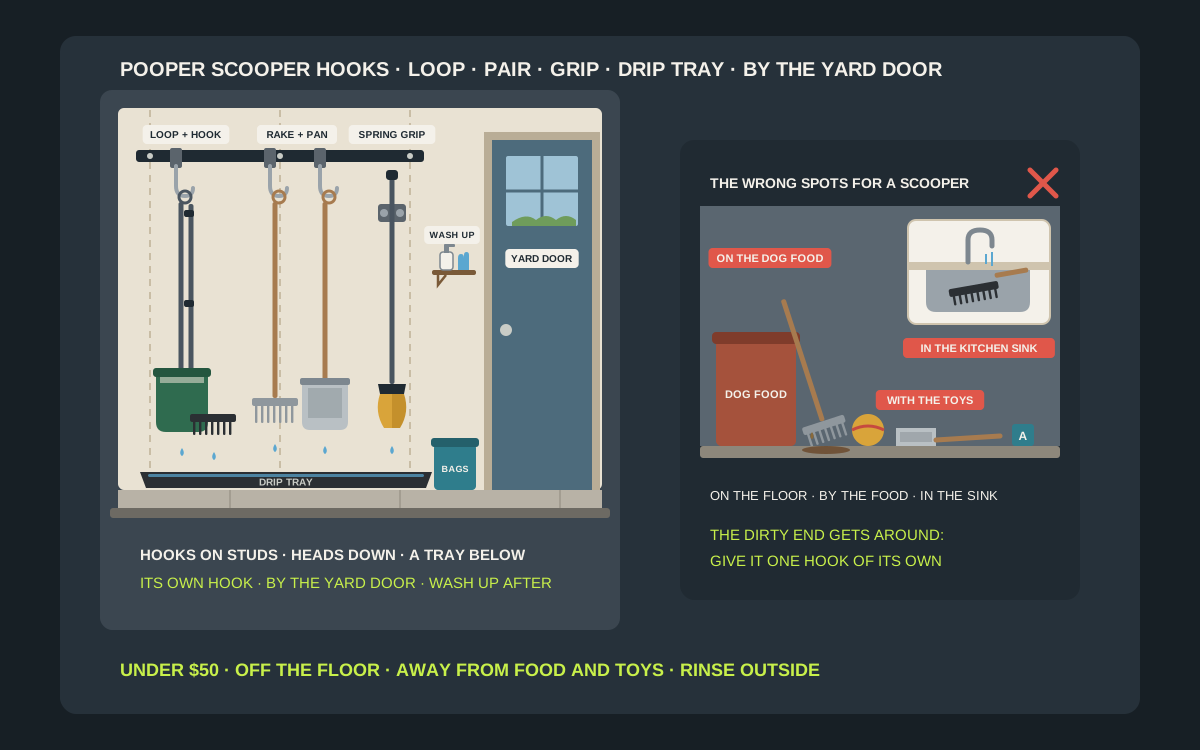
A pooper scooper is the one yard tool nobody wants to think about, which is exactly why it ends up in the worst places: leaning against the dog food bin, propped behind the kids’ bikes, dripping on the garage floor by the door or lying in the grass where it was last used. It is also the one tool on the wall that carries germs. The CDC is blunt about it: dog poop can carry parasites and germs that make people and other animals sick, which is why it says to pick it up even in your own yard, especially where children play. The tool that does that job deserves a spot of its own. The fix is cheap. A screw-in utility hook, a two-handle tool hook, a spring grip or an outdoor-rated adhesive hook will hold almost any rake, pan, spade or jaw scoop for well under $50, and many scoopers already have a loop built into the handle for exactly this. What matters more than the hook is where it goes and how the tool gets there: close to the yard door, well off the floor, apart from food and toys, over something that catches the drips, and cleaned with a routine that never goes near the kitchen sink.
Shop long-handled tool hooks on Amazon
Who this is for
- Dog owners who clean the yard with a rake and pan, a swivel bin or a jaw scoop and want it off the floor and out of the way
- Households with small children or a curious dog, where a scooper lying on the ground becomes a toy, a chew item or a trip hazard
- Anyone sharing a garage or shed wall between yard-cleanup tools, garden tools, dog food, bikes and sports gear who wants to keep them apart
Quick answer
For most garages and sheds, the best under-$50 pooper scooper wall hook is a plain, screwed-in utility hook or a short hook rail by the yard door, with the scooper hung head-down over a drip tray. Many scoopers are designed for it: Arm & Hammer’s Swivel Bin & Rake has looped handles and snaps together into one piece for hanging, and Four Paws says each handle in its All-in-One Rake, Spade & Pan set has a loop for hanging. For a jaw scoop or a handle with no loop, use a spring grip on the shaft. Give the scooper its own hook, apart from the dog food, the garden tools you use in vegetable beds and the kids’ toys, rinse it outside rather than in a sink, and wash your hands afterward. If you cannot drill a shed wall, an outdoor-rated adhesive hook can hold a light wire rake or jaw scoop on a smooth, sealed surface. Check the current price and rating on the listing before you buy.
Quick comparison
| Holder | Best for | How it holds the scooper | Trade-off |
|---|---|---|---|
| Screw-in utility hook (e.g. Rubbermaid FastTrack Utility Hook) | Scoopers with a handle loop, such as a snapped-together swivel bin and rake | The loop drops over the hook and the head hangs down to drain | Needs a loop on the handle and a screw into a stud or solid board |
| Two or three utility hooks side by side | Rake-and-pan sets that should stay together | Each handle hangs by its own loop, heads down, a few inches apart | Takes more wall width than one hook |
| Multi-handle tool hook (e.g. FastTrack 3-Handle Hook) | A rake, a pan and a spade on an existing FastTrack rail | Coated arms cradle up to three handles; Rubbermaid rates it at 50 lb | Holds tools head-up, so let them drain first; part of a rail system |
| Spring-grip tool holder | Jaw scoops and handles with no loop | Spring-loaded jaws clamp the shaft, scoop end down | Grip strength varies, and slim or tapered shafts can slip |
| Short hook rail over a drip tray | Multi-dog yards with a rake, pan, spade, bags and gloves | Three or four hooks in a row above a rubber tray or bucket | The most wall space, but the whole cleanup kit is in one place |
| Outdoor adhesive hook (e.g. Command outdoor metal hooks) | A light wire rake or jaw scoop in a shed you cannot drill | Outdoor-rated strip on a smooth, sealed surface | Not for rough boards or textured plastic; check the weight rating on the pack |
Pooper scooper rake and pan setsSpring-grip tool holdersRubber boot trays for drips
What to look for
Use the loop the scooper already has
Before you buy a hook, look at the end of the handle. Most long-handled scoopers come with a way to hang them. Arm & Hammer lists looped handles for hanging storage on its Swivel Bin & Rake and says the bin and rake handles snap together with built-in pole connectors, so the pair hangs as one piece. Four Paws says each handle of its All-in-One Rake, Spade & Pan set includes a hook for hanging. A loop or a hole means any sturdy utility hook will do. A plain shaft with no loop, which is common on jaw scoops and older wooden-handled sets, means you need a spring grip or a cradle-style tool hook instead.
Let it drain, and catch the drips
A freshly rinsed rake or pan drips for a while, and what runs off is not clean water. If the tool is still wet when it goes up, hang it head-down by the loop so water runs off the tines and out of the pan, not down the handle to where your hand goes next time. A cradle or grip that holds the tool head-up is fine once it has drained. Either way, put a rubber boot tray, a shallow bin or a bucket under it, so a garage floor stays clean and a wooden shed floor does not soak up the drips.
Height, children and dogs
The CDC advises keeping children away from areas that might contain dog or cat poop, to prevent roundworm and hookworm infections, and a scooper head at toddler height is exactly that kind of area. Hang the tool so the head sits well off the floor and above a dog’s nose, and pick a corner that children do not use when they grab bikes and balls. Do the arithmetic before you drill: a 38-inch rake hung by its loop from a hook at 6 feet leaves the head roughly 3 feet off the floor. If small children are in and out of the garage, the shed or a hook behind the side door is a better home than the main wall.
Distance from food, toys and garden tools
The CDC recommends storing dog food separately from human food, keeping pet supplies out of the kitchen and washing up after handling pet waste or supplies. Apply the same logic to the wall. The scooper should not share a rail with the dog food scoop, the treat bin, the kids’ balls or the hand trowel you use in the vegetable bed. Give it its own hook at the end of the rail or its own short rail, at least an arm’s length from anything that goes into a mouth, a bowl or the soil where you grow food.
Rust, handles and a damp corner
Scoopers live outdoors and get rinsed constantly, so materials matter. Four Paws makes the base of its rake-and-pan set from stainless steel and covers the wooden handles, and one retailer’s care note for that set is to rinse both pieces, wipe them dry and store them upright or hung in a shaded spot to protect the handles. Plastic rakes and bins, like the Arm & Hammer set, do not rust at all. For the hook, choose coated steel: Rubbermaid describes its FastTrack hooks as heavy-duty steel that will not rust with age, and a vinyl or soft-grip coating also stops a metal head from scraping the paint every time it goes back up.
Five ways to hang a pooper scooper
Screw-in utility hooks: the simplest fix
For any scooper with a loop on the handle, a single utility hook screwed into the wall is all you need. Rubbermaid’s FastTrack utility hooks are rated at 50 lb and can be screwed straight to the wall as well as clipped to the rail. Capacity is never the issue here: Four Paws lists its small rake-and-pan set at 1.6 lb, and Petmate lists the Arm & Hammer Swivel Bin & Rake at under 2 lb. What matters is the fastening. The hook gets bumped every time someone grabs the tool in a hurry, so drive the screw into a stud or a solid wall board rather than bare drywall. Use one hook per tool, or one hook for a set that snaps together.
Two hooks for a rake and pan
Rake-and-pan sets work as a pair, and the most common way to lose half of one is to hang the pieces in different places. Two utility hooks set a few inches apart let the rake and the pan hang side by side, both head-down, with the pan’s open side facing the wall so it does not catch the rake’s tines on the way out. Four Paws’ small Wee-Wee Rake & Pan set is listed at 7 x 7 x 38 inches, and the large All-in-One set at 9.5 x 10 x 38 inches, so leave about a foot of width per tool and check that the head clears the floor or the tray below.
Multi-handle tool hooks: if you already run a rail
If your garage already has a Rubbermaid FastTrack rail, the system’s long-handled tool hooks are a tidy way to keep a whole set together. The 3-Handle Hook holds brooms, rakes and similar long-handled tools on flared, soft-grip coated arms that take a tool with one hand, and it is rated at 50 lb; the Dual-Handle Hook is a two-tool version with the same soft-grip coating. These cradle the tools by the shaft below the head, so the head sits up, which is fine once a rinsed tool has drained. The rail itself is meant to be screwed into studs at 16- or 24-inch centers, and the hardware is sold separately, so for a single scooper, two plain hooks are the simpler buy.
Spring grips: for jaw scoops and plain shafts
Jaw-style scoops, such as Nature’s Miracle’s Jaw Scoop, use spring-action handles rather than a hanging loop. The medium version is listed at about 27.5 inches long, and the Jumbo version folds for storage. A spring-loaded broom-and-mop grip holds that kind of tool by the shaft, scoop end down, and takes up very little wall. Mount it high enough that the scoop clears the tray, and give the tool a firm tug once it is in the grip: slim or tapered shafts are the ones that slide out. Our guide to no-drill adhesive broom and mop holders covers grip styles in more detail.
Outdoor adhesive hooks: for sheds you cannot drill
In a rented home, or in a metal or resin shed where screws are awkward, an adhesive hook can work for a light tool. Use one sold for outdoor use: Command lists its outdoor metal hooks for temperatures from -20°F to 125°F, while its standard indoor strips are meant for 50°F to 105°F, which an unheated shed will leave far behind in both directions. Clean the spot with rubbing alcohol, press the strip firmly for about 30 seconds and wait an hour before hanging anything. Adhesive only bonds to smooth, sealed surfaces such as painted metal, smooth resin and sealed wood, not rough boards or textured plastic, and it suits a wire rake or a jaw scoop better than a rake-and-pan set that gets yanked off the wall every day.
Matching the hook to your scooper
Swivel bin and rake
Arm & Hammer’s Swivel Bin & Rake pairs a plastic rake with a rotating bin, and its bags hook to either side of the bin so you never have to touch the waste. Petmate lists a 32-inch handle and an assembled bin of 9 x 7 x 32 inches, and says the set works on grass, dirt, gravel and pavement. The two handles snap together for storage and both have loops, so one sturdy utility hook holds the whole set. Keep a roll of spare bin bags in a lidded box beneath it, so a fresh bag goes in before the tool goes back on the wall.
Rake and pan sets
The classic two-piece set is a long-handled rake that sweeps waste into a long-handled pan. Four Paws’ Wee-Wee Rake & Pan set has a stainless steel base and covered wooden handles, and the company markets the rake for grassy areas; in its All-in-One set, it describes the spade as the tool for sidewalks, patios and driveways. Hang the pair side by side on two hooks, pan nearest the door, and make a habit of tipping the pan out and rinsing it before it goes up, since a pan full of yesterday’s pickup is what makes a garage smell.
All-in-one sets with swappable heads
Four Paws’ All-in-One Rake, Spade & Pan set uses one handle with interchangeable rake and spade attachments and push-pins for quick assembly and disassembly, and each handle has a loop for hanging. That makes it the most compact set to store, but the head you are not using needs a home too. A small bin or a second hook right beside the set keeps the spare head from wandering into the garden-tool bucket.
Wire rakes and jaw scoops
Single-piece tools are the easiest to store. Four Paws’ Wee-Wee Wire Rake for grass is listed at 5 x 6.13 x 29.5 inches with a rubber grip and rust-resistant wire, and a jaw scoop is not much bigger. Either one fits on a single hook or in one spring grip, which makes them the best choice for a narrow strip of wall behind a side door or the inside of a shed door.
Walk tools belong at the entry
Short hand-held scoops, bag rolls and clip-on dispensers that go out on walks belong with the leashes by the house door, not on the yard-tool wall. Our guides to poop bag dispenser wall mounts and dog leash wall hooks cover that station. The long-handled yard tool stays in the garage or shed, close to where it is used.
Where the scooper should live
By the yard door, not the house door
The dirty end of the tool should travel as short a distance as possible. If you reach the yard through a garage side door, mount the hooks beside that door, not on the far wall past the car and the bikes. If the yard is closer to a shed, the shed is the better home. A scooper that lives by the yard door also gets used more often, which the CDC would say is the point: it recommends picking up after your dog every time and, for roundworm prevention, picking up pet waste daily.
Away from food and play gear
Most garages hold more than tools: a chest freezer, a bin of dog food, recycling, kids’ bikes, balls and scooters. Map the wall before you drill. Food, bowls and treats belong on one side, play gear on another and the yard-cleanup tools on a third, ideally the corner nearest the door. A scooper hung above the dog food bin will eventually drip into it.
Apart from the garden tools you use for food
According to the CDC, roundworm eggs get into soil through animal waste, typically from dogs and cats, and people are infected by accidentally swallowing contaminated dirt. That is a good reason to keep the scooper off the rail where the trowel, the hand fork and the harvest basket for the vegetable bed hang. Put it at the far end of the run, or on a short rail of its own.
Think about the disposal path
The CDC’s advice is to bury pet waste or bag it and put it in the trash. Plan the wall around that: the scooper, the bags and the route to the outdoor trash can should form a short loop. Do not store a bag or a bin of collected waste in a hot garage overnight. Tie it off and take it straight to the outdoor bin.
Rinse, disinfect, dry: the routine that keeps the wall clean
Rinse it outside, never in the kitchen sink
The CDC’s guidance for pet supplies is to disinfect them outside the house when possible and never to clean them in the kitchen sink, in food preparation areas or in the bathroom sink. For a scooper, that means a garden hose at the outdoor tap, aimed onto the grass or a gravel patch away from storm drains, not into the laundry tub or the kitchen. A spray nozzle on the hose clears the tines quickly, and a hose reel mounted near the same door keeps the whole routine in one spot.
Wash your hands every time
The CDC says to wash your hands with soap and running water after contact with dog poop, even if you used a bag, and before you eat or drink. Running water and soap are best; hand sanitizer is a stopgap until you can wash. A pump bottle of sanitizer and a box of disposable gloves on a small shelf next to the hooks make the habit easy, but they do not replace the sink indoors afterward.
Disinfect after illness
For day-to-day use, a rinse and an occasional scrub with soapy water are enough. If a dog in the household has been sick, especially with parvovirus, you need more. The Oregon Veterinary Medical Association notes that parvo cannot be killed with regular household cleaners and can persist in the environment for months to years. It suggests cleaning items with one part household bleach to 30 parts water, or with an accelerated hydrogen peroxide or potassium peroxymonosulfate disinfectant. Follow the label on whatever you use, never mix bleach with ammonia or other cleaners, rinse the tool afterward and ask your veterinarian about the yard itself.
Dry before it goes back up
Let the rinsed tool drain head-down outdoors for a few minutes, then hang it where air moves around it, out of direct sun if the handles are wood. Wipe wooden handles dry, empty the drip tray when it has water in it and rinse the tray itself every week or two.
Mounting hooks in garages and sheds
Find a stud or solid backing
In a finished garage, a hook for a tool that gets grabbed every day belongs in a stud. Most garage walls are framed at 16- or 24-inch centers; a stud finder or a small test nail along the baseboard line will locate them. If the studs are not where you want the hooks, screw a board across two of them and mount the hooks on the board, or use a rail.
Wood sheds
Many wood sheds have exposed framing, which makes mounting easy: screw the hook into a stud or a horizontal brace. If the wall boards are thin, fasten a 1x4 or similar strip across two framing members and hang the hooks from that.
Metal and resin sheds
Metal and plastic sheds are harder to drill into without making a leak or a crack. Many shed makers sell shelf and hook accessories designed for their own wall panels, and those are the first thing to check. Otherwise, an outdoor-rated adhesive hook on a smooth, sealed panel works for a single light tool.
Leave room to lift off
A loop has to lift over the hook to come off. Leave a few inches of clear wall above each hook, and space the hooks so the heads do not knock into each other. If the tool sits next to a door, check that the door clears the hanging head when it swings.
Mistakes to avoid
- Leaning the scooper against the dog food bin, where it drips into the food and gets knocked over.
- Hanging it on the same rail as the kids’ balls, the bowls or the garden tools you use in the vegetable bed.
- Rinsing it in the kitchen sink, the laundry tub or the bathroom sink instead of outside with a hose.
- Hanging a dripping tool head-up, so the water runs down the handle to where your hand goes.
- Putting the hook at toddler height, or in the corner where the children keep their bikes.
- Screwing the hook into bare drywall, where daily grabs work it loose.
- Using a standard indoor adhesive strip in an unheated shed, or any adhesive on rough boards or textured plastic.
- Leaving a pan or a bin full of waste overnight in a warm garage instead of bagging it and taking it out.
Related guides
Browse the hub: Pet gear wall mounts under $50 - all guides
- Best Litter Scoop Wall Holders Under $50
- Best Poop Bag Dispenser Wall Mounts Under $50
- How to Hang Brooms and Garden Tools on a Garage Wall Under $50
- Best No-Drill Adhesive Broom and Mop Holders for Garages Under $50
- Best Garden Hose Reel Wall Mounts Under $50 for Garages
- Best Dog Leash Wall Hooks Under $50
- Best Backyard Chicken Supply Wall Racks Under $50 for Garage & Shed
- Best Dog Tie-Out Cable Wall Hooks Under $50 for Garage
FAQ
Where should you store a pooper scooper?
On its own wall hook in the garage or shed, close to the door you use to reach the yard. Hang it well off the floor, away from dog food, children’s toys and the garden tools you use for food, with a tray or bucket underneath to catch drips.
Should a pooper scooper hang head-up or head-down?
Head-down while it is still wet, so rinse water runs off the head rather than down the handle. Many scoopers have a loop on the end of the handle for this. Once the tool has drained, a cradle hook or spring grip that holds it head-up is fine.
How do you clean a pooper scooper before hanging it up?
Rinse it outdoors with a hose, never in the kitchen or bathroom sink, scrub it with soapy water now and then, and let it drain and dry before it goes back on the wall. After illness such as parvovirus, the Oregon Veterinary Medical Association suggests one part household bleach to 30 parts water; follow the label and never mix bleach with other cleaners.
Can I keep a pooper scooper in the garage with the dog food?
In the same garage, yes, but not on the same wall section. Keep the scooper and its hook at the far end of the run or near the yard door, and the dog food, bowls and treats somewhere it cannot drip or be knocked against them.
Can adhesive hooks hold a pooper scooper?
A light wire rake or jaw scoop, yes, if you use an outdoor-rated hook on a smooth, sealed surface. Command lists its outdoor metal hooks for -20°F to 125°F. For rake-and-pan sets that get grabbed every day, a screwed-in hook is more reliable.
What hook works for a rake and pan set?
Two utility hooks a few inches apart, so each piece hangs by its own loop with the head down. If you already have a Rubbermaid FastTrack rail, its 3-Handle Hook can cradle a rake, pan and spade together once they have drained.
Bottom line
The best pooper scooper wall hook for a garage or shed is the simplest one that suits your tool: a screwed-in utility hook for a looped handle, two hooks for a rake and pan, a spring grip for a jaw scoop, or an outdoor adhesive hook on a smooth shed wall you cannot drill. Put it by the yard door, well off the floor and apart from food, toys and garden tools, hang wet tools head-down over a tray, rinse outside rather than in a sink, wash your hands afterward, and check the current price and rating on the listing before you order.