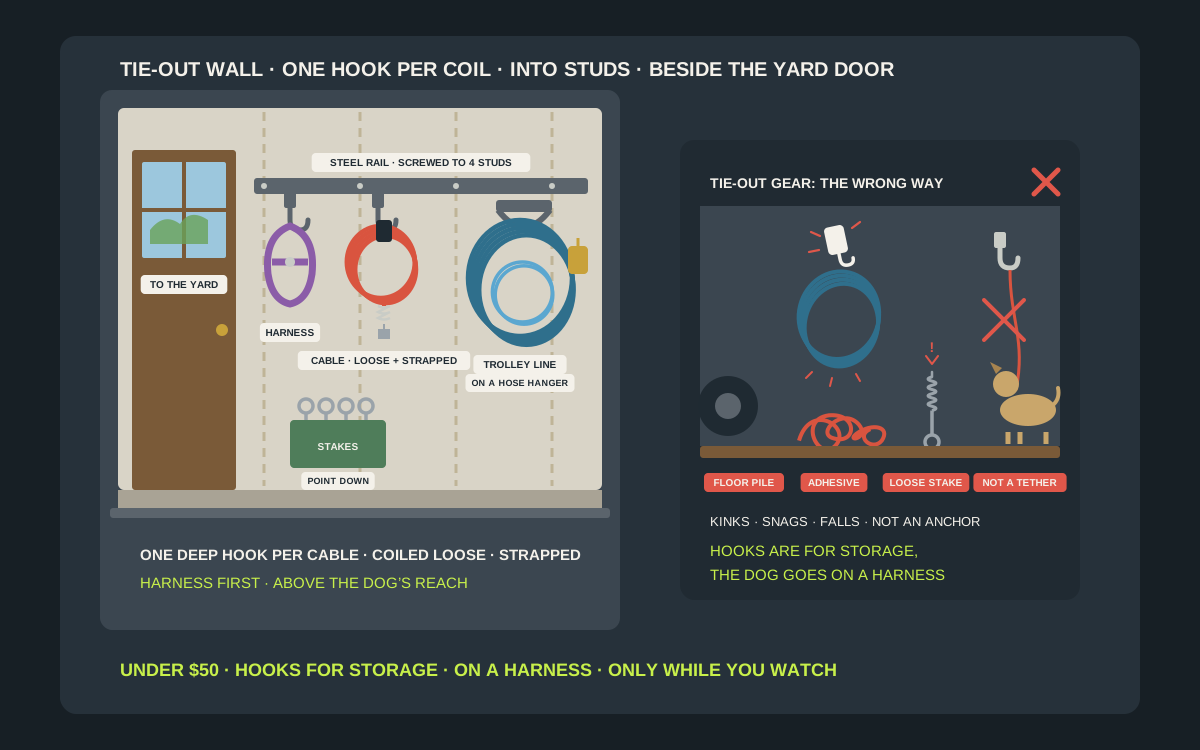
Every dog owner who uses a tie-out ends up with the same tangle in the garage: a red vinyl cable with a spring on one end, a corkscrew stake caked in mud, maybe a 60- or 100-foot trolley line still half-coiled from last summer, and a harness hanging off whatever is nearest. Left on the floor, a tie-out cable kinks, gets driven over, picks up grit that wears the vinyl and snags the first foot that walks past. Left in a bucket, it knots itself around the stake. A few hooks screwed into the studs fix that for well under $50: one deep hook per cable, a hose hanger for a trolley line, a bin for stakes and spare hardware, and a hook for the harness, all next to the door you take the dog out through. This guide covers which hook suits which piece of tie-out gear, how to coil and hang a cable so it comes off the wall untangled, what to check before each use, and how to use the gear the way the makers, humane societies and some state laws expect: supervised, on a harness, and never as a substitute for a fence.
Shop heavy-duty garage wall hooks on Amazon
Who this is for
- Dog owners who use a tie-out cable or stake in the yard, at the lake or at camp and keep the gear in the garage between uses
- Anyone with a 50- to 100-foot trolley or aerial run line that comes down for winter and needs somewhere better than the floor
- Households where the garage door to the yard is also the dog door, and the leashes, harness and tie-out gear all pile up beside it
Quick answer
For most garages, the best under-$50 setup is a short steel track rail or a few heavy-duty utility hooks screwed into studs beside the door to the yard. Hang each tie-out cable in loose loops on its own deep hook, closed with a hook-and-loop strap so it cannot spring open; put a 50- to 100-foot trolley line on a wall-mount hose hanger, which is shaped for exactly that kind of coil; keep spiral stakes, spare snaps, cable clamps and stoppers point down in a small wall bin; and give the harness its own hook at hand height. A tie-out cable weighs little, which is why light hooks look tempting, but the weight that matters is the tug when you pull the coil down, so screws into wood beat adhesive. And treat every hook in this guide as storage only: a wall hook is not a place to clip a dog. Check hook ratings and what is in the box on the listing before you buy.
Quick comparison
| Hook | Holds | How it mounts | Trade-off |
|---|---|---|---|
| Deep utility hook on a stud | One coiled 15- to 30-ft tie-out cable | One or two screws into a stud | One cable per hook, or they tangle |
| Wall-mount hose hanger | A 50- to 100-ft trolley line plus its runner | Screws into studs; wide curved saddle | Bulky; leave space beside it for the coil |
| Steel track rail with hooks | Cables, trolley line, harness and long line together | Rail screwed to studs; hooks slide or click on | Rail and hooks are sold separately; check the total |
| Small wall bin or pegboard cup | Spiral stakes, spare snaps, clamps, stoppers | Pegboard or a bin screwed to the wall | Store stakes point down so nothing catches on them |
| Hook-and-loop strap | Keeps any coil closed on its hook | Wraps the coil; hangs on any hook | A strap, not a hook; still needs a hook |
| Outdoor-rated adhesive hook | A harness or light lead by an exterior door | Adhesive strip rated for outdoor temperatures | Light loads only; never a trolley line or a tether point |
Wall-mount hose hangersGarage track rail hook kitsHook-and-loop storage straps
What to look for
A deep, smooth hook for every coil
A coiled tie-out cable needs a hook with a wide, deep saddle so the loops sit side by side instead of piling into a point, and a smooth, coated finish so the vinyl jacket does not wear against a sharp edge. A 20-foot cable such as Boss Pet’s Q3520SPG99 coils to a loop roughly the size of a dinner plate and its Amazon listing gives the package weight as about 14 oz, so almost any garage utility hook holds it; the depth is what keeps the coil from sliding off when you brush past. Give each cable its own hook. Two cables on one hook always come down tangled together.
A hose hanger for long trolley lines
A trolley or aerial run line is a different storage problem. Boss Pet sells its Prestige Skyline run in lengths up to 100 feet, and BV’s popular kit pairs a 60-foot main cable with a 10-foot runner, so a winter coil of trolley line is as bulky as a garden hose. A wall-mount hose hanger, the curved saddle sold for garden hoses, is the right shape: wide enough for big loose loops, deep enough to hold them, and made to screw into studs. Keep the runner coiled on the same hanger, and slip the pulley, stoppers and clamps into a bag clipped to it.
Screws into studs, not adhesive
The load that pulls a hook off the wall is not the coil hanging still; it is the yank when you lift a tangled cable down in a hurry with a dog pulling at the door. Screw hooks and rails into studs, which in most garages sit 16 inches apart on center. Adhesive hooks are the wrong tool for a trolley line, and even an outdoor-rated one is best kept for something light, like the harness. If you do use adhesive by an exterior door, choose an outdoor product: Command’s outdoor hooks are made for temperatures from -20 to 125°F, while its indoor strips are meant to be applied between about 50 and 105°F, which an unheated garage often is not.
A home for the small parts
The pieces that go missing are the small ones: the spare twin-swivel snap, the cable clamps and nylon stoppers from a trolley kit, the spring if it unclips. Boss Pet’s 18-inch spiral stake is solid steel with a corkscrew point and a loop on top, which makes it the item most likely to scratch a car door or a shin if it lies loose. A small wall bin, a pegboard cup or a hanging bucket keeps stakes upright, point down, with the hardware in a zip bag beside them.
At the door you actually use
Mount the tie-out wall next to the door you take the dog out through, at a height you can reach with one hand while the other holds the dog. Put the harness first, then the everyday cable, then the trolley line farther along, so the things you grab most often are nearest the door. Keep the whole station out of the car door’s swing and away from the path of the bumper.
What you are actually storing
Tie-out cables
The classic tie-out is a vinyl-coated steel cable with a snap at each end, sold in color-coded lengths and weight ratings. Boss Pet’s Q3520SPG99, for example, is a 20-foot cable for large dogs up to 60 lb, made of galvanized aircraft cable coated with crack-resistant vinyl, with a shock-absorbing spring and twin-swivel snaps meant to cut down on tangling; the Q5720SPG99 is the same 20-foot length rated for extra-large dogs up to 125 lb. Both are light, springy and quick to kink if they are coiled tight or left in a pile, which is why they want a hook of their own.
Trolley and aerial run kits
A trolley run strings a long overhead cable between two anchors and lets the dog move along it on a shorter runner. Boss Pet’s Prestige Skyline aerial run is listed with a 100-foot main cable and a 10-foot runner for dogs up to 60 lb, in galvanized steel aircraft cable with a vinyl coat. BV’s kit pairs a 60-foot main cable with a 10-foot runner, a shock spring and nylon stoppers, is rated for dogs up to 125 lb, and deliberately leaves one end of the main cable bare so you can cut it to the distance between your anchors. When a run comes down for the winter, you are storing a long cable, a runner, a pulley and a handful of clamps.
Spiral stakes
A spiral stake screws into the ground and gives a portable tie-out a center point. Boss Pet’s 18-inch spiral stake is solid steel with a loop on top that lets the cable swivel through 360 degrees, and it unscrews to come out again. Stakes come back muddy and sharp, so they belong in a bin or bucket, cleaned and stood point down, not on a hook at head height.
Campsite tethers
Some owners keep a camping hitch with the yard gear. Ruffwear’s Knot-a-Hitch, for example, uses a 28.5-foot, 7 mm reflective kernmantle rope strung between two trees or around one post, packed into a stow bag of about 6 by 7 by 2 inches, and Ruffwear says it should only be attached to a harness. A system like this costs more than this guide’s $50 budget on its own, but it stores the easy way: the bag goes on a hook. If you camp with your dog, our camping mallet and stake holder guide covers where the tent stakes go.
The harness and the long line
The piece of tie-out gear that matters most for the dog is the harness. Humane groups and California law are clear that choke and pinch collars do not belong on a tether, and makers such as Ruffwear say their tethers should attach to a harness, so the harness lives on the tie-out wall, not in the leash basket by the front door. Walking leashes and everyday harnesses for walks are covered in our dog leash wall hook guide.
Six ways to hang tie-out gear
One deep hook per cable
The simplest setup is a row of heavy-duty utility hooks screwed into a stud, one per cable. Coil each cable in loose loops about the size of the hook’s saddle, clip the two end snaps together so the coil cannot unwind, and hang it with the spring end at the bottom, where it cannot catch on the next hook. Label the hook with the length and the weight rating if you own more than one cable, because a 60-lb cable and a 125-lb cable look identical from across the garage.
A hose hanger for the trolley line
A trolley line coiled for winter is as big as a garden hose and wants the same storage. A wall-mount hose hanger screwed into one or two studs holds the big main cable in wide loops, with the runner coiled on the front. Do not wind the line around anything tighter than the hanger’s curve, which is the fastest way to put a permanent kink in steel cable. Our garden hose reel wall mount guide covers hangers and reels in more detail.
A track rail for the whole set
If the cables, a trolley line, the harness and a long line all live together, a steel track rail screwed across two or three studs lets you slide hooks along to fit each piece and move them as the gear changes. Rubbermaid’s FastTrack system, for example, uses a rail screwed into studs with utility hooks rated at 50 lb each, and similar rails are sold by other garage-storage brands; our garage track rail hook guide covers the options. A rail also keeps the station at a consistent height, so nothing hangs low enough for the dog to chew.
A bin or pegboard cup for stakes and hardware
Stand spiral stakes point down in a small wall bin, a bucket on a hook or a pegboard cup, with a zip bag of spare snaps, cable clamps and stoppers beside them. Knock the dirt off a stake and let it dry before it goes back on the wall, so the bin does not turn into a mud tray.
A strap on every coil
A hook-and-loop strap or a short buckle strap wrapped around a coil keeps it closed when you lift it on and off the hook, and lets you carry a cable out to the yard without it springing open. Straps cost little, and they are the difference between a coil that comes off the wall ready to use and one that unrolls across the floor.
A light hook for the harness
The harness is the one item light enough for a smaller hook, and it should be the first thing your hand finds by the door. A screw-in coat hook is ideal; by an exterior door, an outdoor-rated adhesive hook works if its rating clears the harness by a wide margin. Keep it apart from the cables so the straps do not end up threaded through a coil.
Where the tie-out wall goes
Beside the door to the yard
The best spot is the stretch of wall beside the door you use to take the dog outside, so the harness, the cable and the stake come off the wall in the order you need them. If you also keep a yard scooper and bags nearby, our pooper scooper wall hook guide covers that station, and the two fit naturally side by side.
Out of the car’s way
Keep tie-out gear out of the swing of the car door and the path of the bumper. A cable hanging low on the front wall of a garage stall is the one that gets caught on a mirror or driven over when it falls. A side wall beside the yard door, at about chest height, keeps it clear.
Dry, with room to drip
Cables and stakes often come in wet or muddy. Hang them where a little drip does no harm, over a concrete floor rather than above a shelf of cardboard boxes, and wipe off the worst of the mud before they go up. A damp coil in a closed bin stays damp.
Above the dog’s reach
A chewed vinyl jacket exposes the steel cable underneath and gives it sharp ends. Mount everything high enough that a curious dog waiting at the door cannot reach the bottom of a coil.
Sample layouts
One dog, one cable
For a single dog and a single tie-out, the whole station fits on one stud: a harness hook at about shoulder height nearest the door, one deep utility hook below it for the strapped cable, and a small bin at knee height for the stake. Three hooks and a bin come in well under $50, and the setup takes ten minutes with a drill.
Two dogs or two cable lengths
Two dogs means two harnesses, two cables and, if you use a trolley, one line per dog, as the San Diego Humane Society recommends. A short track rail across two studs makes this easy: harness hooks at the door end, a hook per cable labeled with its length and weight rating, and the stake bin under the rail. Keeping each dog’s harness above its own cable saves the sorting every time you head out.
Seasonal trolley plus everyday cable
If a trolley run comes down every winter and a short cable stays in use all year, put the hose hanger for the trolley line at the far end of the wall, away from the door, and the everyday cable and harness nearest the door. The bulky winter coil is out of the way for months, and the gear you use every week is still one reach from the handle.
If your trolley line anchors to the garage
Storage hooks are not anchor points
A hook on the garage wall is for storing the gear, not for tying the dog. Clipping a tie-out to a wall hook makes a fixed tether, the setup humane groups warn against for anything more than a short, supervised moment, and one that some laws restrict outright. California’s Health and Safety Code, for example, bans tethering a dog to a doghouse, tree, fence or other stationary object except for a temporary task, defined as no more than three hours in a 24-hour period, while allowing a running line, pulley or trolley system.
Anchor the run to solid structure
If one end of a trolley run attaches to the garage, it needs solid structure, not trim or siding. The San Diego Humane Society’s trolley guidance lists eye bolts anchored into concrete, metal trolley posts or other sturdy mounts, an installation height of at least 6 feet above the ground, and a line placed so there is nothing the dog can wrap around, including the posts and anchors themselves. BV’s instructions likewise call for hooks screwed into stationary objects at both ends, 6 feet or more above the ground, with the spring end on one of them. Follow the kit’s own instructions, and use the anchor hardware it supplies or a lag eye bolt driven into solid framing.
Keep the run clear of the garage itself
Place the line so the runner cannot reach the garage door track, a parked car, a woodpile, a deck stair or a fence, and so the dog can reach shade, water and shelter from anywhere along it. San Diego Humane’s guidance also asks for one dog per trolley line.
Setting up the wall step by step
- Lay out every piece of tie-out gear on the floor: cables, trolley line and runner, stakes, harness, long line, spare hardware.
- Pick the stretch of wall beside the door to the yard, out of the car door’s swing, at a height the dog cannot reach.
- Find the studs with a stud finder and confirm them with a small nail where the hook or rail will cover the hole.
- Screw a track rail across the studs, or mount individual heavy-duty hooks and a hose hanger directly into them.
- Coil each cable in loose loops, clip its snaps together, add a strap, and hang it on its own hook with the spring end down.
- Coil the trolley line on the hose hanger with the runner on the front, and bag the pulley, stoppers and clamps on the same hanger.
- Mount the stake bin low and to one side, put the stakes in point down, and hang the harness on the hook nearest the door.
- Tug each coil down and put it back once, with one hand, to check that nothing catches or slides off.
Using a tie-out safely
Stay with the dog
Boss Pet’s own stake directions say never to leave a dog unattended while it is tethered, to watch for a kinked tether or a tangled dog, and not to leave a dog tied out in excessive heat or cold. Humane World for Animals (formerly the Humane Society of the United States) says restraint can be acceptable for a short period or while supervised, and that keeping a dog tethered for long periods or in extreme weather is never acceptable. A tie-out is for the twenty minutes you are in the yard together, not for the afternoon you are out.
Use a harness, never a choke or pinch collar
California law bars attaching a dog to a running line, pulley or trolley by a choke or pinch collar. Boss Pet’s directions say never to use a choker-type collar with its stake, and both Ruffwear and the San Diego Humane Society recommend attaching to a harness rather than a collar. Fit the harness snugly, check it every time and keep it on the tie-out wall so it is always the one that goes on.
Nothing to tangle on
Boss Pet tells owners never to tether a dog near any obstacle it can become entangled in or suspended from. Set the stake or the run well away from trees, fences, furniture, deck stairs and the dog’s own shelter, and remember that the reach of a 20-foot cable is a circle 40 feet across. California’s Penal Code adds that any leash, rope or chain must be fixed so the animal cannot become entangled or injured and can still reach shelter, food and water.
Connect and disconnect carefully
Boss Pet’s directions say to keep your hands and feet clear of the tether in case the dog lunges, to attach the spring end to the stake or anchor, to hold the dog’s harness while you connect the other end, and to release the tether first, then the dog. That last step is easy to forget with a dog that knows it is about to go back inside.
Know your local rules
Tethering laws vary by state, county and city, and many are stricter than the manufacturer’s directions. California’s limits on stationary tethering are one example. Check your local animal control rules before you rely on a tie-out, and when a dog needs to spend real time outdoors, a fenced yard or a dog run is the better answer, which is the position the humane groups take too.
Care between uses
Inspect before every use
Boss Pet’s stake directions say to inspect the product before each use and replace it if wear is evident, and retail listings for its tie-out cables add a reminder to replace worn, damaged or sharp-edged products. Run the cable through your hand when you take it off the hook: cracks or splits in the vinyl, broken wire strands poking through, rust at the crimps, a stiff swivel or a snap that does not close cleanly are all reasons to retire it.
Dry it before you coil it
Wipe a wet cable down and let it dry before it goes back on the hook, and rinse mud off the snaps so grit does not jam the swivels. Galvanized steel and vinyl are built for outdoor use, but a cable stored wet and coiled tight in a bin is the one that rusts at the ends.
Coil loose, never tight
Steel cable keeps a kink once it has one. Coil in loops at least as wide as the hook’s saddle, never wrap a cable tightly around a stake or a bracket, and in cold weather give a stiff cable a moment indoors before coiling so the vinyl relaxes and lies flat.
Store the trolley run for winter
When a seasonal run comes down, release the tension at the clamps, slide off the pulley and stoppers, bag them with the clamps, and coil the main line on the hose hanger. Note the cut length on a tag so you know whether it still fits the span next spring.
Mistakes to avoid
- Leaving tie-out cables in a pile on the garage floor, where they kink and get driven over.
- Hanging two or three cables on the same hook so they come down knotted together.
- Trusting an indoor adhesive hook in an unheated garage, or any adhesive hook with a trolley line.
- Storing spiral stakes loose or point up where a foot or a car door can find them.
- Coiling steel cable tightly around a stake, which leaves permanent kinks.
- Clipping a dog to a hook on the garage wall as a tether point.
- Using a choke or pinch collar on a tie-out or trolley instead of a harness.
- Putting a frayed or cracked cable back on the wall instead of replacing it.
Related guides
Browse the hub: Pet gear wall mounts under $50 - all guides
- Best Dog Leash Wall Hooks Under $50
- Best Dog Ramp Wall Hooks Under $50 for Garage Storage
- Best Pooper Scooper Wall Hooks Under $50 for Garage & Shed
- Best Camping Mallet & Stake Wall Holders Under $50
- Best Garden Hose Reel Wall Mounts Under $50 for Garages
- Best Garage Track Rail Hooks Under $50
- Best Dog Bike Trailer Wall Hooks Under $50 for Garage
FAQ
What is the best way to store a dog tie-out cable?
Coil it in loose loops, clip the end snaps together, wrap it with a strap and hang it on its own deep hook screwed into a stud, spring end down. Long trolley lines store best on a wall-mount hose hanger.
Can I use Command hooks for tie-out cables?
Only for light items such as a harness, and only an outdoor-rated hook in an unheated garage; Command’s indoor strips are meant to be applied between about 50 and 105°F. Cables are better on screw-in hooks, because the load that matters is the tug when you pull a coil down.
How do I store a trolley dog run for winter?
Release the tension, slide off the pulley and stoppers, bag them with the clamps, and coil the main cable and runner in wide loops on a hose hanger screwed into studs. Tag it with the cut length.
Can I tie my dog to a hook on the garage wall?
Treat garage hooks as storage only. Fixed tethering is discouraged by humane groups for anything beyond a short, supervised moment, and some laws restrict it: California limits tethering to a stationary object to temporary tasks of no more than three hours in 24 hours.
Should a tie-out attach to a collar or a harness?
A harness. California bars choke and pinch collars on running lines and trolleys, Boss Pet says never to use a choker-type collar with its stake, and Ruffwear and the San Diego Humane Society recommend a harness.
How often should I replace a tie-out cable?
Whenever you see wear. Boss Pet says to inspect before each use and replace the product if wear is evident: cracked vinyl, broken strands, rust at the crimps or a snap that does not close are all signs.
Bottom line
The best dog tie-out cable wall hooks are plain, deep, screw-in hooks: one per cable, coiled loose and strapped, plus a hose hanger for a trolley line, a bin for stakes and a hook for the harness, all on the studs beside the door to the yard, for well under $50. Keep the hooks for storage, not tethering, use the gear on a harness and only while you are with the dog, inspect each cable as it comes off the wall, and check hook ratings and what is included on the listing before you buy.