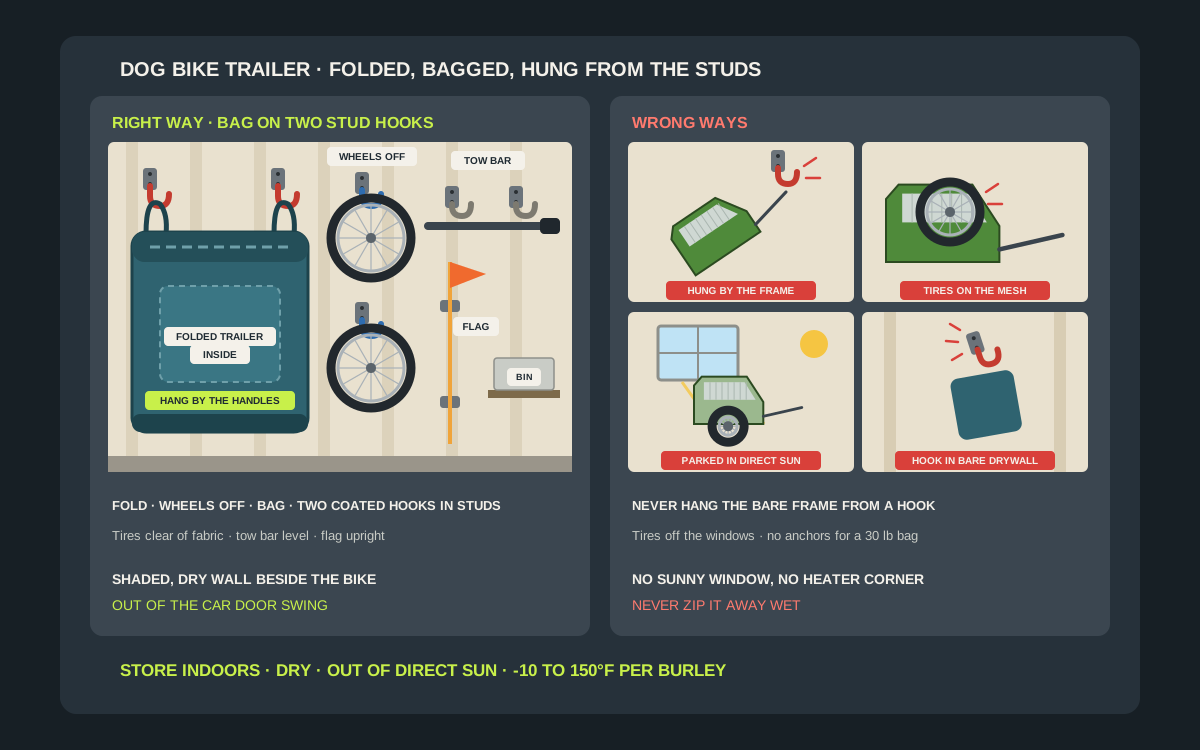
A dog bike trailer is one of those pieces of gear that is wonderful on a Saturday morning and awkward the other six days of the week. Even folded, it is about three feet long and two feet wide, it comes with two wheels, a tow bar, a hitch and a safety flag that all wander off to different corners of the garage, and it tends to end up flat on the floor where the car door, the lawn mower and the dog’s muddy paws all find it. Getting it onto the wall frees a surprising amount of floor, but this is one item where the obvious move, two hooks and the frame, is the one the best-known trailer maker tells you not to do. This guide explains what Burley says about wall storage, how to hang a folded trailer and its parts on a garage stud wall for well under $50 in hooks, where in the garage the kit should live, and the cleaning and inspection habits that make the next ride start without a hunt. It uses the published specifications and care instructions for the Burley Tail Wagon, Bark Ranger and Bark Ranger XL and the Croozer Dog Peppa, and it ends with layouts for one-car garages, family garages and trailers that double as a stroller.
Shop heavy-duty garage hooks for a dog bike trailer on Amazon
Who this is for
- Dog owners who bike with a trailer and are tired of stepping over it on the garage floor between rides
- Riders with a stroller-convertible pet trailer who need the wheels, tow bar and stroller kit in one place by the door
- Households sharing a garage with cars, bikes and a kids’ trailer who want the dog trailer off the floor without damaging it
Quick answer
For most garages, the best setup is to fold the trailer, pop off its quick-release wheels, zip the body into a storage bag and hang the bag by its handles from two heavy-duty, vinyl-coated utility hooks screwed into the studs. Burley’s own support FAQ says it does not recommend hanging a trailer on the wall by its frame or other parts and suggests its Trailer Storage Bag instead, so treat the bag, not the frame, as the thing that hangs. Hang the two wheels on their own coated hooks so the tires never press against the mesh or windows, rest the tow bar across a pair of J hooks, clip the safety flag upright, and keep the pouch, light kit and spare hitch in a small bin on a shelf. Folded trailers in this class weigh roughly 21 to 33 lb, so choose hooks rated well above the loaded bag. If your trailer has no bag, store it folded on the floor or a low platform against the wall with a strap. The hooks, clips and bin together stay under $50; check ratings and current prices on the listing, and note that a branded storage bag is a separate purchase.
Quick comparison
| Option | Best for | How it holds | Trade-off |
|---|---|---|---|
| Two heavy-duty utility hooks | The folded trailer zipped into a storage bag, hung by its handles | Two deep, coated hooks screwed into studs; one handle on each | Never hang the bare frame; the bag must be rated and sized for your trailer |
| Coated bike wheel hooks | The two quick-release wheels | Rim rests in a vinyl-coated hook, tire clear of the wall | Keep the tires away from the bag, mesh and windows |
| Pair of J hooks | Tow bar with the hitch connector | Bar lies level across two shallow hooks at stud spacing | Small parts like the hitch pin need their own bag or bin |
| Spring clip or tool gripper | Safety flag and pole | Pole held upright in a clip, flag above it | Flag fabric fades in sun; keep it away from windows |
| Low wall shelf or platform | A folded trailer with no storage bag, or the stroller kit | Brackets into studs; trailer stands on its edge with a strap | Needs floor-level space; shelf must be rated for the trailer |
| Track rail with movable hooks | Bag, wheels, tow bar, flag and pouch on one rail | Rail screwed to studs; hooks slide to fit each part | Rail plus hooks can pass $50; check the rating per hook and per rail |
Vinyl-coated utility hooksBike wheel wall hooksGarage track rail kits
What to look for
Rated for the folded trailer, with margin
Start with the real weight. Burley lists the Tail Wagon at 21 lb, the Bark Ranger at 26.6 lb and the Bark Ranger XL at 33 lb, and the Croozer Dog Peppa is listed at 13.8 kg, a little over 30 lb. A storage bag, a pet bed left inside and a pouch add a few more pounds. Pick hooks whose published rating is comfortably above that total, and remember that lifting a bag onto the hooks and pulling it off again puts more force on them than the bag hanging still.
A hook that matches what hangs on it
Each part of a trailer kit wants a different hook. Bag handles want a deep, rounded utility hook so the strap sits in the bottom of the curve. Wheels want a coated hook that cradles the rim without scratching it. The tow bar wants two shallow J hooks so it lies level, and the safety flag wants a spring clip so the pole stays straight. A single all-purpose hook for everything is how the flag ends up bent and the hitch pin ends up lost.
Coatings that protect fabric and rims
Bare steel hooks can scuff aluminum rims and wear through fabric straps over time. Vinyl- or rubber-coated hooks are the better choice for every part of the kit that touches paint, fabric or a rim. Check the coating covers the whole contact area, not just the tip.
Fasteners that go into studs
A loaded storage bag of 25 to 35 lb hanging off the wall is a job for wood screws into studs or solid blocking, not plastic drywall anchors or adhesive strips. Look for hooks that come with long wood screws, or buy screws sized to the hook’s own instructions, and plan the layout around where your studs actually are.
Room for the kit, not just the trailer
The wall space you need is set by the bag and the wheels, not the trailer frame. Burley gives approximate dimensions for its Trailer Storage Bag of 57 by 36.25 by 35 inches, so plan for a stretch of wall about five feet wide for the bag, plus another couple of feet for the wheels and tow bar. Measure before you buy hooks, and make sure the spot is clear of the car door, the garage door track and any windows.
What Burley says about hanging a trailer
Not by the frame
Burley’s support FAQ answers this question directly. Asked whether a trailer can hang on the wall for storage, it says it does not recommend hanging the trailer by the frame or other parts, and suggests the Trailer Storage Bag for anyone who wants to get the trailer up off the floor. That is worth taking seriously. A folded trailer is a set of hinges, fabric panels, a roll cage and a tow bar mount packed into a flat bundle, and hanging it from one or two points on the frame puts the whole weight on parts that were designed to carry a dog sitting on the floor of the trailer, not the trailer itself hanging in the air.
The bag hangs, the trailer rides inside
Burley describes its Trailer Storage Bag as durable polyester with a double-layered bottom, side and top handles, and a roll-top closure, and says it hangs easily from its carry handles to free up floor space. Burley says all of its trailers fit, with larger models such as the Bark Ranger XL a snug fit. Hanging the bag by its handles spreads the load through a part built to be lifted, protects the fabric from scuffs and dust, and keeps the small parts together. If you own a Tail Wagon or a Bark Ranger, this is the cleanest way to put the trailer on a wall.
Other brands: read your manual first
Croozer, PawHut, Aosom, Schwinn and other trailer makers write their own storage instructions, and they do not all say the same thing. Look for a storage section in the manual or on the support page before you choose a method. If the manual says nothing about hanging, follow the cautious route: fold the trailer, store it in a bag hung by the bag’s handles, or keep it folded at floor level against the wall.
Where the trailer should not live
Burley’s maintenance guidance says that for the longest product life, a trailer should be stored indoors, not at temperatures below minus 10 degrees F or above 150 degrees F, and out of direct sunlight in a dry, well-ventilated area. In a garage that rules out the floor right under a sunny window, the space beside a water heater or furnace vent, an uninsulated attic over a garage in summer, and any corner that floods or stays damp. A shaded stretch of stud wall away from the big garage door is usually the right spot.
Hanging each part of the kit
The folded body in its bag
Fold the trailer the way the manual describes, take the wheels off, and slide the body into the bag with the tow bar either stowed inside or hung separately. Put two deep utility hooks into two neighboring studs, so the hooks sit roughly 16 inches apart on a standard wall, and hang one bag handle on each. Two hooks keep the bag level and stop it from swinging when you brush past. Mount them high enough that the bottom of the bag clears the floor and any bins below, but not so high that you have to lift 30 lb over your head to reach them.
The wheels
Most pet trailers in this class use push-button or quick-release wheels: Burley lists 16-inch wheels on the Tail Wagon and 20-inch wheels on the Bark Ranger, and Croozer lists 16-inch spoked wheels on the Dog Peppa. Take them off before the trailer goes into the bag and hang each wheel by the rim on its own coated hook. Burley’s maintenance guidance warns that tires should not be stored in contact with the trailer windows, because the windows can discolor, so give the wheels their own spot beside the bag rather than stuffing them in with the fabric.
The tow bar and hitch
The tow bar is the part most likely to get stepped on, bent or separated from its pin. If it does not ride inside the bag, rest it level across two shallow J hooks on the studs next to the wheels. The hitch connector that stays on the bike usually lives on the bike’s rear axle, but a spare hitch for a second bike, the safety pin and any adapter belong in a small zip bag hung on the same hooks or in a labeled bin, not loose in a drawer.
The safety flag
Long fiberglass flag poles bend if they are leaned in a corner behind a door, and the flag fabric fades in sunlight. A spring clip or a tool gripper on the wall holds the pole upright and straight, with the flag above it. Clip it beside the wheels so it goes out the door with the rest of the kit.
Pouch, light kit, rain cover and pet bed
Accessories multiply. Burley sells a Pet Trailer Pouch that attaches to the side of the Tail Wagon and Bark Ranger, a light kit, a rain cover for the Bark Ranger and a pet bed sized to its trailers. Keep the pouch and light kit in one small bin on a shelf above the wheels, hang the rain cover folded over a hook once it is fully dry, and store the pet bed somewhere clean and dry so it does not pick up garage dust and odors. If the bed lives in the trailer between rides, take it out for long storage periods.
Choosing between the six options
When two utility hooks and a bag win
For a folded Burley trailer, two stud-mounted utility hooks and the storage bag are the simplest, strongest and least damaging setup. The hooks are inexpensive, they go in with a drill in a few minutes, and the trailer is fully protected from dust, scuffs and sunlight. The only limit is wall space: you need a clear stretch of about five feet for the bag.
When a low shelf or floor spot is better
If you do not own a bag or your trailer’s manual says nothing about hanging, keep the trailer folded at floor level against the wall. A low platform, a sturdy shelf just off the floor or a simple rubber mat keeps it out of puddles, and a strap or bungee clipped between two screw hooks in the studs holds it upright against the wall so it cannot tip into the car. This uses floor space, but only about a foot of depth, since the folded trailers listed here are roughly 10 to 13 inches thick.
When a track rail makes sense
A garage track rail lets you slide hooks to exactly where each piece of the kit needs to be, which is useful when the trailer shares a wall with bikes, a kids’ trailer or yard tools. The rail spreads the load across several studs, and you can rearrange it when a new bike arrives. It is usually the most expensive route, because the rail and the specialty hooks are sold separately. Check both the rail’s rating and each hook’s rating before you put a loaded bag on it.
When individual wheel and tool hooks are enough
Some riders keep the folded trailer body in a closet, a basement or a car trunk and only need the garage for the wheels, the tow bar and the flag. In that case, a couple of coated bike wheel hooks, two J hooks and a spring clip on one stud are all you need, and the whole set costs very little.
Why adhesive hooks are the wrong tool here
Adhesive hooks are excellent for light items on smooth indoor walls, but a garage stud wall with a 25 to 35 lb bag is outside what they are built for. Garage walls are often unpainted drywall, OSB or textured paint, they see wide temperature swings, and a bag gets yanked off its hooks every ride. Use screws into studs for anything heavier than the safety flag.
Where the kit should live in the garage
Next to the bike that tows it
Store the trailer kit on the wall right beside the bike that pulls it. That way the hitch, the tow bar and the bike come together in one spot, and you can hitch up without walking back and forth across the garage. If the bike hangs vertically or horizontally on the wall, leave enough room beside it for the bag and the wheels; our vertical versus horizontal bike mount guide covers bike spacing.
Out of the car door and walkway
A bag that sticks out a foot from the wall is fine in a quiet corner and a problem where a car door swings open. Measure how far your car door opens on that side and keep the bag, wheels and tow bar outside that arc. Keep the walkway to the house door clear too, so nobody catches a pedal or a shoulder on a wheel in the dark.
Near the yard or driveway door
Like a leash station, trailer gear works best close to the door you leave through. If you usually walk the bike and trailer out of the side door rather than the big garage door, put the kit on that wall. A dog that sees the trailer come down off the wall will usually tell you which door it expects anyway.
Shade and dry air
Pick a wall that does not get direct sun through a window and is not next to the water heater, a dryer vent or a leaky door seal. Burley’s fabric care instructions say to wipe the trailer dry and store it out of direct sunlight in a dry, well-ventilated area, which describes a shaded interior garage wall well. A bag that hangs in a sunny window for a summer fades just like the flag.
Setups for different garages
One-car garage, one bike
In a single garage, the back wall in front of the car’s bumper is usually the best spot. Hang the bike vertically, put two utility hooks for the bagged trailer on the next two studs, and add a wheel hook on each side of the bag. The tow bar sits on two J hooks above the wheels and the flag clips at the end. The whole setup fits in roughly six to seven feet of wall.
Family garage with a kids’ trailer too
When a dog trailer and a child trailer share the garage, label the bags and keep each trailer’s wheels and tow bar beside its own bag, because hitches and tow bars from different trailers can look alike. A track rail along one wall keeps both kits tidy and lets you move hooks as kids outgrow their trailer. Burley’s support FAQ notes that many owners use child trailers for pets or cargo once children outgrow them, but it recommends pet-specific trailers for pets you carry regularly, so the dog trailer is worth keeping separate.
Stroller-convertible trailers
Trailers like the Bark Ranger come with a stroller kit and handlebar, and many owners use the stroller mode far more often than the bike mode. In that case, leave the trailer in stroller mode near the house door on the floor, hang the tow bar, the flag and the bike wheels on the wall, and store the trailer in the bag only for the winter. Our pet stroller wall hook guide covers hanging a folded pet stroller on its own.
Shared or rented garage
In a rented garage or a shared storage room, ask before drilling, or keep the folded trailer in its bag on the floor against the wall and use a freestanding shelf for the wheels and tow bar. If you can drill, small screw holes in studs are easy to fill and paint at move-out, much easier than the damage a falling bag can do to a car door.
Installing the hooks
Find the studs and mark the layout
Use a stud finder and confirm each stud with a small finish nail before you commit. Studs are commonly 16 inches apart on center, sometimes 24, so plan the bag hooks on two neighboring studs and the wheel and tow bar hooks on the next ones. Mark the hook heights with painter’s tape and hold the bag up against the marks to check clearance before drilling.
Pilot holes and full-depth screws
Drill pilot holes sized for the screws the hook maker supplies, and drive the screws until the hook sits flat and tight against the wall. A hook that rocks on its base or sits proud of the drywall will loosen over time. If a hook comes with drywall anchors, use them only for the flag clip, and put anything carrying the bag or wheels into wood.
Height you can lift to
A loaded bag of 25 to 35 lb is easy to carry and awkward to lift over your head. Set the bag hooks at about shoulder height for the person who usually hangs the trailer, so the bag goes up with bent arms rather than a full overhead press, and so the bottom of the bag still clears the floor. Wheels can go a little higher, and the flag clip can go wherever the pole fits.
Tug test before you walk away
Hang the empty bag first, pull down firmly on each hook, and check that nothing has shifted. Then hang the loaded bag and leave it for a day before you add the wheels and accessories around it. If a screw has started to pull out, it will usually show up in that first day.
Clean, dry and inspect before it goes up
Rinse off salt and grit
Burley’s storage advice says that if the trailer has been used in a high salt spray environment, such as the beach or salted roads, you should spray it off after use before storage. Do the same after muddy rides. Grit in hinges and wheel axles is easier to rinse out on the driveway than to scrub off after it has dried in a bag for a month.
Wash the fabric the gentle way
Burley’s manuals say to hand wash fabric parts with warm water and mild soap or detergent, not bleach or solvents, and to line-dry the trailer cover. Its support pages add that most of its products are spot-clean only and that it does not recommend putting trailer fabric in a washing machine. Many pet trailers, including the Tail Wagon and Bark Ranger, have a removable floor, which makes it easy to shake out fur and rinse the floor separately.
Let everything dry fully
A damp trailer zipped into a bag is how mildew starts. After washing or a wet ride, unfold the trailer and let it dry completely in a shaded, airy spot, with the rain cover hung separately, before it goes into the bag. A day on the garage floor with the door open is usually enough.
Check the wear parts
Before long storage, look over the tires, the hitch and the tow bar connection. Burley says inner tubes may need maintenance much like a bicycle’s, and recommends replacing the flex connector, the rubbery part that joins the tow bar to the hitch, every three to five years because of the nature of the material. Note the date on a piece of tape on the tow bar so you know when it is due.
Winter and long-term storage
Pack it complete
At the end of the riding season, put the trailer away as one complete kit: body in the bag, wheels on their hooks, tow bar and flag beside them, and the small parts in one labeled bin. When spring comes, you can be riding in ten minutes instead of searching for the safety pin.
Mind the temperature range
Burley’s storage range of minus 10 to 150 degrees F covers most attached garages, but detached sheds and attics can go beyond it in extreme climates. If your garage gets colder or hotter than that, bring the bag into a basement or closet for the season and leave only the wheels and tow bar on the garage wall.
Keep pests out of the fabric
A pet trailer smells like dog and treats, which is attractive to mice in a winter garage. Shake out the floor, empty the pouch of treats and waste bags, and roll the bag closed. Hanging the bag off the floor helps more than any trap.
Mistakes to avoid
- Hanging the folded trailer on hooks by its frame, roll cage or tow bar mount instead of using a storage bag hung by its handles.
- Storing the wheels pressed against the mesh or windows, which Burley says can discolor them.
- Parking the trailer under a sunny garage window or next to a water heater or furnace vent.
- Using plastic drywall anchors or adhesive strips for a 25 to 35 lb bag instead of screws into studs.
- Zipping a wet or muddy trailer into its bag at the end of a ride.
- Mixing up tow bars and hitches from two different trailers on the same wall.
- Leaning the safety flag in a corner where its pole bends and the flag fades.
- Mounting the bag hooks so high that you have to lift the trailer over your head every ride.
Related guides
Browse the hub: Pet gear wall mounts under $50 - all guides
- Best Pet Stroller Wall Hooks Under $50
- Best Dog Tie-Out Cable Wall Hooks Under $50 for Garage
- Best Dog Ramp Wall Hooks Under $50 for Garage Storage
- Vertical vs Horizontal Bike Wall Mounts: Which Under-$50 Setup Fits Your Garage?
- How to Hang a Bike on a Garage Wall Under $50 (Stud-Safe Hooks)
- Best Garage Track Rail Hooks Under $50
FAQ
Can you hang a dog bike trailer on the wall?
Yes, but not by its frame. Burley says it does not recommend hanging a trailer on the wall by the frame or other parts and suggests its Trailer Storage Bag, which hangs from its carry handles. Fold the trailer, take the wheels off, put it in the bag and hang the bag from two stud-mounted hooks.
How much does a folded dog bike trailer weigh?
Burley lists the Tail Wagon at 21 lb, the Bark Ranger at 26.6 lb and the Bark Ranger XL at 33 lb, and Croozer lists the Dog Peppa at 13.8 kg, about 30 lb. Add a few pounds for the bag and accessories, and pick hooks rated well above the total.
What hooks should I use for a dog bike trailer?
Two deep, vinyl-coated heavy-duty utility hooks screwed into studs for the bagged trailer, coated bike wheel hooks for the wheels, two J hooks for the tow bar and a spring clip for the safety flag. Skip adhesive hooks and plastic drywall anchors for anything heavier than the flag.
How much wall space does a dog bike trailer need?
Plan on about five feet for the bag, since Burley gives its Trailer Storage Bag approximate dimensions of 57 by 36.25 by 35 inches, plus another couple of feet for the wheels, tow bar and flag. A folded trailer stored at floor level needs only about a foot of depth.
Can I store a dog bike trailer in a hot or cold garage?
Burley says to store its trailers indoors, not below minus 10 degrees F or above 150 degrees F, and out of direct sunlight in a dry, well-ventilated area. Most attached garages are fine; very hot attics and unheated sheds in extreme climates may not be.
Should I remove the wheels before storing the trailer?
Yes. Most pet trailers have push-button or quick-release wheels, and taking them off makes the trailer flatter and lighter to hang. Hang the wheels on their own hooks, because Burley warns that tires stored against the trailer windows can discolor them.
Bottom line
The best dog bike trailer wall hooks are simple, strong and used the right way. Fold the trailer, take the wheels off, zip the body into a storage bag and hang the bag by its handles from two coated utility hooks screwed into the studs, never by the frame. Give the wheels, tow bar and flag their own hooks beside it, keep the tires off the fabric, and choose a shaded, dry wall next to the bike that tows it and outside the car door’s swing. Rinse, wash gently and dry the trailer before it goes up, check the flex connector and tires before long storage, and the hooks will cost far less than $50. Check hook ratings, what is included and current prices on the listing before you buy.
Shop heavy-duty garage hooks for a dog bike trailer on Amazon