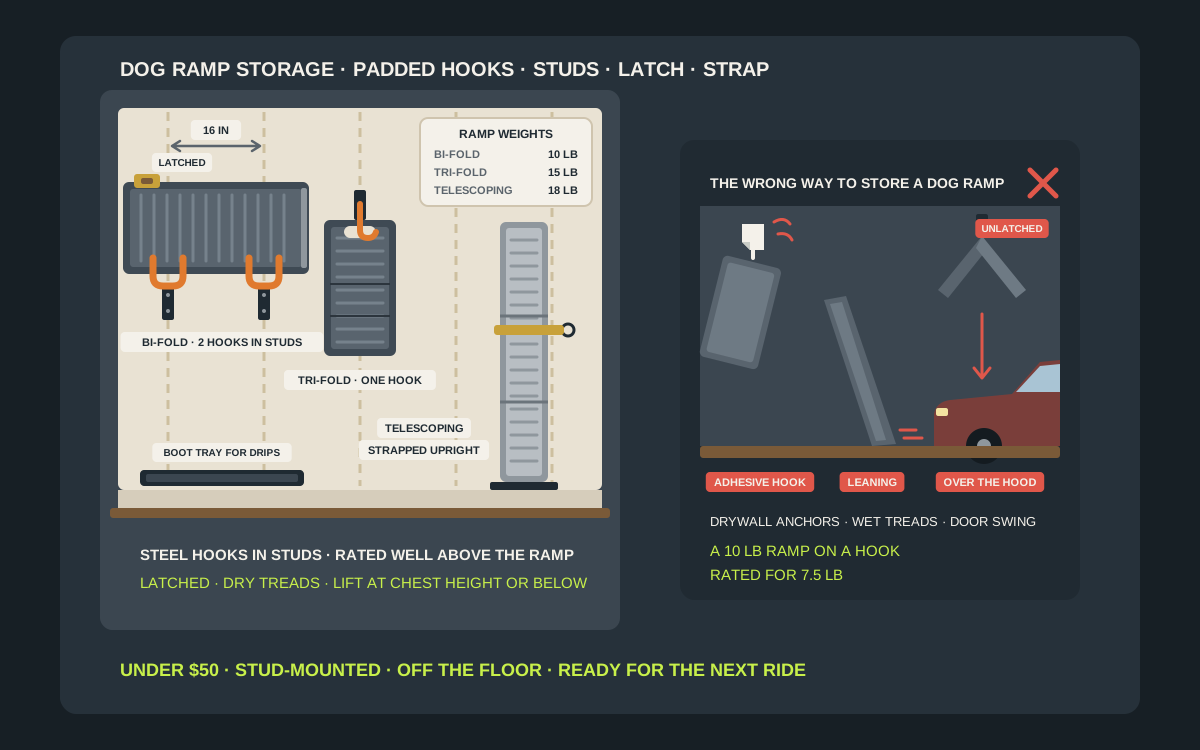
A dog ramp is the piece of pet gear that does the most good and gets in the way the most. For a senior dog, a large breed with sore hips or a dog recovering from surgery, it is the difference between a road trip and staying home, and for the person lifting a 70-pound dog into an SUV it saves a back. Between rides, though, a folded ramp is a long, slick, awkward slab that slides off the cargo floor, leans against the garage wall until it tips over, and ends up under a pile of bags with mud still on the treads. Getting it onto the wall is cheap and quick. A pair of padded hooks, a strap or a short rail costs well under $50, even though the ramp itself usually costs more than that. The right setup depends on how your ramp folds, how much it weighs, where the studs are and how often you reach for it.
Shop padded ladder hooks for dog ramps on Amazon
Who this is for
- Owners of senior, large or recovering dogs who use a folding, tri-fold or telescoping car ramp and want it off the garage floor but easy to grab
- Anyone who has found the ramp knocked over, scratched by the car door or left wet and muddy in the cargo area between trips
- People choosing between hooks, a rail, a strap or upright storage who want a setup under $50 that will not drop a 15-pound ramp on the car
Quick answer
For most folding dog ramps, the best under-$50 setup is two padded ladder hooks screwed into neighboring studs, with the ramp folded, latched and resting on its side rail across both hooks at about chest height. Popular ramps weigh between 10 and 18 lb, so a hook such as Rubbermaid’s FastTrack Ladder Hook, rated at 50 lb, has plenty of margin, and Rubbermaid notes that horizontal storage takes two hooks. A tri-fold ramp with a built-in carry handle can hang from one deep, coated utility hook instead, and a long telescoping ramp is often easiest to stand upright on a rubber mat with a strap to the wall. Skip adhesive hooks: Command’s Jumbo Utility Hook is rated at 7.5 lb, less than even a light ramp, before you add the jolt of hanging it. Check your ramp’s weight and folded size, and the current rating and price of the hooks, before you buy.
Quick comparison
| Format | Best for | Mounting | Trade-off |
|---|---|---|---|
| Two padded ladder hooks | Folded bi-fold and tri-fold ramps hung flat | Two steel hooks screwed into neighboring studs, ramp on its side rail | Needs about 3 ft of clear wall; you lift the ramp to hook height |
| One deep utility hook | Tri-fold ramps with a built-in carry handle | Single coated hook into a stud, through the handle | Ramp can swing or turn; only for handles molded into the frame |
| Rail-and-hook system | Garages that also store ladders, chairs and leashes | Rail screwed to the studs, hooks snap or slide on | Costs more up front; best as part of a whole-wall setup |
| Storage strap on a hook | Odd-shaped ramps, pet steps and ramps without handles | Strap cinched around the folded ramp, hung on a stud hook | Straps stretch over time; check the strap’s own rating |
| Upright with a wall strap | Long telescoping ramps and heavy ramps | Ramp stands on a rubber mat, strapped to an eye in a stud | Uses a little floor; must be strapped so it cannot tip |
Garage storage rail and hook kitsHeavy-duty storage straps with hooksFolding dog ramps for cars and SUVs
What to look for
Know your ramp’s folded size and weight
Start with the spec sheet, not a guess. PetSafe’s Happy Ride Folding Dog Ramp measures 62 by 16 by 4 inches open, weighs 10 lb, supports dogs up to 150 lb and folds in half, so it hangs as a slab about 31 inches long. Pet Gear’s Travel Lite Tri-Fold Ramp is 71 inches long, 16 inches wide and 15 lb (16 lb for the reflective version), supports up to 200 lb and folds into three, and Pet Gear ships it in a carton about 27 by 16.5 by 8.5 inches, a fair guide to the folded bundle. PetSafe’s Happy Ride Extra Long Telescoping Dog Ramp is aluminum, 20 inches wide and 18 lb, and slides from 87 inches down to 47. Those three numbers, length, width and weight, decide how many hooks you need and where they go.
A hook rating far above the ramp
A ramp is heavier in practice than on paper. You lift it off the wall one-handed, swing it into place and drop it back onto the hooks, often with treads still damp. Each of those moments loads the hook harder than the ramp sitting still. Choose hooks rated at several times the ramp’s weight. A steel ladder or utility hook rated around 50 lb, like Rubbermaid’s FastTrack Ladder Hook, is a sensible floor for an 18-lb telescoping ramp, and it is generous for a 10-lb bi-fold.
Stud spacing sets the hook spacing
In most wood-framed garage walls, studs sit 16 inches apart on center, sometimes 24. That spacing works out neatly for ramps. A bi-fold folded to about 31 inches rests well on two hooks one stud bay apart, with several inches of overhang at each end, and a 47-inch telescoping ramp sits comfortably on hooks two bays apart. Find the studs before you decide on the exact height, and let them set the spacing rather than the other way round.
Padded or coated hooks that cradle the side rail
Most ramps have raised side rails and a textured or carpeted walking surface. Hang the ramp so a side rail rests on the hooks, with the treads facing the wall or facing out, rather than letting the hook bite into the tread. A vinyl or rubber-coated hook, or one with a soft-grip coating such as the FastTrack ladder hook, keeps the plastic or aluminum from getting scuffed and stops the ramp from sliding along the hook every time the garage door rumbles.
A latch, tether or strap so it cannot unfold
A ramp that opens while it hangs can swing out into the car or onto someone’s foot. PetSafe’s folding ramp locks folded with a safety latch, and its telescoping model slides in and locks with a latch as well. Close the latch every time before the ramp goes on the wall. If your ramp has no latch, or the latch is worn, wrap a hook-and-loop strap around the folded ends. Pet Gear includes a safety tether with its tri-fold ramp; clip it to the ramp or hang it on the same hook so it is there for the next trip.
Five ways to hang a dog ramp on a garage wall
Two padded ladder hooks: the default for folding ramps
This is the setup most ramp owners should start with. Two coated steel ladder or utility hooks go into neighboring studs at the same height, and the folded, latched ramp rests across them on its side rail. It is stable, it takes seconds to lift on and off, and it leaves the treads untouched. Rubbermaid’s FastTrack Ladder Hook can snap onto the brand’s rail or mount directly to the wall and is rated at 50 lb, and the brand’s own guidance is that horizontal storage needs two hooks. Any similar hook with a deep, upturned tip and a soft coating will do the same job. The upturned tip matters more than it looks: it stops the ramp from creeping off the end when the garage door shakes the wall.
One deep utility hook through a carry handle
Some tri-fold ramps, including Pet Gear’s Travel Lite, have a built-in carry handle molded into the frame. Hanging the folded ramp from that handle on one deep, coated hook is the fastest option of all, and it takes up the least wall width because the ramp hangs vertically. The trade-offs are that the ramp can swing or turn when you brush past it, and that it relies on the handle. Use this method only if the handle is part of the ramp’s frame rather than a strap or clip, keep the ramp latched, and choose a hook deep enough that the handle sits fully in the bend.
A rail-and-hook system for a whole pet wall
If the same wall will hold leashes, a crate pad, a dog stroller or ladders, a rail is worth considering. A horizontal rail screwed into every stud spreads the load, and hooks snap or slide along it, so you can move the ramp hooks to suit a new ramp or a second dog. A basic rail with a couple of ladder hooks can still come in under $50, but price the full kit before buying, because bike hooks, baskets and shelves add up quickly. Rails also make it easy to keep the ramp at one end and lighter gear such as towels and leashes at grab height beside it.
A storage strap for awkward shapes
Heavy-duty storage straps, a loop of webbing with a hook-and-loop or buckle closure and a hanging loop or hook at the top, are made for cords, hoses and camping chairs, and they work for ramps that will not sit on a hook neatly, such as ramps with a curved side rail, foam pet steps or a ramp whose handle is a fabric strap. Cinch the strap around the folded ramp near its middle, hang the strap from a hook screwed into a stud, and check the strap’s own weight rating on the listing. Webbing stretches and buckles wear, so look at the strap each season and retire it once it frays.
Standing upright with a wall strap
A long telescoping ramp is often easiest to store standing up. Collapse and latch it, stand it on end on a small rubber mat in a corner or beside a cabinet, and run a strap or bungee from an eye screw in a stud around the ramp at about two-thirds of its height. It takes a little floor space, but there is no lifting overhead at all, which matters with an 18-lb aluminum ramp that is 47 inches long even when fully collapsed. The strap is not optional: an unsecured ramp leaning on a wall will slide out at the base or tip sideways the first time someone bumps it.
Matching the setup to your ramp
Bi-fold ramps
Bi-fold ramps fold in half along the length and usually latch. Folded, a 62-inch ramp like PetSafe’s Happy Ride becomes a roughly 31-inch slab that weighs about 10 lb, which suits two padded hooks one stud bay apart. Hang it latch side up so you can see that the latch is closed, and with the hinge toward the wall so the open ends cannot catch a sleeve.
Tri-fold ramps
Tri-fold ramps fold into a shorter, thicker bundle. Pet Gear’s Travel Lite Tri-Fold is 71 inches open and folds into three, with a built-in handle, so it can go on two hooks lying flat or on one deep hook by its handle. At 15 to 16 lb, it is worth putting at a height you can lift comfortably rather than up near the ceiling.
Telescoping ramps
Telescoping ramps slide shorter instead of folding, so they stay long and narrow. PetSafe’s Happy Ride Extra Long Telescoping Dog Ramp still measures 47 inches collapsed, 20 inches wide and 18 lb. Store it on two hooks two stud bays apart, or upright with a wall strap. Either way, make sure the latch that holds it collapsed is engaged, so the sections cannot slide out while it hangs.
Short indoor ramps and pet steps
Short ramps and foam or plastic pet steps used for beds, couches or a low car are usually light and bulky rather than heavy. A storage strap on a single hook, or a shelf, suits them better than ladder hooks. Keep them indoors if they are foam or fabric covered, because a damp garage is hard on foam and upholstery.
Where the ramp should go on the wall
Close to where the car is loaded
Mount the ramp on the wall beside the rear of the car if the dog loads through the hatch or tailgate, or beside the rear passenger door if the dog rides in the back seat. The fewer steps between the hook and the car, the more likely the ramp is to be used every time instead of only on bad-hip days. If the dog rides in more than one vehicle, put it near the one used most for vet visits and trips.
Out of the car door swing and away from the hood
Open the car door fully before choosing a spot, and keep the ramp outside that arc so a door edge never chips it, or the ramp never dents the door. Do not hang the ramp on the wall directly above the hood or the windshield, where a slip during lifting drops a 15-lb slab onto the car. Also keep it clear of the garage door’s tracks, springs and opener, and of anything you need to reach in a hurry, such as the electrical panel or a water shutoff.
A lifting height you can manage
Hang the ramp so you lift it from around waist to chest height, not overhead. With hooks at about chest height, the ramp comes off with a short, controlled lift. Higher than that, you are lowering a long, heavy object past your face. If several people in the house use the ramp, set the height for the shortest of them, and leave room below for a boot tray or a towel hook.
Keep the floor below clear
A strip of clear floor under the ramp means you are not stepping over bins while carrying it, and it gives drips from wet treads somewhere to land. A rubber boot tray underneath catches mud and water after a rainy walk.
Installing the hooks
Find and mark the studs
Use a stud finder, then confirm with a small nail or drill bit in a spot the hook will cover. Mark the center of each stud at the height you chose. If the garage walls are bare framing, you can see the studs directly; if they are drywall, the marks keep the screws in solid wood rather than in drywall alone.
Drill pilot holes and use the hook’s own screws or better
Drill pilot holes sized for the screws, and drive the screws into the center of the stud so the hook sits flat and tight to the wall. Use the screws supplied with the hook or the size the maker recommends. On concrete or block garage walls, use masonry anchors rated for the load and follow their instructions.
Skip drywall-only anchors and adhesive hooks
Plastic drywall anchors and adhesive hooks are the wrong match for a ramp. A ramp gets lifted, twisted and dropped back onto its hooks hundreds of times a year, and that repeated pull loosens anchors in plain drywall. Command’s Jumbo Utility Hook, one of the strongest common adhesive hooks, is rated at 7.5 lb, which is below the weight of a 10-lb folding ramp before any shock load. If you cannot reach a stud where you want the ramp, mount a rail or a strip of wood across two studs and put the hooks on that.
Test before the ramp goes up
Level the hooks, then pull down firmly on each one by hand. Hang the ramp, lift it off and put it back a few times, and watch whether the hooks shift or the ramp creeps along them. If it slides, angle the hooks so their tips point slightly up, add a strap, or move the hooks a little closer together under the ramp’s heavier end.
Keeping the ramp clean, dry and ready
Dry the treads before they hang
Mud, rain and snowmelt sit in tread texture and carpet. A ramp hung wet against a wall stays wet for days and can leave mildew on carpeted treads and marks on the wall. Wipe or hose the treads after a muddy trip, let the ramp dry on its side, and hang it once it is dry. Pet Gear’s Travel Lite listing describes its carpet tread as removable and washable, which helps with a dog who comes back from the beach or the woods.
Check the latch, feet and treads
Each time you take the ramp down, glance at the latch, the rubber feet and the treads. A latch that no longer clicks shut is the main reason a hung ramp opens unexpectedly. PetSafe sells replacement high-traction treads for its folding ramp, so a worn surface does not mean a new ramp. Worn rubber feet let a ramp skid on a wet driveway, which matters more to a nervous dog than any storage detail.
Keep the small parts with the ramp
Tethers, a spare tread strip and a towel for wiping paws belong next to the ramp. A small hook or bag beside the ramp hooks keeps them together, so the whole kit goes into the car in one trip.
Mind sun and heat
A garage window that throws afternoon sun on the same spot all summer fades plastic and dries out rubber over time. If you can, pick a stretch of wall out of direct sun, and keep the ramp away from a water heater, a furnace or a space heater.
No garage, small garage or shared parking
Keep it in the vehicle, secured
Many ramps are designed to travel in the cargo area, and for a dog who rides daily, keeping it there is reasonable. Lay it flat, latched, and secure it with the cargo net or tie-down points so it cannot slide forward under braking. Take it out when you need the cargo space or the car is going in for service.
Closets and apartment storage
In an apartment or a home without a garage, a ramp can stand upright in a coat or utility closet with a strap to a stud-mounted eye screw, or lie flat under a bed if it is short enough. Over-door hooks and adhesive strips are not built for a 10- to 18-lb ramp.
Shared garages and storage cages
In a building garage or a storage cage, a strap and a padlocked hook or a ramp stood upright and strapped inside the cage keeps the ramp from walking off and from being knocked into a neighbor’s car.
Mistakes to avoid
- Hanging the ramp on an adhesive hook or plastic drywall anchors instead of steel hooks in the studs.
- Storing the ramp unlatched, so it can unfold or slide open while it hangs.
- Leaning a loose ramp against the wall, where it slides out at the base or tips into the car.
- Hanging it directly over the hood, the windshield or inside the car door’s swing.
- Mounting the hooks so high that you lower a 15-lb ramp past your face every time.
- Using bare metal hooks that bite into the treads and scuff the side rails.
- Hanging the ramp with wet, muddy treads and coming back to mildew.
- Buying hooks before checking the ramp’s weight, folded length and where the studs are.
Related guides
Browse the hub: Pet gear wall mounts under $50 - all guides
- Best Dog Car Seat Cover Wall Hooks Under $50
- Best Pet Stroller Wall Hooks Under $50
- Best Pet Travel Backpack Wall Hooks Under $50
- Best Car Ramp Wall Storage Hooks Under $50 for Garage
- Best Ladder Wall Hooks Under $50 for Garage
- Best Garage Track Rail Hooks Under $50
- Best Dog Tie-Out Cable Wall Hooks Under $50 for Garage
- Best Dog Bike Trailer Wall Hooks Under $50 for Garage
- Best Dog Pool Wall Hangers Under $50 for Off-Season Garage Storage
FAQ
How do you store a folding dog ramp in a garage?
Fold and latch it, then rest it on its side rail across two padded ladder or utility hooks screwed into neighboring studs at about chest height. Most garage studs sit 16 inches apart, which suits a bi-fold ramp folded to around 31 inches. Keep it out of the car door’s swing and not directly above the hood.
How much weight do dog ramp wall hooks need to hold?
More than the ramp itself, by a wide margin. Popular ramps weigh 10 lb (PetSafe Happy Ride Folding), 15 to 16 lb (Pet Gear Travel Lite Tri-Fold) and 18 lb (PetSafe Happy Ride Extra Long Telescoping). A steel hook rated around 50 lb, such as Rubbermaid’s FastTrack Ladder Hook, leaves room for the jolt of lifting the ramp on and off.
Can I hang a dog ramp on Command hooks?
No. Command’s Jumbo Utility Hook is rated at 7.5 lb, which is less than a 10-lb folding ramp before you account for lifting it on and off. Use steel hooks screwed into studs, or a rail mounted across the studs.
How many hooks does a dog ramp need?
Two for a ramp hung flat, one stud bay apart for a bi-fold or tri-fold and two bays apart for a long telescoping ramp. Rubbermaid notes that horizontal storage on its ladder hooks takes two hooks. A tri-fold with a carry handle molded into the frame can hang vertically from one deep hook.
What is the best way to store a telescoping dog ramp?
Collapse it and engage the latch, then either rest it on two hooks two stud bays apart or stand it upright on a rubber mat with a strap from a stud-mounted eye screw. PetSafe’s Extra Long Telescoping ramp is still 47 inches long collapsed and weighs 18 lb, so avoid hanging it overhead.
Should I keep the dog ramp in the car instead?
If your dog rides every day, keeping a latched ramp flat in the cargo area and tied down so it cannot slide is reasonable. A wall spot is better when you need the cargo space, when the ramp comes back wet and needs to dry, or when several vehicles share one ramp.
Bottom line
The best way to store a dog ramp is on steel hooks in the studs, not on adhesive strips or a loose lean against the wall. Two padded ladder hooks suit most folding ramps, one deep hook works for a tri-fold with a molded handle, and a long telescoping ramp is often best upright with a strap. Check the ramp’s weight and folded size, find the studs, hang it latched at a height you can lift, keep it clear of the car, and confirm the current rating and price of the hooks on the listing before you buy.