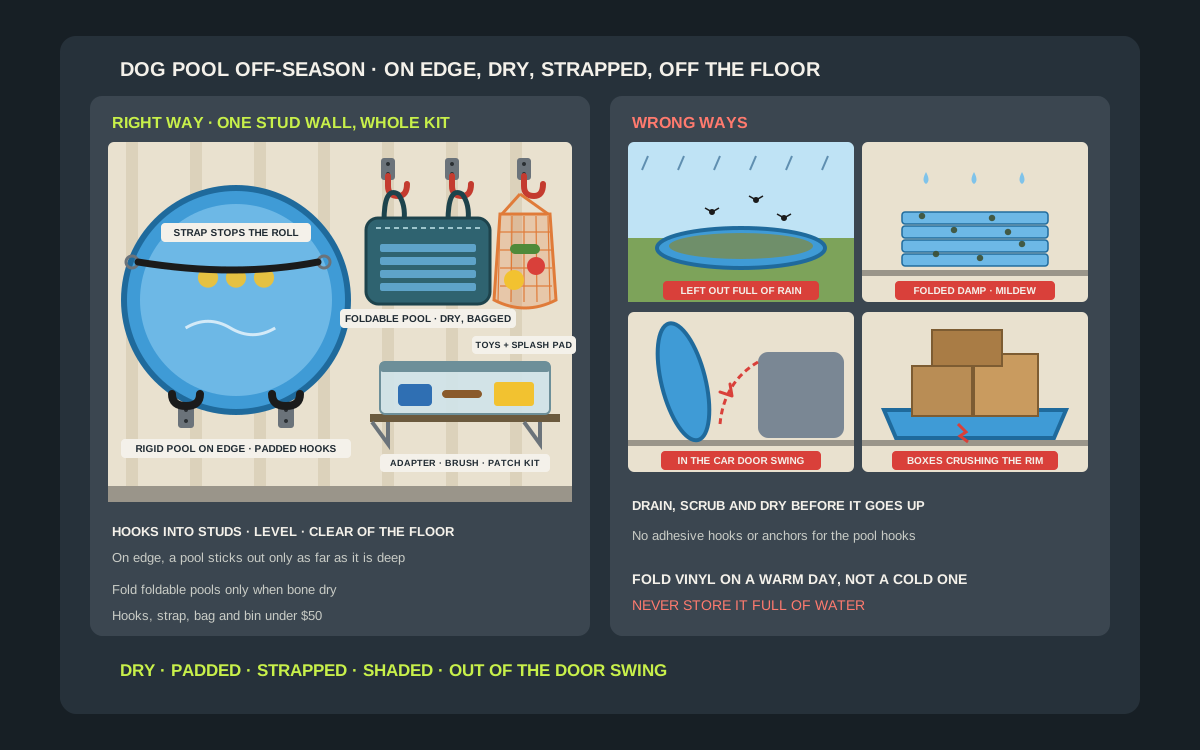
A dog pool earns its place every hot afternoon from June to September, and then it spends the next seven months as the most awkward object in the garage. A one-piece plastic pool is too wide to fit behind anything, a foldable pool flops open the moment you set it down, and an inflatable one ends up in a damp heap in the corner with the hose adapter lost somewhere inside it. Left on the lawn instead, any pool collects rain and turns into a mosquito nursery. The fix is cheap: a dog pool is wide but light and thin, which makes it one of the easiest summer items to put flat against a wall. This guide covers how to hang each type of dog pool on a garage wall for well under $50 in hardware, how to clean and dry it so it comes out in spring without mildew or cracks, and where the toys, brush, hose adapter and patch kit should live. It uses the published specifications for the Jasonwell Foldable Dog Pet Bath Pool as an example of a popular foldable pool, and CDC guidance on standing water as the reason a pool should not winter outside.
Shop padded garage wall hooks for a dog pool on Amazon
Who this is for
- Dog owners with a hard plastic kiddie pool that blocks a whole corner of the garage every winter
- Owners of foldable PVC dog pools who want them flat, dry and out of the way instead of half-open on a shelf
- Families storing a dog pool, a splash pad, floating toys and towels who want the whole summer kit in one place
Quick answer
For a one-piece rigid plastic pool, the best wall hanger is a pair of padded or vinyl-coated utility hooks screwed into studs, with the pool standing on edge and its rim resting in both hooks, plus a strap or bungee across the face so it cannot roll forward. Hung that way, the pool sticks out from the wall only as far as its own depth, usually around a foot. For a foldable pool, dry it completely, fold it the way it came, strap the bundle and hang it in a zippered bag from two coated hooks; the Jasonwell 48-inch model is listed at 10.6 pounds, so any stud-mounted utility hook holds it easily. Inflatables deflate, dry and roll loosely into a lidded bin on a wall shelf. Toys, the splash pad and the hose adapter go in a mesh bag on one more hook. Everything above costs well under $50; check hook ratings and current prices on the listing.
Quick comparison
| Option | Best for | How it holds | Trade-off |
|---|---|---|---|
| Two padded utility or bike hooks | A one-piece rigid plastic pool | Pool stands on edge, rim resting in both hooks | Needs a clear wall area as tall as the pool is wide |
| Strap or bungee across the face | Keeping a rigid pool from rolling or tipping | Strap runs between two screw eyes in front of the pool | One more step each time you take the pool down |
| Two coated hooks plus a zippered bag | A folded foldable PVC pool with fiberboard walls | Bundle is strapped, bagged and hung by the handles | Pool must be bone dry; bag may be sold separately |
| Hanging storage strap | A folded pool without a bag, or a rolled splash pad | Adjustable loop cinches the bundle and hangs from one hook | Leaves the material exposed to dust |
| Wall shelf with a lidded bin | A deflated inflatable pool, pump and patch kit | Loosely rolled pool sits in a bin on stud-mounted brackets | Bin must fit the rolled pool, not just the pump |
| Mesh bag on a single hook | Floating toys, the splash pad, hose adapter and brush | Drawstring bag hangs open to air on one coated hook | Small parts can slip through a coarse mesh |
Padded utility and bike hooksHanging storage strapsMesh drawstring storage bags
What to look for
Padding where the pool touches the hook
Plastic and vinyl scuff, and a thin rim sitting on bare steel all winter can crack or crease. Choose vinyl- or rubber-coated hooks, or bike hooks with a padded cradle, and check that the coating covers the whole area the rim will rest on. For a foldable pool, the zippered bag does the protecting, so ordinary coated utility hooks are fine.
A hook deep enough for the rim
A rigid pool rests on its rim edge, which is usually a rolled or thickened lip. Pick hooks with an opening deep enough to cradle that lip with room to spare, and a raised tip so the pool cannot slide off when you brush past it. Measure the rim thickness before you order; a shallow hook that barely catches the lip is the most common reason a hung pool ends up on the floor.
Fasteners that go into studs
Even a light pool acts like a sail when you lift it on and off, and a bagged foldable pool with its fiberboard panels is denser than it looks. Use wood screws into studs or solid blocking for both hooks. Keep adhesive hooks and plastic drywall anchors for indoor towels, not for anything you lift a pool onto.
A strap to stop the roll
A round pool standing on edge wants to roll or tip forward. A hook-and-loop strap, a bungee cord between two screw eyes or a ratchet-free hanging strap across the face of the pool turns two hooks into a cradle that holds it still. It costs a few dollars and is the difference between a pool that stays put and one that falls on the car.
Wall space that matches the diameter
A pool hung on edge needs a clear stretch of wall a little taller and wider than its diameter. A 48-inch pool needs roughly 4 feet of height above the hooks, and a 60-inch pool needs 5. Measure the pool and the wall before you buy anything, and plan the hook height so the bottom of the pool clears the floor and any bench or bin below it.
Know which kind of pool you are storing
One-piece rigid plastic pools
The classic hard plastic kiddie pool is a single molded shell, often somewhere around 4 to 5 and a half feet across and about a foot deep. It does not fold, which is why it ends up leaning against a wall or lying flat across the floor. The good news is that it is light and thin. Stood on its edge with its bottom against the wall, a rigid pool projects only about as far as it is deep, less than many bikes. It is the type that benefits most from a proper pair of hooks.
Foldable PVC pools with board walls
Foldable dog pools have become the standard choice for many owners because they need no inflating and their makers market them as puncture resistant. Jasonwell, a widely sold example, lists its Foldable Dog Pet Bath Pool in sizes from 32 by 8 inches up to 63 by 12 inches, describes it as extra-tough PVC with a thicker, slip-resistant bottom and a bottom or side drain, and lists the 48-inch model at 10.6 pounds. The walls fold because there are fiberboard panels sandwiched inside the vinyl. Jasonwell itself points out that thin, low-density board or cardboard is easy to get mildewed. That single fact drives everything about how these pools should be stored: completely dry, folded, and in a breathable bag.
Inflatable pools
Inflatable pools pack the smallest but are the least tolerant of being folded tightly while cold or damp. Vinyl stiffens in low temperatures, and a sharp crease made in a cold garage is where a split often starts. Inflatables store best deflated, dried, rolled loosely rather than folded hard, and kept in a bin where nothing sharp can press into them.
Splash pads and sprinkler mats
Splash pads are thin vinyl mats that spray water through small holes when connected to a hose. They hold water in their channels long after use, so they need to be drained, hung to dry and only then rolled. A rolled splash pad fits in a mesh bag with the toys.
The rest of the summer kit
Most dog pool setups come with a supporting cast: floating toys, a long-handled scrub brush, a hose and the pool’s drain adapter, a patch kit, a couple of large towels and sometimes a small ramp or step. Give these a home next to the pool, or the kit will be scattered across three rooms by next June.
Hanging a rigid plastic pool
On edge, not flat
Stand the pool on its rim with the bottom against the wall and the open side facing out. In that position, two hooks at the same height carry the weight on the strongest part of the shell, and the bowl shape faces you, which makes it easy to lift off. Hanging a pool flat, with the opening against the wall, makes it stick out further and puts the weight on a thin bottom edge.
Two hooks, spaced for balance
Set the two hooks so that they cradle the lower part of the rim, roughly a third of the diameter apart and on studs at the same height. For a 48-inch pool on a wall with studs 16 inches apart, hooks on neighboring studs work. For a 60-inch pool, skip one stud. Level the hooks; if one is lower, the pool slowly rotates and slides toward it.
Strap it so it cannot roll
Put a screw eye or a small hook into a stud on each side of the pool, near the top of the bowl, and run a hook-and-loop strap or a bungee across the face. The strap does not carry weight; it keeps the pool from tipping forward if someone bumps it or the garage door slams. Check that the bungee hooks face the wall so they cannot catch a sleeve.
Nesting two pools
Rigid pools of the same model nest, so two can share one pair of hooks if the hooks are deep enough to cradle both rims. Do not nest a smaller pool of a different shape inside a larger one on the wall; it rocks and wears through the coating. Nest only matching pools, and only when both are dry.
When the wall is too short
A 60-inch pool needs a wall at least 5 feet clear above the hooks, and some garage walls are full of shelving, windows or a garage door opener rail. If you cannot find that space, hang the pool above the hood of a parked car on the end wall, or stand it on edge on the floor against the wall between two vertical bungees. The floor option uses a slice of floor only as wide as the pool is deep.
Storing a foldable pool
Drain, scrub and dry it open
Drain the pool through its drain or with a hose connected to the drain adapter, scrub the floor and walls with mild soap and a soft brush, and rinse. Then leave it open in the sun or in a dry, airy spot until the vinyl and the seams around the board panels are bone dry inside and out. Water trapped in the folds is what turns the board inside a foldable pool into a mildew problem.
Fold it the way it came
Fold the walls along the existing creases, the way the maker’s instructions describe, rather than guessing at a new fold. The board panels are designed to stack along those lines. Wrap two straps around the folded bundle so it cannot spring open when you lift it.
Bag it and hang it by the handles
A zippered storage bag or a large canvas duffel keeps dust and garage grime off the vinyl. Hang the bag by its handles from two coated utility hooks on neighboring studs, so the bundle hangs flat and level rather than sagging from one point. Pick a breathable bag if you can; plastic bins and sealed bags trap any moisture you missed.
Lay it flat if you have a high shelf
A folded foldable pool also stores well lying flat on a wall shelf, as long as nothing heavy is stacked on top of it. Weight on top presses the folds into the board panels. If the shelf is shared, keep the pool on top of the pile.
Inflatables, splash pads and the small parts
Inflatable pools: rolled, not crushed
Deflate the pool fully, wipe it dry, and let it air out for a day. Roll it loosely from one side, with the valves on the outside of the roll, and put it in a lidded bin on a wall shelf with the pump and patch kit. Fold it on a warm day if you can; vinyl is far more flexible at room temperature than in a cold garage.
Splash pads: dry the channels first
Hang a splash pad over a railing or a line until the water has run out of its channels and the surface is dry. Roll it loosely around a pool noodle or a towel to avoid sharp creases, then slide it into a mesh bag.
Toys, brush and hose adapter: one mesh bag
Rinse floating toys and let them dry, then put them in a large drawstring mesh bag with the scrub brush and the drain adapter. A mesh bag lets any remaining moisture escape, and hanging it on one coated hook beside the pool keeps the whole kit together. Put tiny parts like the drain cap or valve plugs in a small zip bag inside the mesh bag so they do not slip through.
Towels go back in the house
Pool towels pick up a smell in a garage over winter. Wash them and store them indoors, or on the dog towel hooks by the door if your dog swims year-round. Our dog boot and towel station guide covers that wall.
Where the pool should hang
A shaded, dry wall
Sunlight through a garage window fades vinyl and makes plastic brittle over time. Pick a wall without direct sun, away from the water heater, the furnace, a dryer vent or a leaky door seal. Damp and heat are both hard on vinyl and board panels.
Out of the car door swing
A rigid pool hangs flat, but it is still wide. Keep it out of the arc of a car door and away from the walkway, so nobody clips the rim with a mirror or a shoulder. The end wall above the hood of a parked car is often the best spot in a two-car garage.
Near the door to the yard
The pool comes out in late spring and goes away in early fall, but the toys and brush may come and go all summer. Store the kit on the wall closest to the door you actually use, so carrying a five-foot pool out does not mean squeezing it past the car.
Not overhead
A ceiling rack seems like a natural home for a wide, flat pool, but lifting a 5-foot disc overhead is awkward and a pool that slips off a ceiling rack falls a long way. For most garages, wall hooks at a height you can reach from the floor are safer and quicker.
Setups for different garages
One-car garage with a small foldable pool
On the back wall of a single garage, two coated hooks on neighboring studs hold the bagged pool at about chest height, a third hook beside them takes the mesh toy bag, and a short shelf below holds the bin with the drain adapter and patch kit. The whole kit fits in a stretch of wall about 3 feet wide and leaves the floor clear for the car.
Two-car garage with a big rigid pool
A 5-foot rigid pool fits best on the end wall above the hood of a parked car, or on a side wall beyond the front bumper. Put the padded hooks low enough that you can lift the pool off without a step stool, the strap points on the studs either side, and the toy bag and bin on the same wall so everything comes down together in May.
A household with a pool for the kids and one for the dog
Two pools of the same model can nest on one pair of deep hooks. Two different pools are better on separate pairs side by side, each with its own strap. Label each one with a tag on the rim so the dog pool, with its claw scratches and fur, stays the dog pool.
Rented garage or shed
If drilling is off the table, stand a rigid pool on edge on the floor against the wall and hold it with a strap around a freestanding shelving unit, and keep a folded pool flat on the top shelf of that unit. If you can drill, a few screw holes in studs are easy to fill and paint when you move out.
A realistic under-$50 shopping list
For a rigid pool
Two padded bike hooks or deep vinyl-coated utility hooks, two screw eyes and one hook-and-loop strap or bungee. That is usually the cheapest setup in this guide, and it holds the largest pool.
For a foldable pool
Two coated utility hooks and a zippered storage bag or large canvas duffel, plus two straps for the folded bundle if the pool did not come with any. Check the bag dimensions against the folded size of your pool before ordering.
For the small parts
One large drawstring mesh bag and one hook for the toys and splash pad, and a small lidded bin on a pair of stud-mounted shelf brackets for the drain adapter, brush and patch kit. If a single hook and bag already hold everything you own, skip the shelf.
What not to buy
A ceiling storage rack, a large wall-mounted cabinet or a full slatwall system are all more than a dog pool needs. Spend the money on hooks that fit the rim and a bag that fits the folded pool, then check ratings and current prices on the listing.
Installing the hooks
Find the studs and mark the circle
Use a stud finder and confirm each stud with a small finish nail. Hold the pool up against the wall, or trace its diameter on a sheet of cardboard and tape it up, so you can see exactly how much wall it covers and where the hooks and strap points should go.
Pilot holes and full-depth screws
Drill pilot holes sized to the screws supplied with the hooks and drive them until each hook sits flat and tight. A hook that rocks on its base loosens over time. Use a level between the two hooks before you drive the second set of screws.
Height you can reach
Set the hooks low enough that you can lift the pool on and off with your arms bent, usually between waist and chest height for the hooks, with the bowl above them. The bottom of the pool should clear the floor by a few inches so it does not sit in puddles from melting snow.
Test before you walk away
Hang the pool, fasten the strap, then push gently on the rim from both sides and pull down on each hook. If anything shifts, fix it now, not after the first time the garage door slams.
End-of-season routine
Empty it before it becomes a breeding pool
Do not leave a pool out on the lawn once the season ends. The CDC advises that once a week you empty and scrub, turn over, cover or throw out items that hold water, and it lists pools among them, because mosquitoes lay eggs near water. A pool that is drained, scrubbed and put away cannot become a breeding site.
Inspect for punctures and worn spots
Before storing, look for claw tears, worn spots on the floor where it sat on rough ground, cracked rims on rigid pools and lifted seams on foldable pools. Patch small holes with the maker’s patch kit once the vinyl is clean and dry, so the pool is ready to fill in spring. Mark anything that needs replacing.
Dry means dry
The single best habit for any pool is to put it away completely dry. Leave it open in a sunny spot for an afternoon, flip it, and check folds and seams by hand. If the weather turns before it dries, hang it open in the garage overnight before folding.
Keep mice out
A pool hanging on the wall is far less attractive to mice than one lying on the floor. Check the bag and bin once or twice over winter, and do not store dog treats or food in the same bin.
Mistakes to avoid
- Leaving the pool on the lawn all fall, where rain fills it and mosquitoes breed.
- Folding a foldable pool while the seams and board panels are still damp.
- Hanging a rigid pool on bare steel hooks that scuff and crease the rim.
- Skipping the strap, so a pool on edge rolls forward when someone bumps it.
- Leaning a five-foot pool in the swing of a car door.
- Stacking boxes inside or on top of a plastic or folded pool.
- Folding vinyl hard in a cold garage instead of on a warm day.
- Using adhesive hooks or plastic drywall anchors for the pool hooks.
Related guides
Browse the hub: Pet gear wall mounts under $50 - all guides
- Best Dog Life Jacket Wall Hooks Under $50
- Best Dog Cooling Mat Wall Hooks Under $50
- Best Dog Boot & Towel Wall Stations Under $50
- Best Dog Ramp Wall Hooks Under $50 for Garage Storage
- Best Dog Agility Equipment Wall Storage Under $50 for Garage
- Best Garden Hose Reel Wall Mounts Under $50 for Garages
- Best Cooler & Camping Gear Wall Hooks Under $50 for Summer
FAQ
How do you store a hard plastic dog pool in the garage?
Stand it on edge with the bottom against a wall, rest the rim in two padded hooks screwed into studs at the same height, and run a strap or bungee across the face so it cannot roll forward. Hung that way it projects only about as far as the pool is deep.
Can you hang a kiddie pool on the wall?
Yes. A one-piece kiddie pool is light and thin, so two stud-mounted padded hooks hold it on edge. Make sure the hooks are deep enough to cradle the rim and leave a clear wall area a little larger than the pool’s diameter.
How do you store a foldable dog pool?
Drain, scrub and dry it open until the vinyl and seams are completely dry, fold it along its original creases, strap the bundle and hang it in a breathable bag from two coated hooks, or lay it flat on a shelf with nothing on top.
Why does my foldable dog pool get moldy?
Foldable pools have board panels inside the vinyl walls. If the pool is folded damp, moisture is trapped against the board. Jasonwell notes that thin, low-density board or cardboard is easy to get mildewed, which is why drying the pool fully before folding matters so much.
Is it OK to leave a dog pool outside in winter?
It is better not to. A pool left out collects rain and snowmelt, and the CDC recommends emptying, scrubbing, turning over or covering items that hold water, including pools, once a week to stop mosquitoes laying eggs. Cold also stiffens vinyl and plastic, so storing the pool dry in a garage protects it.
What is the cheapest way to store a dog pool?
Two coated utility hooks screwed into studs and a strap usually cost a fraction of $50. A mesh bag for the toys and a lidded bin for the hose adapter and patch kit complete the setup.
Bottom line
The best dog pool wall hanger is two padded hooks, one strap and a dry pool. Stand a rigid plastic pool on edge with its rim in two stud-mounted padded hooks and a strap across the face, fold a foldable pool only when it is completely dry and hang it bagged from two coated hooks, and roll inflatables loosely into a bin. Keep the toys, brush and hose adapter in a mesh bag next to the pool, choose a shaded, dry wall out of the car door swing, and never let the pool sit outside full of rainwater. The whole setup costs well under $50, and the pool comes out in spring clean, flat and ready to fill. Check hook ratings, what is included and current prices on the listing before you buy.