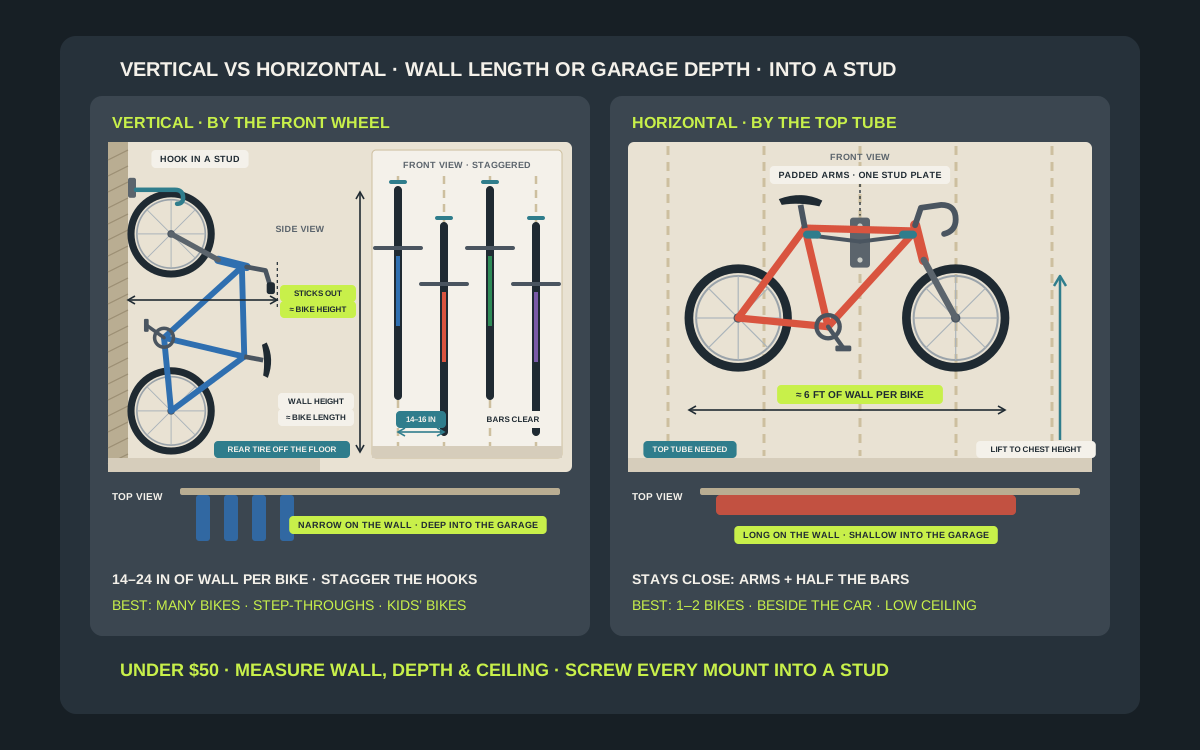
Every bike wall mount solves the same problem in one of two ways. A vertical mount hangs the bike by its front wheel, so it stands on end with its wheels against the wall. A horizontal mount holds the bike level by its top tube, so it hangs flat along the wall like a picture. Both get the bike off the floor, and both can be had for well under $50. What they do with your garage is completely different. A vertical bike barely uses any wall, but it sticks out into the garage about as far as the bike is tall. A horizontal bike stays close to the wall, but it takes about six feet of it. Pick the wrong one and you end up with a bike that blocks the car door, a wall that holds one bike where it could have held four, or a rack your step-through frame cannot sit on. This guide compares the two the way a garage forces you to: by wall length, depth, ceiling height, frame shape and how high you can lift. It uses the spacing figures the rack makers publish and the numbers on real under-$50 mounts, so you can measure once and buy the right kind.
Shop bike wall mounts on Amazon
Who this is for
- Garage owners who have a few feet of open wall and one to four regular bikes, and cannot decide whether to hang them up and down or side to side
- Households with a mix of road, mountain, hybrid, step-through and kids’ bikes who want one wall plan that works for all of them
- Anyone who parks a car next to the bike wall and needs to know how far each kind of mount will push the bikes into the parking lane
Quick answer
Go vertical if you have more bikes than wall: a vertical hook needs only about 24 inches of wall per bike at the same height, or 14 to 16 inches if you stagger the hooks up and down, according to Steadyrack’s spacing guide. The catch is depth, because a vertical bike sticks out from the wall about as far as the bike is tall, and it needs roughly its own length in wall height. Go horizontal if you have more wall than depth, or only one or two bikes: a horizontal rack such as Delta’s RS4000 holds the bike by its top tube with arms that end about 15 inches from the wall, but each bike takes about six feet of wall. Step-through frames and kids’ bikes usually suit vertical hooks better, because they have no straight top tube to rest on. A pivoting vertical mount such as Feedback Sports’ Velo Hinge 2.0, listed just under $50 on Feedback’s own store when we checked in October 2026, splits the difference by swinging the bike toward the wall. Whichever you choose, screw it into a stud and check the weight rating, tire fit and current price on the listing.
Quick comparison
| Setup | Wall length per bike | How far it sticks out | Best for |
|---|---|---|---|
| Vertical hooks at one height | About 24 in | About as far as the bike is tall | Several bikes on a short wall, simple install |
| Vertical hooks, staggered heights | 14 to 16 in | About as far as the bike is tall | The most bikes per foot of wall |
| Pivoting vertical hinge | 16 to 24 in | Swings in until the bars touch the wall | Narrow garages where depth matters |
| Horizontal two-arm rack | About 6 ft | Arm length plus about half the bar width | One or two bikes, easy reach, display |
| Adjustable horizontal hanger | About 6 ft | Set by an extendable beam | Sloping top tubes, bars up to 750 mm |
| Mixed wall: vertical row plus one horizontal | Varies | Deep at one end, shallow at the other | Families with step-throughs and a good bike |
Vertical bike hooksPivoting bike wall mountsHorizontal bike wall racks
What to look for
Wall length versus garage depth
This is the whole decision in one line. The Association of Pedestrian and Bicycle Professionals, which writes the bike parking guidelines that many cities use, gives a standard adult bike a parking footprint of at least 72 by 24 inches. Hang that bike horizontally and the 72 inches run along your wall. Hang it vertically and the 72 inches run up the wall, while the bike’s height, from the floor to the top of the saddle or bars, points out into the garage. So the question is not which mount is better, it is which dimension your garage has to spare: wall length, or depth.
The shape of the frame
A horizontal rack holds the bike by its top tube, so it needs a top tube that is reasonably straight and long enough to reach both arms. Ibera, which sells an adjustable horizontal hanger, lists its IB-ST4 for bikes with a conventional frame shape, and Delta says its RS4000 arms open to about 13 inches, are not adjustable, and are probably not ideal for a step-through frame. A vertical hook does not care about the frame at all, because it holds the wheel. If any bike in the family is a step-through, a kids’ bike or a frame with a steeply sloping top tube, that bike is a vertical bike.
Handlebar width
Handlebars decide how close bikes can sit to each other and how far a horizontal bike sticks out. Stock road bars sit in the region of 40 to 44 cm, according to BikeRadar, while bike-components puts typical mountain bike bars at 680 to 740 mm for cross-country, 740 to 780 mm for trail and enduro, and up to 820 mm for downhill. That is roughly 16 to 17 inches against 27 to 32 inches. Horizontal racks list a limit: Ibera’s IB-ST4 takes bars up to 750 mm, and Feedback Sports says its Velo Wall Rack 2D may not suit bars of 780 mm or wider. Wide bars also push vertical hooks further apart unless you stagger them.
How high you have to lift
A vertical bike is lifted by the front wheel only, and if the hook is set so the rear tire is just off the floor, Steadyrack says that gives the least amount of rise to load the bike. A horizontal bike is lifted whole, to wherever the arms are, usually around chest height so the wheels clear the floor. For a light road bike neither is hard. For a heavier hybrid or a bike with racks and fenders, rolling the front wheel up the wall is usually easier than lifting the whole bike to chest height.
Tire fit and weight rating
Vertical hooks list a tire range and horizontal racks list a weight. Park Tool’s 471 hook has a 3.15-inch opening for large mountain bike tires and tall aero rims, and its 471XX is wider still for fat bikes. Feedback Sports’ Velo Hinge 2.0 fits 700c x 23 mm road tires up to 29 x 3.0-inch mountain tires, while Gladiator rates its vertical bike hook for tires up to 1.7 inches. On the horizontal side, Delta rates its RS4000 at 40 lb, Rubbermaid rates its FastTrack horizontal hook at 50 lb and Ibera rates the IB-ST4 at 18 kg, about 39.5 lb. Lectric eBikes puts a regular bike at 10 to 30 lb, so those ratings cover most of them, but they are why e-bikes need a different plan.
Measure the garage and the bikes first
Three garage measurements
Take three numbers before you buy anything. First, the length of clear wall you can give to bikes, from a corner or a door frame to the next obstacle, such as a shelf, a water heater or the panel. Second, the depth you can give up, measured from the wall to the edge of the car with its doors open, or to the walkway you need to keep clear. Third, the height from the floor to the ceiling, or to the garage door track if it runs along that wall. Steadyrack’s spacing guide asks for at least 150 mm, about 6 inches, between the top mounting hole of a vertical rack and the underside of the ceiling, so a low ceiling can rule vertical out on its own.
Three bike measurements
Then measure each bike. Its length from the front of the front tire to the back of the rear tire tells you how much wall a horizontal bike takes and how much wall height a vertical bike needs. Its height, from the floor to the highest point of the saddle or handlebars, tells you roughly how far a vertical bike will stick out. Its handlebar width tells you how close bikes can hang side by side. Write the numbers on painter’s tape and stick them to the bike; you will use them again when you mark the wall.
Mock it up on the floor
Feedback Sports suggests a neat trick for planning a row of vertical hooks: lay the bikes on top of each other on the floor and see where the handlebars of one fit inside the main triangle of the next. The difference in tire heights is the stagger you need on the wall. For a horizontal plan, lay painter’s tape on the wall at the bike’s length and at the arm height and stand back. If the tape crosses a window, a light switch or the place your shoulder goes when you get out of the car, you have your answer before you drill.
When vertical is the better choice
You have more bikes than wall
This is where vertical hooks win outright. Steadyrack, whose racks hold bikes vertically, recommends about 24 inches between bikes when the racks are all at the same height, based on 600 mm handlebars. Staggering the heights lets the handlebars overlap, and Steadyrack’s figures drop to 14 inches for road bikes and 16 inches for mountain bikes. Feedback Sports gives a similar range for its Velo Hinge, around 16 to 24 inches depending on stud spacing and stagger. Steadyrack’s own racks list above $50, but its spacing figures work for any vertical hook. Compare them with about six feet per bike for horizontal storage, and roughly four staggered vertical bikes fit in about the wall one horizontal bike takes.
The bikes have no straight top tube
Step-through frames, most kids’ bikes, many cruisers and small frames with steeply sloping top tubes are awkward or impossible on a horizontal rack. A vertical hook holds the front wheel instead, so frame shape does not matter. The Association of Pedestrian and Bicycle Professionals also notes that vertical racks are not compatible with recumbents, tandems, cargo bikes and other long bike types, so those belong on the floor.
There is depth to spare at the front of the garage
The wall in front of the car’s bumper is often the best vertical wall in a garage. Bikes there stick out toward the car’s nose rather than into the door swing, and most garages have more spare depth in front of the bumper than beside the doors. Measure from the wall to where the bumper stops, subtract the bike’s height and a hand’s width of margin, and if that number is positive, a row of vertical hooks will work.
You want to roll the bike up, not lift it
With a vertical hook, you lift only the front of the bike. Steadyrack’s spacing guide says the perfect mounting height is reached when the bike hangs with its rear wheel close to the floor but not touching, because that leaves the least rise to load it, and that road bikes and smaller hybrids and mountain bikes can be mounted about 100 mm lower than its standard heights. Feedback Sports suggests centering the Velo Hinge about 6 feet off the ground and adjusting for the bike. In practice you tip the bike up on its rear wheel and guide the front wheel onto the hook.
When horizontal is the better choice
You have more wall than depth
If the only free wall runs along the side of the car, a vertical bike sticking out three feet or more may simply not fit between the wall and the driver’s door. A horizontal bike lies along the wall instead. Delta says the arms of its RS4000 horizontal rack end about 15 inches from the wall, and Feedback Sports’ Velo Wall Rack 2D cradles adjust from 8 to 12 inches out. The handlebars add to that, because half the bar sticks out past the frame, but the bike still stays far closer to the wall than it would hanging vertically.
You only have one or two bikes
With one bike, the main advantage of vertical storage, packing bikes close together, does not matter much. A horizontal rack is often the cleaner choice: the bike hangs at chest height where it is easy to reach, nothing on the floor gets in the way, and the space under the bike stays usable for a low shelf or a bin. Delta’s RS4000 has molded rubber arms, installs into a wood stud with the hardware included, and listed well under $50 on Delta’s own store when we checked.
The ceiling is low or the door track is in the way
A vertical bike needs about its own length in wall height, plus a little for the hook. That is roughly six feet for a standard adult bike. If a garage door track, a beam or a low ceiling cuts into that, horizontal storage at chest height is the practical answer. Mount the arms so the wheels clear the floor and anything stored beneath, and keep the bike below the track rather than squeezing it in under it.
You would rather not hang the bike by a wheel
Some riders simply prefer the bike resting on its frame. The Association of Pedestrian and Bicycle Professionals recommends rubberized treatments where a vertical rack touches the wheel, to prevent damage to rims, which is why good hooks are vinyl coated. A horizontal rack takes the wheels out of the equation, though it moves the contact to the top tube, so padded arms matter just as much. Feedback Sports uses soft rubber cradles on its Velo Wall Rack 2D, which lists above $50, for exactly that reason; on a budget rack, check that the arms are rubber covered.
Pivoting mounts: vertical storage with less depth
How a hinge changes the math
A pivoting vertical mount holds the bike by the front wheel like a hook, then lets it swing sideways toward the wall. Steadyrack says its racks fold until the handlebars touch the wall, not quite flat, and suggests allowing about 16 inches from the wall for a normal road bike and about 39 inches for a mountain bike with wider bars. That turns the biggest weakness of vertical storage, depth, into something you can adjust each day.
Two under-$50 hinges worth knowing
Feedback Sports’ Velo Hinge 2.0 has a secure load capacity of 50 lb when properly stud mounted, fits tires from 700c x 23 mm to 29 x 3.0 inches, has a 4-inch hook opening, comes with a rear wheel bumper that keeps the back tire from sliding along the wall, and can be set to swing left or right before you mount it. Delta’s Single Bike Hinge Wall Mount Rack, the RS4100, is rated at 40 lb, holds tires up to 2.5 inches, measures 10 by 3.75 by 4.25 inches and swings until the handlebars meet the wall; it listed under $50 on Delta’s own store when we checked.
The trade-off
Folded bikes overlap the wall space beside them. Steadyrack’s guide shows that if you want bikes to pivot fully without overlapping, the racks need about 47 inches between them, roughly four feet, which is close to horizontal territory. The usual compromise is a row of hinges at normal spacing, with only the bike nearest the car folded flat, or bikes folded alternately left and right. Pick the swing direction for each hinge before you mount it.
Planning a wall for several bikes
Stagger vertical hooks up and down
The Association of Pedestrian and Bicycle Professionals says vertical racks can be installed in a staggered pattern to avoid handlebar conflicts and increase capacity, and it is the single best trick for a crowded garage. Set alternate hooks higher and lower by enough that one bike’s handlebars clear the next bike’s bars and saddle. Steadyrack’s figures for staggered spacing are 14 inches for road bikes and 16 inches for mountain bikes, based on 600 mm bars, so wider bars need a little more.
Put the bike you ride most at the end
The bike that leaves every day should come off the wall without moving any other bike. Put it at the end of the row nearest the garage door, and put the bikes that only come out on weekends, or only in summer, deeper in the row. If you mix types, the shortest bikes can go on the highest hooks, because their wheels will still clear the floor.
Mix vertical and horizontal on one wall
Nothing says a wall has to use one kind. A common layout is a short row of staggered vertical hooks for the adults’ road and mountain bikes, plus one horizontal rack at the shallow end for a step-through or a bike you like to keep close to the wall. Kids’ bikes and balance bikes, which are short and light, often fit on low vertical hooks the kids can reach themselves.
Keep a floor spot for bikes that do not hang
The Association of Pedestrian and Bicycle Professionals says on-ground parking should always supplement vertical racks, for heavier bikes, long bikes and people who cannot lift. At home that means leaving one spot for a floor stand. Heavy e-bikes are the main case; our e-bike wall mount guide covers 100-lb hooks, rolling a heavy bike up a wall and safe battery charging.
Frame, wheel and brake details
Sloping top tubes and the horizontal angle
Many modern frames have a top tube that slopes down toward the seat. On a fixed two-arm rack that tips the bike nose up. Ibera says the frame holders on its IB-ST4 adjust so the wheels hang level, and its beam extends to fit narrow or wide handlebars, and Feedback Sports’ Velo Wall Rack 2D adjusts its arms 7 inches vertically to level bikes with sloping top tubes. A fixed rack like the RS4000 is simpler and cheaper, but check that your top tube sits on both arms before you commit.
Fenders, racks and deep rims on hooks
On a vertical hook, the hook has to fit around the rim and tire without pressing on the fender. Park Tool’s 471 hook has an inside width of 80 mm, about 3.15 inches, and a J-bend 150 mm tall, which is sized for large mountain bike tires and tall aero road rims, and its 471XX opens to 125 mm, almost 5 inches, for fat bike tires. Hang the bike so the hook seats on the rim, not across a spoke, and check that a front fender clears the hook.
Hydraulic disc brakes
Bikes with hydraulic disc brakes can be stored vertically, but give the levers a few squeezes before you ride. Shimano’s brake manuals warn that turning a bike with hydraulic discs upside down or on its side can let air bubbles in the reservoir move toward the calipers, and tell riders to operate each lever a few times to check the brakes work normally. It takes five seconds and is worth making a habit for vertically stored bikes.
Carbon frames and finishes
Whichever orientation you choose, only soft, coated surfaces should touch the bike. Vertical hooks should be vinyl or rubber coated where the rim sits. Horizontal arms should be padded where the top tube rests, and the bike should sit on the frame tube, not on cables or a frame bag. If your frame is carbon or has a delicate finish, a vertical hook that touches only the tire and rim avoids frame contact entirely.
Mounting either kind safely
Studs first, product second
Every mount in this guide goes into wood framing or solid masonry. Feedback Sports says the Velo Hinge must be mounted to a wall stud, Delta installs its racks into wood studs with the hardware included, and Park Tool rates its 471 hook at 125 lb only provided it is securely screwed into solid material. Rubbermaid sells its FastTrack horizontal hook without wall hardware, so you supply screws that suit your wall. Our stud-safe bike hanging guide walks through finding and confirming a stud, pilot holes and the first test lift.
Pilot holes matter
Drill the pilot hole the maker specifies, no bigger and no smaller. Feedback Sports calls the 1/8-inch pilot holes for the Velo Hinge important in capital letters, and retailers that carry Park Tool’s 471 hook say to pilot its 15/32-inch wood thread with at least an 11/32-inch bit. A pilot that is too small can split the stud; one that is too big leaves the threads nothing to bite.
When the stud is in the wrong place
Studs rarely sit exactly where the stagger or the horizontal arm needs to go. Screw a length of 2x4 or a strip of plywood across two or three studs at the height you need, then mount the hooks or arms on that. One Velo Hinge owner on Feedback’s site did exactly that in an apartment with limited stud access. On a concrete or block wall, use masonry anchors rated for the load; our concrete pegboard guide covers choosing them.
Protect the wall under the rear wheel
A vertical bike rests its rear tire against the wall, and tires leave marks. Feedback Sports says the rear tire may leave a small mark and includes a wheel bumper with the Velo Hinge that keeps the tire from sliding along the wall when the hinge is pivoted. A strip of plywood, a rubber mat or a tire guard behind the rear wheel does the same job for a plain hook.
Mistakes to avoid
- Choosing vertical hooks for a wall beside the car without measuring how far the bikes will stick into the door swing.
- Choosing a horizontal rack for a step-through, kids’ bike or steeply sloping top tube that will not sit on both arms.
- Spacing vertical hooks 12 inches apart at the same height, so every handlebar tangles with the next one.
- Mounting a vertical hook so high that the rear wheel hangs well off the floor and every ride starts with a full lift.
- Ignoring the garage door track or a low beam, which can leave a vertical bike with nowhere for its front wheel to go.
- Buying a horizontal rack without checking its handlebar limit when the bike has 780 mm mountain bike bars.
- Screwing either kind of mount into drywall alone, or into the edge of a stud instead of its center.
- Hanging a heavy e-bike on a 40- or 50-lb rack because it fits, instead of using a mount rated for its real weight.
Related guides
Browse the hub: Garage wall storage under $50 - all guides
- How to Hang a Bike on a Garage Wall Under $50 (Stud-Safe Hooks)
- Best E-Bike Wall Mounts Under $50 for Garage (No-Lift Hooks for Heavy Bikes)
- Best Bike Hooks for Garage Ceilings Under $50
- Wall-Mount Rack vs Freestanding Stand for Bikes Under $50
- Wall Mount Bike Hooks vs Freestanding Bike Stand: Which Under $50 Wins for Garages?
- How to Mount Pegboard on a Concrete Garage Wall Under $50
- Best Dog Bike Trailer Wall Hooks Under $50 for Garage
- Bike Ceiling Hoist vs Wall Hook: Which Under-$50 Option Saves More Garage Space?
FAQ
Is it better to hang a bike vertically or horizontally in a garage?
It depends on which your garage has more of. Vertical hooks need only about 14 to 24 inches of wall per bike, according to Steadyrack’s spacing guide, but the bike sticks out about as far as it is tall. Horizontal racks keep the bike close to the wall, with arms ending about 15 inches out on Delta’s RS4000, but each bike takes about six feet of wall.
How far apart should vertical bike hooks be?
Steadyrack recommends about 24 inches between bikes when the hooks are all at the same height, and 14 inches for road bikes or 16 inches for mountain bikes when the heights are staggered, based on 600 mm handlebars. Feedback Sports suggests around 16 to 24 inches for its Velo Hinge. Wider handlebars need more space.
Can a step-through bike hang on a horizontal wall rack?
Usually not well, because horizontal racks hold the bike by its top tube. Delta says its RS4000 arms open to about 13 inches and are probably not ideal for a step-through frame. Hang a step-through vertically by the front wheel instead.
How high should a vertical bike hook be?
Set it so the bike hangs with its rear wheel close to the floor but not touching, which Steadyrack says gives the least rise when loading the bike. Feedback Sports suggests centering its Velo Hinge about 6 feet off the ground and adjusting for the size of the bike.
Does hanging a bike vertically damage the wheel or brakes?
Not when the hook is coated and seated on the rim. The Association of Pedestrian and Bicycle Professionals recommends rubberized contact points to prevent rim damage. If the bike has hydraulic disc brakes, Shimano advises squeezing each lever a few times before you ride to make sure they work normally.
Are vertical or horizontal bike mounts better for e-bikes?
Neither common under-$50 rack is a good fit for most e-bikes, because many horizontal racks and hooks are rated at 40 to 50 lb. Use a hook rated around 100 lb with the rear tire on the floor, or a floor stand, as covered in our e-bike wall mount guide.
Bottom line
Vertical bike wall mounts win when you have more bikes than wall: staggered hooks fit a bike every 14 to 16 inches, as long as the garage has the depth for bikes that stick out about as far as they are tall. Horizontal racks win when you have more wall than depth, only one or two bikes, a low ceiling, or a bike you would rather hold by the frame. Step-throughs and kids’ bikes go vertical, pivoting hinges split the difference, and every mount goes into a stud. Measure the wall, the depth and the bikes, then check the rating, tire fit and current price on the listing before you buy.