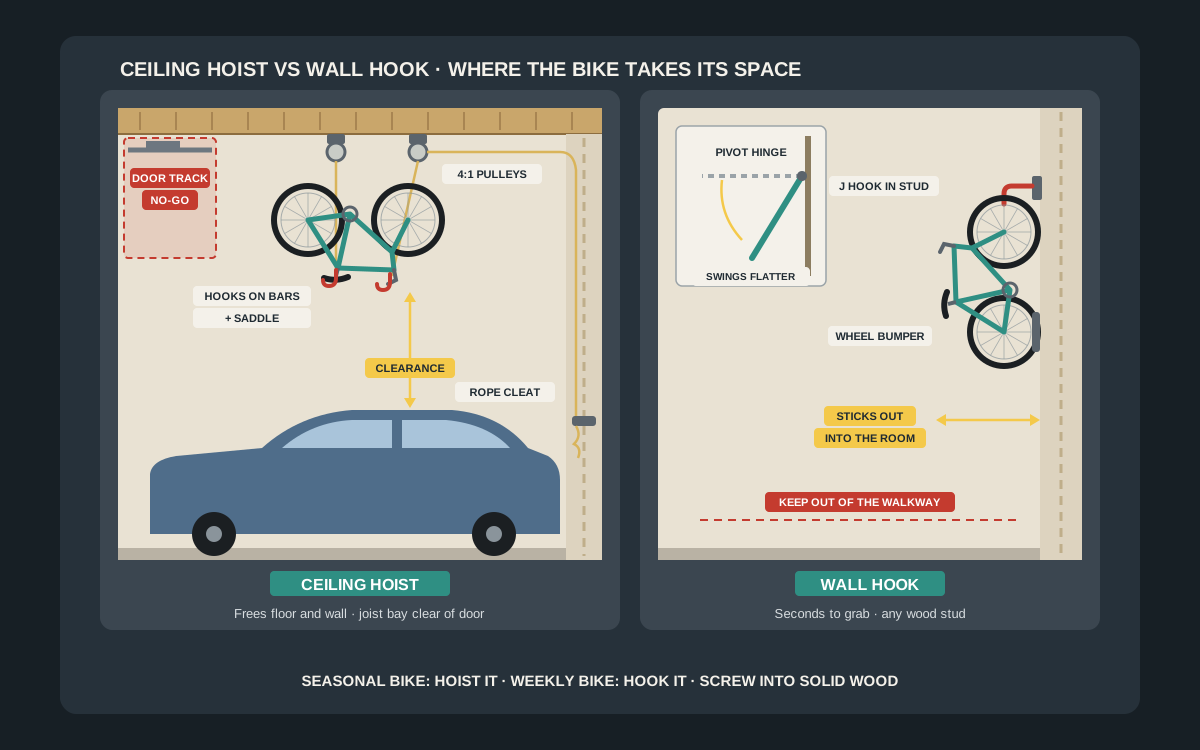
Every garage bike eventually ends up in the same argument: does it go up to the ceiling on a pulley hoist, or onto the wall on a hook? Both cost well under $50 for a single bike, both get the bike off the floor, and both are sold as space savers. They save different kinds of space, though, and they ask very different things of your garage and of you. A ceiling hoist uses air you were not using anyway, above the hood of the car or over a storage bay, but it needs a solid ceiling joist, a clear path past the door track and opener, and a minute of rope work every time you ride. A wall hook takes a few seconds to use and goes into any wood stud, but the bike sticks out into the room and claims a slice of wall that shelves, tools and bins also want. This guide puts the two side by side using what the makers actually say in their instructions: Racor and RAD Cycle for pulley hoists, Delta Cycle for rail hoists and wall racks, Park Tool for the plain J hook and Feedback Sports for the pivoting hinge. By the end you will know which one fits your ceiling, your bike, your riding habit and your car, and why the most practical garages usually end up with one of each.
Shop bike ceiling hoists on Amazon
Who this is for
- Owners of one-car and tight two-car garages where the floor belongs to the car and the long walls are already taken by shelves and tools
- Riders weighing a pulley hoist against a stud-mounted hook for a road, gravel, mountain or kids’ bike and wanting a straight answer on space
- Households with a mix of everyday bikes and seasonal or spare bikes who want each one stored where it makes the most sense
Quick answer
If you ride the bike every week, put it on a wall hook: a coated J hook or a pivoting hinge screwed into a wood stud gets it off the floor and back on the road in seconds. If the bike is seasonal, a spare or a guest bike, your walls are full and you have a clear joist bay that the garage door, the opener rail and the lights do not cross, a ceiling hoist saves more total space because it takes nothing from the floor or the walls except a small rope cleat. Hoists are built for ceilings up to about 12 feet, use 4:1 pulleys so you are not lifting the full weight, and carry ratings from 50 lb (Racor) to 100 lb (RAD Cycle and Delta), but they hang the bike upside down and need joists, not drywall alone. Heavy e-bikes are a poor fit for both and usually belong on a floor-level or no-lift mount. Check the load rating, the ceiling height the hoist supports and the current price on the listing before you buy.
Quick comparison
| Factor | Ceiling hoist | Wall hook | Edge |
|---|---|---|---|
| Floor space | Clears the floor | Clears the floor | Tie |
| Wall space | Only a rope cleat on a wall stud | A stud bay per bike, and the bike projects into the room | Hoist |
| Ceiling needed | A clear joist bay; hoists are sized for ceilings up to about 12 ft | None | Wall hook |
| Getting the bike out | Untie, lower, lift bars and saddle off two hooks | Lift the front wheel off the hook | Wall hook |
| Lifting effort | 4:1 pulleys carry most of the weight | Lift the front wheel up to the hook | Hoist |
| Example ratings | Racor 50 lb; RAD Cycle and Delta 100 lb | Delta RS4000 40 lb; Velo Hinge 2.0 50 lb; Park Tool 471 125 lb | Check your bike |
| Bike orientation | Upside down by bars and saddle | Nose up by the front wheel, or level on a horizontal rack | Wall hook for hydraulic brakes |
| Best for | Seasonal, spare and guest bikes | Bikes ridden every week | Many garages use both |
Vinyl-coated bike storage hooksPivoting bike wall mountsRope cleats for garage walls
What to look for
How often you ride
This is the factor that decides most garages. Getting a bike down from a hoist means untying the rope from its cleat, letting the bike down under control, lifting the handlebar and saddle out of two hooks and tidying the rope; putting it back reverses all of that. It is not hard, but it is a minute or two of rope work, and on a rushed weekday morning that minute is the reason a hoisted bike stops being ridden. A wall hook is the opposite: roll the bike to the wall, lift the front wheel onto the hook, done. If a bike moves more than once or twice a week, the hook wins on convenience every time.
Ceiling height and what lives up there
Hoists are sized for a range of ceilings, not every ceiling. Racor’s retail listing says its pulley lift raises a bike up to 12 feet and ships with 48 feet of rope; RAD Cycle markets its hoist for ceilings up to 12 feet, and Delta’s Ceiling Hoist Pro instructions state a maximum ceiling height of 12 feet. Just as important is what the ceiling already carries. Racor’s manual puts an overhead warning in capital letters: make sure there are no obstructions, such as cars, equipment or garage doors, under the bike. The opener rail, the door track and the lights all need to stay clear of the hanging bike and of the rope.
Joists for a hoist, studs for a hook
A hoist must be fastened into ceiling framing. RAD Cycle’s instructions say the joist must be solid wood, a 2x4 or larger, located with a stud finder, and recommend mounting the hoist onto a 2x4 board fastened to the joists with 1/4 by 3-1/2 inch lag bolts and flat washers in 5/32 inch pilot holes centered on the joist. Racor’s kit uses two 2 inch wood screws per pulley in 1/8 inch pilot holes driven into the joist. Wall hooks need a wood wall stud instead: Feedback Sports rates the Velo Hinge 2.0 at 50 lb when properly stud mounted and says to consult a hardware store for masonry or steel studs, and Park Tool rates its 471 hook at 125 lb only when it is securely screwed into solid material.
Bike weight against the rating
Weigh the bike as you will store it, with lights, bags and bottles on. Racor’s pulley lift is rated for 50 lb; RAD Cycle’s hoist is rated for 100 lb, for one bike only, with all baggage removed; Delta’s Ceiling Hoist Pro says never to exceed 100 lb total. On the wall, Delta rates its RS4000 single-bike wall rack at 40 lb, Feedback Sports rates the Velo Hinge 2.0 at 50 lb and Park Tool’s 471 hook carries 125 lb in solid material. Most non-electric bikes sit comfortably inside every one of those numbers; Lectric, which sells regular bikes as well as e-bikes, describes typical non-electric bikes as weighing about 10 to 30 lb. E-bikes are another matter, covered further down.
Which way up the bike will hang
A ceiling hoist lifts the bike by its handlebar and saddle, so it spends its storage life upside down with the wheels toward the ceiling. That is fine for the frame, but it matters for hydraulic disc brakes: Shimano’s dealer manuals say the disc brake is not designed to work when the bicycle is upside down, that turning a bike upside down or on its side can let air in the reservoir move into the system, and that you should squeeze the brake lever a few times to confirm the brakes work normally before riding. A vertical wall hook hangs the bike nose up by the front wheel and a horizontal rack keeps it level; neither turns it upside down.
The kind of space you are short of
Both options clear the floor. The difference is where the bike goes instead. A hoist moves it into the ceiling zone, a strip roughly the length of the bike that otherwise holds nothing, and leaves only a rope cleat on the wall. A vertical wall hook takes a narrow slice of wall but projects into the room by about a bike length, and a horizontal rack lies flatter but eats a long run of wall. If your walls are full and your ceiling is not, the hoist saves more. If your ceiling is crowded or low and a wall bay is free, the hook does.
How each option actually works
The pulley hoist: two hooks, four pulleys and a rope
A classic bike hoist such as Racor’s PBH-1R is two lift assemblies screwed into the ceiling, one above where the handlebar will hang and one above the saddle, joined by a single long rope. Racor’s manual has you measure the distance from handlebar to seat, mark that spacing on the joist, and fasten each pulley with two screws. You hook the bars and the saddle, pull the rope, and the rope locks with each pull; at the top you tie it off on a cleat screwed to the wall. Racor describes the 4:1 mechanical advantage as making a 50 lb bike feel like it weighs about 12 lb. The manual also says, in capitals, not to cut the rope, because the extra length is what lets the bike come all the way down.
The rail hoist: pulleys that slide to fit the bike
Delta’s Ceiling Hoist Pro puts both pulleys on a single rail. The rail screws into one joist with five screws, or across joists with three, and the pulleys slide along it and lock with set screws, so you can match the spacing to the bike, and it comes with straps for lifting other bulky gear. Delta rates it at 100 lb total for ceilings up to 12 feet, says the cord cleat should go into a stud at a height out of reach of small children, and recommends installation by a competent professional. Delta’s own store lists this Pro model above the $50 line, while its basic single-bike hoist sits right at it; check the current price before you choose.
The vertical wall hook: one screw, one wheel
The simplest wall option is a coated J hook driven into a stud. Park Tool’s 471 is a vinyl-dipped hook with a 150 mm (5.9 inch) J and an 80 mm (3.15 inch) inside opening, made to screw into wall studs or ceiling joists, and rated for 125 lb when it is securely screwed into solid material, which Park Tool says is the user’s responsibility. You lift the front wheel and hang the rim on the hook; the bike hangs nose up and the rear tire rests against the wall. Delta’s RS4000 single-bike wall rack, rated at 40 lb and fastened into a wood stud with the included hardware, is the bracket-style alternative.
The pivoting hinge: a wall hook that folds the bike flatter
Feedback Sports’ Velo Hinge 2.0 is a vertical wall mount that swings left or right after the bike is hung, so the bike lies closer to the wall instead of sticking straight out. Feedback says to center it about 6 feet (2 m) up, drill 1/8 inch pilot holes into a wood stud, which its instructions flag as important, and rates it at 50 lb when properly stud mounted. The 4 inch hook opening takes tires from 700x23 road tires to 29x3.0 mountain tires, and a rear bumper keeps the back wheel from marking the wall. The hinge recovers much of the depth a plain hook loses, at the cost of a little more wall width.
The fixed ceiling hook: the third option
Between the two sits the plain ceiling hook: a J hook screwed into a joist, with the bike lifted overhead by hand and hung by a wheel. It costs the least and uses the ceiling, but it asks you to raise the whole bike above your head every time, which is exactly the job a hoist’s pulleys exist to remove. Our guide to the best bike hooks for garage ceilings covers that route. For most people it suits a light bike and a ceiling low enough to reach comfortably; above that, the hoist is the safer way to use the same ceiling.
Which one really saves more space
Floor space
Call this one a tie. A hoisted bike and a hooked bike both leave the slab clear for the car, the mower and your feet, and both end the daily ritual of moving a leaning bike to reach something behind it. The difference between them shows up only once you look at the walls and the ceiling.
Wall space
This is where the hoist pulls ahead. Apart from a rope cleat on a stud, a hoisted bike uses no wall at all, which leaves the whole wall free for shelving, a track rail, pegboard or a workbench. A vertical hook uses a narrow slice of wall per bike, but the bike projects into the garage by roughly its own length, and the Association of Pedestrian and Bicycle Professionals uses a 72 by 24 inch minimum footprint for a standard adult bike. A horizontal rack lies flatter but spreads along a long run of wall. If you want the spacing math for several bikes, our vertical vs horizontal wall mount comparison works through it.
Ceiling space
The hoist’s cost is a strip of ceiling about as long as the bike, plus a little to each side. RAD Cycle’s instructions say to leave a distance from the side wall equal to the stem-to-grip length of the handlebar plus 5 inches, and to keep the hoist away from electrical outlets and fixtures. That rules out the strip under the opener rail, the path of the door when it rolls up, the attic hatch and the light fixtures. In many garages the best spot is the bay over the hood of the parked car or over a storage zone along the back wall.
Headroom under the hanging bike
A hoisted bike hangs upside down, so the handlebar and saddle are the lowest points, roughly a bike’s height below the ceiling once you add the hooks. Before you drill, measure that drop and compare it with what will pass underneath: the roof of the tallest vehicle, any roof box or rack, an open liftgate or trunk lid, and the heads of the people walking past. A bike that clears the car with the doors shut but meets an opening liftgate is not stored; it is waiting to be hit.
The verdict on space
In a garage with a clear ceiling bay and crowded walls, the hoist saves more total space, because the bike leaves both the floor and the wall. In a garage with a low or crowded ceiling, or with the door track running exactly where the bike would hang, the wall hook saves more, especially a pivoting one that folds the bike toward the wall. Most two-bike households do best with one of each.
When a ceiling hoist is the better choice
Seasonal, spare and guest bikes
A bike that comes down a handful of times a year is the perfect hoist candidate. The rope work does not matter when it is rare, and the bike spends months using space nothing else wanted. Winter road bikes, summer beach cruisers, kids’ bikes that are being outgrown and the guest bike all fit this pattern.
Walls that are already full
If every stud bay already carries shelves, a track rail, garden tools or a workbench, a hoist is the only way to add a bike without taking something else down. It also keeps a bike away from the tool wall, so handlebars stop snagging on rakes and extension cords.
A clear bay and the right ceiling height
The hoist needs a joist bay that runs clear of the door track, opener rail and lights, within the ceiling heights the hoist supports. Racor, RAD Cycle and Delta all size their hoists for ceilings up to about 12 feet; much higher than that and the rope simply will not reach a comfortable working height.
Riders who would rather not lift overhead
The 4:1 pulleys do most of the lifting, which is the whole point. For anyone who cannot or should not hoist a bike above their head onto a fixed ceiling hook, a pulley hoist puts the same ceiling space within reach with a steady pull on the rope.
When a wall hook is the better choice
Bikes you ride every week
Daily and weekly bikes belong on the wall. A hook gets the bike out in seconds, makes it easy to check tire pressure and wipe the chain, and removes the temptation to lean a bike against the car because putting it away is a chore.
Low, crowded or unusable ceilings
If the door track and opener take most of the ceiling, if the ceiling is low enough that a hanging bike would meet the car or a liftgate, or if lights and an attic hatch fill the clear bays, the wall wins by default. The same goes for ceilings where you cannot confirm solid wood framing; RAD Cycle requires solid wood joists of 2x4 or larger, and if you cannot find them, a hoist is the wrong tool.
Rentals and quick installs
A J hook or hinge is one or two screws into a stud, easy to remove and patch when you move out. A hoist is several fasteners in the ceiling and a cleat in the wall, and it may need a mounting board across the joists.
Bikes with hydraulic disc brakes
A vertical hook keeps the bike nose up, and a horizontal rack keeps it level, so neither turns it upside down. If you would rather not flip a hydraulic-brake bike every time you store it, the wall is the more relaxed choice. If you do hoist it, squeeze each lever a few times before riding, as Shimano advises.
How to install a ceiling hoist safely
- Choose the bay first. Open the garage door fully, run the opener, and note where the door, track and rail travel; the bike and rope must stay clear of all of them, and of light fixtures and outlets, as RAD Cycle’s instructions require.
- Find the joist with a stud finder and confirm it with a small test nail. RAD Cycle requires a solid wood joist of 2x4 or larger; never fasten a hoist to drywall alone, and if your ceiling is framed with engineered trusses, ask the truss maker or a builder before adding a hanging load.
- Measure the distance from the handlebar to the saddle on the bike you will hoist, as Racor’s manual describes, and mark that spacing on the joist for the two pulleys. On a rail hoist such as Delta’s, the pulleys slide to this spacing and lock with set screws.
- Check side clearance. RAD Cycle says to leave a distance from the side wall equal to the stem-to-grip length of the handlebar plus 5 inches, so the bars do not scrape the wall on the way up.
- Drill pilot holes and fasten the hardware: 1/8 inch pilots for Racor’s 2 inch wood screws (two per pulley) or Delta’s rail screws, or a 2x4 mounting board fastened across the joists with 1/4 by 3-1/2 inch lag bolts and flat washers in 5/32 inch pilots, as RAD Cycle recommends.
- Thread the rope exactly as the diagram shows and do not cut it. Both Racor and Delta warn against cutting the rope or cord, because the full length is needed to lower the bike to the floor.
- Screw the rope cleat into a solid wood wall stud. RAD Cycle suggests about 4 feet up; Delta says to place the cleat at a safe height out of reach of small children. Pick the height that suits your household and keep it out of the car’s path.
- Test the hoist fully weighted before you trust it, as both Racor and Delta instruct: lift the bike a short way, check that the rope locks and the fasteners hold, then raise it fully, tie it off and stand clear while you check the clearances under it.
How to install a wall hook safely
- Find a wood stud and mark its center. Feedback Sports rates the Velo Hinge 2.0 only when properly stud mounted and points masonry and steel stud owners to a hardware store for the right anchors.
- Check what is inside the wall before drilling. Delta’s wall rack instructions warn to watch for hidden wires and pipes; a stud finder with a wire-detect mode and a look at where outlets and plumbing sit will keep you clear.
- Set the height. Feedback Sports suggests centering the Velo Hinge about 6 feet up; for a plain J hook, hang the bike against the wall first and mark where the front rim falls so the rear tire rests just off the floor or on a bumper.
- Drill the pilot hole. Feedback Sports calls for 1/8 inch pilots into the stud and flags this step as important; it keeps the stud from splitting and the screw biting fully.
- Drive the hook or the screws until the plate sits flat and level. Delta’s instructions use a spirit level on its wall rack plate, and a level hinge swings evenly.
- Place it out of the walkway. Delta warns against mounting its rack where people could walk into it, so keep the projecting bike away from the door into the house, the path to the trash cans and the swing of car doors.
- Hang the bike, then add a wheel bumper or a strip of protection where the rear tire touches the wall.
- Leave enough room between hooks for handlebars and pedals. If you are hanging several bikes, our vertical vs horizontal guide covers spacing and staggered heights.
What daily use feels like
Getting a bike down from a hoist
Untie the rope from the cleat while holding tension, then let the bike down slowly and steadily; RAD Cycle’s brake releases when you pull the rope inward toward the brake pulley, and Racor’s manual has you pull the rope toward the back assembly to unlock it. Keep your feet and the car out from under the bike until it is down, lift the bars and saddle off the hooks, and tidy the rope so it does not tangle.
Putting it back up
Turn the bike upside down, set the handlebar and saddle into the two hooks, check the rope is not twisted around the wheels, then pull it up in steady strokes; RAD Cycle suggests short strokes. The rope locks with each pull. At the top, tie it off on the cleat and coil the slack. Two minutes, once you have the rhythm.
Using a wall hook
Roll the bike to the wall, lift the front wheel and drop the rim onto the hook; the rear tire settles against the wall or the bumper. To ride, lift the wheel off and roll away. With a pivoting hinge, swing the bike flat after hanging it and swing it out before lifting it off.
Brakes after a ride on the hoist
Because a hoisted bike hangs upside down, give hydraulic disc brakes a few squeezes of the lever before you ride. Shimano’s manuals say that if the brakes do not then work normally, stop using them and have them checked or bled.
Kids, pets and hanging bikes
The makers put this in writing. Racor says not to allow children to play on the product; RAD Cycle says never to lift with persons, children or pets on board; and Delta’s wall rack instructions say not to let children play or hang from the rack. A cleat placed out of small children’s reach, as Delta suggests, stops a curious pull on the rope from dropping a bike.
Heavy bikes and e-bikes
Read the rating against the real weight
Hoist ratings range from 50 lb on Racor’s lift to 100 lb on RAD Cycle’s and Delta’s, and wall mounts from 40 lb on Delta’s RS4000 to 125 lb on Park Tool’s 471 hook in solid material. Racor notes that maximum load ratings are for comparison only, which is another way of saying the rating assumes a solid install and sensible use.
Why e-bikes push past most of these limits
Electric bikes are much heavier than pedal bikes. Lectric lists its XP4 750 at 62 lb with the battery removed and its battery at 9 lb, already past Racor’s 50 lb, the Velo Hinge 2.0’s 50 lb and Delta’s RS4000 at 40 lb. A 100 lb hoist can carry that weight on paper, but you are still guiding a long, heavy, upside-down bike up to the ceiling. For most e-bikes, a floor-level or no-lift wall mount is the better answer; our e-bike wall mount guide covers those options.
Strip the bike before storing it
RAD Cycle says to remove all baggage and add no extra weight. Take off panniers, bags, locks and child seats before hoisting, and remove the battery on e-bikes that allow it. On a wall hook, the same habit keeps the load inside the rating and stops a heavy bag from swinging the bike into the wall.
Three sample garages
One-car garage, one commuter and one spare bike
The commuter goes on a pivoting hinge on the wall nearest the door, swung flat, ready every morning. The spare road bike goes on a hoist above the hood of the car, where nothing else could live. Floor and long wall stay clear for the car and a shelf unit.
Two-car garage with shelves on both walls
With the side walls full of shelving, the back wall takes two vertical hooks for the bikes ridden every week, and two hoists over the back of the bays hold the seasonal and guest bikes, clear of the door tracks.
Low ceiling with the door track across it
When the door track and opener take the whole ceiling, the decision is made for you: wall hooks only. A horizontal rack on the one free wall, or vertical hooks staggered in height, keeps two bikes in a space where a hoist would have met the door on its first trip up.
Mistakes to avoid
- Screwing a hoist into drywall or a single thin board instead of a solid wood joist.
- Hanging a hoisted bike where the garage door, the track or the opener rail passes under it, or where an open liftgate will meet it.
- Cutting the hoist rope short to tidy it; both Racor and Delta say not to, because the bike then cannot come down to the floor.
- Tying off on a cleat screwed only into drywall, or placing the cleat where small children can reach it.
- Putting an e-bike or a loaded bike on a mount rated below its weight.
- Skipping the pilot holes; Racor’s and Delta’s hoist instructions and Feedback Sports’ hinge instructions all call for 1/8 inch pilots into wood.
- Mounting a wall hook where people walk into the projecting bike or a car door swings into it.
- Riding off on a hydraulic-brake bike straight from the hoist without squeezing the levers first.
- Choosing a hoist for the bike you ride every day; within a month it will be leaning against the car again.
Related guides
Browse the hub: Garage wall storage under $50 - all guides
- Vertical vs Horizontal Bike Wall Mounts: Which Under-$50 Setup Fits Your Garage?
- Best Bike Hooks for Garage Ceilings Under $50
- How to Hang a Bike on a Garage Wall Under $50 (Stud-Safe Hooks)
- Best E-Bike Wall Mounts Under $50 for Garage (No-Lift Hooks for Heavy Bikes)
- Wall-Mount Bike Rack Systems vs Freestanding Stands Under $50
- Best Garage Track Rail Hooks under $50
- Best Ladder Wall Hooks Under $50 for Garage
FAQ
Is a bike hoist or a wall hook better for a small garage?
It depends on which space is scarce. If the walls are full and a ceiling bay is clear of the door track and opener, a ceiling hoist saves more because the bike leaves both the floor and the wall. If the ceiling is low or crowded, a wall hook, ideally a pivoting one that folds the bike toward the wall, saves more. For a bike ridden every week, the wall hook is faster to use.
How high a ceiling do I need for a bike hoist?
Racor, RAD Cycle and Delta size their hoists for ceilings up to about 12 feet. The lower limit is set by your garage: the hanging bike sits roughly a bike’s height below the ceiling, so measure that drop and make sure the car roof, any roof box, an open liftgate and people walking underneath all clear it.
Can a ceiling bike hoist hold an e-bike?
Only if the rating covers it. Racor’s lift is rated for 50 lb; Delta’s and RAD Cycle’s hoists are rated for 100 lb, and RAD Cycle adds one bike only, with all baggage removed. Lectric lists its XP4 750 at 62 lb without its 9 lb battery, so many e-bikes exceed the lighter hoists, and even within a 100 lb rating a heavy upside-down bike is awkward to guide. Most e-bikes are better on a floor-level or no-lift wall mount.
Do I need to hit a ceiling joist for a bike hoist?
Yes. RAD Cycle requires a solid wood joist of 2x4 or larger and recommends mounting the hoist onto a 2x4 board lag-bolted to the joists; Racor’s pulleys screw into the joist with two 2 inch wood screws each. Drywall alone will not hold a hoist, and for engineered trusses it is worth asking the truss maker or a builder first.
Is it bad to hang a bike upside down from a hoist?
Not for the frame or wheels, but hydraulic disc brakes need a check. Shimano says its disc brakes are not designed to work with the bike upside down and that air can move in the system, so squeeze each brake lever a few times before riding and have the brakes checked if they feel soft.
Can I put a bike hoist above my car?
Yes, that is often the best spot, as long as the hanging bike clears the car roof, any roof rack and an open liftgate or trunk lid, and stays clear of the door track and opener. Racor warns that nothing such as cars, equipment or garage doors should be in the way, so it makes sense to move the car out before lowering the bike.
Bottom line
A ceiling hoist saves more garage space when your walls are full and a joist bay is clear of the door, opener and lights: the bike leaves the floor and the wall, and 4:1 pulleys do the lifting. A wall hook saves more when the ceiling is low or crowded, and it is the better choice for any bike you ride every week. Match the rating to the real bike weight, fasten into solid wood, keep the bike out of the car’s and the door’s path, and check the current price on the listing before you buy.