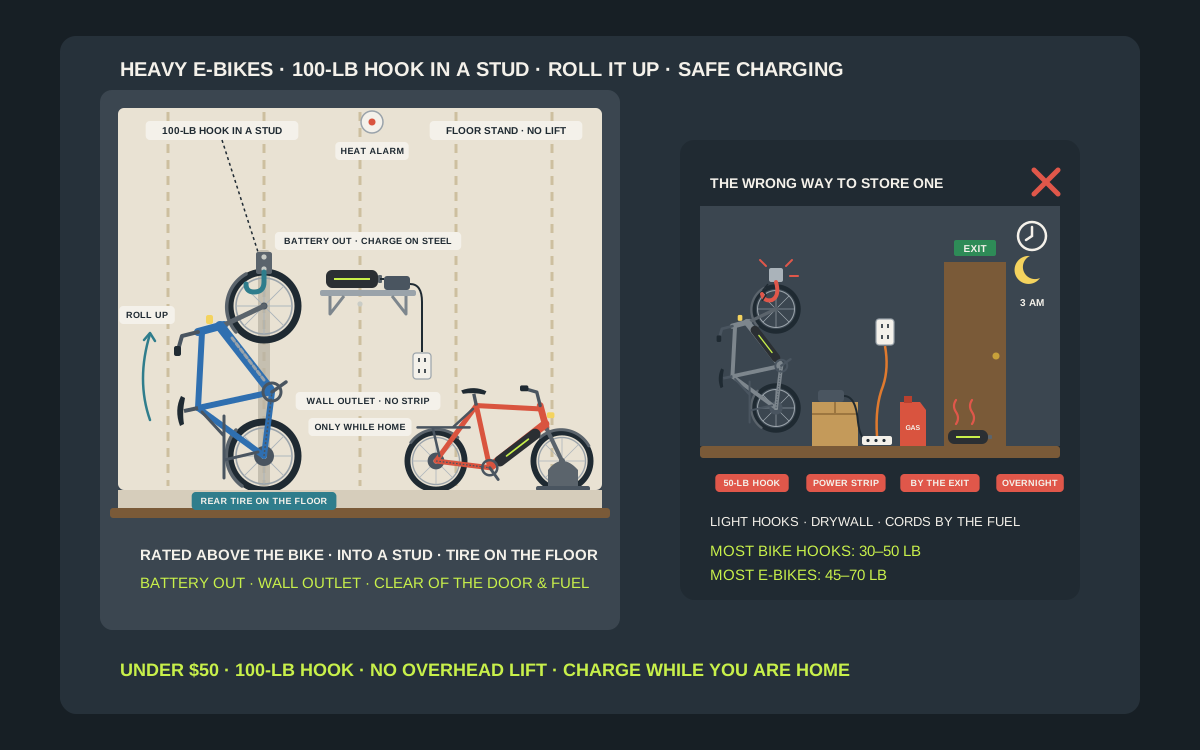
An e-bike changes the garage storage problem. A regular bike weighs somewhere between 10 and 30 lb, and most people can lift one onto a wall hook without thinking about it. A full-size e-bike with a motor, a battery and fenders usually weighs 45 to 70 lb, and lifting it over your head onto a hook is the kind of job people do once, wrench their back, and then give up on. So the bike leans against the wall behind the car, the kickstand sinks into whatever is on the floor, and the charger ends up plugged into a power strip next to the paint cans. There is a better way, and most of it costs well under $50. The trick is to stop thinking about lifting the bike and start thinking about rolling it. With a hook rated for the real weight of the bike, screwed into a stud at the right height, you can lever a 65-pound e-bike onto its back wheel and roll the front wheel onto the hook, while the floor carries the rest. This guide covers which mounts are actually rated for e-bike weight, how to set one up so you barely lift anything, how to anchor it, and where the battery should charge in a garage.
Shop heavy-duty e-bike wall mounts on Amazon
Who this is for
- E-bike owners who have tried to lift a 60- to 70-pound bike onto a standard bike hook and want a setup that doesn’t need a gym membership
- Households with one e-bike and one or two regular bikes who want them off the garage floor and out of the car’s way without buying a pricier pivoting rack system
- Anyone who charges an e-bike battery in the garage and wants the charging spot set up the way fire safety agencies and battery makers recommend
Quick answer
For most garages, the best under-$50 e-bike wall mount is a single vertical hook rated for at least 100 lb, screwed into a stud at the height where the front wheel lands when the rear tire stays on the floor. Delta Cycle’s Wall Ride hook, for example, is rated for bikes up to 100 lb and tires up to 3.75 inches wide, mounts into wood studs or concrete, and comes with a full-length wheel guard; it listed under $50 at Delta and Home Depot when we checked. Squeeze the rear brake, walk the bike up onto its back wheel, roll the front wheel onto the hook, and the floor takes part of the load. Take the battery out first if it is removable; Lectric puts typical e-bike batteries at 7 to 10 lb. Skip ordinary bike hooks rated at 30 to 50 lb: most e-bikes weigh more than that. Check the rating, the tire width limit and the current price on the listing before you buy.
Quick comparison
| Mount | Best for | How much you lift | Trade-off |
|---|---|---|---|
| 100-lb vertical hook, rear tire down | Most commuter and folding e-bikes | Only the front of the bike, rolled up | Needs about six feet of wall height and a stud |
| 100-lb vertical hook, fully hung | Lighter e-bikes when floor space is tight | The whole bike, front first | The hardest lift; take the battery out first |
| Two heavy hooks, low horizontal | E-bikes with a straight top tube | The whole bike, to waist height | No good for step-through frames; check both ratings |
| Floor wheel stand against the wall | Heavy, cargo and fat-tire e-bikes | Nothing; roll the wheel in | Uses floor space; rated e-bike stands cost more |
| Pivoting roll-in rack with tire tray | Several heavy bikes along one wall | Lever onto the rear wheel, roll in | Brand-name versions list above $50 |
| Steel charging shelf by an outlet | Removable batteries | Just the battery | Not a mount; keep it clear of exits and fuel |
100-lb vertical bike hooksE-bike floor standsBike tire wall guards
What to look for
A weight rating above your bike’s real weight
This is the filter that removes most bike hooks. Lectric eBikes, which sells some of the most popular budget e-bikes, says e-bikes typically weigh 45 to 70 lb and fat-tire models 60 to 80 lb, against 10 to 30 lb for a regular bike. Its folding XP 3.0 weighs 64 lb with its 7 lb battery, and Aventon lists its Level.3 commuter at 67 lb. Now compare the hooks: Gladiator rates its vertical bike hook at 30 lb, Delta Cycle rates its single horizontal wall rack at 40 lb, and Rubbermaid’s FastTrack vertical and horizontal bike hooks and Husky’s screw-in bike hook are each rated at 50 lb. Every one of those is a good hook for a regular bike and the wrong hook for most e-bikes. Look for a rating of around 100 lb, which gives a 65-lb bike real margin.
A way to roll the bike up instead of lifting it
The no-lift idea comes from pivoting racks. Steadyrack, which makes them, tells owners to squeeze the rear brake, grab the handlebars and walk backwards so the bike levers up onto its rear wheel, then roll the front tire into the rack, with no lifting at all. Delta’s Pivot Rack does the same thing with a ramped wheel tray and is rated at 100 lb. Both list above our $50 budget. You can borrow the motion with a plain heavy-duty hook: mount it low enough that the front wheel reaches it while the rear tire stays on the floor, and you raise only the front of the bike.
Room for wide e-bike tires
E-bike tires are wider than road and hybrid tires, and many bike hooks are not. Gladiator’s vertical bike hook is listed for tires up to 1.7 inches wide, while the Aventon Level.3 runs 2.2-inch tires and fat-tire e-bikes go far wider. Delta’s Wall Ride hook takes tires up to 3.75 inches. Feedback Sports’ RAKK 2.0 E floor stand fits 23 mm to 4.5-inch tires. Measure your tire at its widest point, including the tread, and buy a mount whose listed tire width covers it, because a tire that is jammed into a narrow hook is hard to get out when the bike is heavy.
Hardware that goes into a stud or solid masonry
A heavy e-bike on a wall hook puts a constant pull on the screws, and that load belongs in wood framing or concrete, not drywall. Delta says its Wall Ride installs into wood studs or concrete walls. Husky rates its screw-in hook at 50 lb only when it is installed in a stud, and Rubbermaid sells its FastTrack bike hooks without wall hardware, so you supply screws suited to your wall. Steadyrack goes further and says its racks must never be fixed to drywall alone. Plan the mount around a stud before you plan anything else.
A spot for the battery and charger
An e-bike wall is not finished until the battery has a safe place to charge. Fire safety agencies are consistent about what that means: the original charger, plugged straight into a wall outlet, on a hard surface, away from anything that burns and away from the way out of the room, and only while someone is home and awake. If your battery comes out, a short steel shelf near an outlet and away from the door gives it a home. Plan the outlet and the shelf at the same time as the hook, so the charger never ends up on a power strip by the gas can.
Weigh the bike before you buy a hook
Use the number on the spec sheet, then add the extras
Every major e-bike maker publishes a weight, and that is the number to start from. Lectric lists the XP 3.0 at 57 lb for the bike and 7 lb for the battery, 64 lb in total. Aventon lists the Level.3 at 67 lb, with an 8.7 lb battery. Then add what you have bolted on since: a rear basket, a child seat, a second lock, panniers. If you are not sure, stand on a bathroom scale holding the bike, then subtract your own weight. It takes a minute and settles the question.
The battery is the easiest weight to lose
Many e-bike batteries are removable, usually with a key, and taking one out before the bike goes on the wall does two useful things. It makes the bike lighter, by 7 lb on the XP 3.0 and 8.7 lb on the Level.3, and it lets the battery charge somewhere safer than hanging in the air next to the bike. Lectric suggests removing the battery to lighten an e-bike for a car rack, and Bosch, which makes e-bike drive systems, says to remove the battery if the bike will not be used for a long period. A bike with a battery that does not come out is just as storable; it is simply heavier, so give it more margin.
Why most bike hooks are the wrong hook
Look at the ratings again: 30 lb, 40 lb, 50 lb, and then e-bikes at 45 to 80 lb. A 50-lb hook might hold a 64-lb e-bike for a while, but it is working beyond what its maker promises, with no margin left for the jolts of loading, unloading and bumping the wheel. A 100-lb hook holding the same bike is working at about two-thirds of its rating. That margin is what you are paying for, and it is why the best under-$50 option is not a pack of cheap hooks.
Fat tires, fenders and racks change the fit
Weight is half the check. Tire width, fenders and the rear rack decide whether the bike physically fits a mount. Steadyrack, for example, asks for at least 3/4 inch of clearance between the tire and the fender stays so its rack arms can fit between them. A plain J-hook does not care much about fenders, but it does care about tire width, so measure both before you order.
Five ways to store a heavy e-bike on or against a garage wall
A 100-lb vertical hook with the rear tire on the floor
This is the setup we recommend for most garages because it gets the bike vertical and off the floor space without a real lift. The hook goes into a stud at the height where the front wheel lands when you stand the bike on its back wheel against the wall, so the rear tire rests on the floor and the floor carries part of the weight. You roll the bike up rather than lifting it. A full-length wheel guard, which comes with Delta’s Wall Ride, keeps the rear tire from marking the wall. The bike stands on end, so it needs roughly its own length in wall height: Aventon lists the Level.3’s wheelbase at about 45 inches, and with a full wheel added the bike stands taller than six feet.
The same hook, fully hung
If you need the floor under the bike for a shop vac or a bin, the same 100-lb hook can hold the bike fully off the ground. The cost is the lift: you raise the whole bike, front wheel first, high enough to clear the hook. With the battery out, an e-bike that weighs 65 lb on the spec sheet is closer to 57, which is still a lot to hold over your head. Only choose this if you can lift the bike comfortably and safely, and keep the hook as low as the floor clearance allows.
Two heavy hooks, low and horizontal
A bike can also hang flat against the wall, with its top tube resting on two padded hooks screwed into neighboring studs at about waist height. The lift is shorter, because waist height is a lot easier than head height, and the bike sits parallel to the wall, so it sticks out only as far as the handlebars. It has limits. It needs a straight top tube, so it does not suit step-through frames, and each hook has to be rated for the share of the weight it carries. Many horizontal bike hooks are rated at 40 to 50 lb, so check the rating per hook and pad the tube where it rests.
A floor wheel stand against the wall
The truly no-lift option is not a wall mount at all. A floor stand holds the bike upright by one wheel, and parking it against the wall keeps it out of the way with nothing to lift. Feedback Sports’ RAKK 2.0 E is built for e-bikes, is rated for bikes up to 75 lb, fits 23 mm to 4.5-inch tires and even has a tray for the charger; it lists above $50. Cheaper wheel-slot stands are usually sized for lighter bikes, so check that the listing names e-bikes and gives a weight rating before you trust one with a heavy bike. Our freestanding bike stand guide covers the options in more detail.
A pivoting roll-in rack, if you stretch the budget
If several heavy bikes share one wall, a pivoting rack is worth knowing about even though the brand-name ones cost more than $50. Delta’s Pivot Rack is rated at 100 lb, swivels 150 degrees each way and loads with a ramped wheel tray. Steadyrack’s ProFlex range holds up to 121 lb and pivots so bikes can fold toward the wall; Steadyrack says a bike with road handlebars sticks out about 16 inches when folded and one with wide mountain bike bars about 39. Generic pivoting racks with tire trays are also sold online. The rules are the same: a stated weight rating above your bike, a tire width that fits, and stud or masonry mounting.
How to roll an e-bike onto a vertical hook
Find the hook height with the bike, not a tape measure
Stand the bike on its back wheel against the wall where it will live, with the rear tire on the floor, and hold it upright. Mark the wall at the top of the front wheel. That is roughly where the hook needs to catch the rim. Steadyrack’s installation sheet works the same way, setting rack height from the bike itself rather than a fixed number, and for its pivoting racks it allows 1 to 3 inches of clearance between the rear tire and the floor. If you want the tire just off the floor, raise your mark by that much. Then find the stud nearest the mark.
Walk it up on the rear wheel
With the hook installed, roll the bike to the wall, squeeze the rear brake and pull back on the handlebars, walking backwards so the bike tips up onto its rear wheel. This is the move Steadyrack describes for its racks, and it works because the rear wheel acts as a pivot. Once the bike is upright, push it forward until the front wheel meets the hook and settles onto it. On a heavy bike, keep the rear brake on until the front wheel is seated.
Seat the rim, not a spoke
Make sure the hook sits on the rim, not across a spoke. A reviewer of Delta’s Wall Ride hook gives the same advice: turn the wheel so you are not resting on a spoke. The rubber or vinyl coating on a good hook protects the rim. If the bike has a front fender, check that the hook catches the rim cleanly without pressing on the fender.
Squeeze the brakes before you ride
Many e-bikes, including the Level.3, have hydraulic disc brakes. Shimano’s brake manuals warn that if a bike with hydraulic discs is turned upside down or on its side, air bubbles in the reservoir can move toward the calipers, and tell riders to operate each brake lever a few times to check that the brakes work normally before riding. Steadyrack, whose racks store bikes vertically, gives similar advice for bikes that have been hanging a while: pump the brakes a few times when you take the bike down. Make it part of taking the bike off the wall.
Anchor it into studs or solid masonry
Find the stud and confirm it
Most garage walls have studs every 16 inches, but corners, windows and old repairs move them. Use a stud finder, then confirm with a small test hole or a finishing nail before you drill the real pilot hole. Mount the hook in the middle of the stud, not near its edge, and drill the pilot hole the size the hook’s instructions call for, so the threads bite without splitting the wood.
If the stud is in the wrong place, add a board
Studs are rarely exactly where you want a bike. Steadyrack’s answer is to screw a rail across the studs at the height you need, or to fix a sheet of 1/2-inch plywood across the studs and mount racks on the plywood wherever you like. The same idea works for a hook: a length of 2x6 or a plywood panel screwed into two or three studs gives you a solid mounting surface between them, and the screws into the studs carry the bike.
Concrete and block walls
Masonry holds a bike well if the anchors are right. Delta says its Wall Ride installs into concrete, and Steadyrack supplies fixings for masonry and timber. On block walls, drill into the solid face of the block or the mortar as the anchor instructions direct, use anchors rated for the load, and keep the holes away from crumbling edges. Our guide to mounting pegboard on a concrete garage wall walks through choosing masonry anchors.
Never drywall alone
Drywall is a finish, not a structure. Steadyrack says its racks cannot be fixed to drywall, plasterboard or gyprock alone and that doing so voids the warranty, and a reviewer of Delta’s hook found the plastic wall anchors did not work and recommended heavy-duty anchors or a stud. With an e-bike’s weight on a hook, drywall anchors are not worth the risk. If there is no stud, add a board across the studs or choose a floor stand instead.
Battery and charging safety in the garage
Buy certified, use the original charger
Start with the hardware. The FDNY tells e-bike owners to buy devices and batteries certified to UL standards and to look for UL 2849, the standard for e-bike electrical systems, or UL 2271 for batteries. Bosch certifies its whole system to UL 2849 and its batteries to UL 2271, and Aventon lists both certifications for the Level.3. Use only the charger that came with the bike or one its maker approves. The CPSC warns against so-called universal chargers, which may fit but be incompatible, and says it received 156 reports of fires and thermal incidents involving them between January 2023 and May 2024.
Plug into the wall, on a hard surface
The FDNY and NFPA both say to plug the charger directly into a wall outlet, never into an extension cord or power strip, and NFPA’s tip sheet suggests charging only one device or battery at a time so the circuit is not overloaded. Charge on a hard, flat surface. Aventon tells owners to set the charger brick on a flat, non-flammable surface like metal or concrete because it heats up while charging. A steel shelf or the bare concrete floor beside an outlet does the job; a cardboard box, a workbench covered in rags or a pile of drop cloths does not.
Keep it clear of the exit and anything that burns
Bosch tells owners not to charge in escape routes, on flammable surfaces or near combustible materials, and the FDNY says not to charge near exits and ways out. In a garage, that rules out the floor in front of the door into the house, the corner where the gas cans and paint live, and anywhere near the lawn mower. NFPA notes that the safest place to charge an e-bike is outdoors, away from any structure and out of direct sun; if you charge in the garage, pick a spot that is open, away from the door and away from fuel.
Charge only while someone is home and awake
The CPSC is blunt about this: always be present when charging, and never charge while sleeping or when no one is home, because it has seen many lithium-ion battery fires and deaths happen at night while families slept. The FDNY adds never to charge overnight, and the CPSC, NFPA and Bosch all say to unplug once the battery is full. Bosch also suggests checking the battery for visible damage and letting it cool after a ride before you charge it.
Watch the temperature, and fit a heat alarm
Bosch says to charge its batteries between 32 and 104°F, and NFPA’s tip sheet gives a similar range, so a garage below freezing is not a place to charge. Bring the battery inside to warm up first. For the garage itself, the U.S. Fire Administration says smoke alarms are not designed for garages, where dust, fumes and humidity set them off, and recommends a heat alarm rated for 175 to 250°F, ideally interconnected with the smoke alarms in the house. If a battery ever smells odd, changes shape or color, leaks or makes strange noises, the FDNY says to stop using it, move it away from anything that can burn if it is safe to do so, and call 911.
Winter and long-term storage
Where the battery should live in winter
A cold garage is fine for the bike and less ideal for the battery. Bosch says cold temperatures, such as those in a garage in winter, are harmless to its batteries in storage, but a cold battery delivers less power, so on very cold days move it to a heated area and let it reach room temperature before riding. Bosch says to store its batteries between 50 and 104°F, ideally at room temperature for the longest service life, and never below 14°F or above 140°F. Aventon tells owners to store and charge the battery in a climate-controlled area. If your garage swings hard with the seasons, keep the battery on a shelf indoors and leave the bike on the wall.
Store it partly charged
Battery makers do not all give the same number, so follow your own bike’s manual. Bosch says a charge level between 30 and 60 percent, two to three lights on its indicator, is ideal for storage. Aventon’s FAQ suggests storing its batteries at about 75 percent. The point both make is the same: do not leave a battery sitting full or completely flat for months. Check it every few weeks over the winter.
Tires, lock and a quick check
Tires lose pressure slowly however a bike is stored, and Steadyrack recommends routine pressure checks for bikes that hang for a long time and turning the tire now and then so the same spot is not always under load. Delta’s Wall Ride hook has a built-in D-ring for a cable lock, which matters because e-bikes are expensive and garages get broken into. Steadyrack also suggests not sharing your home location in ride-tracking apps. Before the first spring ride, check the hook is still tight in its stud, pump the tires and squeeze both brakes.
Mistakes to avoid
- Buying a 30- to 50-lb bike hook for a 60- to 70-lb e-bike because it says heavy-duty on the package.
- Lifting a full e-bike over your head when a rear-tire-down setup would let you roll it up.
- Screwing a hook into drywall with plastic anchors instead of a stud, a board across studs or masonry.
- Leaving the battery in the bike on the wall when it could come out and charge somewhere safer.
- Charging from a power strip or extension cord, or with a universal charger that is not approved for the bike.
- Charging overnight, while no one is home, or on the floor in front of the door into the house.
- Charging a battery in a garage that is below freezing instead of warming it indoors first.
- Riding off the wall without squeezing the hydraulic brakes a few times first.
Related guides
Browse the hub: Garage wall storage under $50 - all guides
- How to Hang a Bike on a Garage Wall Under $50 (Stud-Safe Hooks)
- Best Bike Hooks for Garage Ceilings Under $50
- Best Freestanding Bike Stands for Garages Under $50 (No Wall Mounting)
- Wall Mount Bike Hooks vs Freestanding Bike Stand: Which Under $50 Wins for Garages?
- Best Battery Charger Wall Mounts under $50 (Charging Station Shelves)
- How to Mount Pegboard on a Concrete Garage Wall Under $50
- Vertical vs Horizontal Bike Wall Mounts: Which Under-$50 Setup Fits Your Garage?
- Bike Ceiling Hoist vs Wall Hook: Which Under-$50 Option Saves More Garage Space?
FAQ
Can you hang an e-bike on a regular bike hook?
Usually not safely. Many common bike hooks are rated at 30 to 50 lb, including Gladiator’s vertical bike hook at 30 lb and Rubbermaid’s FastTrack and Husky’s screw-in hooks at 50 lb, while Lectric says e-bikes typically weigh 45 to 70 lb. Use a hook rated well above your bike’s weight, such as Delta’s Wall Ride at 100 lb, screwed into a stud.
How do I store an e-bike in the garage without lifting it?
Mount a 100-lb vertical hook at the height where the front wheel lands when the rear tire stays on the floor, then squeeze the rear brake, walk the bike up onto its back wheel and roll the front wheel onto the hook. For no lifting at all, park the bike in an e-bike-rated floor wheel stand against the wall.
Should I remove the battery before hanging my e-bike?
If it comes out, yes. Lectric says e-bike batteries weigh 7 to 10 lb, such as 7 lb on its XP 3.0, and Aventon lists 8.7 lb for the Level.3. Removing it makes the lift easier and lets the battery charge on a safe surface instead of on the wall. Bosch also recommends removing the battery if the bike will not be used for a long period.
Is it safe to charge an e-bike battery in the garage?
It can be, with care. Use the original charger plugged straight into a wall outlet, on a hard non-flammable surface, away from fuel, combustibles and the door into the house, and only while someone is home and awake. Bosch says to charge between 32 and 104°F, and NFPA says the safest place to charge is outdoors, away from structures.
Will hanging an e-bike vertically damage hydraulic brakes?
It should not damage them, but check them before you ride. Shimano warns that turning a hydraulic disc brake bike upside down or on its side can move air bubbles toward the calipers and tells riders to operate the levers a few times to confirm normal braking. Steadyrack gives the same advice for bikes stored vertically.
Can I mount an e-bike hook on drywall?
No. Mount it into a wood stud or solid masonry. Steadyrack says its racks must not be fixed to drywall alone. If no stud is where you need it, screw a board or a sheet of 1/2-inch plywood across two or three studs and mount the hook on that.
Bottom line
The best e-bike wall mount under $50 is a hook rated for about 100 lb, screwed into a stud at the height where you can roll the front wheel onto it with the rear tire still on the floor. Skip 30- to 50-lb bike hooks, take the battery out, use a floor stand if lifting is off the table, give the battery a hard, clear charging spot by a wall outlet, and check the rating, tire width and current price on the listing before you buy.