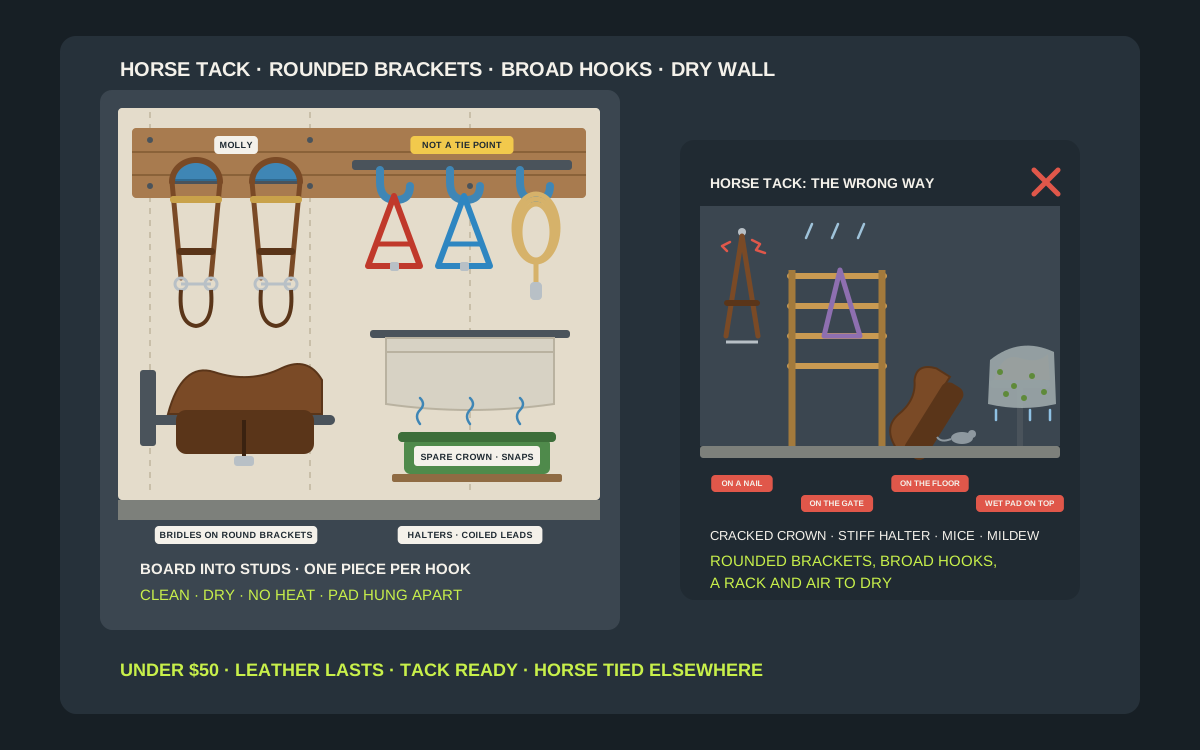
Plenty of horse owners do not have a tack room. The horses live out back or at a small barn, and the bridles, halters and lead ropes end up in the garage, on a nail by the side door, over the back of a chair or in a pile on the floor of the trailer. That is hard on leather. A bridle hung from a nail bends at one sharp point until the crown cracks, a halter left damp in a closed corner grows mildew, and a lead rope dropped in a heap tangles, gets stepped on and picks up grit that wears the snap. The good news is that the fix is cheap. A few wide, rounded bridle brackets, a bar of broad hooks for halters and leads, and a small board screwed into the studs give every piece its own place, off the floor and out of the way of the car. This guide covers which racks suit bridles, halters, lead ropes and a saddle, where the tack wall belongs in a garage or small barn, how to clean and dry tack before it goes back up, what to check while you hang it, and the safety and theft habits that make a tack wall work. It sticks to storage gear that usually costs under $50 a piece.
Shop horse bridle brackets and tack hooks on Amazon
Who this is for
- Backyard horse owners who keep their tack in the garage or a small shed instead of a tack room
- Riders with one or two horses at a small barn who need a tidy tack corner on a budget
- Anyone whose bridles hang on nails, whose halters live on the gate and whose lead ropes live on the floor
- Owners setting up a tack wall in the garage for gear that rides back and forth in the horse trailer
Quick answer
For most garages and small barns, the best under-$50 tack setup is a row of wide, rounded bridle brackets, one per bridle, plus a bar of broad hooks for halters and loosely coiled lead ropes, all screwed into the studs or into a wooden tack board fixed across them. If the saddle lives there too, add a wall-mounted saddle rack below the bridles and a separate open bar where the pad can hang to dry. Put the tack wall in the driest, most enclosed corner you have, away from heaters, sunny windows, fuel cans and the car’s exhaust, and keep a spare breakaway crown and a few snaps in a labeled bin on the same wall. Clean and dry tack before you hang it, and check the dimensions, mounting hardware and current price on the listing before you buy.
Quick comparison
| Setup | Best for | How it holds | Trade-off |
|---|---|---|---|
| Single bridle brackets | One bridle each | Wide half-moon holds the crown in a gentle curve | Screws often sold separately |
| Halter and lead rope hook bar | Halters and coiled lead ropes | Broad hooks on a bar screwed across studs | Narrow hooks kink leather |
| Wooden tack board | Garage walls with awkward stud spacing | Board screwed to studs, brackets and hooks on the board | An hour or two to build |
| Collapsible wall saddle rack | One saddle on a garage wall | Broad arm supports the saddle, folds flat when empty | Check the fit for your saddle |
| Pad and blanket drying bar | Sweaty pads, sheets and coolers | Open bar lets air move through the fabric | Not a long-term blanket store |
| Labeled spare-parts bin | Breakaway crown, snaps, bit guards | Lidded bin on a shelf or under the board | Only works if parts go back |
| Grooming tote shelf | Brushes, hoof pick, fly spray | Tote sits on a shelf or hangs from a hook | Keep sprays off the leather |
| Lockable tack trunk or cabinet | Shared garages and theft risk | Lockable lid or door over the tack | Bigger trunks often top $50 |
Rounded bridle bracketsHalter and lead rope racksWall-mount saddle racks
What to look for
A wide, rounded bracket for every bridle
The crown of a bridle is the strap that sits behind the horse’s ears, and it needs to hang in a gentle curve. Oregon State University’s 4-H guide to tack and equipment says to hang bridles on wide, rounded hooks, and warns that a thin hook or a nail strains the leather until it cracks. That is why the classic bridle bracket is a half-moon of steel, plastic or wood about the width of a hand. The same guide notes that a holder can be as simple as a smooth can or a shaped block of wood screwed to the wall. What matters is the curve, not the price.
Broad hooks for halters, with room for each one
Halters are simpler than bridles, but they still deserve their own hook. A broad, rounded hook holds a halter by the crown without kinking it, and one halter per hook means you can grab the right one in the dark without untangling three. Leather, nylon and rope halters all hang the same way. Keep them off the hooks you use for bridles if those hooks are narrow, and leave enough space between hooks that the halters do not overlap and stay damp where they touch.
A home for lead ropes that keeps them coiled and clean
A lead rope is usually several feet of cotton, nylon or poly rope with a snap at one end. Stored in a heap, it tangles and drags grit into the snap. Coiled loosely and hung by the coil on a wide hook, it dries, stays clean and comes off the wall in one piece. Hang the rope by the coil rather than by the snap, so the snap is not carrying the weight and its spring is not left under strain.
A saddle rack that supports the whole saddle
If the saddle shares the wall, it needs a rack that holds it the way it sits on a horse. The Oregon State guide says saddles should be stored on a rack, a sawhorse or a barrel, never hung from a rope and never stood on the front edge, because the skirts curl under and the stitching around the horn can break. A wall-mounted rack with a broad arm is the space-saving answer for a garage. Tough-1, for example, sells a collapsible steel wall saddle rack that folds flat against the wall when the saddle is out.
Airflow around everything
Leather needs air. The Oregon State guide recommends keeping tack in a dry place with good air movement, and Nutrena’s tack room advice says to leave space between saddle racks, keep wet pads and blankets away from leather and never lay them over saddles to dry. On a wall, that means a little space between brackets, a separate open bar for pads and blankets, and a gap behind the rack so the back of the saddle is not pressed against cold concrete.
Solid mounting and the right size for your gear
Tack gets pulled off the wall in a hurry, often with a horse waiting. Screw brackets, hook bars and the saddle rack into studs or into a wooden board fixed across them, not into drywall alone. Measure before you buy. Tough-1’s steel bridle holder, for instance, is listed at about 4 by 5 1/4 by 3 1/8 inches and attaches to a stall front or tack room wall, with screws not included, so you need your own hardware. Multi-bracket aluminum racks such as Weaver’s 24 inch four-bracket rack are handsome, but they usually cost more than $50, so single brackets on a board are the budget route.
Know what you are storing
Bridles: leather, buckles and a bit
A bridle is a headstall, a bit and a set of reins, and most of it is leather that is stitched or buckled around metal. Those points where leather meets metal are where wear shows first. Dr. Cindy McCall of Auburn University, writing for the University of Arkansas extension service, recommends checking tack at those meeting points and at other stress points such as girths, cinches, stirrups and reins. A good bridle hook supports the crown evenly, keeps the reins off the floor and lets air reach the leather on all sides.
Halters: leather, nylon and rope
The University of Missouri Extension’s guide to haltering and tying describes three common types. Rope halters are adjustable and interchangeable between horses, but cotton rope shrinks when it gets wet. Leather halters should be cleaned with saddle soap, without too much oil, which stretches them and rots the stitching, and they should not be stored damp or near heat. Nylon resists moisture and mildew but stretches. All three hang well on a broad hook by the crown, buckled so they keep their shape.
Lead ropes and snaps
Lead ropes come in cotton, nylon and poly, with a bolt snap, a trigger snap or a quick-release panic snap at the end. The rope itself is tough, but the snap is a small spring that clogs with mud and corrodes when it is left wet. Coiling the rope loosely and hanging it by the coil lets it dry and keeps the snap off the floor. A quick look at the spring each time you hang it up costs nothing and catches the snap that is about to fail.
Saddles, pads and blankets
The saddle is the most expensive piece of tack most people own, and it is the one most damaged by poor storage. Pads and blankets are the opposite problem: they come off the horse damp with sweat and need air to dry. Keeping them apart, with the saddle on a rack and the pad on its own open bar, protects both. This guide covers saddle and pad storage briefly; the main focus is bridles, halters and lead ropes, the tack you handle every day.
How to hang each piece
Bridles: by the crown, reins looped up
Hang each bridle by the crown on its own rounded bracket, with the browband facing out so you can see which bridle is which. Fasten the throatlatch and noseband loosely so the bridle keeps its shape, then loop the reins up and hang them over the bracket or on a small hook beside it, so they do not trail on the floor. Wipe the bit before it goes up. A tag on the bracket with the horse’s name helps when more than one person tacks up.
Halters: one per hook, buckled
Buckle the halter and hang it by the crown on a broad hook. Rope halters can hang the same way, with the tie loop on the hook. Do not leave halters hanging on the pasture gate or a fence post. The University of Arkansas extension article warns that a halter left on the gate weakens and stiffens from the weather, and a halter in the paddock is also one that is not on the wall when you need it.
Lead ropes: coiled loosely, hung by the coil
Coil each lead rope in loose loops about the length of your forearm, wrap the tail around the coil once and hang the coil on a wide hook next to the matching halter. Many owners keep each lead clipped to its halter, which works as long as the snap is closed and the pair hangs on one broad hook, not a narrow one. A wet rope should hang loose until it dries, then be coiled.
Saddle and pad: on a rack and on a bar
Put the saddle on its rack with the girth or cinch off or undone, the stirrups run up or hooked out of the way, and nothing piled on top. The pad goes on a separate open bar, underside out, where air can reach both faces. A breathable fabric cover over the saddle keeps dust off, which the Oregon State guide recommends, but let the saddle dry first. Never use the saddle as a shelf for the pad.
Where the tack wall goes in a garage or barn
Dry, enclosed and away from heat
Extension advice on tack storage is consistent: dry, clean and out of direct heat. The University of Kentucky’s equine tack room guidance describes an enclosed, dry, dust-free space. The Oregon State guide says to keep leather out of direct sun and away from heat, ideally at room temperature, and the University of Arkansas article explains that heat and sun draw the oils out of leather and cause cracking, adding that attics are usually too hot and basements too damp. In a garage, that rules out the wall above the water heater, the spot beside a space heater and the wall under a south-facing window.
Away from fuel, chemicals and the car
Garages hold things a barn does not: gasoline cans, oil, lawn chemicals, ice melt and a car that idles inside on cold mornings. Keep the tack wall on the side of the garage away from the parking spot and the fuel shelf, so exhaust, spills and salt do not reach the leather. Petroleum products are a particular problem; the Arkansas article warns that they can damage vegetable-tanned leather, so a dripping oil can above the bridles is a slow disaster.
Off a sweating concrete wall
Concrete and block walls can sweat when the weather turns, especially in garages that are not insulated. A wooden tack board screwed to the wall, with the brackets on the board, keeps the leather a little away from cold, damp masonry. If the garage feels damp, a small dehumidifier, which Nutrena suggests for tack rooms, keeps mildew down. A cheap hygrometer on the tack board tells you whether the corner stays dry through the year.
Rodent-proof, and with the feed somewhere else
Mice nest in blankets and pads and chew leather. The Oregon State guide recommends protecting blankets and pads from mice, and the Arkansas article says to keep the storage area free of insects and rodents. Store feed and treats in sealed bins away from the tack, and do not leave saddle pads on the floor where mice can reach them. If the same garage holds chicken feed and coop supplies, our backyard chicken supply racks guide covers that wall; keep it on the far side from the tack.
Clean and dry it before it goes back up
Wipe after every ride
Sweat and dirt are what ruin tack, and a quick wipe is what saves it. The Oregon State guide says to sponge leather after every use and never dry it near heat. The University of Florida’s IFAS extension, writing for hot and humid climates, recommends wiping tack daily and doing a thorough cleaning several times a year. Hang the bridle and halter only after the sweat and mud are off, and give the bit a rinse. Tack that goes up dirty stays dirty.
Use saddle soap, not a bucket
For the deeper clean, UF/IFAS recommends glycerin saddle soap and warns never to submerge a saddle, which can damage the tree. The Arkansas article suggests a glycerin or saddle soap with plenty of fat and as little water as possible, then letting the leather dry naturally. That means hanging it on the bracket in open air, not in front of a heater, a hair dryer or a sunny window.
Condition lightly, with the right oil
Conditioner keeps leather supple, but more is not better. The Oregon State guide recommends a light coat of pure neatsfoot oil rather than a neatsfoot compound, and warns that over-oiling attracts dust and rots stitching. UF/IFAS adds a note for humid regions: pure neatsfoot oil mildews more easily than blended conditioners, petroleum-heavy compounds should be avoided, and corn or vegetable oil should never be used because it goes rancid and encourages mold. Choose a conditioner that suits your climate and apply it sparingly.
Deal with mildew early
A white or green bloom on leather is mildew, and it spreads in damp, still air. The Oregon State guide suggests wiping mildew off with a mixture of vinegar and water, then letting the leather dry and conditioning it lightly. Then fix the cause: more space between pieces, a drier corner or a dehumidifier. Nylon halters and leads are easier; Oregon State and the University of Missouri both suggest washing them in soapy water and letting them dry fully before they go back on the hook.
Check it while you hang it
Look at the stress points
Hanging tack is the best moment to inspect it, because every piece passes through your hands. Look at the stitching and the holes where buckles and bits attach, the folds of the reins, the crown of each halter and the swivel of each snap. Dr. McCall’s advice in the Arkansas article is to pay special attention where leather meets metal and to replace anything cracked or weak. Dirty tack is harder to check, which is one more reason to clean it before it goes up.
Recheck fit in the fall
The same Arkansas article suggests checking tack fit in the fall, since horses change condition through the year, and a well-organized tack wall makes that easy: each horse’s bridle and halter are on their own brackets, so you can take them down together and try them on. If a horse is between halter sizes, note it on the tag above its hook.
Keep a spare breakaway crown
Breakaway halters have a leather crown or tab designed to break if a horse gets caught, and once it breaks it needs replacing. Replacement breakaway crowns are sold in several lengths, typically 21, 23 and 25 inches, for halters with 1 inch hardware. JC Saddlery suggests keeping a spare crown in the barn or trailer. A small labeled bin on the tack wall is the place for it, along with a couple of spare snaps and a bit guard.
Halter safety off the wall
The University of Missouri guide is direct about turnout: never turn a horse out in a nylon halter, and if a halter must stay on, it should be leather. It also warns against leaving halters on unwatched horses, because a horse can catch a hind foot in the halter while scratching its head. Storing halters on the wall, rather than on the horse or the gate, helps make that a habit.
A tack wall is not a tie point
Never tie a horse to a storage hook
Brackets and hook bars are built to hold tack, not to stop a pulling horse. The University of Missouri guide says to tie a horse to something solid, at or above the height of the withers, with about 2 to 2 1/2 feet of rope and a quick-release knot. A bridle bracket, a hook bar or a tack board screwed into a stud is none of those things, and a horse that sits back can pull it off the wall and bolt with a board swinging from the rope. If you tack up in the garage or barn aisle, fit a proper tie ring into solid structure, away from the tack wall.
Never tie with the reins
The same guide warns never to tie a horse by the bridle reins, because a horse that pulls back can break the reins or injure its mouth. Take the bridle off its bracket only when you are ready to bridle the horse, and leave the halter and lead on until then. If you use cross ties, the guide recommends quick-release snaps.
Keep the aisle clear of empty hooks
Empty hooks at horse height are a hazard in a narrow aisle or a garage where you lead a horse past. Put the tack wall on a wall the horse does not brush, keep the lowest hooks loaded or above shoulder height, and choose rounded brackets over pointed hooks. Fold a collapsible saddle rack flat when the saddle is out.
Keeping tack from walking off
Mark it and photograph it
Tack theft is common enough that police forces run campaigns about it. Police in Northern Ireland, for example, advise marking saddles and tack, keeping an up-to-date photo inventory with any serial numbers, and locking tack away. Other police and insurers note that marking should go on a hidden but solid area, and that thin bridle leather and reins should not be punched or engraved. A photo of each bridle on its labeled bracket is a quick inventory.
Lock the room, then the rack
In a garage, the garage door is the first lock. In a shared barn or an open shed, a lockable tack trunk or cabinet keeps bridles and halters out of sight, and some saddle racks can be locked or chained. Do not leave tack in an unlocked trailer overnight. A tidy tack wall also makes theft obvious: an empty bracket shows that something is missing.
Long-term and seasonal storage
Taking a horse out of work
If a bridle or saddle will not be used for months, clean it, let it dry and condition it lightly before it goes into storage. The University of Arkansas article suggests taking straps apart and storing them flat for long periods, with the saddle on a rack, and covering everything with a breathable fabric cover. Avoid plastic bags and wraps, which trap moisture. Check stored tack every month or two for mildew and mice.
Moving tack between the garage and the trailer
Horse trailer tack compartments get hot in summer and damp in winter, so they are a poor long-term home for leather. Bring bridles and saddles back to the garage tack wall after a show or trail ride, wipe them and let them dry there. A spare halter and lead can stay in the trailer, since you will want them there in an emergency, but check them for mildew each time you hitch up. Our guide to trailer hitch ball mount holders covers the hitch side of the same garage.
Three sample setups
Two-car garage, one trail horse
On the side wall away from the parking spot, a 4 foot wooden board is screwed across three studs at about shoulder height. Two rounded bridle brackets hold the trail bridle and a spare, and three broad hooks hold the halter, a lead rope and a rope halter. Below, a collapsible saddle rack holds the western saddle under a fabric cover, and an open bar beside it takes the pad. A small bin on a shelf holds the hoof pick, a spare breakaway crown and the saddle soap.
Small backyard barn, two horses
With no room for a tack room, one wall of the feed area becomes the tack wall, with the feed in sealed bins on the opposite side. Each horse gets a labeled column: bridle bracket on top, halter and lead hook below. Two wall saddle racks sit at different heights with a gap between them, and a pad bar hangs near the door where air moves. A hygrometer on the board shows when it is time to run the dehumidifier.
Garage plus trailer for a show horse
The garage tack wall holds the show bridle, the everyday bridle, halters and leads on rounded brackets and broad hooks, with a lockable trunk underneath for the show saddle and good pads. The trailer keeps only a spare halter, a lead rope and a first aid kit. After each show, everything comes back to the garage to be cleaned and dried on the wall before it goes into the trunk.
How to set it up in an afternoon
- Count your tack: bridles, halters, lead ropes, saddles, pads and the small parts that go with them.
- Choose the driest, most enclosed wall, away from heaters, sunny windows, fuel, chemicals and the parking spot.
- Find the studs and screw a wooden tack board across them at about shoulder height, or mark where brackets will go directly into the studs.
- Mount one wide, rounded bracket per bridle, with a hand’s width or more between them so the leather does not touch.
- Add a bar of broad hooks below or beside the brackets for halters and coiled lead ropes, one piece per hook.
- If the saddle lives here, mount a wall saddle rack into the studs below the board, with an open bar nearby for pads.
- Put a labeled bin on a shelf for a spare breakaway crown, snaps, bit guards, saddle soap and conditioner.
- Hang clean, dry tack, label each bracket with the horse’s name, and add a small tag that says the board is not a tie point.
Mistakes to avoid
- Hanging a bridle on a nail or a thin hook, so the crown bends at one point and cracks.
- Leaving halters on the pasture gate or a fence post, where weather stiffens and weakens them.
- Dropping lead ropes in a heap on the floor, where they tangle and grit wears the snap.
- Standing the saddle on its front edge or hanging it from a rope instead of putting it on a rack.
- Throwing a wet pad or blanket over the saddle to dry.
- Putting the tack wall next to a heater, under a sunny window or beside the fuel and oil shelf.
- Hanging tack while it is still sweaty or wet, or over-oiling it until it collects dust.
- Tying a horse to a bridle bracket, a hook bar or the tack board, or tying it by the reins.
Related guides
Browse the hub: Pet gear wall mounts under $50 - all guides
- Best Backyard Chicken Supply Wall Racks Under $50 for Garage & Shed
- Best Pet Grooming Tool Wall Holders Under $50
- Best Dog Leash Wall Hooks Under $50
- Best Pet First Aid Kit Wall Mounts Under $50
- Best Trailer Hitch Ball Mount Wall Holders Under $50 for Garage
- Hook Rail vs Individual Hooks for Garage Walls Under $50
- How to Mount Pegboard on a Concrete Garage Wall Under $50
- Best Dog Tie-Out Cable Wall Hooks Under $50 for Garage
FAQ
How should you hang a bridle?
Hang it by the crown on a wide, rounded bridle bracket, with the throatlatch and noseband fastened loosely and the reins looped up so they do not touch the floor. Oregon State University’s 4-H tack guide warns that a nail or thin hook strains the leather until it cracks, so give each bridle its own curved bracket.
Can I keep horse tack in a garage?
Yes, if the spot is dry, enclosed and away from heat. Keep tack out of direct sun and away from heaters, fuel cans, chemicals and car exhaust, off a damp concrete wall and protected from mice. A wooden tack board on the studs and a small dehumidifier help in damp garages.
What is the best way to store halters and lead ropes?
Buckle each halter and hang it by the crown on its own broad hook, and coil each lead rope loosely and hang it by the coil next to the halter. Do not leave halters on the pasture gate, where weather weakens and stiffens them, and let wet rope dry before you coil it.
How do I keep tack from getting moldy?
Wipe it after every ride, let it dry in open air away from heat, condition it lightly and leave space between pieces so air can move. In humid climates, UF/IFAS notes that pure neatsfoot oil mildews more easily than blended conditioners. Wipe off any mildew with a vinegar and water mix and fix the damp.
Should a saddle go on a wall rack?
A wall-mounted saddle rack screwed into the studs is a good choice for a garage or small barn. Oregon State’s guide says saddles belong on a rack, a sawhorse or a barrel, never hung from a rope or stood on the front edge. Leave space around the rack and keep wet pads off the saddle.
Can I tie my horse to a tack hook or rack?
No. Tack brackets and hook bars are not made to hold a pulling horse. The University of Missouri Extension advises tying to something solid, at or above the withers, with about 2 to 2 1/2 feet of rope and a quick-release knot, and never tying with the bridle reins. Fit a proper tie ring away from the tack wall.
Bottom line
The best horse tack storage for a garage or small barn is a simple wall: one wide, rounded bracket per bridle, a bar of broad hooks for halters and coiled lead ropes, a saddle rack and an open pad bar if the saddle lives there, all screwed into the studs in the driest corner, away from heat, fuel and the car. Clean and dry tack before it goes up, check the stress points as you hang it, keep a spare breakaway crown on the same wall, and never tie a horse to the rack. Count your tack, measure your wall, then check the dimensions, mounting hardware and current price on the listing before you buy.