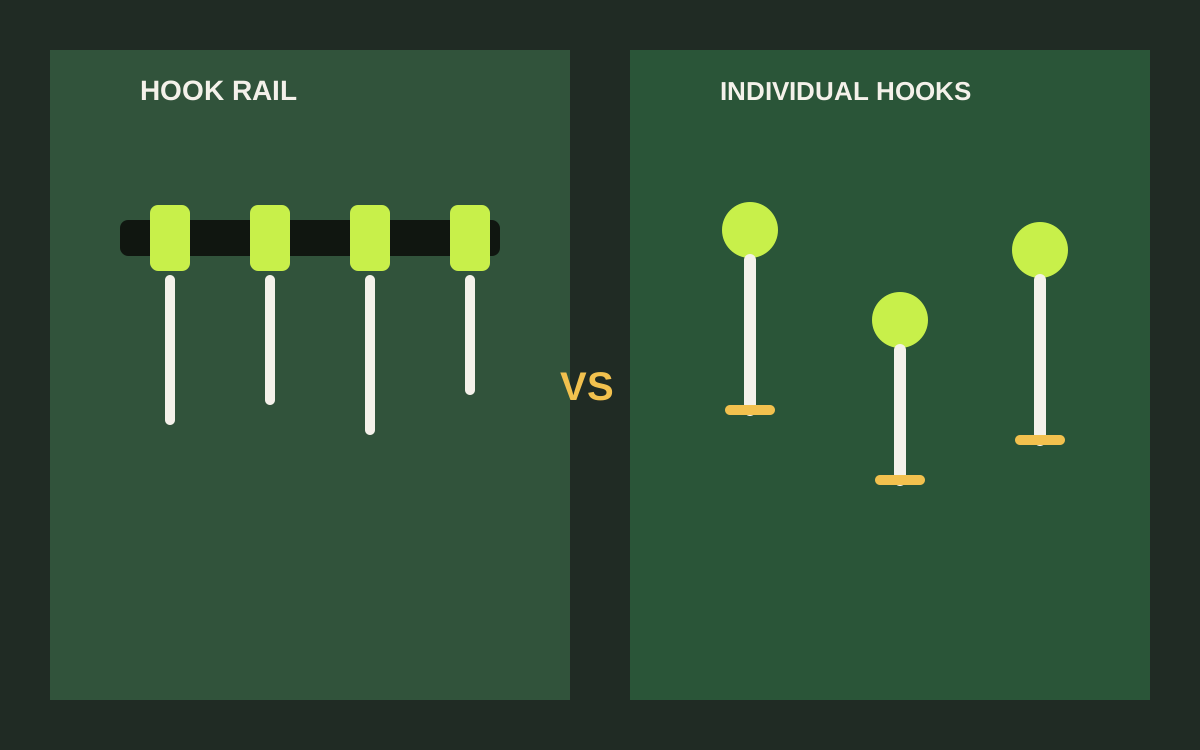
Under $50, a hook rail usually wins when you want even spacing, sliding adjustability, and a cleaner line for several tools; individual heavy-duty hooks win when you only need two or three fixed hang points on awkward studs or mixed wall materials. Start with a rail for a busy tool wall; use singles to solve odd corners.
Compare garage hook rails and utility hooks on Amazon
Who this is for
- Homeowners clearing long-handled tools without a full wall-system remodel
- DIYers deciding whether to buy a rail kit or a pack of heavy-duty hooks under $50
- Anyone who has outgrown random single hooks and wants a cleaner stud bay
Quick answer
Under $50, a hook rail usually wins when you want even spacing, sliding adjustability, and a cleaner line for several tools; individual heavy-duty hooks win when you only need two or three fixed hang points on awkward studs or mixed wall materials. Start with a rail for a busy tool wall; use singles to solve odd corners.
Quick comparison
| Factor | Hook rail | Individual hooks | Edge |
|---|---|---|---|
| Three-plus changing tools | Sliding hooks, even spacing | Usually $20-$45 kits | Rail wins for busy walls |
| One or two fixed hang points | Minimal hardware | Usually $8-$20 | Individual hooks win |
| Irregular studs or masonry spots | Harder to land a long plate | Usually hardware varies | Singles chase structure |
| Visual neatness | Continuous line looks planned | Usually packs vary | Rail wins for tidy bays |
What to look for
Count the hang points you need this month
Three or more tools that change places favor a rail. One ladder and one hose may only need two stout individual hooks.
Stud layout matters more than marketing
Rails want a predictable stud bay so the backplate lands on structure. Individual hooks can chase studs one by one on irregular walls.
Adjustability has a real weekly value
If your tool mix rotates, sliding rail hooks save new holes. If the hang never changes, fixed hooks are simpler and often cheaper.
Load ratings are per hook, not per photo
A rail is only as strong as each hook and each fastener into the wall. Match ratings to the heaviest tool, with margin for swinging loads.
Clear winner criteria
Choose a hook rail when…
You are organizing a row of brooms, cords, bike helmets, or mixed hand tools; you want to slide spacing without new holes; and you can mount a backplate into studs or a rated track system.
Choose individual hooks when…
You need one or two high-capacity hangers for a ladder, hose reel bracket companion, or awkward corner; the studs do not line up for a long rail; or you are testing a wall location before committing to a full bay.
Choose a hybrid when…
Put a rail on the main tool wall and add individual heavy hooks for the odd oversized item that would hog half the rail.
Side-by-side realities
Install time
Individual hooks are fastest for a single stud hit. Rails take longer to level but finish cleaner when you hang five tools at once.
Future changes
Rails forgive rearranging. Fixed hooks punish second thoughts with extra holes unless you guessed perfectly the first time.
Strength myths
A long rail does not magically hold more than its fasteners allow. Two lag-mounted individual hooks can outperform a poorly anchored decorative rail.
Treat price bands as moving targets
Kit contents and hook counts change with sales. Verify live capacity, hook profile, and price on the retailer page before ordering.
How to start under $50 without regret
Map tools on the floor first
Lay out what must come off the ground. If the pile is a line of similar tools, buy a rail. If it is two odd heavy items, buy stout singles.
Prefer coated, closed, or deep throats for the load
Open skinny hooks drop cords. Deep J-hooks or locking rail hooks suit yard tools and coiled lines better.
Level once, load gradually
Install the rail or first hooks level, hang the heaviest item, then fill remaining spots. Fix flex before the wall is crowded.
Leave empty capacity
An empty rail slot is cheaper than a second emergency store run next month.
Mistakes to avoid
- Buying a decorative rail with tiny screws for ladder-class loads.
- Scattering individual hooks at random heights until the wall looks noisy and hard to use.
- Ignoring door swing and car-door arcs when placing either system.
- Mixing adhesive hooks into a heavy rail plan and trusting them for yanking loads.
- Filling every hook on day one with no room to rearrange.
Related pick: Best Affordable Garage Track Rail Hooks Under $50
Related guides
Browse the hub: Garage wall storage under $50 - all guides
Related hub: Apartment no-drill storage under $50 — useful if you are limited to adhesive individual hooks for light loads only.
- Best Garage Track Rail Hooks Under $50
- Pegboard vs Hook Rails for Garage Walls (Budget Pick)
- Best Garage Wall Organizers Under $50
FAQ
Is a hook rail better than individual hooks under $50?
For three or more tools that may move, yes — a rail is usually cleaner and more adjustable. For one or two fixed heavy hang points, individual stud-mounted hooks are often the better buy.
Can I install a garage hook rail on drywall alone?
Light items sometimes work with rated anchors, but long-handled tools and swinging loads belong on studs or solid masonry. Follow the rail manufacturer’s fastening guidance.
Do sliding rail hooks hold as much as fixed hooks?
Only up to the rating of the hook and the rail connection. Check both numbers. A sliding hook is not automatically weaker, but cheap plastic sliders can be.
What belongs on a rail versus a single heavy hook?
Rails suit brooms, cords, helmets, and mixed hand tools. Use a single heavy-duty hook for ladders, bulky odd shapes, or locations where a long backplate will not hit structure.
Bottom line
Under $50, let the tool count choose the system. A hook rail wins for a busy, changing row of hang points; individual heavy-duty hooks win for one or two fixed loads or awkward studs. Mount into structure, leave empty capacity, and keep the line clear of doors and bumpers.