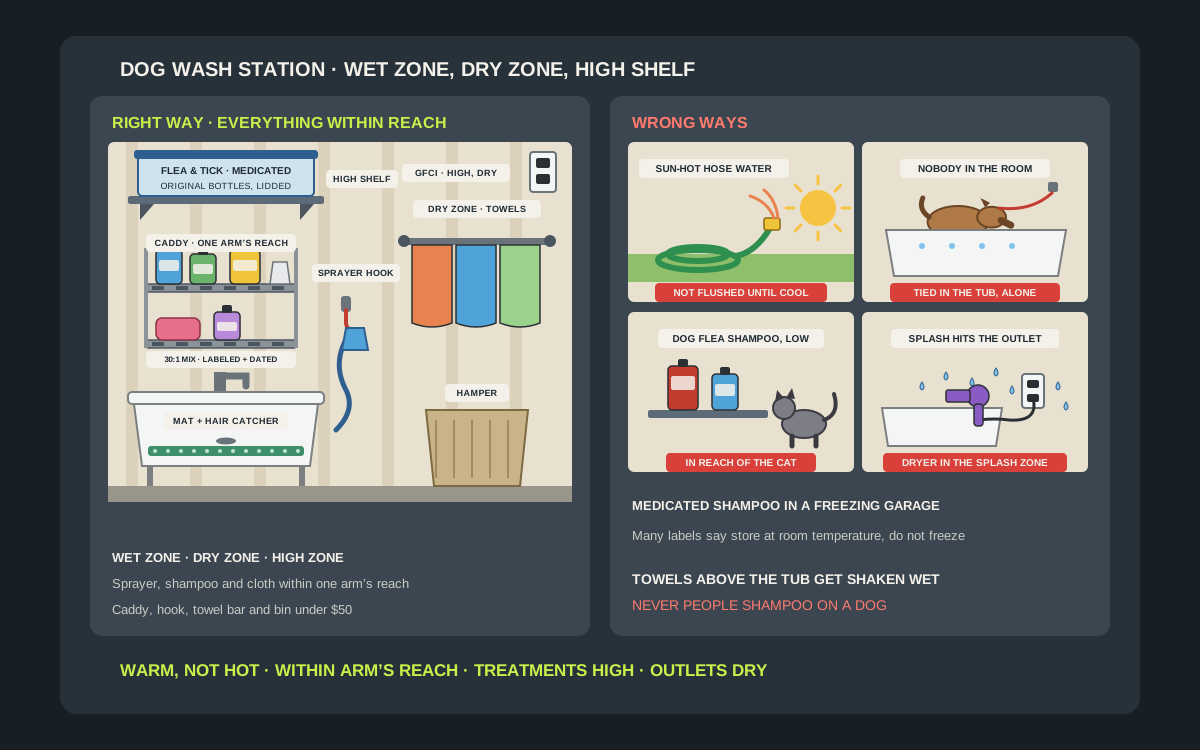
Bath day goes wrong in the first thirty seconds, before the dog is even wet. The shampoo is in the hall closet, the good towel is in the dryer, the sprayer is buried under the sink, and by the time you have found everything the dog has found the door. The American Kennel Club’s first piece of bathing advice is simply to gather everything you need before you start, and a wash station wall is how you make that permanent. One caddy, a hook for the sprayer, a towel bar and a high shelf put every tool within arm’s reach of the tub, so you never have to let go of a wet dog to fetch something. This guide shows how to lay out that wall in a garage, mudroom, laundry room or bathroom, which organizers survive constant water, how to store shampoo and towels so they stay usable, and the safety rules for water temperature, outlets and supervision that the AKC, the ASPCA and product labels spell out. Everything here fits under $50 in hardware.
Shop rustproof wall caddies on Amazon
Who this is for
- Dog owners who bathe at home in a laundry sink, utility tub, walk-in shower or outside by the spigot, and are tired of hunting for supplies with a wet dog waiting
- Households with muddy, swimming or long-coated dogs that need a rinse often enough to justify a permanent setup in the garage or mudroom
- Homes with dogs and cats, or dogs and small children, where flea and tick shampoo and medicated products must stay separate and out of reach
Quick answer
For most homes, the best dog wash station is a wall split into zones. Within arm’s reach of the tub, mount a rustproof two-tier caddy for everyday dog shampoo, conditioner, a washcloth and a pitcher, with a hook beside it for the sprayer. To the side, out of the splash, hang a towel bar or hooks with several thick towels and set a hamper below for the wet ones. Up high, put a lidded bin for flea and tick shampoo, medicated shampoo and refill jugs, kept in their original bottles. Lay a non-slip mat in the tub and a hair catcher over the drain. Run warm, never hot water, flush any garden hose that has been sitting in the sun before it touches the dog, and keep the dryer and its outlet out of the splash zone on a GFCI-protected circuit. A caddy, hooks, a towel bar and a bin stay under $50; check current prices and weight limits on the listing.
Quick comparison
| Organizer | Best for | How it holds | Trade-off |
|---|---|---|---|
| Two-tier draining wall caddy | Everyday shampoo, conditioner, washcloth, pitcher | Screwed rustproof basket or adhesive shower caddy beside the tub | Adhesive models have low weight limits; no gallon jugs |
| Sprayer hook or hose hanger | Handheld dog sprayer, shower hose or garden hose | Coated hook or hose hanger at tub height, into a stud or anchor | Hose must be drained and coiled loosely to dry |
| Pump or squeeze bottles | Diluted shampoo mixed from a concentrate | Ride in the caddy; label each with ratio and date | Mix small batches; label clearly |
| Towel bar or row of hooks | Thick bath towels and a microfiber drying towel | Bar or hooks screwed in the dry zone, beside not above the tub | Needs space for towels to dry between baths |
| High shelf with lidded bin | Flea and tick shampoo, medicated shampoo, refill jugs | Shelf on brackets above head height of kids and pets | Must stay out of the splash and away from the cat |
| Small bin or pegboard strip | Brushes, cotton balls, mineral oil, nail tools | Rail, pegboard or drawer in the dry zone | Keep combs out of the spray to stop rust |
| Tub mat, drain catcher and floor mat | Footing for the dog and the person | Suction mat in the tub, hair catcher over the drain, absorbent mat outside | Not a wall organizer; still part of the station |
Handheld dog wash sprayersWall-mounted towel bars and hooksPump bottles for diluted shampoo
What to look for
Materials that live with water
A wash station is wet several times a month and humid in between. Choose stainless steel, aluminum, powder-coated or plastic organizers with open or slotted bottoms so water drains away instead of pooling under the bottles. Plain chrome-plated wire and raw wood rust or swell fast next to a tub, and a caddy that holds standing water grows slime under every bottle.
Reach from where you stand
The AKC groomer safety standard asks that a pet in the tub never be left beyond arm’s length. Your organizers should respect the same rule: shampoo, washcloth, sprayer and the first towel should all be reachable with one hand while the other stays on the dog. If you have to take a step away to reach it, move it.
A separate, higher spot for treatments
Flea and tick shampoos and medicated shampoos are not everyday products. The label on Sergeant’s Skip-Flea and Tick Shampoo for dogs, for example, says to store it only in its original container in a cool, dry area inaccessible to children and pets. Any station worth building has a high shelf or lidded bin just for these, apart from the daily shampoo.
Mounting that suits the wall
Tile, painted drywall, garage studs and concrete block all need different hardware. Adhesive caddies made for showers hold light loads on smooth tile, glass or painted surfaces; screwed-in shelves and towel bars belong in studs or proper anchors. Full shampoo jugs are heavy, so match the load to the published rating.
Easy to clean
Dog hair, shampoo residue and grit end up on every surface near the tub. Caddies that lift off their wall base, smooth plastic bins and hooks with no deep crevices are easier to rinse. The Command shower caddy, for instance, slides off its base so it can be cleaned.
Why a dog wash station needs its own wall
Everything has to be ready first
The AKC’s guide to bathing at home starts with preparation: brush the dog first, then gather shampoo, a washing brush or washcloth, plenty of towels, cotton balls and mineral oil before you start, so you are not running off with the dog sitting wet in the tub. The AKC’s own advice on shampoos adds a simple rule: get everything ready before you turn the water on. A dedicated wall makes that the default instead of a scramble.
You only have one free hand
The other hand belongs on the dog. Groomer safety standards from the AKC say no pet should be left unsupervised beyond arm’s length in a tub, and groomer trainers repeat that a dog should never be left alone in the tub, even for a moment. Organizers that sit within one arm’s reach of the wash spot are what make that possible.
Wet supplies need somewhere to dry
Towels thrown in a heap, a sprayer left coiled in a puddle and a shampoo bottle sitting in a film of water all turn sour fast. A wall with hooks, a draining caddy and a towel bar lets everything drip and air out between baths.
Some products need to stay apart
Everyday dog shampoo, medicated shampoo prescribed by your vet and flea and tick shampoo do very different jobs. The EPA warns never to use flea and tick products made for dogs on cats, and labels such as Sergeant’s flea and tick shampoo say plainly do not use on cats. Giving each group its own shelf keeps the wrong bottle out of your hand mid-bath.
Where to build it
Laundry or utility sink
A deep utility sink in the laundry room or garage is the most comfortable home wash spot for small and medium dogs, because you work standing up. The wall behind or beside the sink is usually framed drywall or block, which takes a screwed-in caddy and towel bar easily. Check the outlets near it; electrical safety groups list laundry areas and anywhere within six feet of a sink among the places that need GFCI protection.
Walk-in shower or bathtub
A shower or tub is the default for most homes and the best option for big dogs that cannot be lifted. Tile walls are where adhesive shower caddies earn their keep, and a handheld shower sprayer does most of the work. Use the bathroom towel bar or an over-door rack for the dog towels so they stay out of the spray.
Mudroom wash bay
A mudroom with a low basin or a shower pan is the dream setup for active dogs: the dog comes in, gets rinsed and dries off before reaching the rest of the house. Mount the caddy and sprayer hook at the basin, and put the towel bar and a hamper between the basin and the door. Our mudroom pet station guide covers the leash and food side of the same room.
Garage or outdoor spigot
Many owners rinse dogs in the garage or driveway with a garden hose. It works for muddy legs in warm weather, but it brings two hazards that indoor setups do not: hose water heated by the sun, and cold water and freezing temperatures for both the dog and your shampoo. Both are covered below.
Zone the wall: wet, dry and high
The wet zone
Everything you use while the dog is wet goes here, within one arm’s reach of the tub: the sprayer on its hook, a caddy with everyday shampoo, conditioner and a squeeze or pump bottle of diluted shampoo, a washcloth or rubber scrubber, and a plastic pitcher or unbreakable cup. The ASPCA suggests a spray hose or a plastic pitcher for wetting and rinsing, so keep the pitcher in the caddy even if you have a sprayer.
The dry zone
Towels, the brush you use afterward, cotton balls and a small bottle of mineral oil belong to the side of the tub, past the reach of the shake. The AKC warns that dogs shake hard and may get a case of the zoomies after a bath, so put the towel bar where a soaked dog will not drench the clean towels before you get to them.
The high zone
A shelf above head height of kids and pets holds flea and tick shampoo, medicated shampoo, refill jugs and anything with a strong warning label. Use a lidded bin so the bottles stay upright and dry, and keep it out of the splash so labels stay readable.
The floor
A rubber or suction mat in the tub gives the dog footing, a hair catcher over the drain stops fur from clogging the pipe, and an absorbent mat outside the tub catches the drips. Wet fur on a hard floor is slippery for people as well as dogs, so the floor plan matters as much as the wall.
The seven organizers, in detail
Two-tier draining caddy: the core of the station
A two-tier wall caddy holds everything you use with the dog wet. Look for stainless steel, aluminum or rustproof coated wire, with slots or a mesh floor so water drains, and a top tier tall enough for a 16 or 20 ounce bottle. On tile, an adhesive shower caddy can work for light loads: Command’s water-resistant shower caddy is rated to hold up to 6.5 pounds and sticks to glass, mirror, tile, fiberglass, wood and painted surfaces. On drywall or studs, a screwed-in basket carries more and never lets go mid-bath.
Sprayer hook or hose hanger
A good sprayer is the tool you reach for most, and it needs a dedicated hook. The ASPCA notes that a sprayer or showerhead with a long hose lets you control the flow and keep water out of the dog’s eyes, ears and nose. Slip-on sprayers such as Rinseroo fit onto a faucet or showerhead; the maker says the shower and sink version fits fixtures up to 4 inches across, comes with a 6 foot hose in two 3 foot pieces, and should be removed after each use. The Aquapaw Bath Brush Sprayer is a wearable silicone scrubber with an 8 foot hose and adapters for a shower or a garden hose. Hang either one on a coated hook beside the tub, coiled loosely so it drains.
Pump or squeeze bottles for diluted shampoo
Concentrated grooming shampoos are mixed with water before use. Bio-Groom’s Econo-Groom concentrate, for example, dilutes 30 to 1, so one gallon makes 31 gallons of shampoo. Mixing a small batch in a clearly labeled pump or squeeze bottle spreads the shampoo through the coat evenly and stops you from pouring concentrate on the dog. Write the product, the ratio and the date on each bottle with a waterproof marker.
Towel bar or a row of hooks
A towel bar dries towels flat and fast; a row of hooks holds more towels in less width. The AKC recommends blotting, not rubbing, with thick, absorbent towels, and its bathing guide suggests having plenty on hand. For a medium or large dog, plan on at least two or three bath towels plus a microfiber towel for the final pass. Mount the bar in the dry zone, at a height a towel can hang without touching the floor.
High shelf with a lidded bin
A plain shelf on two brackets, screwed into studs above the caddy but out of the spray, is the place for flea and tick shampoo, medicated shampoo and refill jugs. A clear lidded bin keeps bottles upright and lets you read the labels. Store treatments in their original bottles; never decant a flea or medicated shampoo into an unlabeled squeeze bottle.
Small bin or pegboard strip for dry tools
Brushes, combs, a detangling spray, cotton balls for the ears and a bottle of mineral oil live in a small bin or on a pegboard strip in the dry zone. Metal combs and nail clippers rust if they get splashed, so keep them away from the spray. Our grooming tool holder guide goes deeper on brushes and combs.
Tub mat, drain catcher and floor mat
None of these mount on the wall, but every good station has them. A suction mat in the tub stops the dog from scrabbling, a hair catcher over the drain saves a plumber visit, and an absorbent mat or old towel outside the tub keeps the floor from becoming a slide when the dog jumps out. Hang the tub mat on a hook to dry between baths.
Hoses, sprayers and water temperature
Warm, never hot
The AKC says bath water should be warm, not hot, and its shampoo advice repeats that it should be slightly warm and never hot, with a soft stream rather than a hard spray. The ASPCA suggests lukewarm water, filled 3 to 4 inches deep in the tub. Test the water on the inside of your wrist before it touches the dog.
Flush a sun-warmed garden hose first
A garden hose that has been lying in the sun can deliver scalding water. Las Vegas Fire & Rescue warns that water sitting in a hose in direct sunlight can reach 130 to 140 degrees and burn children and animals, and advises letting it run for a few minutes before use. A veterinary study of ten dogs with garden hose scald burns found second and third degree burns, all between May and August in western and southern states, and noted the signs may not show for several days. Hang the hose on a wall hanger in the shade, and always run it until the water is cool before you rinse the dog.
Keep water out of eyes, ears and nose
The ASPCA advises against spraying water into a dog’s ears, eyes or nose, and suggests a large cotton ball in each ear. The AKC suggests a few drops of mineral oil around the eyes to protect them from soap, and the ASPCA mentions asking your vet for a sterile eye lubricant. Keep cotton balls and the mineral oil in the dry-zone bin so they are on hand before the water starts.
Slip-on sprayers need care
Rinseroo says its sprayer should be removed after every use, because its connectors are made from a biodegradable material that breaks down if left attached, and that water must keep flowing while it is in use. It is not made for high pressure. A wall hook beside the tub is the natural place to hang it between baths.
Winterize the outdoor hose
University of Illinois Extension advises removing and draining garden hoses from outdoor spigots before winter and storing them somewhere sheltered, because a connected hose can let ice work its way back into the spigot and the house, even with a frost-proof spigot. If your station uses the outdoor hose, move the wash indoors for the cold months and hang the drained hose on its wall hanger.
Shampoo storage that keeps products usable
Dog shampoo only
The AKC says never to use shampoo made for people on a dog, and the ASPCA explains that human shampoos are not toxic but may irritate a dog’s skin, so a species-specific product is the better choice. Keep only dog products in the station caddy so nobody grabs the family shampoo by mistake.
Room temperature, never frozen
Garage stations need special care in winter. Many veterinary shampoo labels carry a storage temperature. The label for Elanco’s ChlorhexiDerm 4% shampoo says to store at room temperature and protect from freezing, and Vital-KetoDine’s label gives 59 to 86 degrees Fahrenheit and protect from freezing. If your garage drops below freezing, bring medicated shampoos inside for the season and keep only a small bottle of everyday shampoo in the caddy.
Flea and tick shampoo stays in its original bottle
Pesticide shampoos are regulated products, and the label is the law for how to use them. The EPA-registered label for Sergeant’s Skip-Flea and Tick Shampoo says to store it only in its original container, in a cool, dry area inaccessible to children and pets, and not to use it on cats, because it may be toxic or fatal to them and cats that groom a treated dog can be exposed. It also says a partly filled container should not be poured down the drain; ask your local solid waste agency how to dispose of it.
Label diluted bottles
Every squeeze or pump bottle in the caddy should say what is inside, the dilution ratio and the date it was mixed. Mix small batches you will use within a few baths rather than a huge jug. Never put shampoo in an old food or drink bottle where someone could mistake it for something else.
Read the contact time
Some medicated and flea shampoos list a contact time on the label, the number of minutes the lather should stay on before rinsing. Follow the label or your vet’s instructions, and keep a timer or a phone stand within reach so you are not guessing.
Towels and drying
How many towels to keep
One small dog may need two towels, while a large, double-coated dog can soak four or five. The AKC suggests plenty of towels for a reason: wet towels lose their grip on water fast. Keep enough on the bar for a full bath and a spare on a hook in case the dog shakes the first one into the tub.
Blot, then dry fully
The AKC recommends blotting with thick, absorbent towels rather than rubbing, and keeping the dog warm until it is completely dry. Stand back during the shake, then towel the dog in the dry zone so the clean towels are not standing in splash water.
Using a dryer
If you use a blow dryer, the AKC says not to use the hottest setting and to keep it at least a foot away from the dog. A dryer brings electricity into a wet room, so its mount, cord and outlet need their own planning. Our grooming dryer wall mount guide covers placement, cord routing and outlet rules in detail; follow it rather than hanging a dryer over the tub.
Wash and dry the towels
Hang dog towels to dry right after the bath, then wash them separately before they sour. A small hamper or lidded bin under the towel bar keeps used towels off the floor until laundry day.
Electrical safety at the wash spot
GFCI protection
The Electrical Safety Foundation lists bathrooms, garages, outdoors, laundry areas and outlets within six feet of a sink or a tub or shower among the places that need ground fault circuit interrupter protection. Test the GFCI outlet nearest your station with its test and reset buttons, and call an electrician if it does not trip and reset properly.
Keep cords out of the splash
Do not mount the outlet, a power strip or a dryer directly above or beside the tub where the dog shakes. Keep electrical items in the dry zone, high and to the side, and never run an extension cord across a wet floor.
Unplug when the bath is done
Unplug the dryer and any clippers when you finish and hang the cords up off the floor. A wet dog tracking past a dangling cord is an easy accident to avoid.
Handling and supervision
Never leave the dog alone in the tub
AKC groomer safety standards say no pet should be left unsupervised beyond arm’s length in the tub or on the table, and that restraints such as grooming loops should be used only under constant, direct supervision. If you use a tub tether, it keeps the dog in place while you work; it is never a way to step away. Groomer trainers suggest placing the loop so it does not press on the windpipe.
Lift with help
Pet care professionals at Kennelwood warn never to let a dog jump out of the tub onto a wet, slippery floor, and recommend getting help to lift dogs over about 45 pounds. A ramp or step stool at the tub edge, or a walk-in shower, saves both your back and the dog’s joints.
Brush before the bath
Both the AKC and the ASPCA recommend brushing before bathing to remove dead hair and mats, which hold water and soap. Keep the brush in the dry-zone bin so it is the first thing you reach for.
How often to bathe
The ASPCA suggests bathing a dog at least once every three months, and the AKC says that with a gentle dog shampoo most dogs can be bathed as often as weekly. Your vet may recommend a different schedule for a dog with skin problems. Either way, a ready station makes the next bath a quick setup rather than a project.
Mounting by wall type
Tile
Smooth, sealed tile is ideal for water-resistant adhesive caddies and hooks, as long as you clean the tile, follow the strip instructions on waiting time and stay within the rating. For heavier loads, drill through the grout line or use a tile bit and plastic anchors, and seal the screw holes with silicone so water cannot get behind the tile.
Painted drywall
Laundry rooms and mudrooms are usually painted drywall over studs. Screw the caddy, towel bar and shelf brackets into studs where you can, and use rated anchors for light items between them. Plastic expansion anchors in damp drywall loosen over time, so avoid them for anything that holds water.
Garage studs and block
Garages often have bare studs, plywood or concrete block. Screw organizers straight into studs or plywood, and use masonry anchors in solid sections of block. Coated or stainless screws will last; plain screws rust quickly at a wash spot.
Rentals
If you cannot drill, combine an adhesive shower caddy rated for the load, a tension pole caddy in the shower and an over-door towel rack. Our tension pole shower caddy and over-door towel rack guides cover the no-drill options, and the same rules about draining bottoms and dry towels apply.
Three under-$50 builds
The bathroom tub station
An adhesive two-tier shower caddy within reach of the tub for dog shampoo, a diluted pump bottle and a washcloth, a slip-on sprayer on a hook, a suction tub mat and a hair catcher, plus an over-door rack for the dog towels and a lidded bin for flea shampoo on a high closet shelf. It is the right size for an apartment or a small dog, and it comes down without a trace.
The laundry sink station
A screwed-in stainless two-tier basket beside the utility sink, a coated hook for the sprayer, a towel bar on the wall past the sink with three bath towels, a high shelf on two brackets with a clear lidded bin for treatment shampoos, and a small bin for brushes, cotton balls and mineral oil. This is the build most homes with small and medium dogs should copy, and it stays under $50 if you shop basic hardware.
The garage or mudroom rinse wall
A hose hanger in the shade for the garden hose or a wearable sprayer, a rustproof caddy for a small bottle of everyday shampoo, a row of hooks for towels and a hamper by the door, and a bin of medicated products that comes inside for the winter. Add an absorbent mat at the door and our dog boot and towel station guide for everyday paw wipe-downs.
Setting it up, step by step
- Pick the wash spot and stand where you will bathe the dog; note where your free hand naturally reaches.
- Check the nearest outlets for GFCI protection and decide where electrical items will go, high and out of the splash.
- Mount the sprayer hook and the two-tier caddy in the wet zone, within one arm’s reach of the tub or basin.
- Mount the towel bar or hooks in the dry zone, past the reach of the shake, with a hamper below.
- Put up the high shelf and lidded bin for flea and tick and medicated shampoos, in their original bottles.
- Add a small bin or pegboard strip for brushes, cotton balls and mineral oil in the dry zone.
- Lay the tub mat and drain catcher, and put an absorbent mat where the dog will step out.
- Mix a small batch of diluted shampoo, label the bottle and do a dry run with the dog before the first real bath.
Keeping the station clean
After every bath
Pull the hair from the drain catcher, rinse the tub mat and hang it up, coil the sprayer hose loosely on its hook, wipe the caddy and hang towels to dry. Remove a slip-on sprayer from the faucet if the maker says to.
Once a month
Lift the caddy off its base or empty it, scrub away shampoo residue and check for rust or mildew. Look at the shampoo labels for expiry dates and throw out cloudy diluted batches.
Each season
Before winter, drain and hang the garden hose and move freeze-sensitive shampoos indoors. In spring, check the hose for cracks, flush it and remind everyone that a sun-warmed hose must run cool before it touches the dog.
Mistakes to avoid
- Turning on the water before the shampoo, towels and cotton balls are within reach.
- Rinsing a dog with a garden hose that has been sitting in the sun.
- Using people shampoo because the dog shampoo is in another room.
- Keeping dog flea and tick shampoo where a cat could be washed with it, or in an unlabeled bottle.
- Leaving a dog tethered in the tub while you step out for a towel.
- Mounting a dryer or power strip inside the splash zone.
- Hanging towels right above the tub where the dog shakes on them.
- Leaving medicated shampoo in a garage that freezes.
- Using a caddy with a solid bottom that holds water under the bottles.
Related guides
Browse the hub: Pet gear wall mounts under $50 - all guides
- Best Pet Grooming Dryer Wall Mounts Under $50
- Best Pet Grooming Tool Wall Holders Under $50
- Best Dog Boot & Towel Wall Stations Under $50
- Best Dog Coat & Towel Wall Hooks Under $50
- How to Build a Mudroom Pet Station Under $50
- Best Garden Hose Reel Wall Mounts Under $50 for Garages
- Best Tension Pole Shower Caddies Under $50 for Apartments
- Best Over-Door Towel Racks for Apartment Bathrooms Under $50
FAQ
What should a dog wash station include?
A sprayer or pitcher, dog shampoo and conditioner, a washcloth or scrubber, cotton balls and mineral oil, plenty of thick towels, a brush, a non-slip tub mat and a drain hair catcher. Store everything you use while the dog is wet within arm’s reach of the tub, and towels in a dry zone to the side.
Where should I store dog shampoo?
Keep everyday dog shampoo in a draining caddy beside the tub, and flea and tick or medicated shampoo in their original bottles on a high shelf or in a lidded bin, out of reach of children and pets. Many medicated shampoos should be kept at room temperature and protected from freezing, so do not leave them in a garage that freezes.
Is it safe to wash a dog with a garden hose?
It can be, in warm weather, if you let the water run until it is cool first. Water sitting in a hose in the sun can get hot enough to scald dogs. Aim for lukewarm water, keep the spray out of the eyes, ears and nose, and move baths indoors when it is cold.
How warm should bath water be for a dog?
Warm, never hot. The AKC recommends warm or slightly warm water with a soft stream, and the ASPCA suggests lukewarm water. Test it on the inside of your wrist before it reaches the dog.
Can I tie my dog in the tub while I get a towel?
No. Groomer safety standards say a pet should never be left beyond arm’s length in a tub, and restraints should only be used under constant supervision. Keep the towels within reach so you never have to step away.
Do I need a GFCI outlet near a dog wash station?
GFCI protection is required in bathrooms, garages, laundry areas, outdoors and within six feet of a sink, tub or shower, which covers almost every wash spot. Test the outlet with its buttons, and keep dryers and cords out of the splash zone.
Bottom line
The best dog wash station is a wall split into zones: sprayer, shampoo and washcloth within one arm’s reach of the tub, towels and brushes in a dry zone past the shake, and flea, tick and medicated shampoos high up in their original bottles. Use rustproof, draining organizers, lay a tub mat and a drain catcher, and keep the outlet and dryer out of the splash on a GFCI circuit. Run warm, never hot water, flush any sun-warmed hose first, never leave the dog alone in the tub, and bring freeze-sensitive shampoos inside for the winter. A caddy, a hook, a towel bar and a bin cost well under $50 and turn bath day into a quick, calm routine. Check weight limits, materials and current prices on the listing before you buy.