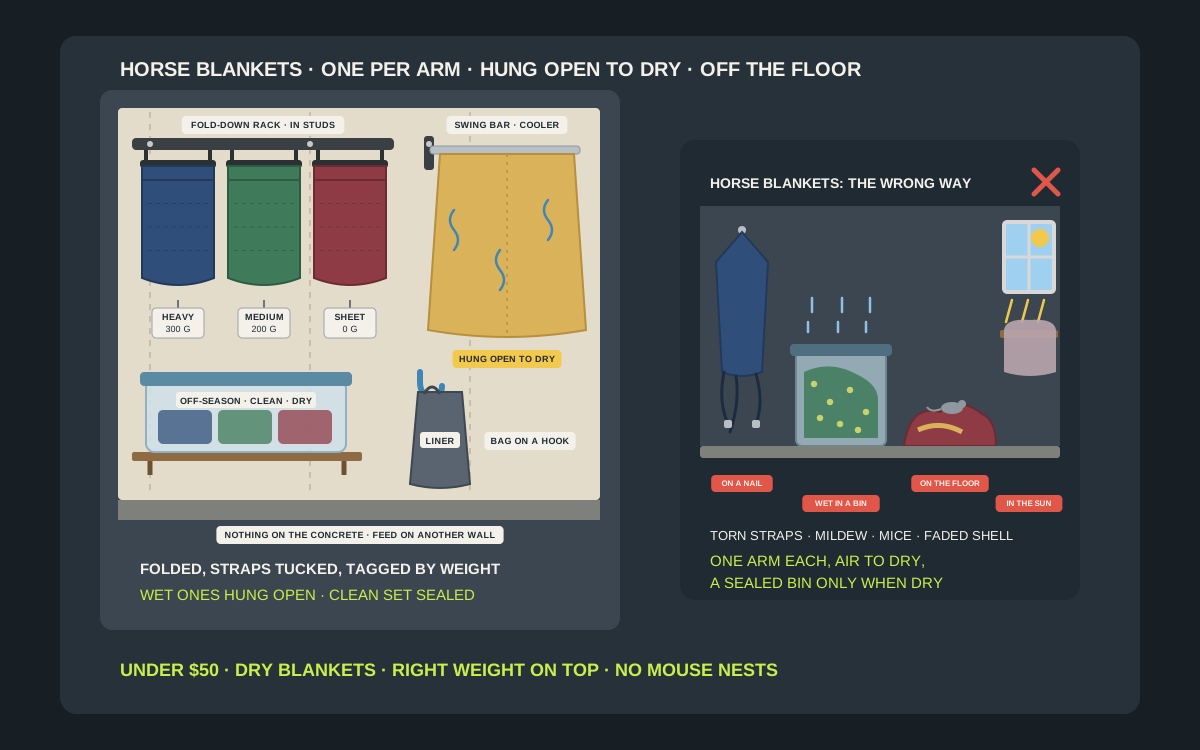
Blanket season turns a small horse setup into a laundry room. Between the rain sheet, the midweight, the heavyweight, the fleece cooler and maybe a liner or a neck cover, one horse can own five or six blankets, and two horses can easily own a dozen. In a barn with a tack room and blanket bars on every stall front, that is manageable. In a garage, a run-in shed or a small backyard barn, the blankets end up over the fence, on the hood of the car, on a pile of feed bags or balled up in the corner, still wet from yesterday’s rain. That pile costs money. A turnout that never dries properly smells and grows mildew, a blanket left on the floor becomes a mouse nest, straps that drag get stepped on and torn, and the right weight is never on top when the forecast changes at six in the morning. A blanket wall fixes most of that for very little. A swinging bar or a fold-down rack screwed into the studs, a place for the wet blanket to hang open, a couple of heavy hooks for blanket bags and one labeled bin for the clean off-season set cost less than a single new turnout. This guide covers which under-$50 racks suit turnout blankets, sheets and coolers, how to fold and hang each kind, where the blanket wall should go in a garage or small barn, how to set up a drying spot for wet blankets, and how to wash, fold and store the whole wardrobe when spring comes, using advice from university extension services, blanket makers and tack suppliers.
Shop horse blanket racks on Amazon
Who this is for
- Backyard horse owners whose blankets live in the garage, a shed or a small barn without a tack room
- Owners juggling a rain sheet, a midweight, a heavyweight and a cooler for one or two horses through the winter
- Anyone whose wet turnouts end up over the fence or on the floor because there is nowhere to hang them
- Riders packing blankets away for summer who want them clean, dry and free of mice next fall
Quick answer
For most garages and small barns, the best under-$50 blanket setup is a fold-down or swinging blanket rack screwed into the studs, holding the blankets in use this week folded over its arms, with a separate bar or a pair of heavy hooks where a wet blanket or the cooler can hang open to dry. Add a heavy-duty utility hook or two for blanket storage bags, and one labeled, lidded plastic tote or trunk for the clean blankets you will not need until the weather changes. Put the wall in a dry spot away from sunny windows, heaters, fuel cans and the car’s exhaust, keep everything off the floor and away from mice, and tag each blanket with the horse’s name, size and fill weight. Check the rack’s length, depth and mounting hardware against your wall and your blankets, and compare the current price on the listing before you buy.
Quick picks
- Best overall: a fold-down blanket rack with three or four arms, screwed into the studs. It holds the week’s blankets folded and separate, and it folds flat against the wall when the car needs the room.
- Best budget pick: a single swinging blanket bar. Tough1’s version is about 26 inches long, mounts with four screws you supply and swings flat against the wall when it is empty.
- Best for drying: a high bar or two heavy hooks where a wet turnout or a fleece cooler can hang open by the neck or tail, with air moving through it, instead of folded over a rail.
- Best for off-season storage: a heavy-duty lidded plastic tote or a metal trunk, labeled with the horse’s name and each blanket’s weight. It keeps mice and dust out of clean, bone-dry blankets until fall.
- Best for small walls: two screw-in utility hooks holding blanket storage bags. Each bag holds one folded blanket, hangs flat and keeps hay dust off it between uses.
- Best for a shared garage: a lockable trunk under the rack. The blankets in use hang above it, the good ones stay out of sight, and nothing sits on the concrete.
Quick comparison
| Setup | Best for | How it holds | Trade-off |
|---|---|---|---|
| Swinging blanket bar | One or two folded blankets | Single arm swings out to use, flat to the wall when empty | Holds few blankets; drying is slow when folded |
| Fold-down multi-arm rack | Three or four blankets in rotation | Separate arms hold folded blankets apart | Sticks out 8 in or more when up |
| Tiered hanging bars | Wet turnouts and coolers | Blanket hangs open by neck or tail strap | Needs height and more wall space |
| Portable blanket bar | Stall fronts, shows, a 2 in partition | Swivel hangers hook over a 2 in wall | Not for a flat garage wall |
| Heavy-duty utility hooks | Blanket storage bags | Bag hangs by its handle from a stud hook | Check the hook rating against a full bag |
| Garage track rail with long hooks | Mixed walls of blankets, bags and tools | Hooks slide along a rail screwed into studs | Rail and hooks add up in cost |
| Lidded plastic tote | Clean off-season blankets | Sealed lid keeps out mice and dust | Traps any moisture left in the blanket |
| Lockable tack trunk | Shared garages and good blankets | Locking lid over clean, folded blankets | Bigger trunks often top $50 |
Swinging blanket barsFold-down blanket racksHorse blanket storage bags
What to look for
Length and arms that match your blanket count
Count the blankets that are in use at the same time, not the whole wardrobe. A horse in a typical winter rotates between a waterproof sheet, a midweight and a heavyweight, with a cooler for wet days and after riding. A single bar holds one or two folded blankets neatly; a multi-arm fold-down rack keeps three or four separate so the one you need is not under the others. Tough1, for example, sells a 36 inch fold-down blanket rack for blankets, coolers and sheets, and a swinging blanket bar about 26 1/4 inches long. Measure the length of wall you can spare before you choose.
Depth that clears the car and the people
In a garage, how far a rack sticks out matters as much as how much it holds. A folded heavyweight turnout is thick, and a rack that holds it sticks well out from the wall. Retailers list Tough1’s 36 inch fold-down rack as extending about 8 to 11 inches from the wall when it is up, which is why the fold-down and swing-away designs suit garages: when the blankets are on the horse, the rack folds or swings flat and the car door opens freely. Leave enough room to stand in front of the rack with a blanket in your arms.
A way to let wet blankets dry
The single most useful thing a blanket wall can do is dry a wet turnout. Breeches.com points out that tiered hanging bars, where the blanket hangs vertically by the neck or tail strap, give air flow to every part of the blanket and speed drying after a rainy day, while horizontal bars that hold a folded blanket look neat but do not let it dry as thoroughly. Classic Equine suggests blanket drying bars or racks for exactly this reason. Plan one spot where a wet blanket can hang open, separate from the dry ones.
Solid mounting for a heavy, wet load
Blankets are heavier than they look. Horze lists its Nevada 1200D heavyweight turnout with 400 grams of fill at about 7 1/4 pounds dry, and a soaked blanket carries a lot of extra water. Several of them on a rack, plus someone leaning on it to pull one out, is a real load. Most blanket bars and fold-down racks come without hardware, so screw them into studs or into a solid board fixed across the studs, with screws long enough for the job, never into bare drywall. Tough1 notes that its swinging bar installs with four screws and its fold-down rack with wood screws, hardware not included.
Rounded, rust-resistant metal
Blankets are nylon and polyester shells over polyfill, with buckles, snaps and elastic straps. A rack with sharp edges or rough welds snags the shell and wears through the waterproof coating where the blanket rubs. Look for smooth tubing, rounded ends and a coated finish. Tough1 describes its fold-down rack as sprayed with a rust- and scratch-resistant finish, which matters in a damp garage or barn where wet blankets hang on it all winter.
Room for labels and a bin nearby
When the forecast changes, the right blanket needs to be easy to find. A rack with arms far enough apart to hang a small tag on each blanket, plus a shelf or floor space below for a lidded bin, turns a pile into a system. Horseware’s own advice is to write the horse’s name and the type of blanket on the storage bag or box, and Kensington suggests labeling with the horse’s name, size and blanket weight. A rack that leaves room for those labels is worth more than one that holds an extra blanket.
Know your blanket wardrobe
Sheets, liners and rain sheets
Sheets are the lightest layer. The University of Maine Cooperative Extension’s winter blanketing bulletin lists stable sheets, liners and rain sheets at 0 grams of fill, meaning they block wind, rain or dust but add little warmth. Rutgers Cooperative Extension adds that stable blankets typically are not waterproof, which is why owners in wet areas keep a waterproof turnout as well. Because they are thin, sheets fold small and hang easily on a single bar.
Light, medium and heavyweight turnouts
Turnout blankets are graded by the polyfill inside. The UMaine bulletin lists lightweight blankets at about 60 to 100 grams, medium weights at 150 to 300 grams and heavyweights at 300 grams and up, with quilted liners anywhere from 100 to 300 grams. Rutgers describes medium-weight turnouts as about 200 grams and heavyweights as about 300 grams, adding that their weight is noticeable when you put one on the horse or wash it at the end of the year. That bulk is why heavyweights need a sturdy rack and their own arm.
Coolers and fleeces
A cooler is a fleece or wool blanket that wicks moisture away from a wet or sweaty horse. Rutgers recommends fleece or wool coolers when a horse’s coat is wet, to keep it warm while it dries, and Purdue University’s equine hospital says a fleece cooler helps wick moisture and dry the hair and skin faster after a winter ride. Coolers get used often and come off the horse damp, so they belong where they can hang open, close to the door, not folded under a pile of turnouts.
Sizes, deniers and hoods
Blanket sizes are measured in inches. Rutgers explains how to measure from the center of the chest straight back to the center of the thigh beside the tail, and notes that ponies usually measure in the 60s, average horses in the 70s and larger warmbloods and drafts in the 80s. UMaine adds that denier describes the strength of the outer weave, so a 1200D shell is tougher than a 600D one, and that hoods are separate pieces that cover the neck. A size and weight tag on each blanket, such as 76 inches and 300 grams, saves unfolding three to find the right one.
Rack types, side by side
Swinging blanket bar
The simplest wall rack is a single steel bar on a pivot. Tough1’s swinging blanket bar is listed at 26 1/4 by 3 by 3/4 inches in chrome, secures to the wall with four screws that are not included, and swings out of the way when it is not in use. One bar holds a folded blanket or two, which is enough for a single horse with one blanket in use; two bars side by side give each horse its own.
Fold-down blanket rack
A fold-down rack is a row of arms, or a frame, that drops flat against the wall when it is empty and lifts out to hold blankets. Tough1’s version is 36 inches long and black with a rust- and scratch-resistant finish, and its listings describe it as mounting with wood screws or eight screws, not included, for blankets, coolers and sheets. In a garage, this is usually the best all-round choice: it holds the week’s rotation and gets out of the way of the car.
Tiered hanging bars for drying
Tiered bars mount high on the wall and let blankets hang vertically, clipped by the neck or the tail strap. Breeches.com notes that this gives air flow to every part of the blanket and speeds drying after a rainy day. They take more height than a folded rack, so they suit the tall back wall of a garage or a barn aisle rather than a spot above a workbench. One tiered bar for wet blankets, next to a fold-down rack for dry ones, is the ideal pair.
Portable blanket bar
Portable bars hook over a stall wall instead of screwing into it. Tough1’s portable blanket bar has two swivel hangers that fit over 2 inch walls and four arms for blankets, sheets and coolers. That makes it a good choice for a barn with 2 inch stall partitions or for horse shows, but it will not hang on a flat garage wall, so check what you are hanging it on before you buy.
Utility hooks and blanket bags
A blanket storage bag holds one folded blanket and hangs by its handle or clips. Breeches.com describes bags that clip to stall bars or wall hooks and keep blankets organized and out of the way, with the warning that a blanket must be completely dry before it goes in the bag. On a garage wall, a screw-in heavy-duty utility hook into a stud holds a bag well. Check the hook’s rating against a full bag, and use one hook per bag.
Garage track rail
If your garage already has a track rail system, long utility hooks and a deep hook or two can hold blanket bags, a folded sheet or the cooler next to the rest of the wall. Our track rail hooks guide covers which hooks suit which loads. Rails are flexible, but a rail plus several hooks can cost more than a dedicated blanket rack, so they make most sense when the rail is already up.
Lidded tote or trunk for the off-season set
The blankets you will not use for months do not belong on a rack at all. Classic Equine recommends heavy-duty plastic totes to protect stored blankets from mice and other rodents, and Kensington suggests heavy-duty bins or metal trunks in barns with rodent problems, warning that mice can chew through fabric bags and even thin plastic. A tote on a shelf or on a low platform under the rack keeps the clean set together and off the floor.
How to fold and hang each blanket
Fold in thirds for daily use
Adams Horse Supply’s blanket care guide suggests folding a blanket in thirds as you take it off the horse, which makes it easy both to hang and to put back on. The UMaine bulletin’s advice is to undo the rump straps first when you take a blanket off. Then lay the folded blanket over its rack arm with the lining facing out, so any damp side can air and the shell is not pressed against the wall.
Tuck the straps before it goes on the rack
Loose straps catch, tangle and get stepped on. Kensington’s advice for blankets that hang on a stall bar or rack is to use a simpler fold than for long-term storage, with the straps tucked in so nothing dangles. Clip leg straps to their own D-rings rather than leaving them hanging, and close the chest buckles so nothing swings into the walkway.
One blanket per arm, heaviest lowest
Give each blanket its own arm or bar, so you can pull the one you need without lifting the others. Put the heaviest turnout on the lowest, strongest arm closest to the wall, and the sheet or cooler where it is easiest to reach. Stacking several blankets on one bar traps moisture between them and turns the rack back into a pile.
Label by horse, size and weight
A small tag clipped to the rack arm or the blanket’s front, saying something like the horse’s name, 78 and 300 grams, tells anyone feeding or turning out which blanket to grab. Horseware suggests writing the horse’s name and blanket type on storage bags and boxes, and the same habit works on the rack. In a barn where more than one person blankets, it prevents a pony from wearing a draft horse’s heavyweight.
Set up a drying spot for wet blankets
Never put a wet blanket back on the rack folded
A soaked turnout folded over a bar stays wet in the middle for days. The UMaine bulletin’s advice is to remove saturated blankets and dry them, and to switch from a rain sheet to a lightweight sheet in long wet spells so blankets get a chance to dry. That means you need two of some layers and a place to hang the wet one open, ideally clipped by the neck or tail on a high bar with air moving around it.
Keep the cooler handy and hung open
Never blanket a wet horse. UMaine says to towel dry or use a blow dryer before adding a non-breathable blanket, Purdue’s equine hospital warns never to put a turnout or overnight blanket on a damp horse because it can lead to skin infections, and Rutgers notes that a wet blanket keeps the wetness in and can create skin fungus. The cooler is the tool that bridges that gap, so hang it open on its own hook or bar near the door where you can grab it the moment you come back from a ride or bring a wet horse in.
Air, not heat
Hang wet blankets where air moves, such as near an open door or under a ceiling fan, rather than pressed against a cold concrete wall or a stack of other blankets. Horseware tells owners to let washed blankets drip dry naturally and never tumble dry them, and Kensington gives the same warning. Keep drying blankets well away from space heaters and anything hot; slow air-drying is what keeps the waterproof coating intact.
Brush, then hang
Mud dries into the shell and wears it. Breeches.com recommends brushing blankets daily, and Horseware and Kensington both point out that dirt, mud, sweat and the ammonia in urine break down blanket fabric over time. Let a muddy blanket dry first, then brush it outside before it goes back on the rack, so the dirt does not end up on the dry blankets beside it.
Where the blanket wall goes in a garage or barn
Dry, shaded and out of the sun
Horseware says excessive heat, moisture or UV exposure can damage blankets and recommends a cool, dry place out of direct sunlight, and Kensington advises against storage spots with temperature extremes. In a garage, that rules out the wall under a south- or west-facing window and the spot above the water heater. Pick the driest wall you have, in shade, where air moves.
Away from fuel, chemicals and the parking spot
Garages hold gasoline cans, oil, lawn chemicals, ice melt and a car that may idle inside on cold mornings. Put the blanket wall on the side away from the parking space and the fuel shelf, so exhaust, spills and salt slush do not reach blankets your horse will wear against its skin. A fold-down rack also keeps blankets out of the swing of a car door.
Off the floor and away from mice
Mice love blankets. Breeches.com points out that the fleece or fuzzy padding at the withers is perfect nesting material, and Kensington warns that mice can chew through fabric bags and even thin plastic. Keep every blanket off the floor, keep feed in sealed bins on another wall, and check the back of the rack and the bottom of the tote for droppings. If your garage also holds chicken feed, our backyard chicken supply racks guide covers that wall; keep it on the far side.
Next to the tack, not on top of it
If the horse’s bridles, halters and saddle share the garage, the blanket wall belongs beside the tack wall, not over it. Damp blankets near leather invite mildew, and folded turnouts piled on a saddle press it out of shape. Our horse tack wall racks guide covers the bridle brackets, halter hooks and saddle rack; leave a gap between the two so air can move.
The daily blanket routine
Check the forecast and change layers
Winter days can swing widely. The UMaine bulletin’s example is a forecast that climbs from 10 F at dawn to 40 F by afternoon: in that case, take the blanket off in the morning rather than leaving a heavyweight on all day. A rack where every weight is visible and labeled makes those quick swaps practical before work.
Take the blanket off and look
Blankets hide problems. Rutgers recommends taking the blanket off at least once a week for a good grooming and a close look at the horse underneath, and many owners pull it off daily for a quick check. The rack is where the blanket waits during that check, so it should be close to where you groom.
Inspect straps and holes every visit
Breeches.com recommends checking blankets for holes and broken straps every time you go to the barn, because broken straps dangling around a horse’s legs can tangle or spook it. Hanging blankets on a rack, rather than in a heap, means you see the torn leg strap before it goes on the horse. A small bin on the rack with spare leg straps, snaps and a repair kit makes the fix a two-minute job.
Match the blanket to the weather
The UMaine bulletin gives a temperature guide: for horses in a full natural coat, no blanket at 40 F and above, a light or midweight at about 15 to 24 F and a heavyweight from 0 to 14 F, with clipped horses needing a layer sooner. Use your own horse’s coat and condition as the final guide, and keep the lighter options within reach.
Wash, repair and store for the off-season
Brush, wash cool and skip the detergent
Horseware’s spring routine is to brush dirt and mud off the shell and straps with a stiff brush, remove hair from the lining, wash on a cool setting in a machine large enough for the blanket and use a wash made for blankets, rinsing out all the soap. Adams warns against washing machines with an agitator, which can damage the material and fill, and Classic Equine and Breeches.com both caution that regular laundry detergent can strip a blanket’s waterproofing. Kensington adds: never use fabric softener. If you hose a blanket, Horseware says to use gentle pressure, because a power washer can damage the waterproof layer.
Dry completely, then re-proof
Hang the washed blanket over a rail or bar to drip dry, never in a dryer. Adams suggests checking whether water still beads off a turnout; if it does not, it may need re-waterproofing, either with a spray or wash-in product or by a professional blanket service, and it recommends checking with the manufacturer first in case re-proofing affects the warranty.
Repair before it goes away
Horseware recommends checking stitching, lining, buckles and straps before storage, so you do not discover a missing surcingle on the first rainy night of fall. Kensington’s checklist adds a simple waterproofing test: sprinkle water on the shell and see whether it beads. Classic Equine has a frugal tip for blankets that are past saving: cut the metal hardware off before you throw the blanket out and keep it for repairs on newer ones. A labeled jar of spare buckles and snaps fits on the shelf next to the tote.
Bag, box or vacuum seal
Horseware says a breathable storage bag is best, and the bag the blanket came in is a good option; a plastic box keeps dust, dirt and rodents away, and vacuum-sealed bags save space. Kensington adds that vacuum bags save the most space but that long compression can affect the loft of the insulation. Whatever you choose, the blanket must be bone dry: Kensington warns that a sealed bin traps any moisture left in it and suggests desiccant packets in humid climates.
Fold small and label everything
For off-season storage, Adams Horse Supply’s guide walks through folding the blanket into a compact square along its back line, and Kensington recommends tucking the straps in first so they do not tangle. Label each bag or tote with the horse’s name, size and blanket weight. Classic Equine suggests a few dryer sheets in the tote to help deter mice and keep the blankets smelling fresh.
Where the off-season set should live
Stored blankets want the same conditions as the rack, only more so: cool, dry, dark and mouse-proof. Kensington warns against uninsulated attics and sheds where temperatures swing widely. In a garage, a lidded tote on a sturdy shelf, off the concrete and away from the door, is the practical answer, with a check every month or two in humid weather.
Taking blankets out again in the fall
Start a week early
Kensington suggests taking blankets out of storage about a week before you expect to need them, airing them out, inspecting them for damage that happened in storage, checking the fit and re-waterproofing turnouts if needed. Horses change shape over a summer, so check each blanket’s fit on the horse before it goes back on the rack. Rutgers and UMaine both explain how to measure if you need a new size.
Rebuild the rotation on the rack
Hang the sheet, the midweight and the heavyweight in that order on the fold-down rack, put the cooler on its drying bar by the door and leave the liners and spares in the tote. As the season settles, you will know which blankets never leave the rack and which can go back in the bin, which keeps the wall uncluttered.
Three sample setups
Two-car garage, one horse out back
On the side wall away from the car, a 36 inch fold-down rack is screwed into three studs at about chest height, holding the rain sheet, the midweight and the heavyweight, each tagged with the horse’s name, size and fill. To the right, a swinging bar holds the fleece cooler hung open. Two utility hooks carry blanket bags with the neck cover and a spare sheet, and a lidded tote on a shelf above holds the liner, spare leg straps and a repair kit.
Small backyard barn, two horses
Each horse gets a column on the aisle wall: a swinging blanket bar for the blanket in use and a hook for its cooler, with names on both. At the end of the aisle, a tiered drying bar high on the wall takes wet turnouts after a rainy day. The off-season blankets, washed and labeled, sit in heavy-duty totes on a platform in the feed room, with the feed in sealed cans on the opposite wall.
Garage plus a boarding barn with stall-front bars
The horse lives at a boarding barn with a blanket bar on the stall front, so only the blanket in use stays there. The garage holds the rest: a fold-down rack for the spare midweight and the show cooler, blanket bags on hooks and two labeled totes for summer storage. When a blanket comes home dirty, it is brushed outside, hung to dry on the rack and then washed or swapped.
How to set it up in an afternoon
- Count the blankets in use at the same time for each horse, and set aside the off-season ones.
- Choose a dry, shaded wall away from sunny windows, heaters, fuel, chemicals and the parking spot.
- Find the studs and mark a run of wall long enough for a fold-down rack or one swinging bar per horse.
- Screw the rack or bars into the studs, or into a solid board fixed across them, with screws long enough for a heavy, wet load.
- Add a high bar or two heavy hooks nearby as the drying spot for wet blankets and the cooler.
- Screw one or two heavy-duty utility hooks into studs for blanket storage bags.
- Put a lidded tote or trunk on a shelf or platform, off the concrete, for clean off-season blankets and a small parts bin for straps and snaps.
- Brush, fold and hang each blanket on its own arm, with straps tucked and chest buckles closed.
- Tag each blanket or arm with the horse’s name, size and fill weight, and check the back of the rack for mice every few weeks.
Mistakes to avoid
- Folding a soaked turnout over a bar where the middle never dries, instead of hanging it open.
- Stacking three blankets on one bar, so moisture is trapped between them and the one you need is at the bottom.
- Leaving blankets on the floor or a feed pile, where mice nest in the fleece at the withers.
- Screwing a blanket rack into bare drywall and loading it with heavy, wet turnouts.
- Hanging blankets with leg straps and belly straps dangling into the walkway.
- Putting the blanket wall under a sunny window or next to a heater, where UV and heat break down the shell and waterproofing.
- Sealing a slightly damp blanket in a plastic tote for the summer.
- Washing turnouts with regular detergent or fabric softener, or tumble drying them, and stripping the waterproofing.
Related guides
Browse the hub: Pet gear wall mounts under $50 - all guides
- Best Horse Tack Wall Racks Under $50 for Garage & Barn (Bridles, Halters & Lead Ropes)
- Best Backyard Chicken Supply Wall Racks Under $50 for Garage & Shed
- Best Dog Coat & Towel Wall Hooks Under $50
- Best Pet Bed Wall Storage Bags Under $50
- Best Pet Grooming Tool Wall Holders Under $50
- Best Garage Track Rail Hooks Under $50
- Best Clear Storage Bins for Garage Organization Under $50
- How to Do a Fall Garage Cleanout with Wall Racks Under $50
- Hook Rail vs Individual Hooks for Garage Walls Under $50
FAQ
What is the best way to hang horse blankets in a garage?
Use a fold-down or swinging blanket rack screwed into the studs, with each blanket folded in thirds, straps tucked, on its own arm. Add a separate high bar or heavy hooks where a wet blanket or the cooler can hang open to dry, and keep the wall away from sunny windows, heaters, fuel and the car.
How do you dry a wet horse blanket?
Hang it open, by the neck or tail strap, where air moves, rather than folded over a bar. Horseware advises letting blankets drip dry naturally and never tumble drying them. Breeches.com notes that vertical hanging bars dry blankets faster than folded horizontal bars. Brush off dried mud once it is dry.
How should horse blankets be stored for the summer?
Brush, wash and repair them, re-waterproof turnouts if water no longer beads, and let them dry completely. Fold them with the straps tucked and store them in a breathable bag, a heavy-duty lidded tote or a vacuum bag, labeled with the horse’s name, size and weight, in a cool, dry, mouse-proof place off the floor.
How do I keep mice out of stored horse blankets?
Keep blankets off the floor and store the off-season set in heavy-duty plastic totes or metal trunks, since mice can chew through fabric bags and thin plastic. Keep feed in sealed bins elsewhere. Classic Equine suggests a few dryer sheets in the tote as an extra deterrent.
Can I put a blanket on a wet horse?
Not a turnout or stable blanket. The University of Maine Cooperative Extension says to towel dry or blow dry the horse first, and Purdue’s equine hospital warns that a turnout on a damp horse can lead to skin infections. Use a fleece or wool cooler to wick moisture until the coat is dry, then blanket.
Should I wash horse blankets with regular laundry detergent?
No. Classic Equine and Breeches.com warn that regular detergent can strip the waterproofing. Use a wash made for horse blankets, a cool setting and a large machine without an agitator, skip fabric softener and hang the blanket to dry. Follow the maker’s care label, since washing outside it can affect the warranty.
Bottom line
The best horse blanket storage for a garage or small barn is a short, sturdy wall: a fold-down or swinging blanket rack in the studs for the blankets in use, one open bar or pair of heavy hooks where a wet turnout or the cooler can dry, a hook or two for blanket bags and a lidded tote for the clean off-season set, all in a dry, shaded spot away from heat, fuel, the car and mice. Fold each blanket with its straps tucked, give it its own arm and a label, never fold a soaked blanket over a bar, and wash, dry and box everything properly in spring. Count the blankets you rotate, measure your wall, then check the length, depth, mounting hardware and current price on the listing before you buy.