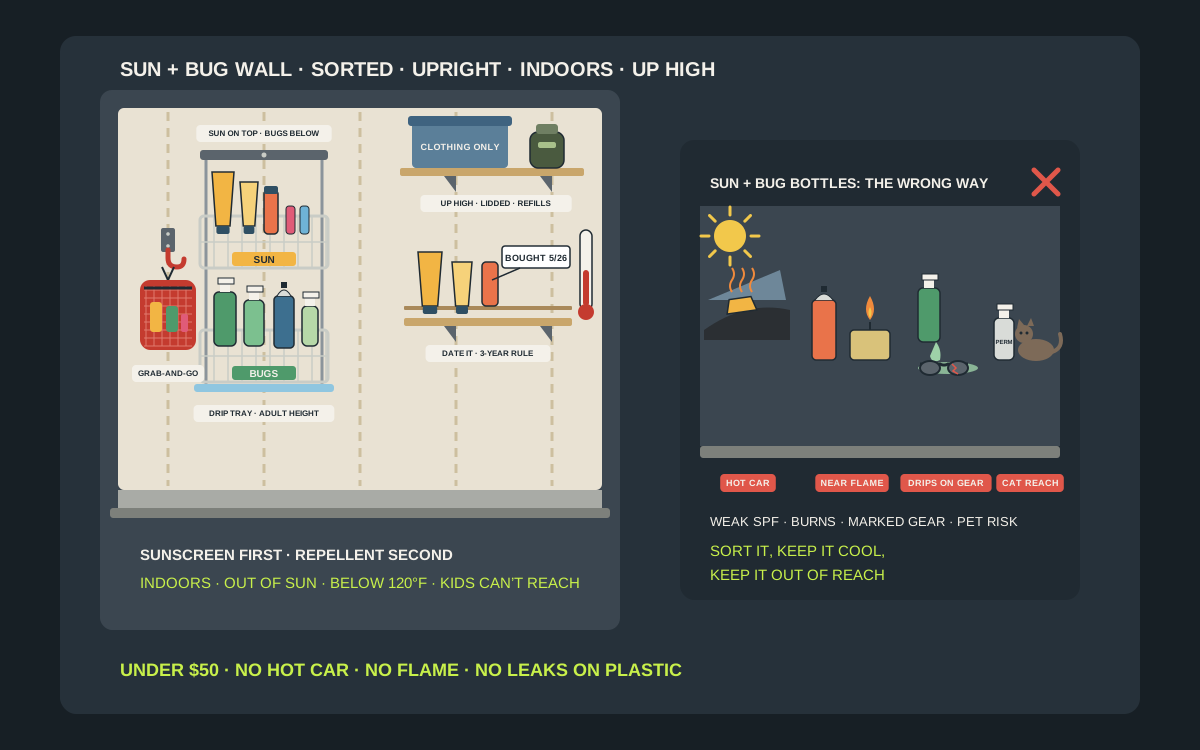
Every camping household has the same pile somewhere: three half-empty bottles of bug spray, a can of spray sunscreen with no cap, a sunscreen stick from two summers ago, a bottle of permethrin nobody remembers buying, and a lip balm with SPF that turns up in the dryer. Most of it lives in a tote in the garage or the glove box, which is exactly where it should not be. Sunscreen labels have to say "protect the product in this container from excessive heat and direct sun," aerosol cans warn against storage above 120°F, and DEET labels warn that the product can damage plastics, leather and painted surfaces. Meanwhile, the one bottle you need is never in the bag when you reach the trailhead. A small wall caddy fixes both problems for well under $50. It keeps the sun products and the bug products sorted, upright and indoors at room temperature, puts the grab-and-go kit by the door you leave from, and puts the clothing-only treatments and refills up high, away from children and pets. This guide covers which caddy suits which collection, how to sort the bottles the way their labels sort them, what the FDA, EPA and CDC say about heat, flame, children and expiration, and where the caddy belongs at home, in a cabin and in the RV.
Shop wall caddies for bug spray and sunscreen on Amazon
Who this is for
- Campers, hikers and anglers who use sunscreen and insect repellent every weekend from spring to fall and keep losing the right bottle
- Families with kids, where the repellent has to be easy for adults to grab and hard for small hands to reach
- RV, van and cabin owners who want a small, tidy station for sun and bug products that does not bake in the rig or rattle on the road
Quick answer
For most people, the best under-$50 bug spray and sunscreen wall caddy is a two-tier wire or plastic shower-style caddy screwed into a stud, or a clear over-door pocket organizer, on an inside wall near the door you leave from. Put sunscreen in one basket and skin repellents in another, label them, stand aerosols upright, and set a small tray under the repellents so a leak never reaches painted trim or plastic gear. Clip a mesh grab-and-go pouch with one sunscreen, one repellent and an SPF lip balm to a hook beside it, and keep permethrin, refills and repellent devices in a lidded bin on a high shelf. Keep the whole station indoors, out of the sun and below 120°F, write the purchase date on bottles without an expiration date, and check the caddy size, hook rating and current price on the listing before you buy.
Quick comparison
| Setup | Best for | How it holds | Trade-off |
|---|---|---|---|
| Two-tier wall caddy | A family station by the back door | Screws into a stud; sun basket over bug basket | Needs screws, not stickers |
| Clear over-door pocket organizer | Closets, laundry rooms and rentals | Hooks over a door; each bottle gets a pocket | Pockets sag with heavy cans |
| Pegboard bins | Garage gear walls and mudrooms | Bins hang on pegboard hooks and move as needs change | Small bins tip if overloaded |
| Small wall shelf with a lip | Cabins and entryways | Bottles stand in a row behind a raised edge | Open to dust and small hands |
| Mesh pouch on a hook | The grab-and-go trail kit | One sunscreen, one repellent and lip balm zipped in a clip-on pouch | Holds travel sizes only |
| Lidded bin on a high shelf | Permethrin, refills and repellent devices | Closed bin out of reach, labeled clothing only | Not for everyday bottles |
| RV cabinet-door caddy | Campers, trailers and vans | Screwed or adhered inside a cabinet door, out of the sun | Only shallow bottles fit |
Clear over-door pocket organizersPegboard bins and basketsMesh zip pouches with a clip
What to look for
Two zones, not one bin
Sun products and bug products are used differently, so they should not share a basket. The CDC says that if you use both, you should apply sunscreen first and insect repellent second, and its Yellow Book advises against products that combine the two, because sunscreen needs reapplying far more often than repellent. A caddy with two clearly labeled baskets, or two pockets of a door organizer, turns that advice into a habit: top basket sunscreen, bottom basket bug spray, and nobody grabs the wrong bottle in a hurry.
Holds bottles upright
Most of what goes in this caddy is a pump spray, a lotion tube, an aerosol can or a stick, and almost all of it is happier standing up. Aerosols spray properly upright and are less likely to leak at the valve, pump caps stay sealed, and lotion bottles do not ooze into the basket. Look for baskets at least 3 inches deep with a solid or tight-mesh floor, or pockets that are snug enough to keep a 6 oz bottle vertical.
Leak-proof under the repellents
This is the detail most people skip. EPA-registered DEET labels routinely say the product will not damage cotton, wool or nylon but may damage some synthetic fabrics, plastics such as eyeglasses and watch crystals, leather, and painted or varnished surfaces. A weeping pump bottle sitting on a painted shelf or on top of a plastic sunglasses case can leave a mark. A removable plastic tray, a silicone mat or a lined basket under the repellents catches drips, and it lifts out to wash.
Mounted where heat and sun cannot reach
The FDA recommends that sunscreen containers not be exposed to direct sun, and the required label line is to protect the product from excessive heat and direct sun. Aerosol sunscreens and repellents carry their own warning, typically do not store above 120°F, and DEET labels say to store the product in a cool, dry place. The caddy you buy matters less than where you mount it: an inside wall of the house, away from a sunny window, a heater vent, a water heater or a furnace.
High enough for adults only
EPA’s guidance for storing pesticides at home, which includes insect repellents, is to keep them out of reach of children and pets, ideally in a locked cabinet. Repellent labels add that children should not handle the product and that adults should apply it to their own hands first and then to the child. A caddy mounted at adult chest height, around 48 to 60 inches to the bottom basket, keeps everyday bottles handy for grown-ups, and a higher shelf or a latched cabinet takes the stronger products.
Rated for a full load
A full caddy is heavier than it looks. Six full 6 oz bottles and two spray cans weigh roughly 4 lb, and a two-tier metal caddy adds another pound or two. Command lists its Large utility hook at 5 lb and notes its indoor strips are for roughly 50 to 105°F, which makes adhesive mounting fine for a single pouch but marginal for a loaded two-tier caddy. Screw a wall caddy into a stud or use the anchors it comes with, and save adhesive for light pockets and the grab-and-go pouch.
Why sun and bug products need their own spot
Heat ruins sunscreen quietly
Sunscreen is an over-the-counter drug in the United States, and the FDA treats storage as part of keeping it effective. It recommends keeping containers out of direct sun and wrapping them in towels or keeping them in the shade when you are outside in the heat for long periods. A tube that spends July in a glove box or a black tote in the garage may look the same and quietly protect less. A wall caddy indoors keeps the stock at room temperature, and only the travel-size bottle in the pouch goes out into the heat.
Aerosols and alcohol sprays are flammable
Many spray sunscreens and repellents carry a flammable warning, contents under pressure, keep away from fire and smoking, do not store above 120°F. The FDA has reported people who suffered serious burns after applying a flammable sunscreen spray and then getting close to a flame, and the ignition sources included a lit citronella candle and a grill. That is a strong reason not to store spray cans on a shelf above a camp stove, beside a fire-starter kit or next to the candles on the porch.
Repellents can mark gear and finishes
DEET is the most widely used repellent and one of the most effective, and its labels are frank about what it can do to materials: synthetic fabrics such as acetate, rayon and spandex, plastics, leather, watch crystals, and painted or varnished surfaces. Sawyer says its 20 percent picaridin will not damage plastics or synthetic coatings, though independent testing has found some picaridin lotions can mark vinyl and leather. Either way, a repellent bottle should not sit loose in a bag with sunglasses, a phone, a headlamp and a rain jacket.
Kids, pets and the wrong bottle
Bug spray is a registered pesticide. EPA tells households to store pesticides out of reach of children and pets, in their original containers, and never to move them into another bottle. Permethrin clothing treatment adds another layer: it is not for skin at all, and Sawyer warns that it is toxic to cats until it has completely dried. Keeping it in the same basket as the kids’ sunscreen is how mistakes happen.
Sort the bottles the way their labels do
Sunscreens and SPF lip balm
Lotions, sticks, sprays and SPF lip balms go in the top basket. The CDC’s travel guidance recommends broad-spectrum SPF 30 or higher, about 1 fluid ounce per full-body application for an adult, and reapplying every 2 to 4 hours, more often after sweating or swimming. That means you go through sunscreen far faster than repellent, so the sun basket should be the easiest one to reach and the first one restocked.
Skin repellents
Pump sprays, lotions and wipes with DEET, picaridin, IR3535, oil of lemon eucalyptus, PMD or 2-undecanone go in the bottom basket. Those are the active ingredients the CDC lists for EPA-registered repellents. The CDC says not to use products containing oil of lemon eucalyptus or PMD on children under 3, so if you keep one, label it adults only and put it at the back of the basket. Keep each product in its original container, with the label facing out.
Clothing treatments
Permethrin is a separate category. It is applied to clothing and gear, not skin, then left to dry for at least 2 hours, or 4 in humid weather, according to the EPA-registered labels. It belongs in a lidded bin on a high shelf, with a label that says clothing only, next to a pair of gloves. Sawyer suggests storing treated clothing in a dark plastic bag between uses to help it last, and that bag can live on the same shelf.
Repellent devices and refills
Thermacell-style repellers use repellent mats and small butane cartridges. Thermacell says to store unused mats in their original packaging in a cool, dry place out of reach of children and pets, and the cartridges away from heat, sparks and flame, below 120°F. They go in the lidded bin with the permethrin, never loose in the everyday caddy, and never in a hot vehicle.
Seven caddy setups for under $50
A two-tier wall caddy
The classic choice is a two-tier wire or powder-coated metal caddy, the kind sold for showers or kitchen walls, screwed into a stud. The top basket holds sunscreens, the bottom basket holds skin repellents, and a removable plastic tray or a cut-to-fit silicone mat sits under the repellents. Choose baskets 10 to 12 inches wide and at least 3 inches deep, which hold six to eight bottles each. It is the best setup for a family, and it looks tidy on a mudroom wall.
A clear over-door pocket organizer
A clear vinyl or mesh shoe organizer over a closet or laundry-room door gives every bottle its own pocket, and you can see at a glance what is running low. Use the top rows for repellents, so children cannot reach them, the middle rows for sunscreen and lip balm, and the bottom rows for things like hats, bandanas and sunglasses. Pockets sag with heavy aerosol cans, so put cans in the row closest to the hanging hooks. It is the best no-drill option for renters.
Pegboard bins
If your camping gear already lives on a pegboard, two hanging bins next to the packs make a sun-and-bug station in five minutes. Pegboard bins move as the season changes, and a label clip on each bin keeps the two zones apart. Pegboard in an attached garage works if that wall stays out of the sun and the garage stays reasonably cool; in a hot garage, move the bins indoors for the summer.
A small wall shelf with a lip
A short floating shelf or spice-rack style shelf with a raised front edge holds a row of bottles at eye level in an entryway or a cabin. It is the most attractive setup and the easiest to keep tidy, but it is open: bottles collect dust, and the shelf is within reach of anyone. Keep it for sunscreen and lip balm, and put repellents somewhere higher.
A mesh grab-and-go pouch on a hook
The single most useful piece is a clip-on mesh pouch hung on a hook by the door, packed with one travel-size sunscreen, one travel-size repellent, an SPF lip balm and a few wipes. It goes in the pack on the way out, comes back on the hook on the way in, and the caddy refills it. One pouch per pack, in different colors, ends the argument over whose sunscreen is whose. A pouch weighs a few ounces, so a small adhesive hook is fine here.
A lidded bin on a high shelf
Permethrin, spare bottles, repellent mats and cartridges go in a small lidded bin on the highest shelf of the closet or gear wall, labeled clothing only and refills. This is where EPA’s advice about keeping pesticides out of reach and in their original containers is easiest to follow, and it keeps the everyday caddy down to the bottles you actually use.
An RV cabinet-door caddy
In a camper, trailer or van, the best spot is usually inside a cabinet door near the entry, where a slim caddy or a few adhesive pockets hold shallow bottles out of the sun. Stand bottles upright and keep caps closed, because rigs shake. Avoid the cabinet over the stove and any window-side cabinet that gets afternoon sun. For mounting without damaging RV walls, see our guide to hooks in an RV.
Where the caddy goes
The mudroom or back door
The best spot is an inside wall right by the door you leave through for hikes, the lake or the campground. Mount the bottom basket at about 48 inches and the top around 60 inches, which keeps bottles at adult reach and above most toddlers. A hook for the grab-and-go pouch goes at the same height beside it. If you also keep packs there, our camping backpack hooks guide covers a full gear wall.
The laundry room or a closet door
A laundry room stays at room temperature, often has a door for an over-door organizer, and is a natural place for the permethrin bin, because treated clothes are hung there to dry. It is also a good home for sunscreens that would otherwise sit in a hot garage. Keep the repellents in the top pockets and the room door closed if small children are around.
The garage, with care
Garages are where camping gear lives, so it is tempting to put the caddy there too. An attached garage that stays cool works for part of the year, but a garage in July can get far hotter than the 120°F limit printed on aerosols, and the FDA’s heat warning for sunscreen applies well below that. If you store gear in the garage, keep the caddy on the inside wall shared with the house, away from the door and windows, and bring the sunscreen indoors for the summer.
The cabin or campsite
At a cabin, a lipped shelf or a wall caddy just inside the door works as it does at home. At the campsite, the FDA’s advice is simple: keep sunscreen in the shade, wrapped in a towel, or in a cooler. A mesh pouch hung inside the tent vestibule or under the awning keeps it out of the sun, and away from the stove, the fire and any citronella candles.
Heat, flame and the 120°F line
Read the can, not the shelf
Aerosol labels state the limit plainly: flammable, contents under pressure, do not store above 120°F, do not puncture or incinerate. Some sunscreen sprays also advise against long-term storage above 104°F. That makes a car, a black tote in the sun, a shed roof shelf and the space above a water heater the wrong places for cans, whatever caddy you use.
Keep cans away from the fire kit
Many camping households keep a fire-starter kit, fuel canisters and a grill lighter on the same gear wall. The FDA notes that spray sunscreens, insect repellents and hairspray can all contain flammable ingredients, often alcohol. Keep the sun-and-bug caddy on a different wall from the fuel and fire kit, and never on a shelf above the stove in an RV.
Apply away from flame, too
The FDA’s advice after a flammable sunscreen spray is to avoid open flames, sparks and grills while wearing it, even if your skin feels dry, and to choose a non-flammable sunscreen if you will be near a flame. For families who cook over a campfire, a lotion or stick is the better product to keep in the trail pouch.
Kids, pets and the reach rule
Adults apply, children watch
Repellent labels and the CDC say the same thing: do not let children handle repellent, do not apply it to their hands, eyes or mouth, and for the face, spray it on your own hands first. A caddy mounted at adult height enforces that without anyone having to remember.
Locked or lidded for the strong stuff
EPA suggests a locked cabinet for pesticides at home. For most families, a latched cabinet or a lidded bin on the top shelf, plus a basket that toddlers cannot reach, is a realistic version of that advice. Keep high-concentration repellents and permethrin there, and keep the everyday family repellent in the bottom basket of the caddy.
Cats and permethrin
If you have a cat, permethrin needs its own rules. Sawyer says permethrin is safe for dogs but toxic to cats until it has completely dried. Treat clothing outdoors, as the labels say, let it dry fully out of the cat’s reach, and keep the bottle in a closed bin. Our cat harness hooks guide covers a cat-friendly entry wall.
Three sample stations
A family of four by the back door
A two-tier caddy on a stud at 48 and 60 inches: sun basket on top with a family-size lotion, two sticks and four SPF lip balms; bug basket below with one family repellent and one adults-only bottle at the back, on a silicone mat. Four colored mesh pouches hang from a short rail beside it. Permethrin and refills sit in a lidded bin on the closet shelf above.
A renter who hikes on weekends
A clear over-door organizer on the coat closet door: repellent in the top row, sunscreen and lip balm in the middle, buff, sun hat and sunglasses in the bottom row. One mesh pouch on an adhesive hook inside the door. Nothing drilled, nothing left in the car.
A weekend travel trailer
A slim caddy inside the cabinet door nearest the entry holds one sunscreen, one repellent and a stick. A mesh pouch hangs on a hook by the door for walks around the campground. Spare bottles and cans stay at home, in the caddy, and only travel sizes ride in the rig, out of the sun.
How to set up a sun and bug caddy
- Empty every bag, tote and glove box, and gather every sunscreen, repellent, lip balm and clothing treatment in one place.
- Throw out anything past its printed expiration date, any sunscreen without a date that is more than three years old, and anything that has separated, gone grainy or changed smell.
- Sort what is left into three groups: sunscreens and lip balms, skin repellents, and clothing treatments, devices and refills.
- Choose an inside wall by the door you leave from, out of direct sun and away from heaters, the water heater and the fire kit.
- Mount the caddy into a stud or with its anchors, bottom basket at about 48 inches, and add a removable tray or mat under the repellent basket.
- Label the baskets, sun on top and bugs below, and stand every bottle upright in its original container with the label facing out.
- Hang a hook beside the caddy for a mesh grab-and-go pouch, and pack it with travel sizes of one sunscreen, one repellent and an SPF lip balm.
- Put permethrin, spare bottles, repellent mats and cartridges in a lidded bin on a high shelf, labeled clothing only and refills.
- Write the purchase month on any bottle without an expiration date, and check the caddy at the start and end of each season.
Season-end reset and disposal
Check dates twice a year
The FDA requires an expiration date on sunscreen unless the maker’s testing shows it stays stable for at least three years, so a bottle without a date should be considered expired three years after purchase, and if you do not know how old it is, the FDA says to discard it. A spring check before the first trip and a fall check when the camping gear is put away keep the caddy honest.
Store repellents cool and dry over winter
Repellent labels ask for a cool, dry place out of reach of children, and aerosols must stay below 120°F. Over winter, the indoor caddy is usually ideal. A garage that freezes is not a problem for most pump bottles, but cold cans may spray poorly, so let them warm to room temperature before the first trip.
Dispose of leftovers the right way
Repellent labels say to put empty, non-refillable containers in the trash or recycling where it is offered, to call your local solid waste agency about partly filled containers, and never to pour leftover product down any indoor or outdoor drain. Permethrin labels add that it is extremely toxic to fish and aquatic life. Keep a corner of the refills bin for bottles waiting for a household hazardous waste day.
Rewash and re-treat on schedule
Wash skin and clothing after a day with repellent, as the labels advise, before treated clothes go back on the hook. Sawyer suggests re-treating permethrin clothing after about 6 weeks or 6 washings, so a small note on the bin lid with the last treatment date saves guesswork.
Mistakes to avoid
- Storing sunscreen or spray cans in the car, a sunny window or a hot garage over summer.
- Keeping aerosols on the same shelf as the fire-starter kit, fuel canisters or citronella candles.
- Letting a DEET bottle weep onto painted trim, a plastic bin, sunglasses or a watch.
- Mixing permethrin in with the skin products, or keeping it where a cat can reach it.
- Mounting the caddy at toddler height, or letting children handle repellent themselves.
- Using a combined sunscreen and repellent instead of two products, so either the sunscreen goes on too seldom or the repellent too often.
- Moving repellent into an unlabeled travel bottle instead of buying a travel size.
- Hanging a loaded two-tier metal caddy on adhesive strips.
- Keeping sunscreen that is past its date or more than three years old.
Related guides
Browse the hub: RV & camping storage under $50 - all guides
- Best Bear Spray & Bear Canister Wall Holders Under $50
- Best Camping Backpack Wall Hooks Under $50 for Cabins
- Best Hydration Bladder Drying Hangers Under $50 for Camping Gear
- Best Camping Fire Starter Wall Organizers Under $50
- Best RV Bathroom Wall Caddies Under $50 (No Drill)
- Best Travel Trailer Over-Door Organizers Under $50
- Best Cat Harness Wall Hooks Under $50
- How to Mount Hooks in an RV Without Damaging Walls Under $50
FAQ
Where should I store bug spray and sunscreen at home?
Indoors, on an inside wall away from sunny windows, heaters and the water heater, at adult height. The FDA says to keep sunscreen out of direct sun and excessive heat, aerosol labels say not to store above 120°F, and EPA says to keep repellents out of reach of children and pets in their original containers.
Can I keep sunscreen and bug spray in my car?
Not as storage. A parked car can get hotter than the 120°F limit on aerosol labels, and the FDA says to protect sunscreen from excessive heat and direct sun. Carry a travel-size pouch with you and bring it back inside.
Should sunscreen and bug spray be stored together?
Nearby is fine, mixed is not. Use two labeled baskets so the right product is grabbed first. The CDC says to apply sunscreen first and repellent second, and recommends separate products rather than combined sunscreen-repellent lotions.
Is it safe to keep aerosol sunscreen in the garage?
Only if that garage stays cool. Many aerosol sunscreens and repellents are flammable and should not be stored above 120°F, and some sunscreens advise against long-term storage above 104°F. In a hot garage, move the cans indoors for the summer.
How long does sunscreen last?
Until its printed expiration date. If there is no date, the FDA says to treat it as expired three years after purchase, and to discard it if you do not know how old it is. Writing the purchase month on the bottle makes this easy.
Where should I keep permethrin?
In a closed bin on a high shelf, separate from skin products and labeled clothing only. It is for clothing and gear, not skin, and Sawyer says it is toxic to cats until it has completely dried, so keep it out of reach of pets and children.
Bottom line
The best bug spray and sunscreen wall caddy is a simple two-zone station: sunscreen on top, repellent below on a drip tray, a grab-and-go pouch on a hook and the clothing-only permethrin and refills in a lidded bin up high. Mount it indoors by the door you leave from, out of sun and heat and below 120°F, at a height only adults can reach, and away from the fire kit. Check dates every spring and fall, and confirm the caddy size, hook rating and current price on the listing before you buy.