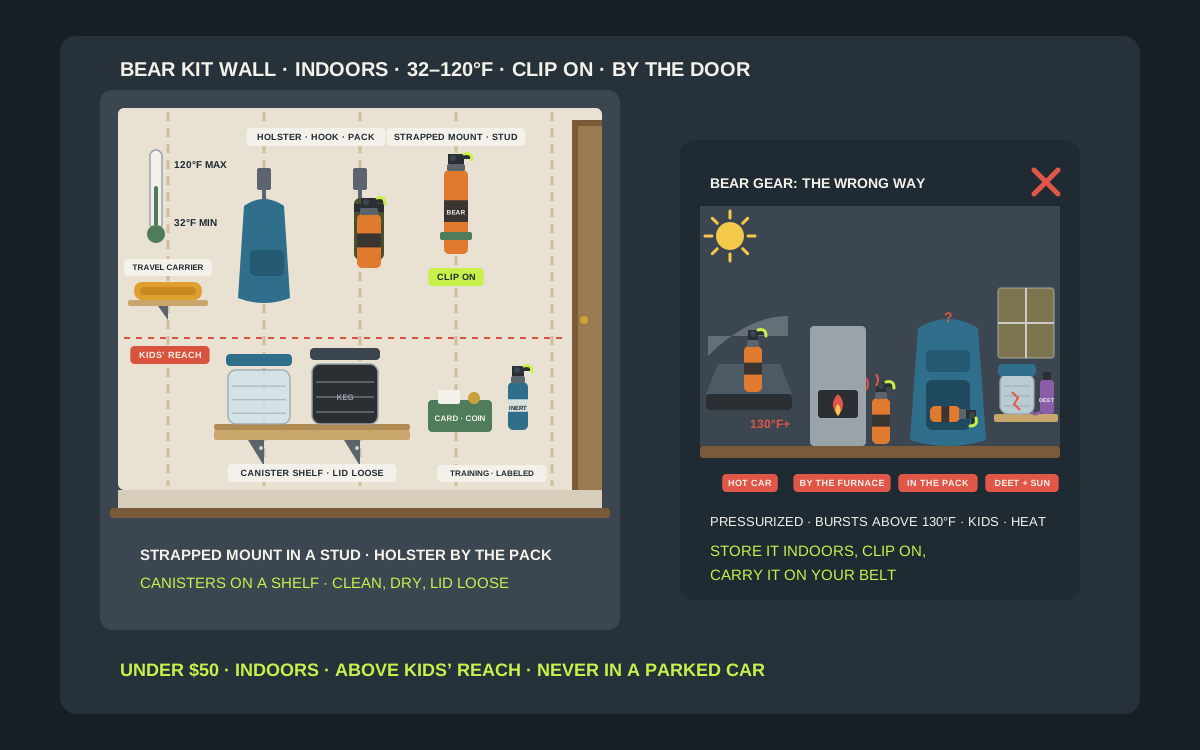
Bear spray and a bear canister are the two pieces of camping gear that spend most of the year doing nothing and then have to work perfectly on the one day they matter. Between trips they tend to end up in the worst possible places: the spray rolling around a truck console or a hot garage shelf, the canister in a closet corner with a forgotten granola bar inside and the lid cranked so tight it will not open in the cold. A small wall setup fixes both for well under $50. A strapped mount or a holster hook keeps the spray upright, out of children’s reach and ready to grab on the way out the door, and a short shelf on studs gives an 8- to 9-inch canister a clean, dry place to sit. The rules that matter come straight from the can and the canister makers. Counter Assault and UDAP both print the same storage line on their labels: keep bear spray in a cool, dry place out of reach of children and pets, not above 120°F or below 32°F, and never in a hot vehicle or direct sunlight. BearVault warns that DEET and other harsh chemicals can crack its canisters. This guide covers which holder suits which job, where the bear wall belongs in a house, cabin, garage or RV, and the habits that keep the can in date and the canister ready to open.
Shop bear spray wall mounts on Amazon
Who this is for
- Hikers, hunters, anglers and campers who keep a can or two of bear spray at home between trips and want it in one predictable place
- Backpackers with a BearVault, Garcia or Counter Assault Bear Keg canister that lives in a closet, garage or gear room between seasons
- Cabin owners and RV travelers in bear country who want spray by the door while they are there, and a plan for where it goes when they leave
Quick answer
For most people, the best under-$50 bear spray wall holder is a small strapped mount sized for standard cans, such as the Spartan Mounts bear spray mount, screwed into a stud or pegboard inside the house by the door you leave from, at a height children cannot reach. If you carry the can in a holster on the trail, hang the holster itself on a stud-mounted hook beside your pack so the holster and spray leave the house together. Canisters belong on a 10- to 12-inch-deep shelf on brackets screwed into studs, clean and dry, with the lid resting loose instead of cranked tight. Keep everything indoors, between the 32°F and 120°F printed on bear spray labels, away from furnaces and water heaters, out of direct sun and well away from DEET bug spray. Check fit, the hardware included and the current price on the listing before you buy.
Quick comparison
| Holder | Best for | How it holds | Trade-off |
|---|---|---|---|
| Strapped bear spray wall mount | One can, by the door | Can sits in a molded cradle; a hook-and-loop strap holds it in | Check diameter; mount above children’s reach |
| Holster on a stud-mounted hook | Spray you carry on a belt or chest | The maker’s holster hangs from a sturdy hook, can inside | Holster must hang upright so the can cannot slide out |
| Travel carrier on a shelf | Spray that rides in a vehicle | Can rides in a hard carrier such as the Kozee-Tote | For the drive only; never left in a parked car |
| Canister shelf on stud brackets | BearVault, Garcia, Bear Keg | Canister stands on a 10- to 12-in deep shelf with a lip | Needs studs; keep it out of sun and away from DEET |
| Pegboard or rail kit strip | Holsters, training can, tags | Hooks and a small bin around the spray mount | Easy to clutter; label the training can |
| Ventilated wall bin | Lid tools, odor bags, spare straps | Open bin on a rail or pegboard under the canister shelf | Holds the small parts, not the canister |
Bear spray holstersHeavy-duty shelf bracketsPegboard bins and hooks
What to look for
Sized for a bear spray can, with a strap
Bear spray comes in larger cans than personal pepper spray. The Interagency Grizzly Bear Committee (IGBC) tells buyers to look for cans labeled bear spray or bear deterrent with at least 7.9 ounces (225 g) of product and an EPA registration number, and the common sizes run from UDAP’s 7.9, 9.2 and 13.4 oz cans to Counter Assault’s 8.1 and 10.2 oz. A holder made for this job fits the can’s body, not a slim jogger canister. Spartan Mounts says its bear spray mount fits most standard cans of roughly 2.1 inches in diameter and uses a hook-and-loop strap to keep the can seated while still letting it slide out fast. Check your can’s diameter against the holder before you order, especially for the largest sizes.
Screws into studs or pegboard
A can of spray is light, but it is pulled out and pushed back in, sometimes in a hurry, so the holder should be screwed down rather than stuck on. Spartan Mounts rates its bear spray mount at 15 lb when screwed into a wood stud, includes drywall anchors, accepts any #8 screw and lines its holes up with standard pegboard, where it recommends #8 machine screws and lock nuts. For canisters, the load is a 2- to 4-lb container plus whatever is inside it, which is why a shelf on stud-mounted brackets is the right base. Adhesive is a poor fit for either: Command’s indoor strips are rated for 50°F to 105°F, and the places bear gear tends to live, from cabins to garages to RVs, swing outside that range.
Inside the label temperature range
This is the rule that decides where the wall goes. Counter Assault’s EPA-registered label says to store bear spray in a cool, dry place, not above 120°F or below 32°F, not in a hot vehicle and not in direct sunlight, and warns that exposure above 130°F may cause bursting. UDAP prints the same 120°F and 32°F limits. The Alaska Department of Fish and Game adds why both ends matter: in extreme heat, pressure can build until the can explodes, and in extreme cold, pressure may drop so the can does not spray properly. An interior wall in a heated, cooled house meets the label easily. An attic, shed, vehicle or uninsulated garage often does not.
Out of reach of children and pets
Both brands’ labels say to store bear spray inaccessible to children and pets, and the reason is on the same label: Counter Assault warns that the spray may cause irreversible eye damage at close range. The Alaska Department of Fish and Game says to treat bear spray like a firearm and notes that it leaves the can at more than 70 mph. Mount the holder high enough that small children cannot reach it, keep the safety clip on, and use the strap so a curious dog or a bumped shelf cannot knock the can loose.
Away from heat, flame and sun
Counter Assault’s label calls its spray extremely flammable and says to keep it away from fire, sparks and heated surfaces. UDAP’s spray is listed as non-flammable, but its label still says not to use or store it near heat or open flame. So the bear wall does not go beside a furnace, a water heater, a wood stove, a clothes dryer vent or a south-facing window. The same goes for canisters: BearVault’s warranty excludes damage from ultraviolet exposure and excessively warm or cold temperatures.
Grab-and-go by the right door
The IGBC says bear spray should be carried where it can be reached quickly, such as in a hip or chest holster, and Grand Teton National Park adds that the can should be immediately available, not in your pack. The wall at home is where that habit starts. Put the spray, its holster and the canister near the door you actually load the car from, next to the pack, so the spray goes on your belt before you leave rather than into the bottom of a duffel.
Know what you are storing
Bear spray is a pressurized pesticide
Bear spray is an EPA-registered pesticide, not a generic aerosol. Grand Teton National Park explains that registered bear sprays list 1% to 2% capsaicin and related capsaicinoids as the active ingredient, and Counter Assault and UDAP both use 2%. The cans are under pressure, and Counter Assault’s label says exposure above 130°F may cause bursting. UDAP describes its can as a seamless, internally lined aluminum can with a liquefied propellant and a fire-extinguisher-style spray. In storage terms, that means one thing: treat it like the pressurized can it is, keep it in the label range and never somewhere it can be crushed or punctured.
Common can sizes
UDAP sells its Pepper Power bear spray in 7.9, 9.2 and 13.4 oz cans (225, 260 and 380 g), and Counter Assault sells 8.1 and 10.2 oz cans. Spartan Mounts sizes its wall mount for standard cans of roughly 2.1 inches in diameter, and UDAP lists its Griz Guard holster for 2-inch cans in the 225 g and 260 g sizes, with a separate chest holster for the 13.4 oz can. If you own more than one size, check that each can fits its holder before you rely on it.
Bear spray expires
Counter Assault gives its bear spray a four-year shelf life, prints the expiration year on the can and recommends replacing it after that date because pressure in any aerosol can drop over time. UDAP says each can is batch coded with a three-year expiration date. The IGBC tells users to check the expiration date and replace expired cans. A wall mount where the label faces out makes that check a two-second job.
Bear canisters are bulky, not heavy
BearVault lists its BV450 at 2 lb 1 oz with 440 cubic inches (7.2 L) of usable space, 8.7 inches across and 8.3 inches tall, and the BV500 at 2 lb 9 oz, 700 cubic inches (11.5 L) and 12.7 inches tall; every BearVault model shares the same 8.7-inch diameter. Yosemite National Park lists the Garcia Backpackers’ Cache 812 at 12 inches tall, 8.8 inches across, 615 cubic inches (10 L) and 2 lb 11 oz. Counter Assault lists its Bear Keg at 13 by 9 inches, 716 cubic inches (11.7 L) and 3 lb 10 oz. None of them is heavy, but all of them are wide, round and slippery by design, which is why they want a shelf, not a hook.
Canisters cost more than their holders
A certified canister costs more than $50 on its own, so the point of this guide is protecting it, not buying it. If you only need one for a single trip, Yosemite rents Garcia canisters at its wilderness permit stations for a small weekly fee and asks renters to return them empty and clean. If you own one, a shelf that keeps it clean, dry, out of the sun and away from chemicals is the cheapest insurance it can have.
Six ways to store bear spray and canisters on a wall
A strapped spray mount by the door
This is the simplest and best home for a can you keep at the house. Spartan Mounts’ bear spray mount is a molded PETG cradle about 3.5 inches tall, 1.9 inches wide and 1 inch deep, with a hook-and-loop strap and holes 2 inches apart, and it was listed under $50 on Spartan Mounts’ own store when we checked in October 2026. Screw it into a stud, or into pegboard with machine screws and lock nuts, at about chest height for an adult, trigger facing out and safety clip on. Standard Mount Co. sells a similar strapped mount for standard cans. Put it inside the door you leave from, next to the hook that holds your day pack.
The holster itself on a hook
If you carry the spray in a belt or chest holster, the best wall holder may be the holster. Counter Assault sells universal belt, waist, backpack and chest holsters separately, each listed under $50, and UDAP’s Griz Guard clip-on holster for 2-inch cans is listed well under $50. Hang the holster from a sturdy hook screwed into a stud, can inside and upright, so the holster and the spray leave the house together. The hook must hold the holster upright; one that lets it hang upside down invites the can to slide out onto the floor.
A travel carrier on a shelf
For the drive to the trailhead, Counter Assault’s advice is to secure bear spray in a glove box or a designated storage area with nothing packed on top of it to prevent accidental discharge. Its Kozee-Tote is a hard carrier that keeps an 8.1 or 10.2 oz can protected while traveling in vehicles, boats and noncommercial aircraft; it measures 11.5 by 3.75 inches, weighs about 0.31 lb and was listed under $50 when we checked. At home, it lives on the bear shelf, empty or with the can inside, and goes out to the car with you. It is a travel case, not permission to leave the spray in a parked car.
A canister shelf on stud-mounted brackets
Canisters are 8.7 to 9 inches across, so a shelf 10 to 12 inches deep holds one with room to spare. Screw two heavy-duty brackets into studs at a comfortable height, add a front lip or a strip of non-slip mat, and stand the canisters upright with lids resting on loosely. Do not hang a canister by a strap or net. BearVault says its canisters are not designed for loaded falls and should never be hung, and Counter Assault says not to hang or attach anything to the Bear Keg at camp. A shelf is simpler and kinder to the plastic.
A pegboard or rail kit strip
If you keep more than one can, a short pegboard panel or track rail turns the bear gear into a station. Mount the strapped spray holder or holster hook in the middle, add a hook for the inert training can and a clip for the expiry tag, and keep the canister shelf directly above or beside it. Spartan’s mount lines up with standard pegboard holes. Keep the training can clearly marked and on a different hook from the real one.
A ventilated bin for the small parts
Canisters come with odd little accessories. BearVault suggests a plastic card for extra leverage when a cold lid sticks and sells a key for the same job, and Counter Assault’s Bear Keg opens with a coin or a screwdriver. Odor-proof bags, a small trash bag for the trail and spare carry straps all belong in one open bin on the rail under the canister shelf. Keep chemicals out of that bin, because BearVault warns that DEET, bug sprays, adhesives, paint and solvents can damage its canisters.
Where the bear wall goes
Mudroom, hall closet or gear room
The best home for bear spray is an interior wall of the heated part of the house, near the door you leave from. A mudroom, a hall closet or a gear room off the garage usually stays well inside the 32°F to 120°F label range year round, it is out of the sun, and it is on your way to the car. Put the canister shelf on the same wall so the whole bear kit is in one place.
Garages and sheds
Many people keep camping gear in the garage, and the canister can usually live there if the space stays dry and out of direct sun. The spray is different. If your garage freezes in winter or bakes in summer, it is outside the range printed on the can, and Counter Assault’s advice is to keep bear spray at room temperature, away from extremes. Store the spray indoors, and in the garage keep it far away from the furnace, the water heater, the clothes dryer and anything that sparks.
Cabins in bear country
At a cabin, the IGBC’s camp advice translates directly to the wall: keep spray readily available where you sleep and where you cook. A strapped mount by the main door and a second by the outdoor kitchen or grill door means a can is always within reach when you step outside. When you close the cabin for the season and the heat goes off, take the spray home with you, because an unheated cabin can drop below the 32°F the label sets.
RVs, vans and campers
An RV is a home while you are in it and a vehicle when you are not. Grand Teton National Park tells visitors not to store bear spray in a vehicle because it may explode, and Counter Assault says bear spray should never be left in a car. So an RV or van mount by the door is for the time you are parked and living in it, with the climate under control. On travel days, secure the can in a carrier with nothing on top, and when the rig is parked and closed in the sun, or put into storage, take the spray with you. Use screws into solid backing where the wall allows; our RV hook-mounting guide covers how to do that without damaging thin walls.
Apartments
Renters can still have a bear wall. A strapped mount needs only two small screws, which are easy to patch when you move out, and a freestanding shelf can hold the canister. Ask your landlord before drilling, keep the spray out of reach of children and pets, and keep it out of a sunny window, which can get far hotter than the room.
Setting up the wall step by step
- Choose an interior wall near the door you leave from, away from heat sources, windows in direct sun and chemical shelves.
- Find a stud with a stud finder and confirm it with a small nail where the mount will cover the hole.
- Mark the spray mount at a height adults reach easily and small children cannot.
- Drill pilot holes and drive #8 screws into the stud, or use machine screws and lock nuts on pegboard.
- Seat the can with the trigger facing out, the safety clip on and the expiry date visible, then close the strap.
- Screw two shelf brackets into studs beside it, add a 10- to 12-inch shelf with a lip, and stand the clean canisters on it with lids resting loose.
- Hang the holster, the training can and the small-parts bin within arm’s reach, and label the training can.
- Pull the can out and put it back a few times to make sure the strap releases cleanly with one hand.
Habits that keep the can ready
Check the date every season
Write the expiration date on a tag beside the mount, or on tape on the holster, and look at it when you load up each spring. Counter Assault prints the expiration year on the can and recommends replacing it after that date. The Alaska Department of Fish and Game goes further: if a can is partly used or past its date, do not rely on it as a deterrent.
Leave the safety clip on
Grand Teton National Park tells visitors to leave the safety clip on the trigger until they are ready to spray an aggressive bear, because the can may discharge otherwise. That applies on the wall too. Counter Assault’s cans include a glow-in-the-dark safety wedge with a string tether; keep the tether attached so the clip cannot wander off while the can is stored.
Practice with an inert can
Counter Assault recommends practicing with its inert training canister and says that even without spraying, you should practice pulling the can from its holster and removing the safety clip until it feels natural. UDAP also tells first-time users to get a training can. Store the training can on its own hook, clearly marked, so nobody grabs it on the way to the trailhead.
Never use it as a repellent
The IGBC says bear spray only works as an airborne deterrent sprayed at an aggressive bear, and should not be applied to people, tents, packs or other equipment. The Alaska Department of Fish and Game adds that pre-spraying objects may actually attract a bear because of the residue’s strong odor. Never test it in the garage or near the bear wall, either; Counter Assault’s label says to test-fire only outdoors with the wind at your back, for no more than half a second.
Plan for flights
The TSA does not allow bear spray in carry-on or checked bags, and the Alaska Department of Fish and Game notes that airline safety rules prohibit transporting it. Counter Assault suggests buying spray at your destination when you fly. That leaves a can at home on the wall, so make sure it is in date when you get back.
Dispose of old cans properly
When a can expires, do not toss it in the trash with spray still inside. The Alaska Department of Fish and Game says a completely emptied can may be discarded as trash, but one that still holds spray is hazardous waste. Counter Assault’s label says to call your local solid waste agency for disposal instructions for a partly filled can, and never to puncture or burn it.
Canister care between trips
Clean it before it goes on the shelf
A canister that comes home with crumbs, wrappers and toothpaste inside will smell like a pantry all winter. Empty it completely, wash it with mild soap and warm water, let the canister and lid dry fully in the open air and only then put it on the shelf. Yosemite charges a fee on rental canisters that come back dirty, which tells you how often people skip this step.
Keep DEET far away
BearVault’s warranty says exposure to DEET and other harsh chemicals will cause the material to spontaneously crack and voids the warranty, and its tips page says chemicals should never touch the plastic. So the canister shelf is not the place for bug spray, sunscreen tubes that leak or paint cans. On the trail, BearVault says to double-bag DEET and other bug sprays if they must ride inside.
Do not crank the lid shut
BearVault says to twist the lid only until the nubs click past the stopper and warns that over-tightening makes the lid much harder to open later, especially in cold or wet conditions. For storage, there is no need to lock it at all. Rest the lid on loosely, or set it beside the canister so the inside can breathe. If the lid starts to stick, BearVault suggests cleaning the threads with mild soap and a toothbrush and using a food-grade silicone lubricant.
Keep it out of the sun and the cold
BearVault’s warranty does not cover damage from ultraviolet exposure or excessively warm or cold temperatures, and its tips page notes that cold stiffens the plastic. An interior shelf away from windows avoids both. Water-based stickers are fine on a BearVault, but solvent-based adhesives and paint can damage the plastic, so label the shelf, not the canister. Yosemite also asks renters not to put labels or tape on the lid, where they can interfere with the lock.
Mistakes to avoid
- Leaving bear spray in a car, truck, camper or RV that is parked and closed in the sun.
- Storing spray in an unheated garage, shed or cabin that freezes in winter.
- Mounting the holder next to a furnace, water heater, wood stove or sunny window.
- Hanging the can low enough for a child or a dog to reach.
- Taking the safety clip off for storage, or losing it.
- Keeping the inert training can and the real can on the same hook without labels.
- Hanging a bear canister by a strap instead of standing it on a shelf.
- Storing the canister next to DEET bug spray, paint or solvents.
- Packing the spray in the bottom of a bag instead of on your belt.
Related guides
Browse the hub: RV & camping storage under $50 - all guides
- Best Camping Fuel Canister Wall Holders Under $50
- Best Camping Fire Starter Wall Organizers Under $50
- Best Camping Backpack Wall Hooks Under $50 for Cabins
- Best Camping Gear Wall Hooks Under $50 for Van & Cabin
- Best Aerosol Can Organizers for Garage Walls Under $50
- How to Mount Hooks in an RV Without Damaging Walls Under $50
- Best Bug Spray & Sunscreen Wall Caddies Under $50 for Camping Gear
FAQ
Where should I store bear spray at home?
Indoors, in a cool, dry place out of reach of children and pets, between the 32°F and 120°F printed on Counter Assault and UDAP labels, out of direct sunlight and away from heat sources. A strapped wall mount on an interior wall near the door you leave from is ideal.
Can I keep bear spray in my car or RV?
Not as storage. The labels say not to store it in a hot vehicle, Grand Teton National Park says not to store bear spray in a vehicle because it may explode, and Counter Assault says it should never be left in a car. Carry it in a secure spot with nothing on top while you drive, and take it with you when the vehicle is parked.
Is a garage too hot or cold for bear spray?
Often, yes. Labels set a range of 32°F to 120°F, and the Alaska Department of Fish and Game warns that heat can build pressure until a can explodes while cold can stop it from spraying properly. If your garage freezes or bakes, keep the spray indoors and store only the canister in the garage.
How long does bear spray last?
Counter Assault gives its spray a four-year shelf life and prints the expiration year on the can; UDAP says its cans carry a three-year expiration date. Replace expired or partly used cans, and dispose of any can with spray left in it as hazardous waste.
Can I hang a bear canister on the wall?
Stand it on a shelf instead. BearVault says its canisters are not designed for loaded falls and should never be hung, and they are round and smooth on purpose. A 10- to 12-inch-deep shelf on stud-mounted brackets holds BearVault, Garcia and Bear Keg canisters easily.
How should I store a bear canister between trips?
Empty it, wash it with mild soap and water, let it dry completely, and store it indoors out of the sun with the lid resting loose. Keep it away from DEET, bug spray, paint and solvents, which BearVault warns can damage the plastic.
Bottom line
The best bear spray wall holder is a small strapped mount screwed into a stud or pegboard inside the house, by the door you leave from and above children’s reach, or the maker’s holster on a sturdy hook so the spray leaves with you. Give canisters a 10- to 12-inch shelf on stud-mounted brackets, clean, dry and lid loose. Keep everything between 32°F and 120°F, out of the sun, away from heat, flame and DEET, never in a parked vehicle, and check fit and the current price on the listing before you buy.