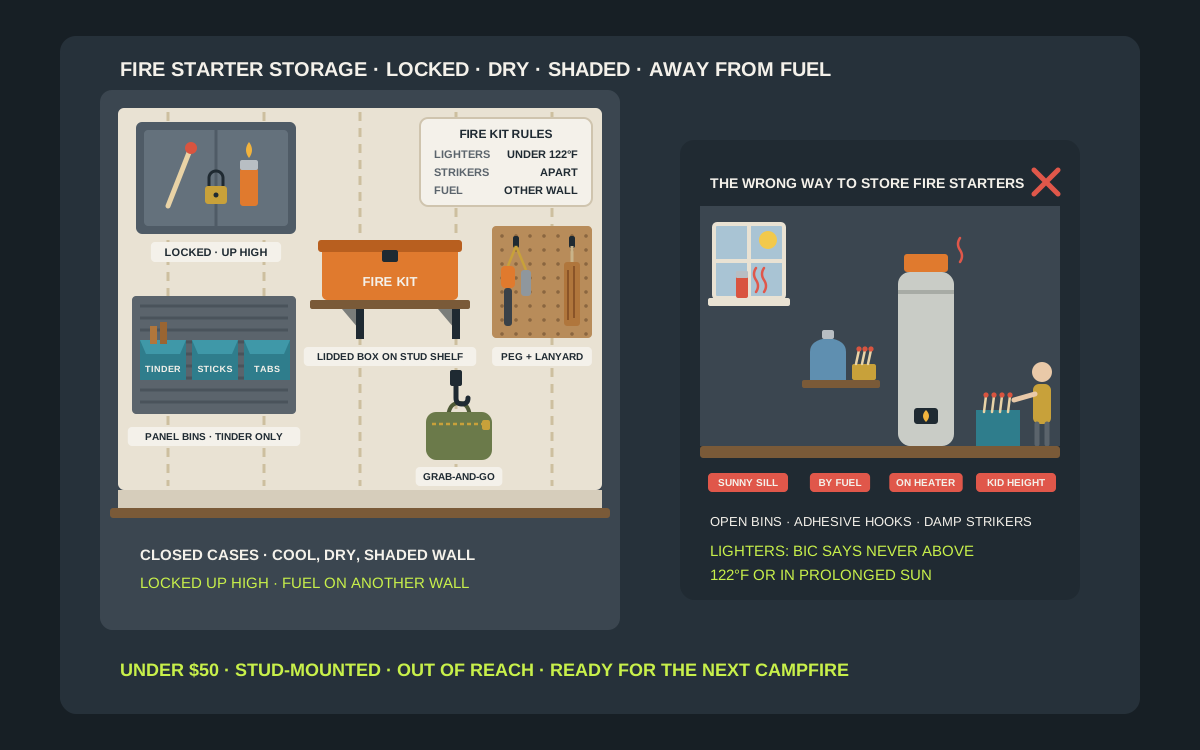
Fire starters are the smallest things in a camping kit and the easiest to lose. A box of stormproof matches slides under the cooler, a lighter rolls into the bottom of a chair bag, the ferro rod ends up in last year’s backpack, and the fatwood is somewhere in the garage, probably next to the bag of charcoal. Then the first evening at camp starts with a hunt through every bin in the car for something that makes a flame. A small wall organizer fixes that for well under $50, but it has a second job most gear storage does not. Matches, lighters and tinder are made to catch fire, so where they live matters as much as how tidy they look: dry, out of the sun, away from fuel and heat, and out of children’s reach. This guide covers which organizer suits which fire starter, where on the wall it should go, and how to keep the kit stocked and ready for the next trip.
Shop small lockable wall cabinets on Amazon
Who this is for
- Campers, RV owners and cabin owners who keep matches, lighters, ferro rods and tinder in three different bins and want one place to grab them before a trip
- Households with young children who need the fire kit organized but locked up high, not sitting in an open bin on a low shelf
- Anyone setting up a garage or shed camping wall who wants the ignition kit stored safely away from fuel canisters, the water heater and a sunny window
Quick answer
For most households, the best under-$50 setup is two parts: a small lockable cabinet screwed into a stud at adult height for matches and lighters, and a lidded kit box on a stud-mounted shelf or small panel bins for tinder, fire sticks and fuel tablets, with a ferro rod hanging from a peg by its lanyard. Keep everything in a cool, dry, shaded spot. BIC’s own warning is never to expose its lighters to heat above 122°F (50°C) or to prolonged sunlight, so a sunny windowsill or the top of a water heater is the wrong place. State fire marshals advise storing matches and lighters up high, out of children’s sight and reach, and preferably in a locked cabinet. Keep the kit on a different stretch of wall from fuel canisters and propane. Check the cabinet’s size and the current price on the listing before you buy.
Quick comparison
| Format | Best for | Mounting | Trade-off |
|---|---|---|---|
| Small lockable wall cabinet | Matches and lighters in homes with children | Screwed into a stud at adult height, door locked | Slower to open; a key or code to keep track of |
| Lidded kit box on a stud shelf | The main home fire kit for camping trips | Shelf bracket screwed into studs, box with a latching lid | You lift the box down to reach one item |
| Louvered panel or rail with small bins | Sorting tinder, fire sticks and fuel tablets for several kits | Panel or rail screwed to the studs, bins hang on it | Open tops; matches and lighters must stay in closed cases |
| Pegs or hooks with a lanyard | Ferro rods and fatwood sticks with a carry cord | Single peg or screw hook into a stud or pegboard | Only for items that hang by a cord; never loose matches |
| Grab-and-go pouch on a hook | A complete trip kit that goes straight into the car | Zip pouch on a stud hook near the door or camping bins | Easy to forget to restock after a trip |
Waterproof match containersLouvered wall panels with small binsFerro rod fire starters
What to look for
A closed container for anything that lights
Matches and lighters should always sit inside something closed: their own waterproof case, a lidded box or a cabinet with a door. An open bin or a hook collects dust and moisture, and it puts a flame source where a child or a stray spark can reach it. UCO’s Stormproof Match Kit is a good example of a container doing its job. It holds 25 matches and three strikers in a waterproof case that floats and has room for up to 40 matches, and UCO notes that its matches and strikers last for many years as long as they stay dry inside the case or a sealed plastic bag. A wall organizer for fire starters is really an organizer for small closed containers.
Cool, shaded and dry beats convenient
Heat is the main enemy of a fire kit. BIC’s lighter warning says never to expose the lighter to heat above 50°C (122°F) or to prolonged sunlight, because it contains flammable gas under pressure. Moisture is the second enemy. A wet match striker will not work until it dries, and damp tinder is the reason so many campfires never start. Choose an organizer that closes, and choose a wall that does not get afternoon sun, sits away from the water heater, furnace and dryer vent, and stays dry when the garage door is open in the rain.
Adult height, out of children’s sight
Fire safety offices are consistent on this point. The Utah State Fire Marshal’s Office advises keeping matches and lighters up high, out of the reach of children and preferably in a cabinet with a child lock, and Massachusetts and Washington State fire officials give the same advice. Child-resistant lighters are not childproof, and BIC’s own label says no lighter is child-proof. If there are young children in the house, the part of the organizer that holds matches and lighters should be locked or at least well above their reach, not on a pegboard at waist height.
Separate compartments for ignition, spark and tinder
A good fire starter organizer keeps the different kinds of fire starter apart. Matches, lighters, a ferro rod and tinder do different jobs, they need slightly different storage, and you want to see at a glance what is running low. UCO goes further and recommends storing matches separately from strikers to prevent accidental ignition, which is easy with a divided box or two small bins. Small stacking bins work well for tinder and fire sticks. Akro-Mils’ AkroBin 30220, for example, measures about 7-3/8 by 4-1/8 by 3 inches outside, is rated for 10 lb, and hangs on the brand’s louvered panels and rails.
Screws, not adhesive
Even a light fire kit is better on a screwed bracket or cabinet than on an adhesive hook. Command’s own instructions give its indoor hooks a temperature range of 50°F to 105°F, and an uninsulated garage, shed or parked RV can go well outside that range in summer or winter. A small cabinet or shelf bracket screwed into a stud costs little more, will not drop the kit when the adhesive softens, and is far harder for a child to pull down.
What goes in a camping fire starter kit
Matches and strikers
Stormproof or waterproof matches are the most reliable flame in a camp kit. UCO’s Stormproof matches are rated to burn for up to 15 seconds each and to relight after being submerged, and the kit includes spare strikers because a wet striker has to dry before it works. Store the matches in their own case, keep spare strikers in their protective sleeves as UCO advises, and keep the strikers apart from the matches. Ordinary kitchen matches belong in a closed box inside the organizer, never loose in a drawer or bin.
Lighters
A disposable lighter and a long utility lighter for the stove or grill earn a place in most kits. They are also the items most sensitive to heat. BIC’s packaging warns against heat above 122°F (50°C) and prolonged sunlight, so a lighter should never live on a windowsill, a dashboard or the top of an appliance. In the organizer, keep lighters upright in a closed box or cabinet, with the child-resistant feature intact. Fire officials warn never to disable it.
Ferro rods and spark strikers
A ferrocerium rod is the backup that does not care about wet weather or an empty lighter. Light My Fire’s Swedish FireSteel 2.0 Army, for example, is a magnesium alloy rod with a stainless steel striker, rated for about 12,000 strikes, throwing sparks of around 2,980°C (5,400°F), and it works when wet. The rod and striker are tied together with a lanyard so they do not get separated, and the striker handle has a built-in whistle. That lanyard is also the easiest way to store it: hang it from a single peg where you can see it.
Tinder and fire sticks
Tinder is what catches the first spark or flame. Light My Fire’s MayaSticks on-a-rope, sold for years as Tinder-on-a-Rope, are natural fatwood from cultivated pine with up to 80% resin content, which the company says burns even when wet. Coghlan’s Fire Sticks are a manufactured option made of fiberboard and wax, sold 12 to a pack, each burning for about 9 minutes, and they will light after being submerged once they have dried. Cotton balls, dryer lint and fatwood shavings fill the gaps. Keep tinder in a closed bin or zip bag so it stays dry, and keep a separate supply for each kit you pack.
Solid fuel tablets
Solid fuel tablets, such as Esbit’s, double as a fire lighter and a stove fuel. Esbit says its solid fuel is mainly methenamine and wax, burns for about 5 to 15 minutes depending on tablet size, and keeps for many years with no specific expiration date if stored dry. Esbit’s storage advice is simple: a dry place away from potentially flammable sources. All of its sizes except the 4 g tablets come in waterproof packaging, so leave them in that packaging inside the organizer.
Five ways to organize fire starters on a wall
A small lockable wall cabinet for matches and lighters
This is the most important piece if there are children in the house, and it is a good habit even if there are not. A small steel or wooden cabinet with a lock, screwed into a stud at or above adult shoulder height, keeps matches and lighters out of sight and out of reach, which is exactly what fire marshals recommend. Measure your longest utility lighter first and look for a cabinet wide enough inside for it to lie flat, checking the internal dimensions on the listing rather than the outside measurements. Many small key cabinets and first aid cabinets are the right size. Pick one with a door that closes fully rather than a shelf with a lip.
A lidded kit box on a stud-mounted shelf
For the main fire kit, the one that goes to camp every time, a lidded box on a shelf is hard to beat. A pair of shelf brackets screwed into studs, a short board and a latching plastic or metal box create a single place for matches in their case, a lighter, a ferro rod, tinder and a few fire sticks. When it is time to pack the car, the whole box goes in. Label the lid, keep a printed checklist taped inside, and put the shelf at chest height or above so the box comes down with a short, controlled lift. If there are young children around, mount the shelf high or put the box itself in the locked cabinet.
A louvered panel or rail with small bins
If you pack fire kits for more than one vehicle, a camper and a backpack, or you buy tinder in bulk, small open-front bins on a louvered panel or rail make the spare stock visible. One bin for fatwood, one for fire sticks, one for solid fuel tablets in their packaging, one for cotton balls in a zip bag. Bins like Akro-Mils’ AkroBin 30220 are about 7-3/8 inches deep and rated for 10 lb, which is far more than tinder weighs. Because the bins are open at the front, they are for tinder and fuel tablets only. Matches and lighters stay in their closed cases or in the cabinet.
Pegs or hooks for ferro rods and fatwood on a rope
Some fire starters come ready to hang. A ferro rod on its lanyard and a fatwood stick on its carry rope can each hang from a single peg on a pegboard or a small screw hook in a stud, beside the kit box. They are not fuel or pressurized gas, and seeing them on the wall is the easiest reminder to put one in each pack. Do not extend this to anything else: loose matches, lighters and open bags of tinder do not belong on an open hook.
A grab-and-go pouch on a hook
A zip pouch or small dry bag holding a complete trip kit (matches in a waterproof case, a lighter, a ferro rod and tinder) can hang on a sturdy screw hook by the door to the car or next to the camping bins. It is the fastest option on the morning of a trip. The risk is that it goes on the trip, comes back half empty and goes straight back on the hook. Pair it with a restocking habit, and if there are young children in the house, hang it high or keep it in the locked cabinet between trips.
Where the fire kit should go
A cool, shaded wall
Walk the garage at the hottest time of day and look for the wall that stays coolest. Avoid the wall behind a sunny window, the wall above or beside the water heater, furnace or dryer, and the inside of the garage door. An interior wall shared with the house is often the best choice, because it stays closest to indoor temperature. In very hot climates, consider keeping lighters indoors in a closet and only the rest of the kit in the garage.
Away from fuel, but close to the camping gear
The ignition kit should sit near the camping bins so it actually gets packed, but on a separate stretch of wall from fuel canisters, propane cylinders, gas cans and charcoal lighter fluid. Keeping the spark and the fuel apart is basic fire sense, and it also makes it easier to check that both are packed. Our guide to camping fuel canister wall holders covers storing the gas side of the kit.
Up high, with the matches and lighters highest
Place the lockable cabinet or the highest shelf at a height adults can reach comfortably and children cannot. Put the matches and lighters there and the tinder, bins and pegs lower down if you like, since a fatwood stick or a ferro rod is far less of a hazard in a small child’s hands than a lighter. Keep the area in front of the organizer clear so no one has to climb on a bin to reach it.
Within reach of an extinguisher
A garage that holds a fire kit, camping fuel and a car is a good place for a fire extinguisher mounted by the door. It does not need to be next to the fire kit, but it should be somewhere you can reach on the way out. See our guide to fire extinguisher wall mounts for the brackets and placement.
Setting up and stocking the organizer
Mount it into studs
Find the studs with a stud finder, confirm with a small nail where the bracket or cabinet will cover the hole, and screw the cabinet, shelf brackets or panel into them. Most garages have studs every 16 inches. A small cabinet usually needs only two screws through its back into one stud, but use the screws and anchors the maker supplies or recommends, and on concrete or block walls use masonry anchors.
Sort by job, not by brand
Give each kind of fire starter its own space: matches and strikers, lighters, spark tools, tinder, fuel tablets. Keep the matches and spare strikers in separate compartments or separate small cases, as UCO recommends. A divided box, a few small bins or even zip bags labeled with a marker are enough. The goal is to see what is missing in two seconds.
Keep moisture out
Tinder and strikers are ruined by damp. Keep tinder in zip bags or lidded bins, leave Esbit tablets and fire sticks in their original packaging until they go into a trip kit, and add a small desiccant pack to the kit box if your garage is humid. If a kit comes back from a trip wet, let it dry indoors before it goes back on the wall.
Restock after every trip
The best organizer fails if it is empty. When you unpack from a trip, put the kit back, count the matches, test the lighter, and top up tinder and fire sticks from the bins on the wall. A short list taped inside the kit box lid (matches, strikers, lighter, ferro rod, tinder, fire sticks, fuel tablets) makes it a one-minute job. Keeping bulk supply on the wall and a fixed kit in the box is what makes this quick.
Fire starters in an RV, van or cabin
RVs and vans: a closed cabinet, not the dash
In an RV or camper van, keep the fire kit inside a closed, latched cabinet or drawer, out of direct sun and away from the stove, furnace and water heater. The inside of a vehicle parked in summer sun can get much hotter than BIC’s 122°F limit for lighters, so the dashboard, window ledges and any surface that bakes in the sun are out. Open wall hooks are a poor choice in a moving vehicle in any case, because whatever hangs on them swings and falls on rough roads.
Exterior storage bays
Many campers keep camp gear in an exterior storage bay. If the fire kit lives there, put it in a closed box, keep it away from propane fittings and fuel, and check the bay for heat on a sunny day. A bay that faces the sun can get very hot inside, which is fine for chairs and leveling blocks but not ideal for lighters.
Cabins with a wood stove
In a cabin, it is tempting to keep matches and lighters on the mantel or right beside the stove. Keep them nearby but not on or next to a hot surface. A small cabinet or a lidded box on a shelf a few feet away, at adult height, is easier on lighters and safer with children visiting. Fatwood and kindling can sit in a bin near the stove, but not against it.
The camping bin itself
If your camping gear lives in a set of totes rather than on a wall, the same rules apply inside the tote. Keep the fire kit in its own closed pouch or box, separate from fuel, packed where you can find it first when you arrive, and store the tote somewhere cool and dry.
Mistakes to avoid
- Leaving matches or lighters in an open bin or on an open hook instead of a closed case or cabinet.
- Storing lighters on a sunny windowsill, a dashboard or on top of the water heater, above BIC’s 122°F limit.
- Keeping the fire kit on the same shelf as fuel canisters, propane or charcoal lighter fluid.
- Putting matches and lighters at a child’s height or anywhere a child can climb to.
- Hanging the kit on an adhesive hook in a garage that runs hotter or colder than the adhesive’s rated range.
- Mixing matches and strikers loose in one bag instead of keeping them apart.
- Letting tinder and strikers get damp in an unsealed box in a humid garage.
- Putting a used kit back on the wall without restocking or testing the lighter.
Related guides
Browse the hub: RV & camping storage under $50 - all guides
- Best Camping Fuel Canister Wall Holders Under $50
- Best Portable Camping Stove Wall Mounts Under $50
- Best Camping Axe & Hatchet Wall Holders Under $50
- Best Camping Lantern Wall Hooks Under $50 for Cabins
- Best Fire Extinguisher Wall Mounts Under $50 for Garage
- Best Camping Gear Wall Hooks Under $50 for Van & Cabin
- Best Bear Spray & Bear Canister Wall Holders Under $50
FAQ
What is the best way to store fire starters for camping?
Keep them in closed containers in a cool, dry, shaded spot, away from fuel and out of children’s reach. A small lockable wall cabinet for matches and lighters, plus a lidded kit box or small bins for tinder and fire sticks, covers most households for under $50.
Can I store lighters in a hot garage?
Only if the spot stays well below the lighter maker’s limit. BIC warns never to expose its lighters to heat above 122°F (50°C) or to prolonged sunlight. Avoid sunny walls, windows and the top of the water heater, and in very hot climates keep lighters in an indoor closet instead.
Where should matches be stored in a house with children?
Up high, out of children’s sight and reach, and preferably in a locked cabinet. That is the advice from state fire marshals, including Utah’s and Washington’s. Child-resistant lighters are not childproof, so they need the same treatment.
Should matches and strikers be stored together?
Keep them apart. UCO recommends storing its Stormproof matches separately from the strikers to prevent accidental ignition, and keeping spare strikers in their protective sleeves so they stay dry.
Can I hang a ferro rod on a pegboard?
Yes. A ferro rod is not fuel or pressurized gas, and models like Light My Fire’s Swedish FireSteel come with a lanyard that ties the rod and striker together, so a single peg works well. Keep matches and lighters in a closed cabinet instead.
Do fire starters expire?
Most last a long time if they stay dry. Esbit says its solid fuel has no specific expiration date when stored dry, and UCO says its matches and strikers last many years in a waterproof case or sealed bag. Damp is the usual cause of failure, so check the kit before each trip.
Bottom line
The best camping fire starter wall organizer is less about the rack and more about where it goes and what it closes. Lock matches and lighters in a small cabinet at adult height, keep the main kit in a lidded box on a stud-mounted shelf, sort spare tinder and fuel tablets into small bins, and hang the ferro rod by its lanyard. Choose a cool, dry, shaded wall away from fuel and appliances, restock after every trip, and confirm the cabinet’s inside dimensions and current price on the listing before you buy.