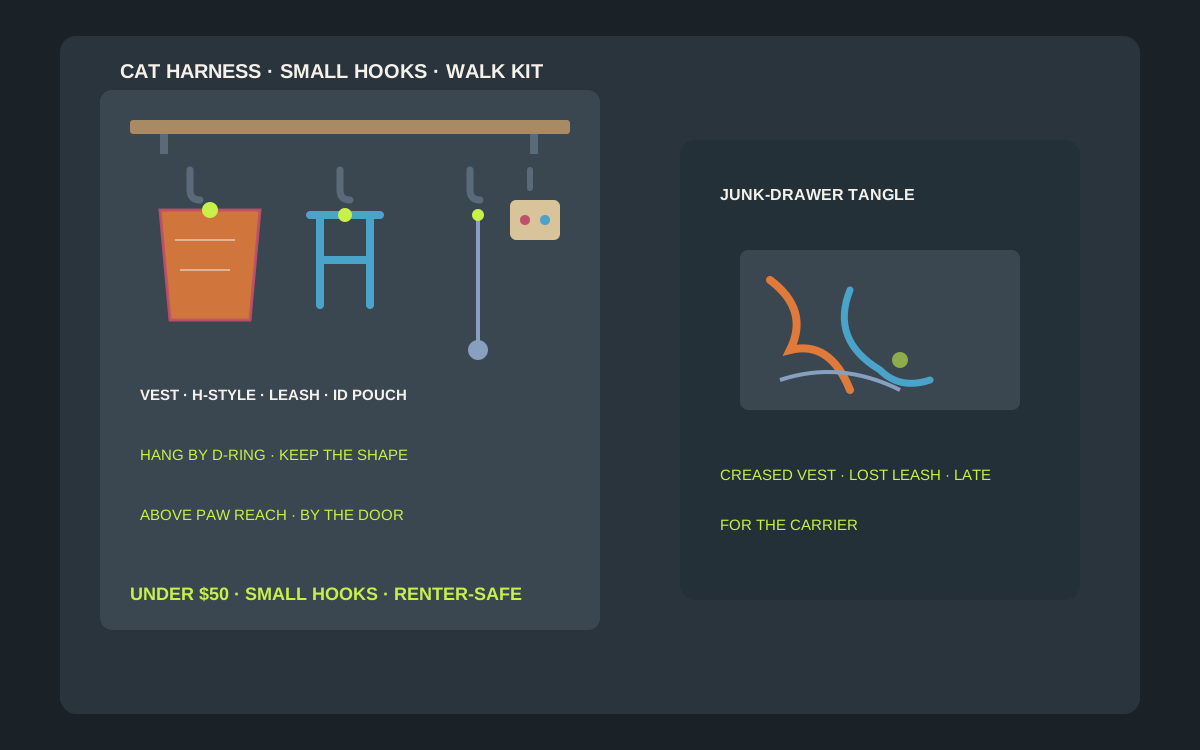
For most cat homes, the best under-$50 way to store a cat harness is one small, rounded utility hook per harness, mounted by the door or carrier cupboard so the vest or H-style hangs by its D-ring or a strap loop with the matching leash on the hook next to it. Cat harnesses are light, so quality adhesive hooks on smooth cured paint can work for renters after the full cure time; multi-hook rails and anything also holding a carrier or backpack belong on screws into studs or proper anchors. Keep ID tags and a spare breakaway collar in a small pouch on the same rail so walk and vet-day kits stay together. Check current hook depth, wall-type guidance and price on the listing before you buy.
Shop small wall hooks and rails for cat harnesses on Amazon
Who this is for
- Cat owners who walk, patio-train or car-travel with a vest or H-style harness and keep losing it in a junk drawer
- Households with more than one cat harness size, a spare escape-proof vest and a thin leash fighting for the same bin
- Renters and homeowners comparing small utility hooks, multi-hook rails, pegboard and over-door racks under $50
Quick answer
For most cat homes, the best under-$50 way to store a cat harness is one small, rounded utility hook per harness, mounted by the door or carrier cupboard so the vest or H-style hangs by its D-ring or a strap loop with the matching leash on the hook next to it. Cat harnesses are light, so quality adhesive hooks on smooth cured paint can work for renters after the full cure time; multi-hook rails and anything also holding a carrier or backpack belong on screws into studs or proper anchors. Keep ID tags and a spare breakaway collar in a small pouch on the same rail so walk and vet-day kits stay together. Check current hook depth, wall-type guidance and price on the listing before you buy.
Quick comparison
| Format | Best for | Typical price band | Why it wins |
|---|---|---|---|
| Small utility hooks (1–2) | One cat, one vest or H-style harness | Usually $6–$20 | Simple; light load; easy for renters with adhesive |
| Multi-hook rail or key rail | Harness + leash + ID pouch side by side | Usually $12–$35 | Walk kit in one glance; stud or anchor mount |
| Pegboard + short hooks | Multi-cat homes, several sizes and spares | Usually $15–$40 | Sizes labeled side by side; add a clip-on bin |
| Over-door hook rack | Renters, no drilling, soft fabric vests | Usually $10–$28 | Zero holes; confirm door still closes |
| Small wall shelf + hooks underneath | Harness kit plus treats and wipes | Usually $15–$40 | Travel day station in one place |
| Adhesive hook strip | Smooth paint, light nylon-only kits | Usually $8–$25 | Renter-safe after full cure; stay inside rating |
What to look for
Hook size for thin straps, not dog hardware
Cat harnesses use narrow webbing and small D-rings. A wide bike J-hook built for dog gear swallows a cat vest and lets it slide sideways; a small rounded utility hook or a multi-hook rail with closely spaced pegs cradles the D-ring or a closed strap loop without pinching the nylon. Measure the D-ring opening and pick a hook tip that fits through it cleanly.
Hang so the harness keeps its shape
Vest harnesses that spend months crumpled in a drawer crease at the chest panel and take longer to buckle on a wriggly cat. Hang the vest from the back D-ring or a closed loop so the panel stays open. H-style and figure-eight harnesses hang neatly from a strap intersection. Do not hang a damp harness that just came in from rain or a bath.
Pair the leash and the harness
A cat harness without its leash is half a kit. Give the leash its own adjacent hook, or clip the leash to the harness D-ring only if the combined weight still sits well inside the hook rating. Keep retractable leads and long patio tethers on a deeper hook so the cord does not unwind onto the floor.
Mount above cat reach, in a spot you actually use
Cats climb. Mount the bottom of the harness above standing-paw reach of your tallest cat, away from a nearby shelf they can leap from. Place the rail by the exit you use for walks, balcony time or the carrier cupboard for vet days — not in a forgotten laundry loft.
Hooks vs rails vs pegboard vs over-door
When a pair of small utility hooks wins
If you have one cat and one harness, two small rounded utility hooks are the best under-$50 answer: harness on the left, leash on the right, both at eye level by the door. Choose hooks with smooth tips so they do not fray nylon, and leave enough space between them that a hanging vest does not tangle with the leash.
When a multi-hook rail earns the wall
A short rail with four to six hooks turns harness storage into a walk station: vest, spare H-style, thin leash, ID pouch and a roll of waste bags if you use them outdoors. Rails distribute load across more fasteners than a single hook, which matters once you add metal tags or a spare collar.
When pegboard is worth the panel
Two cats of different sizes, or a kitten that outgrew last year’s vest, fill a single rail fast. A small pegboard panel lets you hang each size on short hooks, label the row with the cat’s name, and clip a bin underneath for spare buckles, a folding travel bowl and the vet-day checklist.
When an over-door rack is the renter move
An over-door hook rack on a closet or mudroom door holds soft vests and thin leashes with no holes at all. Confirm the door still latches over the bracket, pick shallow hooks so a swinging door does not fling a harness across the room, and keep hard plastic carriers on a separate shelf — doors are for light gear.
When a shelf plus hooks becomes a travel station
A small wall shelf with hooks underneath is ideal if harness days are also carrier days: hang the harness and leash below, keep treats, calming wipes and a spare liner on the shelf above, and store the carrier on a nearby wall shelf or floor stand so you are not hunting three rooms at once.
Build a cat walk and travel kit you can grab in seconds
Hang by the exit you actually use
Patio harness time, hallway walks and car rides usually start at the same door. Mount the hooks there so the vest is in reach while you hold a cat who has already decided the adventure is optional.
Label size and fit notes
A scrap of tape on the harness with the cat’s name, girth and “two-finger fit” note saves re-fitting every spring, especially when more than one cat shares a hook rail.
Store the matching leash with the harness
Thin cat leashes disappear into coat pockets. Clip or hang the paired leash on the next hook, and keep retractable cords fully retracted before hanging so they do not creep open overnight.
Keep escape-proof details intact
Many cat vests rely on a specific buckle order or a belly strap that must stay flat. Hang the vest open, not twisted, and check buckles before you put it away so the next outing does not start with a missing slider.
Treat under-$50 bands as moving targets
Check the current hook depth, wall-type guidance and price on the listing before you buy.
Installation that holds up around cats
Find studs or use the right anchor
Use a stud finder for rails, shelves and pegboard. Where there is no stud, use anchors rated by the maker for the load and wall type. Cat harnesses are light, but a rail that also holds metal tags, a spare collar and a leash still needs real fasteners. Adhesive hooks belong on smooth, cured paint and light nylon-only kits.
Mount above climb-and-swat range
Hang harnesses high enough that a standing cat cannot bat them into a tug toy, but low enough that you can grab one one-handed while managing a carrier door with the other. Keep hooks away from bookcases and window perches that turn into launch pads.
Dry-fit before you commit
Hold your largest vest against the wall at the planned height. Check that it clears light switches, door swing and the carrier handle, and that a second harness will fit beside it without overlapping straps.
Move-out or rehang without scars
Remove the harnesses first. Release adhesive hooks with the maker’s slow-pull method, or fill screw holes if you used hardware. Never pry a loaded hook off painted drywall.
Mistakes to avoid
- Stuffing a vest harness into a drawer until the chest panel creases and fights every buckle.
- Using a wide dog-gear J-hook that lets a small cat D-ring slide off sideways.
- Hanging a damp harness after rain or a bath so the nylon mildews.
- Mounting within paw reach of a climber who treats dangling straps like toys.
- Separating the leash from the harness so half the kit is missing at the door.
- Trusting décor adhesive with a rail that also holds metal tags, spare collars and a heavy leash.
Related guides
Browse the hub: pet gear wall mounts under $50 - all guides
- Best Dog Harness & Leash Combo Wall Stations Under $50
- Best Dog Leash Wall Hooks Under $50
- Best Cat Carrier Wall Shelves Under $50
- Best Pet Travel Backpack Wall Hooks Under $50
FAQ
What is the best way to store a cat harness on the wall?
Hang each vest or H-style harness from its D-ring or a closed strap loop on a small rounded utility hook, with the matching leash on the hook beside it, mounted by the door or carrier cupboard above cat reach.
Can adhesive hooks hold a cat harness?
Usually yes — cat harnesses are light. Choose a quality adhesive utility hook rated for your wall, mount it on smooth cured paint, and wait the full cure time. Rails, pegboard and anything also holding metal tags or a backpack should be screwed into studs or proper anchors.
Should I hang a cat harness by the D-ring or a strap?
Either works if the hook tip fits cleanly. The back D-ring keeps most vest panels open and ready to buckle; a closed strap loop works well for H-style designs. Avoid pinching thin webbing over a sharp hook edge.
Where should I mount cat harness hooks?
By the exit you use for walks, patio time or vet-day carrier loading — typically a mudroom, hallway or closet near the door. Keep the bottom of the harness above your tallest cat’s standing reach.
How is this different from dog harness and leash wall stations?
Dog walk stations are built for heavier wet gear, denser harnesses and thicker leashes. Cat harness hooks use smaller tips, lighter ratings and climb-aware mounting; they store vest and H-style cat harnesses, not dog coats or retractable dog leads as the main load.
Is it worth keeping a spare cat harness on the wall?
Often yes — a backup vest in the next size up, or a different style if one cat prefers H-style over a vest, saves a frantic reorder before a trip. Label each hook and hang the spare the same way as the daily harness.
Bottom line
Cat harness wall hooks under $50 work when the vest keeps its shape and the leash stays beside it: one small rounded hook per harness, a matching hook for the leash, mounted above climb range by the door or carrier cupboard. Use adhesive only for light nylon kits on smooth cured paint; put rails, pegboard and mixed metal gear on screws into studs or proper anchors, and check current ratings and price on the listing before you buy.