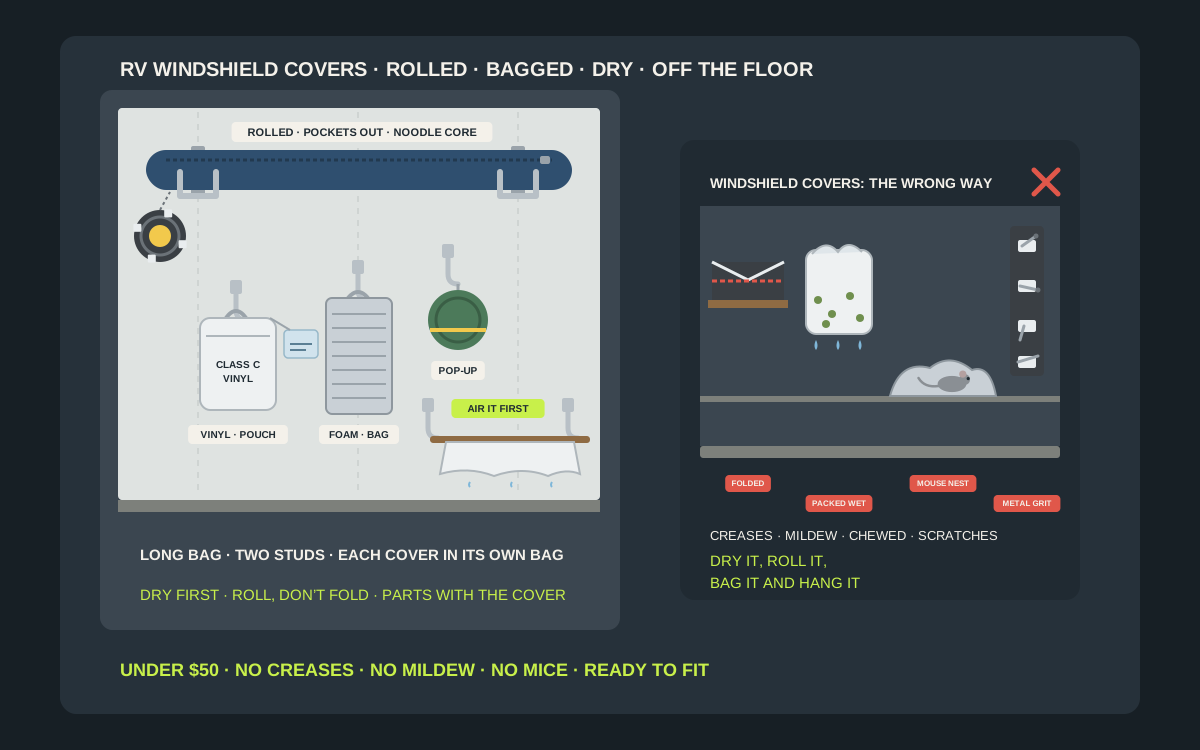
An RV windshield cover is the easiest thing in the rig to put on and the hardest to put away. The magnetic shade for a Class A is longer than the garage is deep, so it ends up folded in half on a shelf. The white vinyl cover for a Class C comes off wet after a frosty night and gets stuffed into its pouch in a hurry. The foam sunscreen for the cab is wedged behind a seat with one corner bent, and the pop-up shade springs open in the overhead cabinet every time somebody looks for the coffee. By spring the magnetic shade has a crease across the middle, the vinyl cover smells of mildew, and the corner of the foam shade no longer stays behind the visor. None of that needs an expensive fix. A long bag, two hooks, a drying rail and a little discipline about rolling instead of folding cost far less than a replacement shade, and they keep a cover in the shape it was made in. This guide covers the kinds of RV windshield shades and snow covers, what Magne Shade, Covercraft, WeatherTech, ADCO and FrostGuard say about storing and cleaning them, where each one should live in the garage, in the coach and at a storage lot, which under-$50 setups work, and how to swap summer and winter covers without losing a part.
Shop RV windshield cover storage bags on Amazon
Who this is for
- Class A owners with an exterior magnetic windshield shade that is too long to store flat
- Class C owners with a vinyl windshield cover that comes off wet, frosty or dusty
- Van and truck-camper owners with a foam sunscreen or pop-up shade that has to live in the cab
- Anyone who swaps a summer sunshade for a winter frost or snow cover and wants both in one tidy place
Quick answer
For most RV owners, the best under-$50 setup is a long storage bag for a rolled exterior shade, cradled level on two stud-mounted utility hooks or a short track rail in the garage, with the vinyl cover, the foam sunscreen and any frost cover in their own bags on separate hooks beside it. Roll magnetic shades loosely with the magnet pockets on the outside, ideally around a foam pool noodle, and never fold them. Let every cover dry completely over a rail or a line before it goes into a bag, and keep the bags off the floor, away from mice and out of a hot enclosed trailer in summer. Measure the length of your rolled shade, check the hook ratings and the bag size, and compare the current price on the listing before you buy.
Quick picks
- Best overall: a long zip storage bag for a rolled shade, hung level across two heavy-duty hooks screwed into two studs. The roll keeps its shape, the bag keeps out dust and metal grit, and it lifts down in one move.
- Best for magnetic Class A shades: a foam pool noodle as the core of the roll, with the magnet pockets on the outside, in a bag at least as long as the shade is tall.
- Best for Class C vinyl covers: the pouch the cover came with, or a breathable mesh bag, on its own stud hook with the cover folded loosely and dry.
- Best for foam accordion sunscreens: the shade’s own storage bag on a wide hook, or flat behind a seat, with the corners protected.
- Best for drying: a wall-mounted fold-down drying rack or a simple rod on two hooks, where a wet cover can air out before it is packed.
- Best inside the coach: a long overhead cabinet, the space under the bed or a pocket behind a seat, with pop-up shades kept twisted and strapped in their pouch.
Quick comparison
| Setup | Best for | How it holds | Trade-off |
|---|---|---|---|
| Long bag on two stud hooks | Rolled exterior magnetic shades | Bag cradled level across two studs | Needs a long clear run of wall |
| Short track rail with wide hooks | Rolled shades and bagged covers | Rail screwed to studs, hooks slide | Costs more than single hooks |
| Single heavy-duty utility hook | Class C vinyl cover in its pouch | Pouch handle on a stud hook | Cover must be dry before packing |
| Wide hook or bag loop | Foam accordion and roll-up sunscreens | Bag hangs flat against the wall | Corners still need care |
| Small adhesive or screw hook | Pop-up twist shades in a pouch | Light pouch on a small hook | Springs open hard if the strap slips |
| Fold-down drying rack or rod | Airing a damp cover before packing | Rack or rod on studs or hooks | Uses wall space when open |
| Small labeled parts pouch | Wiper covers, straps, small parts | Clipped to the hook or in the bag | Easy to forget to refill |
| Overhead cabinet or under-bed space | Covers that travel in the coach | Lies flat inside the rig | Takes cargo space |
Long storage bags for windshield shadesHeavy-duty garage utility hooksWall-mounted drying racks for the garage
What to look for
It keeps the cover in the shape it was made in
Every windshield cover has a way it wants to be stored, and the storage should match it. Magne Shade says its exterior shades should be stored rolled up the way they were shipped and never folded, because folding creates wear points and stress on the fabric. Covercraft’s foam sunscreens fold like an accordion along their seams, and WeatherTech’s roll up and close with a hook-and-loop strap. ADCO’s vinyl Class C covers fold into a pouch, and pop-up shades twist into a circle. Store a rolled shade folded, or a folded shade crushed under something heavy, and the cover takes a set that shows up as a crease, a bent corner or an edge that no longer sits flat on the glass.
It keeps the cover dry
Mold and mildew are the commonest way a windshield cover dies in storage. Magne Shade warns that a shade stored wet will grow mold and mildew, and says that if it was packed wet in the rain it should be taken out and dried as soon as possible. FrostGuard’s care guidance says to spot-clean its covers with soap and cold water. The US Environmental Protection Agency notes that mold generally will not grow if wet or damp materials are dried within 24 to 48 hours. The practical rule is simple: no cover goes into a bag until it is dry on both sides, and the garage needs somewhere to hang it while it dries.
It keeps grit and metal off the magnets
Magnetic shades pick up anything iron. Magne Shade says iron dust collects on the pockets that hold the magnets, and that the storage bag keeps the shade clean and stops the pockets collecting metal objects. In a garage that is a real risk: screws, nails, steel wool and grinding dust all end up near the floor and the workbench. A grain of grit trapped under a magnet pocket can scratch paint or glass the next time the shade goes on, so a magnetic shade should live in a closed bag, off the floor and away from the bench.
It keeps rodents out
Mississippi State University Extension says mice and rats gather soft materials for their nests and are known to chew wiring in vehicles. A felt-backed foam sunscreen or a vinyl cover lying folded on a garage floor, in a storage-lot bay or behind a seat in a parked RV is exactly the soft, quiet material they look for. Hanging the bags on the wall, closing the zips and checking the covers when you check the rig over the winter stops most of the damage before it starts.
It fits the space you actually have
An exterior shade for a Class A windshield is long even when rolled, and many garages do not have a wall that is clear for that length. Measure the rolled shade in its bag before buying hooks, and look for a run of wall above the car, above the door track or along the side of the garage where two studs line up under it. Smaller covers, such as foam sunscreens, pop-up shades and tow-vehicle frost covers, need only a single hook each, so they can go wherever there is a spare stud.
It keeps every part together
Windshield covers come with small parts that go missing: wiper covers, the telescoping installation rod Magne Shade supplies for putting its shade on from the ground, side-window and mirror covers, straps and pouches. Store each cover with its parts in the same bag, or clip a small labeled pouch to the hook, so a cover never comes out of storage without the pieces that hold it on.
Know which cover you have
Exterior magnetic shades for Class A motorhomes
These are the large mesh shades that cover the whole windshield of a Class A from the outside. Magne Shade’s version holds on with strong rare earth magnets sewn into pockets along its edges, and comes with wiper covers and a telescoping rod so the shade can be put on from the ground. Magne Shade says its shades can be used all year, and that the magnets actually hold more strongly in the cold. Because they are long and must not be folded, they are the hardest cover to store and the one that benefits most from a proper wall setup.
Vinyl windshield covers for Class C motorhomes
Class C covers, sometimes called snooze bonnets, wrap the cab windshield and the side windows. ADCO’s covers are made of heavy-duty white vinyl, hold on with magnetic fasteners and anti-theft tabs that close inside the doors rather than snaps or screws, come with a storage pouch, and are made for specific chassis, such as the Ford E-Series, Chevy and Sprinter. One RV parts retailer lists the Ford and Chevy versions at roughly 6 and 8 pounds, which is heavier than most people expect from a cover and too heavy for a light adhesive hook.
Interior foam accordion sunscreens
Covercraft’s UVS100 is the classic example: a custom-cut foam core shade with a triple laminate and a soft felt backing that folds like an accordion and is held in place by the sun visors. Covercraft warns not to bend the corners when fitting it, because that can damage the insulation inside, and its instructions say to fold it and store it in the trunk or under a seat when it is off. A vinyl storage bag that keeps the shade folded is sold separately. On a Class C or a van, a shade like this often covers the cab glass from the inside.
Roll-up foam sunshades
WeatherTech’s SunShade is a custom-fit foam core shade that is held by the visors and rolls up for storage with a hook-and-loop strap, with storage bags sold separately. WeatherTech also suggests turning the shade to its dark side in winter to help reduce frost. Because it rolls rather than folds, it stores well in a bag on a hook or standing in the corner of a closet.
Pop-up twist-fold shades
Pop-up shades are fabric on a spring-steel hoop that twists down into a circle and goes into a flat pouch. They are cheap, light and easy to keep in the cab. The instruction sheet for Seiwa’s pop-up shades warns that the springs open forcefully, so they should be opened away from your face and eyes, kept out of reach of children and taken off before driving. In storage the risk is the strap: if it slips, the shade springs open inside a cabinet or a bag.
Frost and snow covers for the tow vehicle
The truck or SUV that tows a trailer often has its own winter cover. FrostGuard’s covers do not use magnets: they hold with dowels, elastic loops that go over the mirrors and security panels that close inside the doors, and come in standard and extra-large sizes for cars, SUVs and pickups. FrostGuard says its covers are designed for frost, snow and ice and should not be used as a sunshade or in extremely hot weather, so in summer they go into storage beside the RV covers.
What the makers say about storing and cleaning them
Roll magnetic shades, never fold them
Magne Shade’s storage advice is the most specific of any maker. Store the shade rolled up the way it arrived, never folded. Roll it so the magnets do not repel each other, with the bound magnet pockets on the outside of the roll, and roll it around a pool noodle if you have one, which keeps the fabric from creasing and gives the roll a firm core. Keep it in its storage bag, both to keep it clean and to stop the magnet pockets collecting metal objects.
Fold vinyl covers loosely and keep them out of the heat
ADCO’s covers ship with a pouch, and one RV parts retailer’s care notes for them say to fold the cover loosely into its bag, keep it away from sharp objects and extreme heat, such as an enclosed trailer in summer, wipe it with a damp cloth and avoid petroleum-based cleaners. The same notes say to clean the windshield before fitting the cover for long-term storage so trapped grit does not scratch the glass, and to check the vinyl and magnets each season.
Fold foam shades on their seams
Accordion sunscreens are designed to fold along their seams and nowhere else. Covercraft’s instructions say to take care not to bend the corners, because that can damage the insulator inside, and its storage bag is described as keeping the shade folded until it is needed. Store it flat, on its edge or hanging in its bag, never under a box or a cooler that will dent the foam.
Roll FrostGuard covers from the pole side
FrostGuard’s folding instructions are to fold the security panel nearest the logo across the cover, fold the wiper cover over, fold in the remaining panels, straps and poles, then roll the cover tightly from the pole side and slide it into its quick-dry pouch. Its FAQ says to spot-clean with soap and cold water, and its manual says to fit the cover over a dry windshield.
Clean before you store
Magne Shade recommends cleaning its shades with a soft brush and a mild or organic detergent, rinsing with a garden hose and letting the shade dry before it is rolled. It also notes that salt can build up in winter and corrode the thread, so a shade used in road-salt country should be rinsed before it goes away for the season. Dust, pollen and salt left on a cover in storage are still there in spring, usually with mildew added.
Dry it within a day or two
Magne Shade says a shade that was packed wet in the rain should come out of the bag and be dried as soon as possible. The EPA’s general guidance on mold is that damp materials dried within 24 to 48 hours will usually not grow it. On a trip that means opening the bag at the next stop and draping the cover over a chair or a line; at home it means a rail or a rack in the garage.
Where each cover should live
Garage wall: the off-season home
For covers that are off the rig for weeks or months, a garage wall is the best place: dry, off the floor, out of the sun and close to where the rig is loaded. Put the long bag for a magnetic shade high and level, across two studs, and the smaller bags on single hooks at chest height beside it, with the drying rail or rack nearby so a damp cover can air out before it is packed.
Inside the coach: covers in use
When the rig is travelling, the covers in use travel with it. Long overhead cabinets, the space under the bed and the pockets behind the cab seats are the usual homes. A rolled magnetic shade in its bag can lie along an overhead cabinet or under a bed platform; a folded foam shade can stand on its edge behind a seat; a pop-up shade goes in its strapped pouch in a door pocket or a seat-back organizer. Keep the covers away from the sewer gear and from anything with sharp edges.
Storage lot: what stays and what comes home
If the rig spends the winter at a storage lot, decide which cover stays on. A Class C vinyl cover or a Class A magnetic shade that is on the rig all winter protects the dash from sun and the glass from snow, and needs a check when you visit, to clear snow, look for wind damage and make sure it is still tight. The covers that are not on the rig, such as summer sunscreens or a spare, come home to the garage wall, where they are dry and away from mice.
Summer and winter: separate bags, one wall
Owners who use a sunscreen in summer and a frost or snow cover in winter should give each its own labeled bag and hook, and swap them at the same time each year. Hang the off-season cover clean and dry, and put the wiper covers, straps and rods for each one in the same bag, so a swap is a single trip to the garage.
Eight ways to store windshield covers under $50
A long storage bag on two stud hooks
This is the best home for a rolled exterior shade. Choose a zip bag at least as long as the rolled shade, screw two heavy-duty utility hooks or ladder hooks into two studs at the same height, and lay the bag across them so it sits level. The roll keeps its shape, the bag keeps out dust and metal, and you can lift the whole thing down with both hands.
A short track rail with wide hooks
If you have several covers, a short track rail screwed to the studs lets you hang the long bag on two wide hooks and the smaller pouches on the same rail. The hooks slide, so you can line them up with the roll and add more as your covers change. Rubbermaid’s FastTrack system, for example, has utility hooks rated at 25 and 50 pounds, far more than any cover needs.
A pool noodle core for the roll
A foam pool noodle is cheap and makes a big difference to a magnetic shade. Roll the shade around it with the magnet pockets out, as Magne Shade suggests, and the shade keeps a gentle curve instead of a tight crease. If the noodle is longer than the shade, trim it so it does not push the bag out of shape.
A single stud hook for a vinyl cover
A Class C vinyl cover in its pouch hangs well on one heavy-duty utility hook screwed into a stud. The pouch handle goes over the hook and the cover hangs flat against the wall. A light adhesive hook is the wrong choice here: Command’s Jumbo Utility Hook, for example, is rated at 7.5 pounds, which is close to the listed weight of a cover in its pouch.
A wide hook or bag loop for foam sunscreens
Foam accordion shades and roll-up shades are light, but they are wide. Hang them in their bags on a wide, coated hook so the bag sits flat against the wall and the corners do not bend. Without a bag, a strap around the folded or rolled shade with a loop for the hook does the same job.
A small hook for a pop-up shade
Pop-up shades in their pouches weigh very little and can hang on a small screw-in hook or a light adhesive hook inside a closet, a cab or a garage. Check that the strap or band is closed before you hang it, so the shade cannot spring open.
A fold-down drying rack or a rod on two hooks
The cheapest way to stop mildew is somewhere to dry the cover. A fold-down wall drying rack, or a length of dowel or conduit resting on two hooks, gives a wet vinyl cover or a damp mesh shade a place to hang overnight before it is folded or rolled. Keep it away from heaters and car exhausts.
A labeled parts pouch
Wiper covers, straps, small bungees and the installation rod for a magnetic shade go missing more often than the covers themselves. A small zip pouch with a label, clipped to the hook or packed inside the cover’s bag, keeps every part with the cover it belongs to.
Mounting it in a garage
Find the studs and use them
Garage walls are usually drywall over wood studs. A long bag on two hooks needs both hooks in studs, at exactly the same height, so the roll lies level. Use a stud finder or measure from a corner, mark both studs, check the line with a level, and use the screws the hook maker supplies.
Use the high wall for the long roll
A rolled Class A shade is the longest thing on the wall, so it usually goes high, above the car or above the bench, where nothing else needs the space. Keep it clear of the garage door track and the opener, and check that the bag can be lifted off without hitting a light or a shelf.
Keep the bags off the floor and away from the bench
The floor is where water, salt and mice are, and the workbench is where metal filings and screws are. A magnetic shade near a grinder or a drill press will pick up iron dust through the bag sooner or later, so put the covers on a wall away from the bench.
Mind heat and cold
An unheated garage is fine for windshield covers, and Magne Shade says its magnets are stronger in the cold. Heat is the bigger risk: the care notes for ADCO’s vinyl covers warn against extreme heat, such as an enclosed trailer in summer, and a cover on a sunny wall or next to a water heater can soften and stick to itself.
Inside the RV: covers that travel
Overhead cabinets and under-bed storage
A rolled magnetic shade in its bag fits along most long overhead cabinets or under a bed platform. Lay it flat with nothing heavy on top, and keep it away from the sewer kit and from tools with sharp edges.
Behind the seats
Folded foam sunscreens stand on their edge behind the driver or passenger seat. Put them back in their bags first, so the felt side does not collect dust and the corners are protected when the seat moves.
Hooks inside the coach
A light pop-up shade or a foam shade in its bag can hang from a hook inside a closet or on the back of a door. Our guide to mounting hooks in an RV without damaging walls covers which hooks hold on RV paneling and which ones fall off on the first rough road.
Drying on the road
If a cover comes off wet on a travel day, do not leave it in the bag until you get home. Open it at the next stop and drape it over a chair, a line or the picnic table, then roll or fold it once it is dry.
Three rigs, three setups
Class A owner with a magnetic shade
An owner with a 36-foot diesel pusher stores the rig at home. In the off-season, the rolled magnetic shade sits in a long bag across two ladder hooks screwed into the studs above the garage door side of the wall, with a pool noodle inside the roll. The wiper covers and the telescoping rod are in a labeled pouch clipped to one of the hooks. A rod on two hooks below it is used to dry the shade after a wash.
Class C at a storage lot
A family with a 24-foot Class C keeps the vinyl windshield cover on the rig at the lot from November to March and checks it on each visit. The foam sunscreen used in summer goes home in its bag and hangs on a wide hook in the garage. In spring the vinyl cover is wiped down, dried over a fold-down rack for a day, folded loosely and hung in its pouch on a stud hook.
Travel trailer and tow truck
A couple who tow a travel trailer have a roll-up foam shade for the truck in summer and a FrostGuard cover in winter. Both live on the same short track rail in the garage, each in its own labeled bag, with the pop-up shades for the trailer’s front window on a small hook beside them. They swap them on the first frost and again in spring.
Set it up in an afternoon
- Bring every windshield shade, cover, wiper cover, strap and rod you own into the garage and lay them out on a clean tarp.
- Clean each cover the way the maker suggests, such as a soft brush and mild detergent for mesh shades and a damp cloth for vinyl, then rinse.
- Dry every cover completely over a rail, a line or a rack, on both sides, before anything goes into a bag.
- Measure the rolled length of any exterior shade and choose a storage bag at least that long.
- Choose a wall away from the workbench and the floor, find two studs for the long bag, mark them at the same height and check with a level.
- Screw in two heavy-duty hooks or a short track rail for the long bag, and single hooks for the smaller covers.
- Roll magnetic shades with the magnet pockets on the outside, around a pool noodle if you have one, and fold the other covers along their seams or loosely.
- Pack each cover in its own labeled bag with its wiper covers, straps and small parts, and hang it.
- Fit a fold-down rack or a rod on two hooks nearby for drying, and note the date of the next seasonal swap.
Mistakes to avoid
- Folding an exterior magnetic shade in half to fit a shelf, which leaves creases and wear points.
- Packing a cover wet after rain, frost or a wash and leaving it in the bag for days.
- Leaving covers on the garage floor or in an open bay, where mice look for nesting material.
- Storing a magnetic shade near the workbench, where screws, nails and iron dust stick to the magnet pockets.
- Hanging a heavy vinyl cover from a light adhesive hook or from a single hook in drywall.
- Bending the corners of a foam sunscreen to squeeze it behind a seat or into a cabinet.
- Keeping covers in an enclosed trailer or on a sunny wall in summer, where the heat can soften vinyl.
- Losing the wiper covers, straps or installation rod because they are stored apart from the cover.
Related guides
Browse the hub: RV & camping storage under $50 - all guides
- Best RV Tire Cover Storage Hooks & Bags Under $50
- Best RV Outdoor Rug & Patio Mat Wall Storage Under $50
- Best Awning Crank & RV Leveling Block Wall Mounts Under $50
- Best RV Winterizing Kit Wall Storage Under $50 (Antifreeze, Blowout Plug & Bypass Hoses)
- Best Grill & Patio Furniture Cover Wall Hooks Under $50 for Garage (Winter Off-Season)
- Best Snow Shovel Wall Hangers & Ice Scraper Holders Under $50
- Best Affordable Garage Track Rail Hooks Under $50
- Best Travel Trailer Over-Door Organizers Under $50
- How to Mount Hooks in an RV Without Damaging Walls Under $50
FAQ
How should I store a magnetic RV windshield shade?
Roll it, never fold it. Magne Shade says to store its shades rolled the way they were shipped, with the bound magnet pockets on the outside of the roll so the magnets do not repel each other, ideally around a pool noodle to stop creasing. Keep it dry and in its storage bag, which keeps it clean and stops metal objects collecting on the magnet pockets, then hang the bag level on two stud-mounted hooks.
Can I fold my RV windshield cover?
It depends on the cover. Exterior magnetic mesh shades should be rolled, not folded. Vinyl Class C covers are made to fold loosely into a pouch, foam accordion sunscreens fold along their seams, and FrostGuard covers fold their panels in and then roll from the pole side. Follow the maker’s instructions and avoid sharp creases and bent corners.
What should I do if my windshield cover gets wet?
Take it out of the bag and dry it as soon as you can, on both sides, before you roll or fold it again. Magne Shade says a shade stored wet will grow mold and mildew, and the EPA notes that materials dried within 24 to 48 hours usually will not grow mold. A rod on two hooks or a fold-down rack in the garage is the easiest way to dry one at home.
Where do I keep a windshield sunshade while I travel?
Keep it in its bag in a long overhead cabinet, under the bed or behind a cab seat, lying flat or on its edge with nothing heavy on top. Pop-up shades go in their strapped pouches in a door pocket or seat-back organizer, and you should always take a shade off before driving.
Can I hang an RV windshield cover on an adhesive hook?
Only a light one, such as a pop-up shade in its pouch. Heavier covers, such as a Class C vinyl cover or a rolled Class A shade, should hang on hooks screwed into studs. Command’s Jumbo Utility Hook, for example, is rated at 7.5 pounds, which is about the listed weight of some vinyl covers.
Can I use a winter frost cover as a summer sunshade?
Not always. FrostGuard says its covers are designed for frost, snow and ice and should not be used as a sunshade or in extremely hot weather. Some exterior shades, such as Magne Shade’s, are made for year-round use. Check your cover’s instructions, and store the off-season cover clean, dry and bagged.
Bottom line
The best RV windshield cover storage keeps each cover in the shape it was made in: magnetic shades rolled with the pockets out in a long bag on two stud hooks, vinyl covers folded loosely in their pouches, foam sunscreens folded on their seams in their bags, and pop-up shades strapped shut on a small hook. Clean and dry every cover before it is packed, keep the bags off the floor and away from the workbench, and keep the small parts with the cover they belong to. Measure the rolled shade and the wall, check the hook ratings and the bag size, and compare the current price on the listing before you buy.