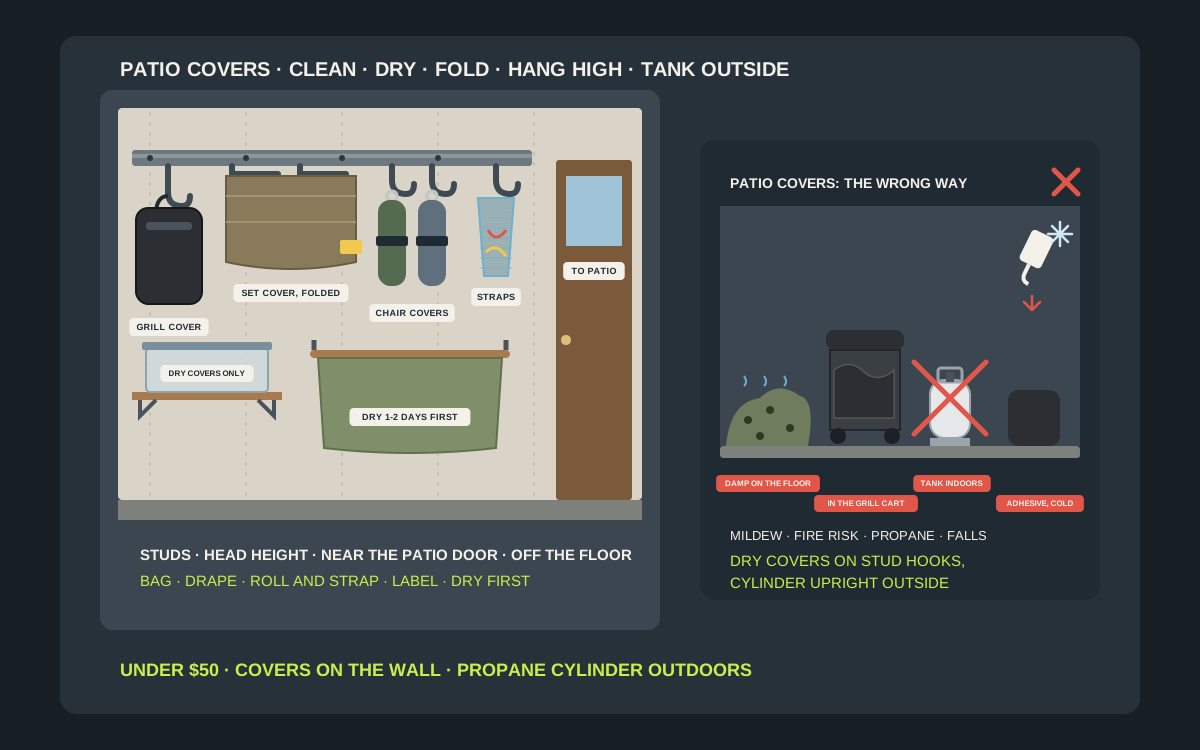
Patio covers spend half their life doing their job and the other half in the way. In summer the grill cover comes off before every cookout and ends up draped over a chair, kicked into a corner or rained on in a heap. In autumn, when the grill rolls into the garage and the patio set goes into the shed, the covers come off for good and get stuffed into a bin, still damp, where they wait until spring smelling of mildew. A good cover is not cheap, and most of the damage it suffers happens in storage, not on the patio. The fix is a few dollars of hardware. A deep hook or two on a garage stud, a short length of track rail, a pair of hook-and-loop straps and a place to let a wet cover dry before it is folded will keep every grill cover, sofa cover and chair cover clean, dry, labeled and easy to find. This guide covers which hooks and holders suit which covers, how to clean, dry and fold a cover before it goes on the wall, where in the garage the covers should hang, how to mount hooks that will still be holding in January and the one item that must never come into the garage with the grill: the propane cylinder. Almost everything here costs under $50 for the whole wall.
Shop heavy-duty garage utility hooks on Amazon
Who this is for
- Grill owners who are tired of the cover living in a heap on the patio between cookouts
- Anyone moving a grill or a patio set into the garage or a shed for winter and wondering what to do with the covers
- Households with several fitted covers, for a sofa, a dining set, chairs, a fire pit and an umbrella, that never get matched to the right furniture in spring
- People who have opened a storage bin in April to find a mildewed, cracked or chewed cover
Quick answer
For most garages, the best under-$50 setup is a short track rail or two heavy-duty utility hooks screwed into the studs near the door you use to reach the patio, about head height and away from the cars. Hang the grill cover in its storage bag on one deep hook, drape a folded patio set cover over a pair of long arm hooks, and roll smaller chair covers in hook-and-loop straps that hang by their grommets. Keep the tie-downs, bungees and support poles in a mesh bag on another hook, and give every cover a label that says which furniture it fits. Clean and dry each cover completely before it goes up; a wall drying rod or a line for a day is enough. If the grill comes inside, disconnect the propane cylinder and leave it outdoors. Check hook ratings, strap lengths and current prices on the listing before you buy.
Quick comparison
| Hook or holder | Best for | How it holds | Trade-off |
|---|---|---|---|
| Deep stud-mounted utility hook | A grill cover in its storage bag | Bag handle or folded cover sits deep inside a lipped hook | Needs a stud or a rated anchor |
| Track rail with utility hooks | A row of covers near the patio door | Rail screwed across studs; hooks slide and lock where needed | Rail costs more than single hooks |
| Pair of long arm hooks | A folded patio set or sofa cover | Folded cover drapes across two arms like a towel bar | Takes a wider stretch of wall |
| Hook-and-loop straps with grommets | Chair, chaise and fire pit covers | Rolled cover is strapped and hung by the grommet | Static loads only; check strap length |
| Mesh or canvas bag on a hook | Straps, bungees, toggles and support poles | Small parts collect in one bag beside the covers | Bag must breathe, not trap damp |
| Lipped shelf with a lidded bin | A stack of small chair covers | Bin sits on a bracket shelf above the floor | Lid keeps pests out but slows drying |
| Wall drying rod or retractable line | Wet covers before they are folded | Cover hangs open across a rod or line until dry | Needs space to open the cover fully |
| Adhesive or over-door hook | One light chair cover by the patio door in season | Hook stuck to smooth paint or hung over a door | Weak in a cold garage; light covers only |
Garage track rail and hook kitsHook-and-loop storage straps with grommetsPatio furniture cover storage bags
What to look for
Depth for a bulky, slippery cover
A folded grill cover is soft, slippery and thicker than it looks, and a patio sofa cover folded down to a manageable size can be a bundle the size of a sleeping bag. Shallow coat hooks and small pegboard hooks let a cover slide off as soon as someone brushes past it. Look for deep utility hooks with an upturned tip or a lip, wide arm hooks that a folded cover can drape across, or a storage bag with a strong handle that sits fully inside the hook. The deeper and wider the hook, the less the fabric bunches and creases.
A rating with margin, mounted in wood
A single cover is light, but a hook rarely holds just one cover for long. A bag with a grill cover, a sofa cover and a set of straps, plus the odd bike helmet that ends up on the same hook, adds up quickly. Rubbermaid lists its FastTrack hooks at 25 or 50 pounds depending on the model, which is far more than covers need, as long as the hook or rail is screwed into studs. The rating on the packet assumes the hardware is installed the way the maker says; a hook screwed into bare drywall is not rated for anything.
Something that keeps the cover off the floor
Garage floors are where the damp, the road salt, the oil and the mice are. A cover stored on the slab, even in a bag, picks up moisture from the concrete and invites anything looking for nesting material. The whole point of a wall hook is to get the cover up, ideally at or above head height, where it stays dry and clean and is not in the way of car doors. A lipped shelf with a lidded bin does the same job for a stack of small chair covers.
Room for straps, buckles and poles
Most good covers come with parts that go missing: click-close leg straps, drawcord toggles, tie-down straps and sometimes a support pole that keeps water from pooling on top of a table cover. Store those with the cover or right next to it, in the cover’s own bag or in a mesh bag on the next hook. A cover that turns up in spring without its straps is a cover that blows into the neighbor’s yard in the first storm.
A way to dry the cover first
Classic Accessories, which makes many of the patio covers sold in North America, says mold and mildew grow when moisture mixes with organic material such as dirt, food particles and lotions, and that covers should be clean and completely dry before they are folded and stored. That means your storage plan needs somewhere for a wet cover to hang open for a day or two first: a wall drying rod, a retractable line, a pair of arm hooks or even a ladder hook. Skipping this step is the most common way to ruin a good cover.
Labels and a fixed place for each cover
A dining set cover, a sofa cover and a chaise cover look identical once folded. A simple tag on each bundle, or a label on the hook or rail above it, saying which piece of furniture it fits and which way it goes on, saves a frustrating half hour in spring. If each cover always goes back on the same hook, you will also notice straight away when one is missing.
Know the covers you are storing
Grill covers
A fitted grill cover is usually polyester or a polyester and vinyl blend, cut to the shape of a particular grill, with straps or hook-and-loop tabs to stop it blowing away. Weber, for example, lists its Spirit cover as 100 percent polyester with UV inhibitors, breathable and water-resistant, with fastening straps, and specifies spot cleaning only. Some covers come with a small storage pouch or a carry bag; keep it, because a bagged cover hangs neatly from a single hook. A grill cover is light, but it is bulky and often greasy on the inside where it has touched the lid.
Patio set and sofa covers
Covers for dining sets, sectionals, sofas and loveseats are the big ones. A cover for a full dining set can be several feet across when it is open, and even folded it is a thick bundle. Many have vents to reduce condensation, padded handles for pulling them on and off, and a belted or elastic hem with click-close straps that snap around the furniture legs. Those straps and buckles are the parts most likely to go missing in storage.
Chair, chaise and stacking covers
Individual chair covers, chaise lounge covers and covers for stacked chairs are smaller and lighter, which makes them easy to roll and strap. They are also the ones that get confused with each other, because a set of four chair covers can include two sizes. Rolling each one and tagging it with the furniture it fits is the cleanest way to store them.
Fire pit, umbrella and accessory covers
Round fire pit covers, long tube-shaped umbrella covers, heater covers and planter covers round out most patios. Umbrella covers are long and thin and hang well from a single hook by their drawstring or zip end. A fire pit cover is wide and flat and folds like a table cover. Store them on the same rail as everything else so the whole patio packs away in one place.
When the covers come off
Between cookouts in summer
In season, the grill cover comes off and goes back on every time you cook, and the question is where it waits in between. Draped over a patio chair it gets wet, dirty and in the way; dropped on the deck it collects leaves and grease. A hook just inside the garage or on an outside wall near the grill, out of the way of the cooking area, gives it somewhere to go. Never put it back on a hot grill; covers say to let the grill cool completely first.
When the grill and furniture come inside for winter
If you move the grill into the garage or shed for winter, or stack the patio set inside, the covers come off for months. This is the storage that matters most, because a cover that is folded damp in October will be stained and musty in April. It is also when people discover that their garage has no space set aside for a bundle the size of a sleeping bag. Plan for it before the first frost rather than after.
When the furniture stays out under its covers
Many people leave the patio set outside under fitted covers all winter, and Classic Accessories says its covers are built for year-round use in rain, snow, frost and wind. In that case the winter storage job is different: the covers stay on, and what needs a home on the garage wall is everything else, including the summer chair covers, the umbrella and its cover, the spare tie-down straps and the support pole that keeps snow from pooling on a table cover.
The spring changeover
In spring the process runs in reverse. Covers come off the wall, get a quick check for holes, missing straps or chewed corners, go onto clean, dry furniture, and the hooks are free for whatever comes in next, such as snow shovels, winter tires or sleds. A rail with sliding hooks earns its money here, because the same wall can hold patio gear in winter and winter gear in summer.
Clean and dry every cover before it hangs
Shake, brush and rinse
Shake off leaves and debris, then lay the cover flat or hang it over a rail outdoors. Classic Accessories recommends a soft scrub brush and warm water, with white vinegar diluted in water for heavy soiling, and advises against detergents and bleach, which can damage the protective coatings, and against machine washing, which can tear the seams. Weber says its covers should be spot cleaned only, with hot water, a dish soap with a mild degreaser and a cloth or paper towel. Whatever the brand, follow the care label on your cover.
Clean the inside, too
The inside of a grill cover is where the grease lives, because it rests on the lid and the side shelves. A greasy patch attracts dust and, in a garage, the attention of mice. Wipe the inside with the same warm water and mild cleaner, then rinse. For patio furniture covers, the inside picks up pollen, bird droppings that soaked through and whatever was on the furniture, which is exactly the organic material that feeds mildew.
Dry it completely, open and hanging
A cover should be completely dry, inside and out, before it is folded. Hang it open across a drying rod, a clothesline, two arm hooks or the back of a patio chair on a dry, breezy day, and turn it so the underside and the seams dry too. Heavy fabric and folded hems take longer than you expect; a cover that feels dry on top can still be damp in the corners. Fold it only when every part is dry to the touch.
Never cover a damp grill or damp furniture
The same rule applies in reverse. Covers protect against rain, but they cannot stop condensation, which forms whenever warm, humid air cools, and Classic Accessories recommends removing cushions and making sure furniture is clean and dry before it is covered. A cover put on a wet table or a still-warm grill traps moisture underneath, which is how covered furniture ends up with mildew and covered grills end up with rust.
Fold, label and bag
Fold it flat and square
Classic Accessories’ fold-and-store instructions are simple: lay the cover on a flat surface such as a table or clean floor, square it up by folding in the angled and elastic sides, then fold it in half until it is the size you want. A neat, flat bundle drapes over arm hooks without sliding, fits in a storage bag and comes out in spring with fewer creases. For very large covers, a second person makes the job much easier.
Or hang it by its handles
Some covers are designed to be hung rather than folded. Classic Accessories’ Storigami covers, for example, have guide labels and handles so the cover can be lifted off, folded in half and then hung by the handles or folded further. If your cover has sturdy handles, hanging it by them from a deep hook is the quickest way to store it.
Roll the small ones
Chair and chaise covers roll well. Fold the cover lengthwise to the width of the strap, roll it tightly and wrap a hook-and-loop strap around the middle. Wrap-It, one maker of these straps, rates its 7-inch heavy-duty straps for 25 pounds and its longer straps for 50 pounds, for static loads only, so they are more than strong enough for a rolled cover hanging on a hook.
Label every bundle
Write the furniture name and size on a luggage tag, a strip of tape or a clip-on label, for example dining table 72 in or left chaise. Put the straps, toggles and support pole in the cover’s bag or in one shared mesh bag right beside it. A photo of each cover on its furniture, saved on your phone, also helps when you are matching covers in spring.
Choosing the hooks and holders
Deep utility hooks
A heavy-duty utility hook with a deep, upturned end is the workhorse for a bagged grill cover or a cover hung by its handles. Screw it into a stud at head height. A vinyl or rubber coating protects the fabric and stops the bag sliding, and a hook deep enough to take the whole handle without the bundle hanging off the tip is worth a little extra.
Track rail systems
A track rail is a metal or resin rail screwed across several studs, with hooks that clip on and slide along it. It is the best choice if you have more than two or three covers, because you can space the hooks to suit the bundles and move them around when the season changes. Rubbermaid’s FastTrack hooks, for example, are rated at 25 or 50 pounds depending on the model. Rails are sold in different profiles, so buy hooks that match the rail.
Long arm and ladder hooks
Paired long arm hooks, sold for ladders, folding chairs or garden hoses, make a good rack for a folded patio set cover. Drape the folded cover across both arms like a towel over a towel bar. Fabric draped this way keeps breathing, which is useful in a damp garage, and the same pair of hooks doubles as a drying rack when a cover comes in wet.
Hook-and-loop straps
Storage straps with a metal grommet let you roll a small cover, strap it and hang it from any hook or nail. They are inexpensive, reusable and come in several lengths, and they stop rolled covers unwinding into a heap. They are designed for static loads, so they are ideal for covers but not for anything that swings or vibrates.
Bags and bins
A breathable mesh or canvas bag on a hook keeps straps, toggles, bungees and support poles together. A lidded plastic bin on a lipped shelf suits a stack of small chair covers, especially in a garage with a mouse problem. Plastic bins keep pests out but slow drying, so only put completely dry covers in them, and consider leaving the lid slightly loose or adding a moisture absorber in a humid climate.
Adhesive hooks, used carefully
Adhesive hooks have a place by the patio door in summer for a single light chair cover, but they are a poor choice in a garage over winter. Command lists its indoor products for about 50 to 105 degrees Fahrenheit and its outdoor line for about minus 20 to 125 degrees, and every adhesive hook has a weight limit far lower than a stud-mounted hook. A heavy cover bag on an adhesive hook in a cold garage is a cover on the floor by morning.
Where the covers belong in the garage
Near the door to the patio
Put the cover station on the wall closest to the door you use to reach the patio or the back yard. In season that means the grill cover is a few steps from the grill, and in autumn every cover comes in by the shortest route. A spot near that door also tends to be away from the car bays, so bundles do not get brushed by doors or bumpers.
High, dry and away from the slab
Hang covers at or above head height on an inside wall, away from the garage door where snow melts off the car and away from any wall that sweats in winter. Keep them a few inches off the wall if the wall gets damp; a rail with hooks does this naturally. The higher the covers sit, the less road salt, dust and splash they collect.
Away from heat, fuel and chemicals
Covers are flammable fabric and plastic. Keep them well away from a furnace or water heater, a space heater, a workbench where you grind or weld, and shelves of gasoline, solvents and pool chemicals. A grill cover with grease on the inside is worth keeping out of the way of anything hot. Weber’s Q owner’s guide even warns against putting a barbecue cover or anything flammable in the storage area under the barbecue, so do not stuff the cover into the grill cart’s cabinet.
Next to the gear it belongs with
If the patio chairs fold and hang in the garage too, put their covers on the same rail. Our guide to folding chair wall hangers covers the chairs themselves, and our guide to cooler wall mounts covers the other big summer item that usually comes inside at the same time. Keeping the patio season together makes spring set-up a single trip.
The grill and the propane tank
The cylinder stays outdoors
If you bring a gas grill into the garage for winter, the propane cylinder does not come with it. Weber’s gas grill owner’s guides say that when the grill is stored indoors, the gas supply must be disconnected and the cylinder stored outdoors in a well-ventilated space, out of reach of children, and that a disconnected cylinder must not be stored in a building, garage or any other enclosed area. If the cylinder stays connected, the grill and the cylinder both stay outdoors.
Why a garage is the wrong place
The Propane Education & Research Council says never to use or store a portable cylinder in an enclosed area such as a basement, garage, shed or tent, and points out that even an empty cylinder may contain enough propane to be hazardous. The North Carolina Department of Agriculture’s propane storage guidance, which references the NFPA 58 LP-Gas Code, lists storing tanks indoors as something not to do, and says tanks should stand upright on their foot ring, with the valve closed, away from heat and out of the hot sun. Cold weather does not harm a propane cylinder, so outdoors is fine in winter.
Cover the grill, not the problem
Turn the cylinder valve off whenever the grill is not in use, and keep spare cylinders away from the grill. If the grill stays outside all winter under its cover, that is fine; just make sure it is cool, clean and dry before the cover goes on, and check the cover’s straps before the first storm. Before the first cookout in spring, Weber’s guides recommend checking the grill for gas leaks and for obstructions in the burner tubes and spider and insect screens.
Charcoal and pellet grills
For charcoal grills, let the grill and the ash cool completely, and empty the ash before covering or bringing the grill inside. Pellet grill makers generally recommend emptying the hopper before long storage, because pellets absorb moisture; check your grill’s manual. The cover itself is stored exactly the same way whatever the fuel.
Moisture, pests and the cold garage
Let covers breathe
Breathable fabric bags, mesh bags and covers draped over arm hooks let any leftover moisture escape. Sealed plastic bags and tightly closed bins trap it. If you use a bin, put only bone-dry covers in it, and open it once in midwinter to check for damp or a musty smell. A dehumidifier or moisture absorber helps in a garage that stays humid.
Keep nesting material out of reach
Garages attract mice and insects looking for shelter as the weather turns, and soft fabric is ideal nesting material. Covers hung high on the wall, away from shelves of birdseed and pet food, are much less tempting than covers in a heap on the floor. Clean covers with no food grease on them help too. Check each bundle when you take it down in spring.
Plan for freezing temperatures
Vinyl-backed covers can stiffen in the cold. Fold them while they are at room temperature rather than in a freezing garage, and unfold them slowly in spring. Avoid hanging covers so that they bend sharply over a narrow hook; a wide arm, a padded hook or a bag spreads the load and reduces creasing.
Mounting hooks that last the winter
Find the studs
Garage walls are usually framed with studs 16 inches apart, behind drywall or plywood. A stud finder, or a small nail tapped in a few places, will locate them. Screw single hooks directly into a stud, and screw a track rail into every stud it crosses. On concrete or block walls, use masonry anchors rated for the load.
Use the right anchor when there is no stud
If the perfect spot falls between studs, a light hook for a single chair cover can go into drywall with a rated anchor, but anything that will hold several covers belongs on a stud or a rail. Our comparison of adhesive and screw-in hooks for garage walls explains which fixing suits which load.
Leave room to reach
Mount the rail high enough that bundles clear car doors and heads, but low enough that you can lift a folded sofa cover onto the hooks without a ladder. For most people that is somewhere between shoulder and head height. Leave space below the rail so a cover hung by its handles does not touch the floor.
Three sample setups
Two-car garage, gas grill and a dining set
A 48-inch track rail runs across three studs beside the door to the back yard, at head height. The grill cover hangs in its bag on a deep hook at one end, the folded dining set cover drapes across two arm hooks in the middle, and four rolled chair covers hang in hook-and-loop straps at the other end. A mesh bag on the last hook holds the leg straps, two bungees and the table support pole. The propane cylinder stands upright outdoors behind the shed. Total hardware cost is comfortably under $50.
Single garage, furniture stays outside
The sofa set stays on the deck under its fitted cover all winter. Inside the garage, one deep utility hook holds the bagged umbrella and its cover, a pair of arm hooks holds the summer chair covers folded flat, and a small mesh bag holds spare tie-downs. A drying rod on two brackets near the door gives a wet grill cover somewhere to air after a rainy cookout.
Townhouse with a small grill and a balcony set
There is no room for a rail, so two stud-mounted utility hooks inside the garage door hold the compact grill cover in its pouch and a lidded bin on a small lipped shelf holds two rolled chair covers and a bistro table cover. The grill stays on the balcony under its cover, cylinder attached and valve closed, as its manual allows.
How to set it up in an afternoon
- Pick a stretch of inside wall near the door to the patio, away from the car bays, heaters and fuel.
- Find the studs and mark them, then mount a track rail or two deep utility hooks at about head height.
- Add a pair of long arm hooks for the largest folded cover and a drying rod or line for wet covers.
- Clean each cover with a soft brush and warm water, following its care label, and let it dry completely, inside and out.
- Fold the big covers flat and square, roll the small ones and wrap them with hook-and-loop straps.
- Tag every bundle with the furniture it fits and put straps, toggles and support poles in a mesh bag beside it.
- Hang each cover on its own hook, high and off the floor, and keep a lidded bin only for bone-dry small covers.
- Leave the propane cylinder outdoors, valve closed, and check the covers for damp or pests once in midwinter.
Mistakes to avoid
- Folding a cover while it is still damp, or storing it in a sealed plastic bag.
- Putting a cover on a grill that is still warm or on furniture that is still wet.
- Washing a cover in a washing machine or with bleach or strong detergent.
- Leaving covers in a heap on the garage floor where damp, salt and mice reach them.
- Hanging heavy cover bags on adhesive hooks in a cold garage.
- Stuffing the grill cover into the grill cart cabinet.
- Bringing the propane cylinder into the garage along with the grill.
- Losing the leg straps and support poles because they were stored somewhere else.
Related guides
Browse the hub: Garage wall storage under $50 - all guides
- How to Do a Fall Garage Cleanout with Wall Racks Under $50
- Best Camping Grill & Griddle Wall Hooks Under $50
- Best Folding Chair Wall Hangers for Garages Under $50
- Best Cooler Wall Mounts Under $50 for Garage
- Best Affordable Garage Track Rail Hooks Under $50
- Best Bungee Cord Wall Organizers Under $50 for Garage
- Best Winter Tire & Seasonal Gear Wall Storage Under $50
- Adhesive Hooks vs Screw-In Hooks for Garage Walls Under $50
FAQ
How do you store a grill cover in the garage?
Clean it with warm water and a mild cleaner as its care label allows, let it dry completely, fold it flat and hang it in its storage bag or by its handles from a deep utility hook screwed into a stud at head height. Keep it away from heaters, fuel and the floor, and never stuff it into the grill cart cabinet.
Should patio furniture covers stay on in winter?
They can. Many fitted covers are made for year-round use, and Classic Accessories says its covers handle rain, snow, frost and wind. Make sure the furniture is clean and dry before covering, remove cushions and use a support pole on tables so water and snow do not pool. If you bring the furniture inside, clean, dry and hang the covers instead.
How do you fold a patio furniture cover for storage?
Lay it on a flat surface, square it up by folding in the angled and elastic sides, then fold it in half until it is the size you want. Some covers, such as Classic Accessories’ Storigami line, are designed to be folded in half and hung by their handles.
Can I store the propane tank in the garage with the grill?
No. Weber’s owner’s guides say a grill stored indoors must have its cylinder disconnected and stored outdoors in a well-ventilated area, and the Propane Education & Research Council says never to store a portable cylinder in a garage, shed or other enclosed space, even if it seems empty. Store it upright outdoors with the valve closed.
What hooks hold a patio furniture cover?
Deep stud-mounted utility hooks for bagged covers, a pair of long arm or ladder hooks for a large folded cover and hook-and-loop storage straps with grommets for rolled chair covers. A track rail lets you hang several covers in a row and move the hooks as the seasons change.
How do you stop a stored cover getting mildew?
Clean off dirt, food and pollen first, because mildew grows when moisture meets organic material. Then dry the cover completely, inside and out, before folding, store it somewhere it can breathe rather than in a sealed bag, and check it once in midwinter.
Bottom line
The best grill and patio furniture cover storage is a short stretch of garage wall set aside for it before the first frost. For most homes that is a track rail or two deep utility hooks in the studs near the patio door, a pair of arm hooks for the big folded cover, hook-and-loop straps for the chair covers, a mesh bag for the straps and poles, and somewhere to dry a wet cover first. Clean and dry every cover, fold it flat, label it, hang it high and leave the propane cylinder outdoors. Check hook ratings, strap lengths and current prices on the listing before you buy.