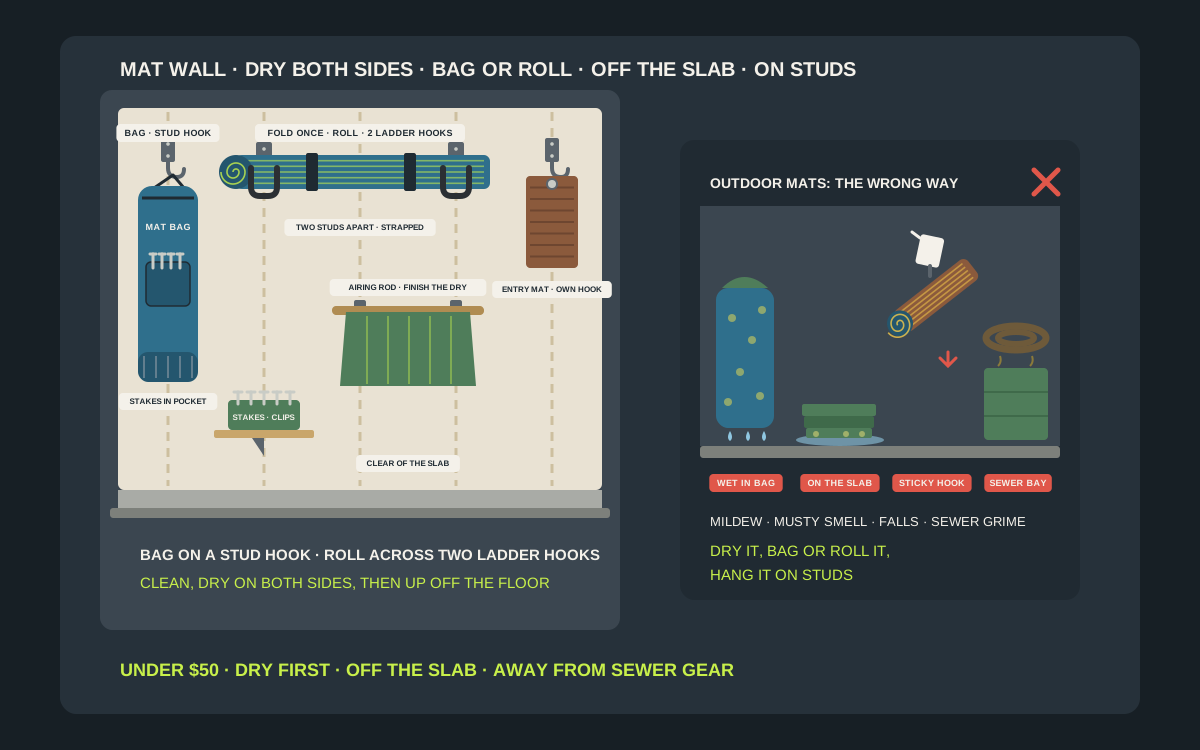
An RV outdoor mat is the most-used thing at a campsite that nobody thinks about until it is time to leave. It lies under the awning for a week, collects sand, pine needles and morning dew, and then has to be folded up in five minutes before checkout. At home it gets worse: the mat lands in a heap on the garage floor or gets stuffed into the basement bay next to the sewer hose, and when you unroll it on the next trip it smells like a damp basement. A patio rug that comes in for the winter tends to suffer the same fate. The fix costs well under $50. A stud hook for the mat in its bag, a pair of ladder hooks for a rolled rug, a couple of long storage straps and a rod to finish drying it give an outdoor mat a clean, dry, off-the-floor home. The rules that matter come from the people who make the mats and rugs: Camco describes its Open Air mats as lightweight, breathable, mold and mildew resistant and easy to fold, while outdoor rug makers say the same thing about storage again and again: clean it, dry it completely, roll or fold it loosely and keep it somewhere dry. This guide covers which wall setup suits which mat, where the mat wall belongs at home and in the rig, and the habits that stop mildew before it starts.
Shop RV mat storage bags on Amazon
Who this is for
- RV owners with a 6x9, 9x12, 8x16 or 8x20 awning mat that lives in a basement bay on the road and in the garage between trips
- Campers and tailgaters with a woven outdoor mat or a reversible plastic rug that comes home sandy, damp or both
- Homeowners and renters bringing a polypropylene patio rug in for winter who want it off the floor and out of the way
Quick answer
For most people, the best under-$50 outdoor mat storage is the mat’s own storage bag hung by its handle from a deep utility hook screwed into a stud, with stakes in the bag’s outside pocket. For a thicker patio rug, or a mat you would rather roll than fold, fold it once lengthwise, roll it loosely, and lay the roll across two ladder hooks screwed into studs two bays apart, with a strap at each end. Whatever you choose, the mat goes up clean and bone-dry on both sides, off the concrete floor, out of direct sun and well away from sewer gear. Check the fit, the included hardware and the current price on the listing before you buy.
Quick comparison
| Setup | Best for | How it holds | Trade-off |
|---|---|---|---|
| Mat bag on a stud hook | Folded awning mats up to 9x12 | Bag hangs by its handle from a deep utility hook | Mat must go in fully dry |
| Fold-and-roll on two ladder hooks | Thicker patio rugs and long mats | Roll rests across two hooks screwed into studs | Needs about 4 to 5 ft of wall width |
| Storage straps with grommets | Rolled mats and small rugs | Strap wraps the roll; the grommet hangs on a hook | Rated for static loads only |
| Airing rod on brackets | Finishing the dry at home | Mat drapes over a wall-mounted dowel or closet rod | Drying station, not long-term storage |
| Entry mat on its own hook | Door, step and boot mats | Grommet or corner loop on a single hook | Hang it apart from the big mat |
| Stake and clip bin | Mat stakes, clips and tie-downs | Open bin on a shelf or rail under the mat | Holds the hardware, not the mat |
Ladder and utility hooksHeavy-duty storage strapsWall-mount dowel rod brackets
What to look for
Sized for the folded or rolled mat
Mats vary more than people expect. Camco’s catalog lists its Open Air reversible mats in 6x9, 9x12, 8x16 and 8x20 ft sizes, and retailers list the 9x12 at about 7.5 lb and the 8x16 at about 13 lb. Camco’s own mat bag measures 39 by 15.25 by 7.5 inches and is sold to fit its 6x9 and 9x12 mats. A 16- or 20-footer folds into a fatter bundle, and a rolled 8x10 patio rug can be 8 inches or more across. Measure the mat folded or rolled the way you will actually store it before you choose a hook depth, bag size or strap length.
Screws into studs, not adhesive
A mat is light compared with a bike, but it is pulled down and pushed back up in a hurry, often wet and gritty, and a rolled rug puts its weight on a narrow hook lip. Screw hooks into studs, or into a track rail that is itself screwed into studs. Adhesive hooks are a poor fit: Command’s indoor strips are rated for roughly 50 to 105°F, and garages and RV bays swing outside that range for much of the year. A 7- to 13-lb mat on one adhesive hook is also the kind of load that peels slowly and then lets go all at once.
Holds the mat off the floor
Concrete wicks moisture, and a mat lying on the slab never dries underneath. Outdoor rug makers are blunt about this: one Swiss rug retailer’s winter storage guide says to keep the rolled rug on a pallet or shelf, never in direct contact with the concrete floor. A wall hook, a pair of ladder hooks or a rod all solve that for the price of a few screws.
Lets air reach the mat
Breathable woven mats are designed so that rain and snow drain through instead of pooling, which is exactly why they should not be sealed up while damp. The same retailer’s guide warns against plastic film because it traps moisture, and recommends a breathable cover instead. A bag with a mesh panel, an open roll on hooks and a drying rod all let a mat keep breathing on the wall.
Quick to load with gritty hands
The best mat storage works at the end of a long travel day. A bag that hangs by a handle, a roll that drops onto two hooks or a strap that closes with one pull will get used. A setup that needs a ladder, two people or a precise fold will not, and the mat ends up on the floor again.
Clear of sewer gear, chemicals and heat
A mat is the thing you sit on, eat on and let the kids and the dog play on, so it should never share a hook, a bin or a bay corner with the sewer hose, the black tank rinse wand or the chemical caddy. At home, keep it away from a furnace, water heater or clothes dryer vent, and out of a sunny window where UV can fade the pattern and stiffen the weave.
Know what you are storing
Woven awning mats are made to fold
Most RV awning mats are thin, woven synthetic mats, not carpets. Camco describes its Open Air mats as reversible, lightweight, mold and mildew resistant and made from breathable material that will not trap rain or snow, with a UV coating, and says they fold easily for storage and clean with soap and water. One RV retailer describes the 8x16 version as woven polypropylene that drains through and folds compactly into a basement bay. That is why folding along the existing creases and bagging the mat is the maker’s own storage method.
Sizes and weights
Camco’s catalog lists 6x9, 9x12, 8x16 and 8x20 ft mats. Retail listings put the 9x12 Charcoal Oriental at 7.5 lb, a 9x12 mat with grommeted corners at 9.3 lb and the 8x16 Charcoal Swirl at 13 lb. None of those is heavy for a screwed-in hook, but every one of them is bulky, and the weight is spread along a soft, floppy bundle that slides off a shallow hook. The size of the folded or rolled mat matters more than the number on the scale.
Patio rugs roll better than they fold
A thicker reversible plastic or polypropylene patio rug is a different animal. Rug makers and retailers generally recommend rolling over folding because folding can leave permanent creases that damage the weave and the backing. A Swiss rug retailer’s winter guide says to roll loosely with the pile facing inward, and a polypropylene rug care guide says the same: roll rather than fold to avoid creases. If you own both a thin awning mat and a heavier patio rug, they probably want different storage.
Door, step and boot mats
Many RV owners also carry a small entry mat for the steps or a boot tray mat for the door. These are light enough for a single hook, especially if they have a grommet or a corner loop, and they get dirty faster than the big mat. Give them their own hook so the grit on a boot mat does not end up inside the awning mat’s bag.
Stakes, clips and tie-downs
Mats with corner tie-down loops or grommets need stakes on breezy sites, and stakes are sharp, muddy and easy to lose. Camco’s mat bag has an exterior pocket for mat anchors so the stakes travel with the mat but outside it. If your bag has no pocket, a small open bin on the same wall keeps the stakes together, points down, and out of the folded mat where they can poke holes.
Six ways to store an outdoor mat on a wall
The mat bag on a stud hook
This is the simplest and best home for a folded awning mat. Camco’s 42739 mat bag is made for its 6x9 and 9x12 reversible mats; it measures 39 by 15.25 by 7.5 inches, has a handle, an adjustable shoulder strap, a drawstring top and an outside pocket for mat anchors, and is polyester with a waterproof PVC lining and a PVC mesh bottom. Fold the dry mat along its creases, slide it in, put the stakes in the pocket and hang the bag by its handle from a deep utility hook screwed into a stud. Rubbermaid’s FastTrack utility hooks, for example, are rated at 50 lb, far more than a bagged mat. Because the lining is waterproof, anything that goes into the bag damp stays damp, so the bag is for dry mats only.
Fold once, roll and rest it on two ladder hooks
For a patio rug or any mat you prefer to roll, fold it in half lengthwise first. A 9x12 becomes a 4.5x12 strip and rolls into a bundle about 4.5 ft long, which sits neatly across two ladder or utility hooks screwed into studs two bays apart, about 32 inches apart on a typical 16-inch stud layout. Rubbermaid’s FastTrack ladder hook, for example, is rated at 50 lb and is meant to be used in pairs for horizontal storage, on its rail or straight on the wall. Roll loosely, with the top face inward, and let the roll rest in the hooks rather than hang from them. Padded or vinyl-coated hooks are kinder to the weave than bare metal. This is the best way to store a rug for winter without leaving new creases.
Hook-and-loop storage straps with grommets
Long storage straps keep a roll from unwinding and give you a way to hang it from a single hook or a pegboard. Wrap-It rates its Heavy-Duty straps at 25 lb for the 7-inch size and 50 lb for the 10- to 28-inch sizes, with a rust-resistant grommet for hanging, but only for static loads with the full hook side fastened to the loop side, and not for loads subject to dynamic or vibrating conditions. Its 10-inch strap wraps a bundle only about 2.9 inches across, so a rolled mat needs the longer sizes; check the wrapping capacity on the listing against the diameter of your roll. Use two straps, one near each end, on a roll that rests on ladder hooks, and do not trust a strap alone in a moving RV.
An airing rod for the last of the drying
A wall-mounted dowel or closet rod on two heavy-duty brackets screwed into studs turns any garage wall into a drying station. Drape the mat over it, top side out, for a day after you get home, flip it, and only then bag or roll it. This is also where a mat goes after a hosing on the driveway. It is a drying station, not long-term storage: once the mat is dry on both sides, it moves to the bag hook or the ladder hooks so the rod is free for the next wet item.
A single hook for the entry mat
A small step or door mat with a grommet or corner loop hangs from one hook at shoulder height, beside the big mat but not on the same hook. Hanging it vertically lets loose grit fall out instead of working into the weave, and the grommet makes it a one-handed job on the way out. If the mat has no grommet, a short storage strap through a corner loop does the same job.
A stake and clip bin
Mat stakes, awning mat clips, tie-down cords and a small brush all belong in one open bin on a short shelf or rail under the mat. Store stakes points down, and keep the bin open so damp hardware can dry instead of rusting in a sealed box. If you camp in sand, a pair of sand stakes in the same bin saves a trip to the campground store.
Where the mat wall goes
The home garage
For most RV owners, the mat lives in the garage between trips. Pick a stud wall near the door you load the rig from, away from the furnace, water heater and dryer vent, and out of the path of the car door. Mount the bag hook at a height you can reach with a wet, heavy bag, and put the ladder hooks for a rolled rug higher, above head height, where the roll will not catch a shoulder. Keep the whole station well above the slab so a spilled bucket or melting snow from the car never reaches it.
Sheds and storage units
A shed or storage unit works if it stays dry. Many do not: an uninsulated shed can sweat on cold mornings, and a storage unit can trap humidity for months. If you store a mat there, use the same hooks off the floor, choose a bag with a mesh panel, and open it once or twice over the winter to check for musty smells. An outdoor rug maker’s storage guide recommends a sheltered, dry place for the winter and rainy months, because constant moisture and frost wear out the fibers over time.
The RV basement bay
On the road, the mat lives in a basement bay, and that is where it most often picks up smells. Give it a dedicated corner or compartment away from the sewer hose, the tank rinse gear and anything that leaks. A bag with a handle hung from a screwed-in hook or tied to a bay cargo ring keeps it from sliding around, but a storage strap alone is not rated for a bouncing bay. On travel days, keep the mat low and tied down rather than hung high where it can swing into the bay door.
Inside the RV
A mat that has to come inside because it is wet, or because the bays are full, is best carried in its bag and laid on the floor of the shower or tub until you reach the next site and can dry it. Do not hang a wet mat from a wall hook inside a moving RV: it drips, swings and loads thin walls in ways they are not built for. Our RV hook-mounting guide covers what interior walls can take.
Apartments, balconies and patios
Renters bringing a balcony rug in for the winter can use the same fold-and-roll trick on a freestanding shelf or in a closet, rolled loosely and strapped. Consumer Reports recommends drying outdoor rugs thoroughly, rolling them up and storing them in an enclosed space protected from rain and excess moisture in the off-season. If you can mount two screws, a single strap hook in a closet holds a small rolled rug off the floor.
Three sample mat walls
Weekend travel trailer with one 9x12 mat
One stud hook for the mat bag, one hook beside it for a step mat and a small open bin on a shelf below for stakes and clips. That is the whole station, it fits in a 2-ft strip of garage wall, and it can sit right next to the hooks that hold the camping chairs, so loading the trailer is one trip along one wall. If the mat comes home damp, it spends a day on the driveway or over a rod before it goes back in the bag.
Full-timer or long-stay rig with a big mat and a patio rug
A 16- or 20-ft awning mat and a thicker patio rug want more room. Put two ladder hooks two studs apart up high for the rolled rug, a deep hook for the bagged mat below it, and an airing rod at chest height on the same wall. When the rig goes into storage for a season, both come home, get washed and dried, and hang here until spring, off the slab and away from the car.
Tent camper, tailgater or beach-day kit
A 6x9 mat, a picnic blanket and a door mat fit on a short track rail screwed into studs: a utility hook for the bagged mat, a strap hook for the rolled blanket and a small hook for the door mat, with a bin for stakes. Keep the rail near the cooler and chairs so everything for a day out lives on one wall, and the mat goes back up dry instead of being left in the trunk.
Setting up the mat wall step by step
- Choose a stud wall in the garage near the door you load the RV from, away from heat sources, sunny windows and the car door’s swing.
- Find two studs two bays apart with a stud finder and confirm each with a small nail where the hook will cover the hole.
- Screw a deep utility hook into one stud at a height you can reach easily with a full mat bag.
- Screw two ladder or utility hooks into the two studs at the same height, above head height, for a rolled rug, and check them with a level.
- Mount a rod on two brackets screwed into studs at chest height on the same wall for drying.
- Add a single hook for the entry mat and a short shelf or rail bin for stakes and clips under the station.
- Clean and dry the mat completely, then bag it along its creases or fold it once and roll it loosely with the top face in.
- Load the bag or roll, close the straps, and pull it down and put it back once to make sure it is a one-person job.
Cleaning and drying before it goes up
Shake, sweep and rinse
Shake or sweep the mat on site before you fold it, so sand and needles stay at the campsite. At home, lay it on the driveway, sweep both sides and rinse it with a garden hose. One outdoor rug maker’s care sheet says to sweep or vacuum off dirt, use a garden hose or light water pressure on stubborn dirt, and pre-treat stains with lukewarm mild soapy water. Camco says its mats clean with soap and water.
Skip bleach and harsh cleaners
The same care sheet says never to use cleaners containing chlorine, acids or solvents, or abrasive scouring agents, on an outdoor rug. For mildew spots, The Home Depot’s outdoor rug care guide suggests a solution of one part white vinegar to three parts water over a little baking soda, and testing any cleaner on the underside first. Rinse thoroughly so no soap is left in the weave to attract dirt.
Dry both sides completely
This is the step that decides whether the mat smells next spring. Outdoor rug makers say to let the rug dry thoroughly after any damp cleaning, and a Swiss rug retailer’s guide calls rolling up a damp rug the most common storage mistake, the one that shows up as mold and odor. The Home Depot suggests drying in a sunny spot, then flipping the rug to dry the reverse side. On a garage wall, the airing rod does the same job on a rainy day. Feel the back of the mat, and the inside of every fold, before it goes in the bag.
Check it once over the winter
Pull the bag down or unstrap the roll once in mid-winter. If it smells musty, wash it, dry it in the sun and store it again; if it is fine, it goes back up. Mildew caught early usually washes out. Mildew found in spring after months in a sealed, damp bag often does not.
Campground rules and the grass
Some parks want breathable mats only
Many campgrounds care about what your mat does to their lawn. High Eagle RV Park, for example, allows only breathable RV mats on its grass and says improper carpet or mats on grassed areas will be removed. A woven, breathable awning mat is the kind those parks expect; a solid-backed indoor rug is not.
Some want mats on the pad only
Broward County Parks in Florida says rugs, mats and other ground covers are to be used on campsite pads only, and that anything covering the grass should be moved often to keep the grass from dying. The Winterset City Park campground in Iowa says RV mats should not be placed over existing turf. On those sites the mat goes on the concrete or gravel pad, which also means it comes home dustier.
Some ban them on grass entirely
Dallas NE Campground’s rules say that anything that can leave dead areas on the lawn is not allowed, including breathable mats. Read the campground rules before you unroll, and if the mat cannot go down, it stays in its bag in the bay. That is one more reason the bag and its stakes should always travel together and be easy to grab.
Mistakes to avoid
- Folding or rolling the mat while it is still damp, especially into a bag with a waterproof lining.
- Leaving the mat folded on the concrete garage floor all winter.
- Hanging a heavy rolled rug from a single adhesive hook.
- Storing the mat in the same bay corner or bin as the sewer hose and tank rinse gear.
- Folding a thick patio rug into tight squares instead of rolling it loosely.
- Wrapping the mat in plastic sheeting that traps moisture.
- Packing stakes loose inside the folded mat, where they poke holes in the weave.
- Hanging a wet mat from a wall hook inside a moving RV.
- Unrolling a solid-backed rug on campground grass without checking the park rules.
Related guides
Browse the hub: RV & camping storage under $50 - all guides
- Best Camping Tarp & Ground Cloth Wall Bags Under $50
- Best Camping Chair Wall Hangers Under $50 for Cabins
- Best Folding Camp Table Wall Brackets Under $50
- Best Awning Crank & RV Leveling Block Wall Mounts Under $50
- Best RV Sewer Hose Support Wall Storage Under $50
- Best Camping Clothesline Wall Kits Under $50
- How to Mount Hooks in an RV Without Damaging Walls Under $50
- Best RV Tire Cover Storage Hooks & Bags Under $50
FAQ
How do you store an RV outdoor mat at home?
Clean it, let it dry completely on both sides, fold it along its creases and put it in its storage bag, then hang the bag by its handle from a deep utility hook screwed into a stud in the garage. Keep it off the concrete floor, out of direct sun and away from the furnace, water heater and sewer gear.
Should I roll or fold an outdoor rug for storage?
Thin woven RV awning mats are made to fold along their existing creases. Thicker patio rugs are better rolled loosely with the top face inward, because rug makers warn that folding can leave permanent creases in the weave and backing. Folding a long mat once lengthwise before rolling keeps the roll short enough for two wall hooks.
How do I keep an RV mat from getting moldy?
Never store it damp. Sweep and rinse it, use mild soap instead of bleach, dry it in the sun and flip it to dry the back, then store it somewhere dry with air around it. Avoid plastic wrap, check it once over the winter and keep it away from sewer gear in the basement bay.
Can I hang an outdoor rug on the wall?
Yes, if the hooks are screwed into studs. Fold the rug once lengthwise, roll it loosely and rest the roll across two ladder or utility hooks two studs apart, with a storage strap near each end. Skip adhesive hooks for a rolled rug; garages often fall outside the temperature range indoor adhesive strips are rated for.
Do I need a storage bag for my RV mat?
It is the easiest option for a folded awning mat. Camco’s mat bag fits its 6x9 and 9x12 reversible mats, has a handle, a shoulder strap, a drawstring and an outside pocket for anchors, and hangs from a single hook. Because it has a waterproof lining, only put the mat in once it is fully dry.
Are outdoor mats allowed at every campground?
No. Some parks allow only breathable mats on grass, some require rugs and mats to stay on the campsite pad, and some ban anything that can kill the lawn, including breathable mats. Check the campground rules before you unroll the mat.
Bottom line
The best outdoor mat storage is the mat’s own bag hung by its handle from a deep hook screwed into a stud, with the stakes in the outside pocket, or, for a thicker patio rug, a loose roll resting across two ladder hooks two studs apart with a strap near each end. Add a rod for drying and a single hook for the entry mat. Put everything up clean and dry on both sides, off the concrete, out of the sun and away from sewer gear, check the campground rules before you unroll, and check the fit and the current price on the listing before you buy.