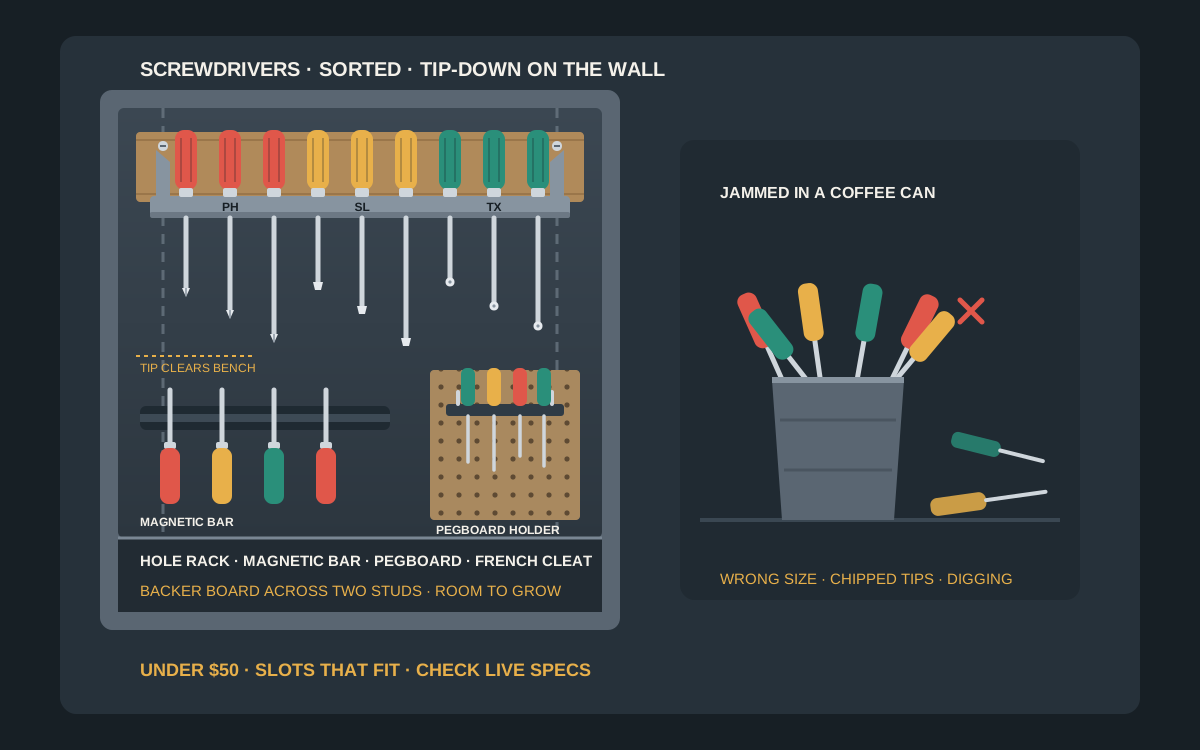
For most garage workshops, the best under-$50 screwdriver wall rack is a hole-style rack — a powder-coated steel or heavy plastic shelf with a row of slots — screwed through a backer board into the studs just above the workbench: each screwdriver drops in tip-down, the handle rests on top, and the whole set reads by drive type and size at a glance. A magnetic tool bar wins when you grab the same handful of drivers all day and want pliers on the same strip; a pegboard screwdriver holder wins when the wall is already pegboard; a French cleat block wins on a cleat wall you rearrange. Size the holes for your real shanks, leave clearance under the longest blade, fasten into framing rather than bare drywall, and verify live dimensions and price before buying. Check current prices and slot counts on the listing before you buy.
Shop screwdriver wall racks on Amazon
Who this is for
- Garage DIYers whose screwdrivers live in a coffee can or roll around a drawer, so finding the #2 Phillips means dumping the lot on the bench
- Workshop owners comparing hole-style screwdriver racks, magnetic tool bars, pegboard holders and French cleat blocks under $50
- Anyone building a hand-tool wall above the bench next to pliers, wrenches and hammers who wants every driver sorted by type and size at a glance
Quick answer
For most garage workshops, the best under-$50 screwdriver wall rack is a hole-style rack — a powder-coated steel or heavy plastic shelf with a row of slots — screwed through a backer board into the studs just above the workbench: each screwdriver drops in tip-down, the handle rests on top, and the whole set reads by drive type and size at a glance. A magnetic tool bar wins when you grab the same handful of drivers all day and want pliers on the same strip; a pegboard screwdriver holder wins when the wall is already pegboard; a French cleat block wins on a cleat wall you rearrange. Size the holes for your real shanks, leave clearance under the longest blade, fasten into framing rather than bare drywall, and verify live dimensions and price before buying. Check current prices and slot counts on the listing before you buy.
Quick comparison
| Format | Best for | Typical price band | Why it wins |
|---|---|---|---|
| Hole-style screwdriver rack (steel or plastic) | Full sets of standard and insulated drivers | Usually $10–$35 | Tip-down slots; a gap shows what is missing |
| Magnetic tool bar | A small daily set mixed with pliers | Usually $10–$30 | Any spacing, fastest one-hand grab |
| Pegboard screwdriver holder | Benches that already have pegboard | Usually $8–$25 | Moves with the layout; no new wall holes |
| French cleat screwdriver block | Cleat walls you rearrange | Usually $15–$45 | Lifts off the cleat; holes fit your shanks |
Hole-style screwdriver racksMagnetic tool barsPegboard screwdriver holders
What to look for
Hole size and spacing that fit your real shanks
A hole rack only works if the shank passes through and the handle’s bolster does not. Check the shank diameter of your thickest driver — often a large slotted or a demolition-style driver with a hex bolster — and your thinnest precision driver against the listed hole sizes. A rack sized for standard drivers lets precision drivers drop straight through, and one sized for small tips will not take a #3 Phillips, so mixed sets usually need graduated holes or two racks. Spacing matters as much: fat cushion-grip handles need wider center-to-center spacing than slim acetate handles, or you cannot pull one without lifting its neighbor.
Capacity and room to grow
Count the drivers you own, then add about a third. Sets grow — a Torx run for cars and appliances, square drive for deck and cabinet screws, a couple of stubbies — and a rack with no empty slots sends you back to the drawer within a month. Two short racks side by side are often easier to fit and reorganize than one long one.
Clearance below the longest blade
A hole rack hangs the blades below the shelf, so its height on the wall is set by your longest screwdriver, not by the rack. Measure from bolster to tip on the longest driver and keep that tip a couple of inches above the bench top, the backsplash and anything you park there, so tips are not bent, dulled or knocked out when you slide a board along the bench.
Material, edges and insulated drivers
Powder-coated steel shrugs off solvents and dropped tools; heavy plastic is quieter and kinder to chrome; wood blocks are easy to drill to custom sizes. Look for deburred holes that will not chew handles and a raised front edge so a bumped driver does not jump out. Insulated electrician screwdrivers have coated shafts, so a magnet grabs only the bare tip — they belong in a hole rack, and racking them is a good moment to check the insulation for nicks.
Hole rack vs magnetic bar vs pegboard vs French cleat
When a hole-style screwdriver rack wins
If you own a real set — Phillips #0 to #3, a run of slotted, Torx and square drive — a hole rack is the cleanest answer. Every driver stands tip-down in its own slot, handles line up along the top, and an empty slot tells you instantly which one is still under the car. Racks with graduated holes handle mixed sets, and some add side slots for pliers or a hammer loop, so compare the layout with what you actually own.
When a magnetic tool bar is the faster grab
A magnetic tool bar holds any steel shank at any spacing, so it suits a small working set you use constantly, mixed with pliers, nut drivers and a utility knife. The tradeoffs: tips slowly become magnetized — handy for starting screws, annoying when filings cling to them — a weak bar lets a bumped driver fall, and insulated drivers barely stick. Choose a bar long enough to space handles apart and mount it where a falling driver lands on the bench, not on your foot.
When a pegboard screwdriver holder makes sense
If the wall above the bench is already pegboard, a pegboard screwdriver holder — a slotted strip on pegboard hooks — costs little and moves when your layout changes. Match it to your board: 1/4-inch-hole and 1/8-inch-hole pegboard take different hooks, and peg locks or a zip tie stop the holder lifting out when you pull a tight driver.
When a French cleat screwdriver block fits
On a French cleat wall, a screwdriver holder is simply a block with a 45-degree back cleat and a row of drilled holes. It lifts off and moves with the rest of the system, and you can drill each hole to the exact shank. Ready-made cleat holders exist, but this is also the easiest rack in the shop to build from scrap if your budget is closer to zero than to $50.
Lay out a screwdriver wall that stays sorted
Sort by drive type, then by size
Give Phillips, slotted, Torx and square drive their own runs, and order each run from smallest to largest, left to right. You stop reading tip shapes and start reaching by position — the same slot always holds the #2 Phillips.
Mount within easy reach above the bench
Put the rack on the wall behind the bench where you can reach it without leaning over your work: handles roughly between elbow and shoulder height when you stand there, tips clear of the bench by a couple of inches. Too high and drivers come out at an angle, scraping handles and working the fasteners loose.
Give precision drivers their own home
Jeweler-style precision drivers are too thin for standard holes. Give them a small graduated rack or keep the stand they came in on a nearby shelf, so they do not slip through a slot or hide behind big handles.
Label the rail, not the drivers
A label-maker strip or paint-marker line under each run (PH, SL, TX, SQ) gets everyone in the house to put drivers back in the right place.
Treat under-$50 bands as moving targets
Check the current dimensions, hole sizes, slot count and price on the listing before you buy.
Mounting a screwdriver rack on a garage wall
Find the studs first
Garage walls are commonly framed with studs 16 inches on center, but confirm with a stud finder and a small test hole hidden behind where the rack will sit. A full rack weighs only a few pounds, yet every pull on a tight driver levers on the fasteners, so framing beats hollow drywall.
Use a backer board for short racks
Many screwdriver racks are shorter than the gap between studs, or their screw holes do not line up with framing. Screw a strip of 3/4-inch plywood or a 1x4 across two studs, then fasten the rack to the strip wherever you want it — the same board takes a pliers rack or hammer holder later.
If you must use drywall anchors
For a light rack that cannot reach framing, use quality screw-in or toggle-style anchors rated well above the load, not the plastic plugs in the box. If the rack shifts when you pull a driver, move it to a backer board.
Concrete block and masonry walls
On concrete or block, drill with a hammer drill and use masonry screws or sleeve anchors. Mounting a backer board first is usually easier: a few masonry anchors hold the board, and the rack’s small screw holes go into wood.
Mistakes to avoid
- Keeping screwdrivers in a coffee can, where tips grind against each other and the size you need is always at the bottom.
- Buying a rack sized for standard drivers and losing precision drivers straight through the holes.
- Mounting the rack so low that the longest blade hits the bench and bends or dulls its tip.
- Hanging the rack on bare drywall with plastic plugs and pulling it off the wall on the first tight driver.
- Parking insulated electrician screwdrivers on a magnetic bar, where the coated shafts slide off.
- Filling every slot on day one, with no room for the Torx or square-drive set you will buy next.
Related guides
Browse the hub: Garage wall storage under $50 - all guides
- Best Wall-Mount Pliers Organizers Under $50
- Best Wall-Mount Wrench Racks Under $50 for Garage Wrench Sets
- Best Hammer Racks Wall Mount Under $50 for Garage Workbenches
- Best Chisel Racks Wall Mount Under $50 for Garage Workbenches
- Best Hex Key Organizers Under $50 (Wall Mount Allen Wrench Racks)
- Best Magnetic Tool Bars Under $40 for Garage Walls
- Pegboard vs French Cleat for Garage Walls: Which Under-$50 System Wins?
- Best Rotary Tool Wall Mounts Under $50 for Garage Workshops
- How to Mount a Screwdriver Rack on a Garage Wall Under $50
FAQ
What is the best screwdriver wall rack under $50 for a garage workshop?
For most garages, a hole-style rack in powder-coated steel or heavy plastic, screwed through a backer board into studs above the bench, with drivers standing tip-down sorted by type and size. Choose a magnetic tool bar for a small daily set, a pegboard holder if the wall is already pegboard, or a French cleat block on a cleat wall.
Will a magnetic tool bar damage my screwdrivers?
It will not hurt the steel, but it gradually magnetizes the tips. Many people like that for starting screws; if filings clinging to the tips bother you, a hole rack avoids it, and a magnetizer-demagnetizer block can reset a tip. Insulated screwdrivers have coated shafts, so a magnet holds them poorly.
How high should I mount a screwdriver rack above a workbench?
Set the height from your longest driver: its tip should hang a couple of inches above the bench top and anything you store on it, with the handles roughly between elbow and shoulder height when you stand at the bench. Dry-fit with the longest driver before you drill.
Can I mount a screwdriver rack on drywall without hitting a stud?
For a light rack, quality screw-in or toggle-style drywall anchors can work, but pulling tight drivers levers on them. A plywood or 1x4 backer board screwed across two studs is stronger and lets you put the rack exactly where you want it.
How do I organize Phillips, slotted and Torx screwdrivers on one rack?
Give each drive type its own run, order each run from smallest to largest, and label the rail under each group. Leave a few empty slots per run so new sizes have a home, and keep precision drivers in a separate small rack.
Bottom line
A screwdriver wall rack under $50 earns its spot when every driver has a slot that fits its shank, each run reads by drive type and size, and the longest blade clears the bench. Pick a hole rack for a full set, a magnetic bar for a daily handful, a pegboard holder or cleat block if that is your wall system, fasten into studs or a backer board, leave room to grow, and check the current dimensions and price on the listing before you buy.