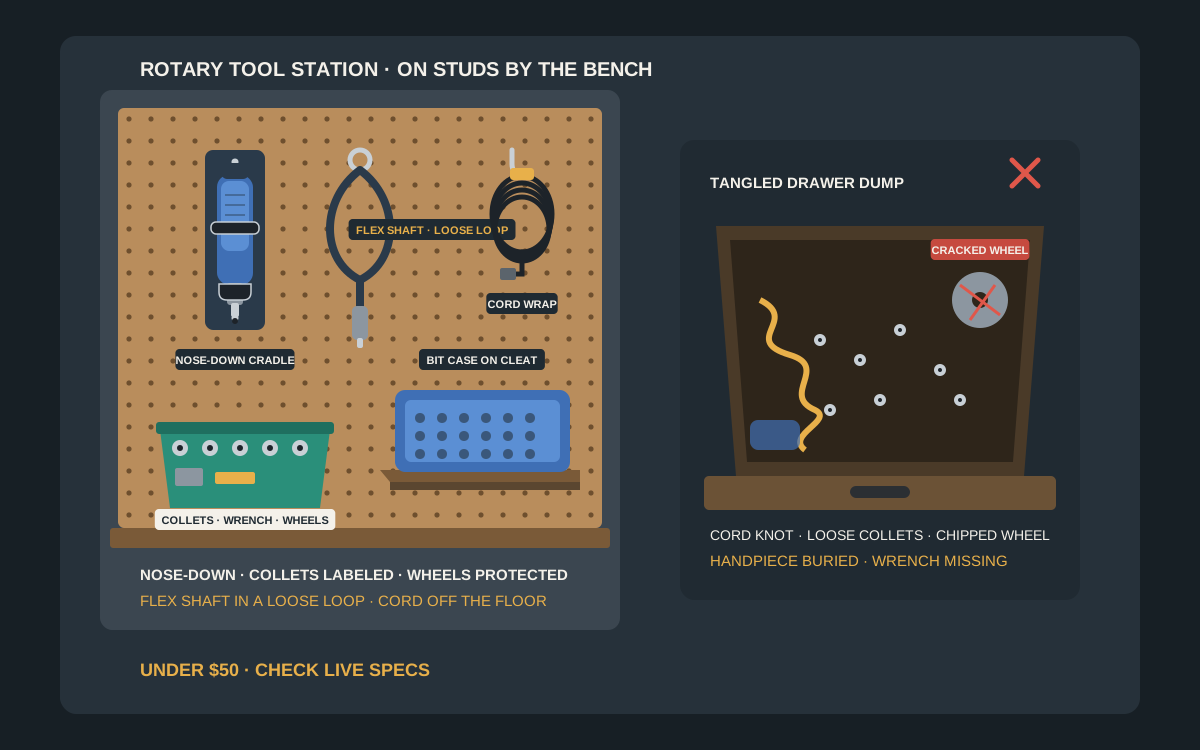
A rotary tool is small enough to vanish into a drawer and sharp enough that the drawer becomes a hazard. The handpiece ends up under a pile of sandpaper, the collets roll into a corner, the cut-off wheels crack when they get stepped on, and the flex shaft wraps itself around everything else. A few under-$50 pieces on the wall fix that: a cradle or holder that hangs the tool nose-down so grit falls out of the vents, a labeled bin for collets and wheels, and a spot for the accessory case within arm’s reach of the bench. This guide compares those options, explains how to store bits and wheels safely, and shows how to mount a rotary-tool station so the kit is ready the next time you need a clean cut or a detail grind.
Shop rotary tool holders on Amazon
Who this is for
- Garage and woodshop DIYers who own a corded or cordless rotary tool and spend more time hunting the handpiece, the right collet and a fresh cut-off wheel than making the cut
- Hobbyists with engraving bits, sanding drums, grinding stones and a flex shaft who want the kit on the wall next to the bench instead of loose in a drawer
- Anyone choosing between a pegboard cradle, a dedicated wall holster, a magnetic bar, a shelf for the kit case or wall bins for collets and wheels under $50
Quick answer
For most garage workshops, the best under-$50 rotary tool wall setup is a cradle or holster screwed into studs or hung on 1/4-inch pegboard that holds the handpiece nose-down, with a labeled bin for collets, chuck keys and cut-off wheels right beside it and the accessory case on a narrow shelf or French cleat holder above. Add a smooth hook for the flex shaft coiled in a loose loop, keep the cord off the floor with a simple cord wrap, and mount the whole station at chest height next to the bench rather than across the garage. Hang only one tool per cradle, keep brittle wheels in a case or sleeve so they do not chip, and check the listing’s current size, fit and price before you buy.
Quick comparison
| Format | Best for | Mounting | Trade-off |
|---|---|---|---|
| Pegboard cradle or holster | Corded or cordless handpiece you grab every week | Screw into pegboard with hook locks, or into studs | Cheapest dedicated hang; rearrange as the kit grows |
| Dedicated wall mount / dock | One primary tool and a tidy look | Usually screws into studs or a backer | Purpose-built shape; less flexible than pegboard |
| Magnetic tool bar | Steel-bodied tools and metal chuck keys by the bench | Screw to studs; keep brittle wheels off the bar | Fast grab, but dust sticks and wheels can chip |
| Shelf or French cleat for the kit case | Full bit assortments, cut-off wheels and travel kits | Cleat or shelf brackets on studs | Best protection for brittle wheels; slower than open bins |
| Wall-mount small-parts bins | Collets, wrenches, drums and spare wheels | Screw or pegboard hang under the cradle | Stops the small parts that make the tool useless when missing |
| Hook + cord wrap for flex shaft | Flex shafts, foot pedals and power cords | Smooth utility hook on a stud | Keeps cords off the floor without kinking the shaft |
Pegboard tool holdersWall-mount parts binsMagnetic tool barsRotary tool accessory casesFrench cleat shelves
What to look for
A cradle that fits your handpiece
Rotary tools vary: slim pencil-grip bodies, thicker variable-speed barrels, cordless packs with a battery footprint, and some with a hanging loop molded into the rear cap. Measure the barrel diameter and overall length of your tool, including the battery if it is cordless, and compare that with the cradle’s opening and depth. A holder meant for a skinny corded body will not lock a fat cordless pack, and a deep cup that swallows the nose makes it hard to grab the tool one-handed. Look for a soft or coated contact surface so the finish and the vents are not scratched every time you dock and undock.
Somewhere for collets, wheels and bits
The handpiece is only half the kit. Collets (often 1/8 inch and 1/32 inch, sometimes 1/4 inch), the collet wrench, cut-off wheels, grinding stones, sanding drums, polishing tips and engraving bits need a labeled home within arm’s reach. Wall-mount small-parts bins, a shallow pegboard bin, or the original accessory case on a shelf all work; the failure mode is bits rolling free in a drawer where a stepped-on cut-off wheel shatters. Keep brittle resin and fiberglass wheels flat in a sleeve or case, not stacked loose on a magnetic bar.
Nose-down storage and dust control
Hanging a rotary tool nose-down lets grit, metal dust and sanding residue fall out of the nose and vents instead of packing into the bearings. A cradle that angles the tool slightly or a simple open hook through the rear hanging loop both work if the tool cannot tip out when bumped. Keep the station away from the grinder spark zone and out of the wet strip just inside the garage door, because moisture plus metal dust is how collets and chuck parts rust.
Mounting that survives daily grab-and-go
A rotary tool and a loaded bit case are light compared with a circular saw, but the station still belongs on studs, a plywood backer or solid pegboard furring, not drywall anchors alone. Pegboard hooks need locks or retainers so the cradle stays put when you yank the tool free. Put the station at chest height next to the bench you actually use, with the flex-shaft hook and cord wrap clear of the walkway so nobody snags a loop walking past.
Cradle vs dock vs magnetic bar vs case shelf vs bins
When a pegboard cradle wins
Most garage workshops already have pegboard near the bench, and a simple U-shaped or loop cradle turns one square of board into a rotary-tool dock. Hang the tool nose-down, lock the hook so it cannot lift out with the tool, and put a small bin directly underneath for the collet wrench and the two collets you actually swap between. Pegboard also makes it easy to add a second cradle later if you keep both a corded and a cordless body, or a detail engraver beside the main tool. Prefer 1/4-inch-hole board for power-tool holders; thin 1/8-inch board and wire hooks are better left for light hand tools.
When a dedicated wall dock makes sense
Purpose-built rotary-tool docks and holsters mold around a common barrel size and often include a small tray or magnet for the wrench. They look tidy and dock the tool in one motion. Check the opening against your exact model, especially cordless packs and tools with a hanging loop or soft grip that changes the outer diameter. A dock that only accepts one brand’s body is fine if that is the only tool you own; pegboard is more forgiving when the kit grows.
When a magnetic bar is enough
Many rotary-tool bodies and chuck keys are steel enough to stick to a strong magnetic bar. A short bar beside the bench can hold the handpiece and the wrench with nothing to unclip. The trade-offs are real: dust and swarf stick to the magnet and migrate into vents, a heavy cordless pack can slide if bumped, and cut-off wheels and grinding stones do not belong on a bare magnet where they chip. Use a bar for the steel handpiece and wrench only, and keep wheels in a case.
When the kit case on a shelf or cleat is smarter
If your bits and wheels came in a molded case, that case is the best chip protection you own. A narrow shelf or French cleat holder that keeps the case upright with the latch facing out turns the assortment into wall storage without dumping it into open bins. This is the right home for rarely used engraving bits, polishing tips and spare cut-off wheels, and for kits that travel to a job. Many shops use both: everyday collets and two go-to wheels in an open bin under the cradle, and the full case on a shelf above.
When small-parts bins earn their spot
Collets are easy to drop and hard to find in sawdust. A short row of wall-mount bins, labeled 1/8, 1/32 and wrench, keeps the changeover parts next to the tool. Add a bin for sanding drums and a sleeve or shallow tray for cut-off wheels stored flat. The goal is that every piece you need to change a bit is visible without opening a drawer.
Bits, wheels, collets and the flex shaft
Store cut-off wheels flat and protected
Resin and fiberglass cut-off wheels chip and crack when they are stacked loose, dropped in a drawer or hung from a nail through the arbor hole under side load. Keep them in the original sleeve, a shallow case tray or a labeled envelope standing on edge in a bin. Discard any wheel with a nick on the rim or a hairline crack before it spins up.
Keep collets and the wrench together
Most rotary tools use a collet nut and interchangeable collets rather than a keyed chuck. The wrench and the collets you own should live in the same labeled bin under the cradle so a bit change never starts with a hunt. If you own both 1/8-inch and smaller collets, label them clearly; grabbing the wrong collet and overtightening is how shanks slip or collets distort.
Coil the flex shaft in a loose loop
A flex shaft stored in a tight bend takes a set and feels notchy later. Hang it from a smooth utility hook in a generous loop, or coil it loosely in a wide wall bag, and keep the handpiece end capped so grit does not pack into the sheath. Do not hang the entire shaft by the handpiece alone if the weight of the cable will yank the cradle off the wall.
Cord and battery habits
For corded tools, a simple cord wrap or Velcro strap on a hook beside the cradle keeps the cord off the floor and out of the mower path. For cordless tools, dock the body in the cradle and park the spare battery on the charging shelf you already use for drills; do not leave a loose battery on the magnetic bar where it can fall.
Installation that holds and stays safe
Find studs or add a backer
Screw cradles, docks, magnetic bars and case shelves into studs, commonly 16 inches on center and sometimes 24, or into a plywood backer fixed across two studs first. Pegboard needs furring strips or spacers behind it so the hooks can seat. On poured concrete or block, use masonry anchors sized for the load and installed per the anchor maker’s instructions.
Height and reach
Mount the cradle at roughly chest height so you can dock and undock the tool without reaching over a cluttered bench. Keep the bit bins directly below or beside it, and keep the flex-shaft loop clear of the walkway. Avoid hanging the tool at eye level where the spinning nose would be if someone walked into it while it was still coasting down.
Lock pegboard hooks
Pegboard hooks lift out by design. Fit hook locks, clip-on retainers or a zip tie on every cradle and bin hook so the hardware stays in the board when you yank the tool free one-handed.
Test the dock once
Hang the tool, change a bit, pull the flex shaft down and put everything back once before you call the station done. If the cradle tips, the cord snags or a wheel tray spills when bumped, fix the spacing now rather than mid-project.
Mistakes to avoid
- Leaving the rotary tool and bits loose in a drawer where wheels crack and collets disappear.
- Hanging an oscillating multi-tool cradle and expecting a rotary handpiece to fit it (different body and hang geometry).
- Storing cut-off wheels loose on a magnetic bar or stacked where they chip.
- Separating the collet wrench from the collets so every bit change starts with a search.
- Coiling a flex shaft in a tight bend that sets a kink into the cable.
- Mounting a loaded cradle on drywall anchors alone instead of studs, a backer or locked pegboard.
- Parking the station across the garage from the bench you actually use.
- Putting a still-hot grinding stone or cut-off wheel straight into a plastic bin.
Related guides
Browse the hub: Garage wall storage under $50 - all guides
- Best Oscillating Tool Wall Holders Under $50 (Multi-Tool Racks)
- Best Screwdriver Wall Racks Under $50 for Garage Workshops
- Best Router Wall Mounts Under $50 for Woodshop Garage Walls
- Best Hole Saw Kit Wall Organizers Under $50 for Garage
- Best Drill Bit Organizers Wall Mount Under $50
- Best Magnetic Tool Bars Under $40 for Garage Walls
- Best Cordless Tool Battery Racks Under $50 (Wall Mount)
FAQ
What is the best way to store a rotary tool on a garage wall?
For most workshops, hang the handpiece nose-down in a pegboard cradle or dedicated dock at chest height, keep collets and the wrench in a labeled bin beside it, and put the accessory case on a narrow shelf or French cleat holder. Add a smooth hook for a loosely coiled flex shaft and a cord wrap so nothing lives on the floor.
Can I hang a rotary tool on pegboard?
Yes. A U-shaped cradle or loop holder on 1/4-inch pegboard works well for most corded and many cordless bodies. Use hook locks so the cradle stays in the board when you pull the tool free, and confirm the opening fits your barrel or battery pack before you buy.
How should I store rotary tool cut-off wheels and bits?
Keep brittle cut-off wheels flat in a sleeve, tray or the original case so they do not chip. Put everyday collets, the wrench and sanding drums in labeled wall bins under the cradle, and leave rarely used engraving and polishing tips in the kit case on a shelf.
Is a rotary tool the same as an oscillating multi-tool for storage?
No. Oscillating multi-tools use a different body shape, blade clamp and hang geometry, so their wall holders are a separate product. Use this guide for Dremel-style rotary handpieces, collets and wheels, and the oscillating multi-tool wall holders guide for those tools.
Where should I mount a rotary tool station in the garage?
Next to the bench you actually use, on studs or pegboard with a backer, at chest height, away from grinder sparks and the wet zone inside the garage door. Keep the flex-shaft loop and cord clear of the walkway.
Can I use a magnetic bar for a rotary tool?
A magnetic bar can hold a steel handpiece and the chuck key for quick grab-and-go. Keep resin cut-off wheels and grinding stones off the bar so they do not chip, wipe dust off the magnet regularly, and screw the bar into studs.
Bottom line
Rotary tool wall mounts under $50 work when the handpiece has a nose-down cradle, the collets and wrench live in a labeled bin beside it, and brittle cut-off wheels stay protected in a case or sleeve: pegboard cradles or dedicated docks for the tool you grab every week, a magnetic bar only for steel bodies and keys, a shelf or French cleat for the full accessory case, and a smooth hook for a loosely coiled flex shaft. Mount the station on studs next to the bench, lock pegboard hooks, keep wheels and bits from rattling loose, and check the listing’s current size, fit and price before you buy.