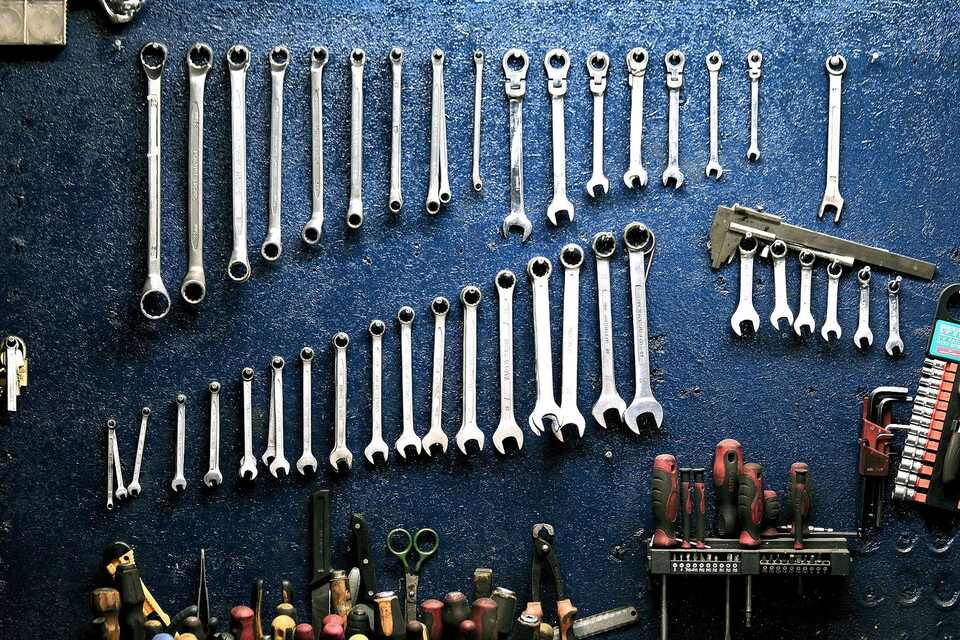
A chisel rack should make the right width easy to spot without turning sharp edges into a wall-level hazard. For most garage workbenches, the best under-$50 option is a rack with individual slots or a shallow shelf that keeps blades separated, handles visible, and the cutting ends pointed down or fully enclosed. A little order here protects both the tools and the fingers that reach for them.
Shop current under-$50 chisel racks on Amazon
Who this is for
- Woodworkers keeping bench chisels accessible in a garage or shared workshop
- DIYers who want a compact wall station instead of a loose drawer full of sharp tools
- Small shops comparing slotted racks, magnetic bars, shallow shelves, and pegboard solutions
Quick answer
Choose a slotted wall rack that separates each chisel and lets the blade point down into a protected opening. If your set includes unusually wide chisels, mortise chisels, or long handles, a shallow shelf with dividers is more adaptable than a tightly molded rack. Mount it beside the bench, above the work surface but below awkward reach, and keep the cutting edges covered or facing away from the normal hand path.
What to look for
Separate the blades
The best rack prevents blades from knocking together. Individual slots, a divided tray, or a covered shelf keeps cutting edges from rubbing against neighboring tools and makes width selection visible. Avoid open pegs that let chisels swing into each other or place an exposed edge at hand height.
Measure handles and ferrules
Chisels are not sized only by blade width. Handle length, ferrule diameter, bolster shape, and the flare at the end can determine whether a slot accepts the tool smoothly. Measure the widest handles in your set and allow enough clearance to lift one chisel without brushing the next.
Keep the cutting end controlled
A wall rack should give the blade a predictable direction. Blade-down slots or a covered compartment are safer than a loose horizontal ledge, especially in a busy garage where a coat, hose, or power cord can catch the tools. If the rack leaves edges exposed, place it outside the normal shoulder and hand sweep of the bench.
Use a mount that stays put
A full set of steel chisels is compact but not weightless. Studs or a solid backer are preferable for a permanent station. On pegboard, use locking hardware and confirm the panel is supported; a rack that rocks when one chisel is removed will eventually spill the set.
Quick comparison
| Product type | Best for | Typical price band | Why it wins |
|---|---|---|---|
| Individual-slot chisel rack | Daily bench chisels | Usually $20–$35 | Separates sizes and controls blade direction |
| Covered wall shelf with dividers | Mixed handles and odd sizes | Usually $25–$45 | Flexible fit with better edge protection |
| Pegboard chisel holder | Existing reinforced pegboard | Usually under $30 | Easy to relocate as the bench changes |
| Magnetic bar plus blade guards | Metal tools and small sets | Usually $15–$30 | Fast visibility in a narrow wall strip |
Shop current under-$50 chisel racks on Amazon
How to install and use it
- Lay out the full chisel set and measure the widest handles, longest tools, and the space needed to lift each one clear.
- Choose a position beside the bench that keeps cutting edges away from the usual hand path, clothing, cords, and passing shoulders.
- Mark studs or fit a solid backer, mount the rack level, and check that every slot remains accessible when the bench is occupied.
- Put blades in the rack with their edges controlled by slots, guards, or a closed compartment; keep widths in a consistent order.
- Test the station one tool at a time. Tight slots, a rocking mount, or a blade that protrudes into the walkway deserves a fix before normal use.
Common mistakes
- Using a generic open hook that lets chisels swing or exposes the edge at hand height
- Buying by blade width alone and discovering the handles will not fit the rack
- Mounting a full steel set to thin, unsupported pegboard or weak drywall anchors
- Hiding chisels behind a shelf lip where the blade is hard to see during removal
- Mixing screwdrivers, awls, and loose blades into the same compartment without dividers
FAQ
Are wall-mounted chisel racks safe?
They can be, when the rack separates tools and controls the cutting edges. Blade-down slots, guards, or a covered compartment are preferable to open hooks. Mount the rack where a passing arm or hanging cord cannot sweep across exposed blades.
How many chisels fit on a rack under $50?
Capacity varies with handle diameter and slot spacing. Count usable slots rather than the listing’s headline number, then allow a little room so one chisel can be removed without scraping the adjacent tools.
Should chisels point up or down in a wall rack?
For most garage workbenches, blade-down storage is easier to control because the edge is directed into a slot or protected opening. Whatever orientation you choose, the cutting edge should not face the normal hand path or a walkway.
Can a magnetic bar hold wood-handled chisels?
A magnetic bar can hold steel parts on some chisels, but it is not a universal substitute for a rack. Check the actual contact point and use blade guards; a loose or top-heavy chisel can slide, swing, or fall when another tool is removed.
Browse the hub: Garage wall storage under $50 — all guides
Related guides
- Best Wrench Racks Wall Mount Under $50
- Best Pliers Organizers Wall Mount Under $50
- Best Framing Square & Speed Square Wall Racks Under $50
- Best Hand Plane Wall Racks Under $50 for Woodshop Garages
Bottom line
The best chisel rack under $50 keeps each tool visible, separated, and controlled at the cutting end. Pick the rack around your largest handles and actual wall backing—not just the blade-width label—and you will get a safer, faster bench station that remains useful when the set grows.