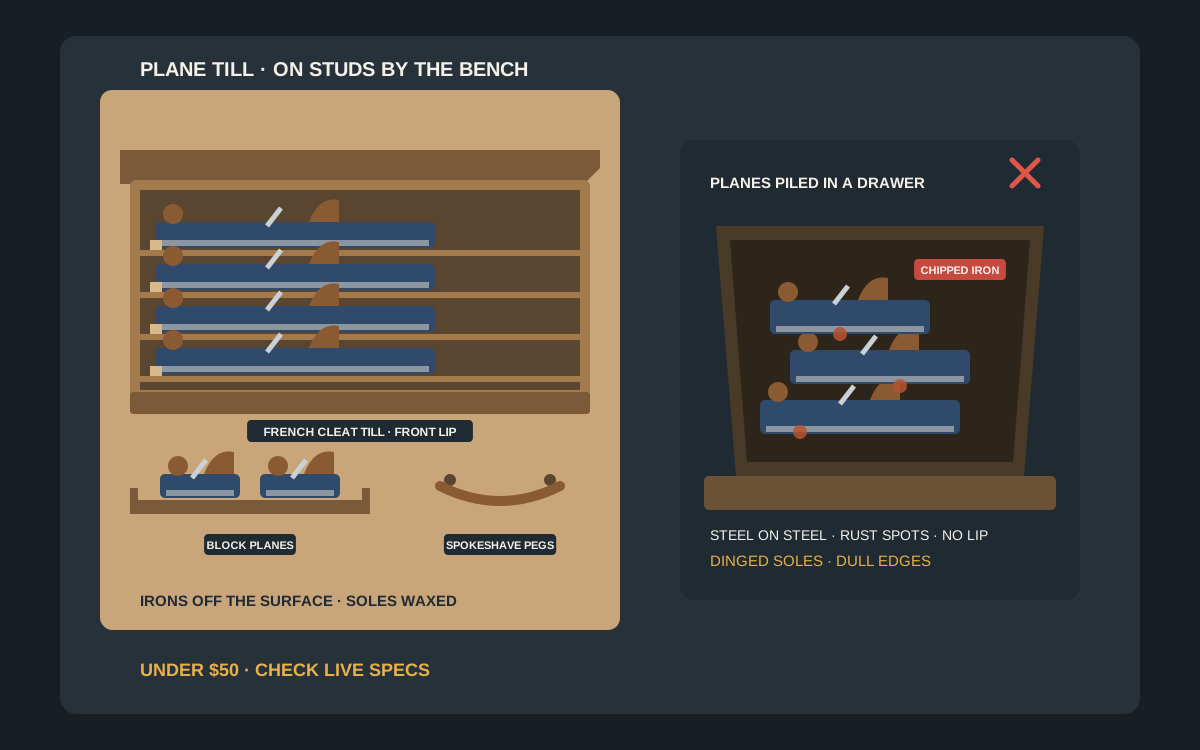
A hand plane is a precision tool that hates bad storage. Drop it sole-down on a bench and the iron edge takes the hit; stack it in a drawer and the sole picks up dings and rust where it touches other steel; leave it on a shelf with no lip and one bump sends a heavy jack plane onto concrete, where a cast-iron body can crack. Wall storage fixes all three at once, and it does not need an expensive cabinet. A simple French cleat till, an angled shelf with a front stop, or a small wall cabinet keeps every plane visible, edge-protected and one reach from the bench. This guide compares the under-$50 options, explains how to hang bench planes, block planes and specialty planes safely, and covers the rust habits that matter in an unheated garage.
Shop hand plane racks on Amazon
Who this is for
- Woodworkers with a growing set of bench planes (smoothers, jacks, a jointer) who are tired of digging them out of drawers or finding a fresh nick in the iron
- Garage shops where planes share wall space with power tools and need protection from bumps, dust and humidity
- Anyone choosing between a French cleat till, an angled shelf, a wall cabinet or simple block-plane holders under $50
Quick answer
For most woodshop garages, the best under-$50 hand plane storage is a French cleat till or a shallow shelf screwed into studs, with planes standing on their sides or resting with the toe on a thin wooden strip so the iron never touches the surface, and a front lip tall enough that a bumped plane cannot slide off. Put block planes and spokeshaves on a small shelf or pegs beside it, wipe soles with a light oil or paste wax before they go up, and mount the till near the bench but away from the garage door and any wet wall. Choose a cabinet with a door only if dust or humidity is a real problem, and check the listing’s current size, fit and price before you buy.
Quick comparison
| Format | Best for | Mounting | Trade-off |
|---|---|---|---|
| French cleat plane till | A full set of bench planes by the bench | Cleat screwed into studs; till hangs on it | Movable and slotted; takes some wall depth |
| Angled shelf with front lip | Three to six planes on a budget | Shelf brackets on studs | Cheapest; planes can still touch if spaced tight |
| Wall cabinet with door | Humid garages and dusty shops | Cleat or brackets on studs | Best dust and rust protection; slower to grab |
| Block-plane shelf or pegs | Block planes, spokeshaves, small specialty planes | Small shelf or dowel pegs on a backer | Light tools only; not for bench planes |
| Plane socks on a shelf | Vintage or premium planes in an unheated garage | Any existing lipped shelf | Extra rust and ding protection; adds a step |
French cleat shelvesWall-mount tool shelvesCamellia oil and rust preventivePlane socks and tool rollsWall cabinets for tools
What to look for
Iron protection first
The cutting edge is the part you paid for in sharpening time. Any rack should keep the iron off hard surfaces: planes stored on their sides, on a raised strip under the toe, or hung by the body in a slot so the sole floats. A flat shelf where the plane rests fully sole-down is acceptable only if the shelf is wood and the iron is retracted, and even then a thin strip under the toe is cheap insurance.
A real front lip or slot
A No. 5 jack plane weighs roughly 4 to 5 pounds and a jointer more, and a cast-iron body dropped on concrete can crack. Look for a till with individual slots or a shelf with a front lip of at least an inch, and avoid open hooks or magnetic bars for anything larger than a small block plane. The rack should hold the plane even if a clamp or board knocks into it.
Spacing that fits your set
Measure the width of your widest plane across the cheeks and the length of the longest one before buying or building. Bench planes run from about 2 to 3 inches wide; a till sized for block planes will not take a jointer, and a shelf too shallow lets the tote hang over the edge. Leave enough gap between planes that you can lift one out without knocking its neighbor.
Mounting rated for cast iron
A row of bench planes can add up to 20 to 30 pounds on a short shelf. Screw cleats and shelf brackets into studs, a plywood backer spanning studs, or masonry anchors on block walls. Drywall anchors alone are not a home for a full plane till, and the weight sits forward of the wall, which levers on the top screws.
Till vs shelf vs cabinet vs small-plane holders
When a French cleat till wins
A French cleat till is the classic woodshop answer: a short box with angled slots or dividers that hangs on a 45-degree cleat screwed to studs. Each plane sits on its side or leans with its toe on a strip, so the iron never touches anything, and the till lifts off the wall if you rearrange the shop. If you already run French cleats, buy or cut a cleat shelf bracket and add a tall front lip and plywood dividers; it costs far less than a dedicated plane cabinet and holds a full bench set.
When an angled shelf with a lip is enough
If you own three to six planes, a single deep shelf on two brackets with a 1- to 2-inch front lip and a thin strip glued along the back does the job. Tilt the shelf slightly toward the wall or rely on the lip so a bumped plane slides back rather than off. Space planes so the totes do not touch and the irons stay retracted. It is the cheapest correct storage and easy to add under an existing cabinet.
When a wall cabinet makes sense
Garages that swing between hot and cold, or shops next to the laundry or a wet door, are hard on bare cast iron. A small wall cabinet with a door, lined with wood and a desiccant pack, keeps condensation and sanding dust off soles and irons. The trade-off is speed: you open a door every time you want a plane, so keep the one smoother you use most on an open shelf and the rest inside.
When block-plane shelves and pegs earn their spot
Block planes, spokeshaves, shoulder planes and router planes are light enough for a small shelf, dowel pegs or a shallow slotted holder right above the bench. Keep them separate from the bench-plane till so you can grab a block plane one-handed for chamfers. Spokeshaves can hang on two dowels by their handles with the blade facing the wall.
Rust, irons and humidity in a garage
Wax or oil before the plane goes up
Wipe the sole and cheeks with camellia oil or a thin coat of paste wax after use, especially in an unheated garage. A plane that goes back on the wall clean and lightly coated rarely needs more than a quick rub before the next job.
Retract the iron
Back the iron off a turn before storing a plane on a shelf or in a till, so a bump cannot drive the edge into the surface. It also prevents a sharp corner from catching a hand reaching past it.
Keep planes off the cold outside wall when you can
Exterior garage walls and walls next to the garage door collect condensation. Mount the till on an interior wall or add a plywood backer that keeps the planes off cold block, and use a cabinet or plane socks if you see rust spots appear overnight.
Plane socks for valuable tools
Fitted fabric plane socks slow rust and stop dings when planes touch. They are worth it for vintage or premium planes; for a basic jack plane, a lipped shelf and wax are usually enough.
Installation that holds and stays safe
Find studs or add a backer
Screw cleats and brackets into studs, commonly 16 inches on center and sometimes 24, or into a 3/4-inch plywood backer fixed across two studs. On concrete or block walls, use masonry anchors sized for the load and installed per the maker’s instructions.
Height and reach
Hang the till between waist and shoulder height beside the bench so you can lift a heavy jointer out with two hands without reaching overhead. Never put cast-iron planes on a high shelf above where you stand.
Plan for the set you will have
Most woodworkers add planes over time. Leave one or two empty slots or build the till a little longer than today’s set so a new plane does not end up back in a drawer.
Test before you load it
Hang the empty till, press down hard on the front lip, then load the planes and bump the shelf. If anything shifts or the till rocks on the cleat, add a screw at the bottom rail before calling it done.
Mistakes to avoid
- Storing planes sole-down on a metal shelf or in a drawer where the iron hits steel.
- Using open hooks or magnetic bars for heavy bench planes that can drop and crack.
- Hanging a loaded till on drywall anchors instead of studs or a backer.
- Leaving planes on the exterior wall by the garage door where condensation rusts the sole.
- Putting the plane shelf above head height where a falling jointer hits a person.
- Building the till for today’s set with no room for the next plane.
- Storing a plane with the iron fully extended against a hard surface.
Related guides
Browse the hub: Garage wall storage under $50 - all guides
- Best Chisel Racks Wall Mount Under $50 for Garage Workbenches
- Best French Cleat Kits Under $50 for Garage Walls
- Best Router Wall Mounts Under $50 for Woodshop Garage Walls
- Best Wall-Mount Clamp Racks Under $50
- Best Hammer Racks Wall Mount Under $50 for Garage Workbenches
- Best Screwdriver Wall Racks Under $50 for Garage Workshops
FAQ
How should hand planes be stored on a wall?
On their sides in a slotted till, or resting on a wooden shelf with a thin strip under the toe so the iron does not touch the surface, behind a front lip that stops them from sliding off. Mount the rack on studs near the bench and wipe soles with oil or wax first.
Is it bad to store a hand plane sole-down?
On a wooden shelf with the iron retracted, sole-down storage is acceptable. On metal, in a drawer or with the iron extended, it risks chipping the edge and denting the sole. Lying the plane on its side or raising the toe on a strip is safer and costs nothing.
What is a hand plane till?
A plane till is a wall-mounted rack with slots or dividers that holds planes upright or angled so the irons are protected. Most woodworkers hang it on a French cleat so it can be moved.
Can I hang hand planes on pegboard or a magnetic bar?
Small block planes and spokeshaves are fine on sturdy pegs. Bench planes are too heavy and awkward for pegboard hooks or magnets; a bump can drop them and crack the cast-iron body. Use a lipped shelf or till instead.
How do I keep hand planes from rusting in a garage?
Wipe the sole and cheeks with camellia oil or paste wax, keep the rack off cold exterior walls, and use a closed cabinet, plane socks or a desiccant pack in very humid garages.
How much weight does a plane rack need to hold?
A full set of bench planes can weigh 20 to 30 pounds, held forward of the wall. Screw the rack into studs or a plywood backer and confirm any bracket’s published rating on the product page.
Bottom line
Hand plane wall racks under $50 work when every plane has its iron off hard surfaces, a front lip or slot that stops it falling, and a stud-mounted home near the bench: a French cleat till for a full bench set, a lipped shelf for a small kit, a cabinet for humid garages and small shelves or pegs for block planes and spokeshaves. Wax the soles, retract the irons, keep the rack off cold exterior walls and check the listing’s current size, fit and price before you buy.