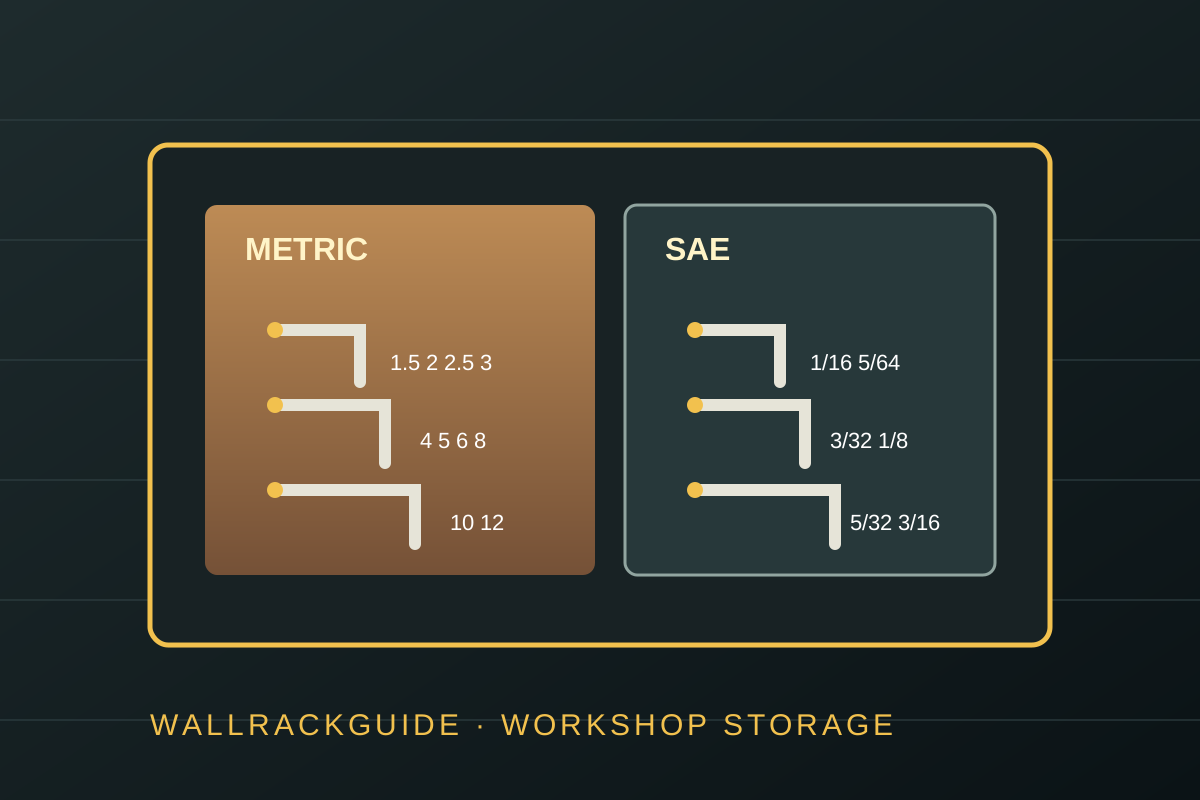
Hex keys are small enough to disappear and important enough to stop a project. A wall-mounted organizer makes the size you need visible, separates metric from SAE, and keeps an Allen wrench set from becoming a loose metal tangle in a drawer. The best option under $50 is not the rack with the biggest slot count; it is the one that retains the keys, reads clearly from standing height, and lets you return a tool one-handed.
Shop hex key organizers under $50 on Amazon
Who this is for
- DIYers and mechanics who reach for hex keys at a garage bench
- Woodworkers and installers keeping metric and SAE sets within one arm’s reach
- Small garages that need a compact wall station instead of another overfilled drawer
Quick answer
For most garages, choose a divided wall rack that keeps metric and SAE sets in separate, labeled sections and supports both short and long legs without letting keys slide out. A folding indexed case is best for a complete precision set; an open rack is faster for daily-use keys. Mount it beside the bench, not above a walkway, and check that the largest key can be lifted out without striking the wall or its neighbors.
What to look for
Metric and SAE separation
The first useful distinction is not color; it is measurement system. Look for large, permanent labels or two clearly separated banks. A mixed row can save a few inches while making a near-size mistake much more likely.
Retention for short and long legs
Straight L-keys and ball-end keys do not sit the same way. Slots should be deep enough to retain the short leg, with an opening wide enough for the long leg and your fingers. Avoid a shallow ledge that lets a key vibrate onto the floor when the wall is bumped.
Fit for the set you actually own
Count the keys in both sets, then measure the thickest handle, ball end, or color-coded sleeve. A compact organizer that fits standard L-keys may reject T-handle keys or a folding holder. Leave one spare position if you expect the set to grow.
Mounting and reading height
A loaded rack sees repeated lift-out force rather than just static weight. Prefer a stud or solid backer, and place the labels between comfortable waist and eye level. Keep the station away from door swings, grinding dust, and the edge of the bench.
Quick comparison
| Product type | Best for | Typical price band | Why it wins |
|---|---|---|---|
| Divided open hex-key rack | Daily-use metric and SAE L-keys | Usually $15–$30 | Fast one-handed selection with clear separation |
| Wall-mounted folding case | Complete sets and small sizes | Usually $20–$40 | Protects tips and keeps the index readable |
| Pegboard hex-key holders | Existing reinforced pegboard | Usually under $25 | Repositionable as the tool wall changes |
| T-handle or mixed-key shelf | Bulky handles and varied profiles | Usually $25–$45 | More forgiving depth than tight molded slots |
Compare current under-$50 hex key organizers on Amazon
How to build a useful hex-key station
- Group before mounting: Separate metric, SAE, ball-end, and specialty keys. Remove duplicates and damaged tools so the wall rack represents what you actually reach for.
- Measure the largest profile: Check the widest handle, longest leg, and any folding case. Confirm that each key can be lifted clear without catching the rack above it.
- Mount to sound backing: Mark a stud or install a solid plywood backer. Use the organizer’s specified hardware, keep it level, and test the largest key before loading the rest.
- Label for the real workflow: Put the most-used sizes at the easiest height. A small metric/SAE label at the top is more useful than relying on memory when the shop is busy.
- Keep the station clean: Brush out metal dust and return keys dry. If the organizer is open, a shallow lip or covered front is worth more than a few extra positions.
Common mistakes
- Choosing by headline capacity without checking the largest key and handle profile
- Mixing metric and SAE keys in one unlabeled row
- Using a shallow ledge that cannot retain short-leg or ball-end keys
- Mounting a loaded rack to weak drywall anchors or an unsupported pegboard sheet
- Putting the organizer behind a door swing or in the direct path of grinding dust
FAQ
Are wall-mounted hex key organizers worth it?
Yes, if you use Allen keys regularly or keep more than one set. Separating measurement systems and making sizes visible saves time; the mount is only worthwhile when it retains the keys and is installed on sound backing.
Should metric and SAE hex keys be stored separately?
Yes. Separate banks or clearly labeled sections reduce near-size mistakes. Color alone is not a reliable substitute for readable metric and SAE labels.
Can a pegboard hold a hex key organizer?
It can when the pegboard is firmly backed and the holder locks into the hardware. For a dense steel set or a rack that is pulled on repeatedly, reinforce the panel or use studs instead.
Are ball-end keys safe in an open wall rack?
They can be, provided the slots retain the short leg and the ball end cannot roll or catch on a neighboring tool. A folding case is a better choice for tiny keys or a set that travels.
Browse the hub: Garage wall storage under $50 — all guides
Related guides
- Best Wrench Racks Wall Mount Under $50
- Best Drill Bit Organizers Wall Mount Under $50
- Best Measuring Tape Holders Under $50 (Wall Mount)
Bottom line
For most garages, a divided open rack is the best hex key organizer under $50: it keeps metric and SAE sets legible, makes daily sizes quick to grab, and takes less wall depth than a cabinet. Choose a folding indexed case when tip protection matters more than speed, mount either style to sound backing, and leave enough room to add the next useful size.