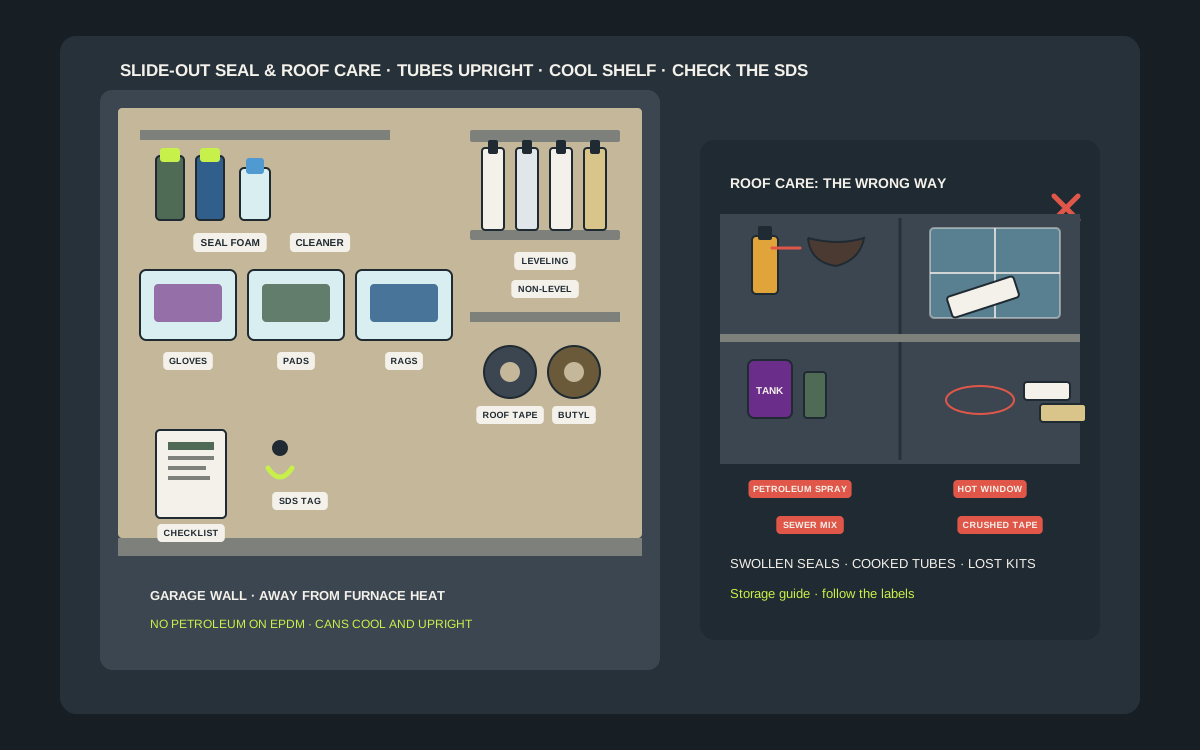
The stain on a slide-out floor rarely starts on the morning you notice it. It starts months earlier, when a wiper seal dried out, a tube of lap sealant rolled under the workbench, or the roof-tape roll was crushed under a crate of winterizing fluid. The chemistry that keeps a coach weathertight is easy to lose because you reach for it only a few times a year, and because the cans, tubes and rolls do not look like a matching set when they sit in three different drawers. A short run of garage wall fixes that. A rail of labeled bins, a tube rack that stands sealant nozzle-up, a cool shelf for aerosols and a hook for gloves turn the scatter into a kit you can carry to the rig in one trip, usually for well under $50. This guide is about storing those supplies at home: slide-out rubber seal treatments and protectants, roof cleaner, self-leveling and non-leveling lap sealant tubes, roof tape, butyl or putty tape, applicator tools, gloves, rags and a printed checklist. It is not a full roof-reseal how-to, and it is not about hanging organizers inside a slide-out room. Other guides on this site cover hooks mounted in an RV, collapsible organizers that live in a slide, and tire-cover storage; those pages mention slide-outs only as travel-path or mechanism hazards. Follow your coach maker, the seal maker and the sealant label for any work on the roof or the slide, and call a qualified technician when a leak, a torn seal or a soft floor is already in progress.
Shop RV slide-out seal treatments on Amazon
Who this is for
- RV owners who keep slide-out seal treatments, lap sealant and roof tape at home between trips instead of hunting through drawers on inspection day
- Anyone who has bought the wrong tube because the self-leveling and non-leveling cartridges were mixed in a coffee can
- Owners who store the coach at a lot or in the driveway and want the maintenance kit on a garage wall they can see
- Households that need aerosols and solvent-based sealants stored cool, upright and out of reach of children and pets
Quick answer
For most owners, the best under-$50 setup is a short rail screwed into studs with three labeled hanging bins (one for foam seal treatments and protectants, one for roof cleaner and rags, one for gloves, applicator pads and the printed checklist), a caulk-style tube rack that stores lap sealant nozzles up and labeled by type, and a cool, interior-facing shelf for roof-tape and butyl-tape rolls. Keep pressurized cans and flammable sealant tubes away from the water heater, the furnace, sunny windows and any ignition source. Read every safety data sheet for petroleum distillates before a product touches an EPDM slide seal or a rubber roof. Compare bin sizes, tube-rack length and the current price on the listing before you buy.
Quick picks
- Best overall: a short stud-mounted rail with three labeled hanging bins, a tube rack for 10.3-ounce lap sealant cartridges and a cool shelf for foam cans and tape rolls. The whole kit is visible at a glance and lifts off in one trip on inspection day.
- Best for seal-treatment cans: a high, shaded cubby or a lidded hanging bin that keeps aerosol cans upright, out of direct sun and well away from the furnace or water heater.
- Best for lap sealant tubes: a wall-mounted tube rack with slots labeled leveling and non-level, sized for the common 10.3-ounce, roughly 11-inch cartridge, stored nozzle-up with the cap on.
- Best for roof and butyl tape: a shallow shelf or cubby that keeps rolls in their original wrap, standing on edge so the adhesive is not crushed, in the temperature band the maker names.
- Best for travel: a small zip pouch with one foam can, one of each sealant type, a short length of roof tape, gloves and the checklist that clips to the rail at home and rides in a cool, dry bay of the rig.
- Best on a tight budget: two heavy stud hooks, two clear zip pouches (chemistry in one, gloves and paper in the other) and an inexpensive tube caddy screwed to a stud.
Quick comparison
| Setup | Best for | How it holds | Trade-off |
|---|---|---|---|
| Rail with labeled bins | The whole roof-and-seal kit | Bins hook onto a stud-mounted rail | Needs a short clear run of wall |
| Wall-mounted tube rack | Self-leveling and non-leveling tubes | Tubes stand nozzle-up in labeled slots | Must fit common 10.3 oz cartridges |
| High cool shelf | Aerosol foams and roof cleaner | Cans sit upright, out of sun | Keep away from furnace heat |
| Shallow tape cubby | Roof tape and butyl rolls | Rolls rest on edge in original wrap | Avoid hot attics and freezing floors |
| Hook rail for tools | Gloves, rags, foam brushes | Items hang so they dry | Takes a little extra width |
| Wall file or clipboard | Printed checklist and SDS notes | Paper lives in a plastic sleeve | Easy to ignore if it is not labeled |
| Clear zip pouches on a hook | Budget kit, quick to see | Pouches hang on one stud hook | Pouches wear out over time |
| Travel pouch on the rail | Supplies that ride in the rig | Clips to the rail at home | Duplicates a few items |
RV lap sealant tubesRV roof seal tapeWall bins and tube racks
What to look for
It keeps the chemistry honest
The first job of this wall is to stop the wrong product from touching the wrong rubber. EPDM, the synthetic rubber used on many RV roofs and slide seals, has poor resistance to oils and solvents. A Forest River public note that reprints Dicor’s guidance is blunt: petroleum distillates should never go on an EPDM roof or on the EPDM seals around slide-outs, pop-ups and baggage doors, and a lab test of one petroleum-based roof treatment produced about 63 percent swelling. A good station puts the dedicated seal foam and the roof cleaner where you can see them, and it keeps WD-40, metal slide lube and household oil on a different part of the wall.
It stores aerosols and flammable tubes the way their labels ask
Dicor’s safety data sheet for 501LSW and 502LSW lap sealant classifies the paste as a highly flammable liquid and vapor, with a flash point around 57 to 64 degrees Fahrenheit, and tells you to store it cool, tightly sealed, locked up, away from direct heat and away from oxidizing agents and foodstuffs. Camco’s SDS for its 41105 slide-out lube, a metal-parts aerosol that is not a seal conditioner, says to keep the can out of reach of children, away from heat and flame, upright, and not exposed to temperatures above 122 degrees Fahrenheit. The wall should make those rules easy: a cool interior shelf, cans standing up, tubes capped, nothing above the furnace.
It separates self-leveling tubes from non-leveling tubes
Dicor sells self-leveling 501LS-series 10.3-ounce tubes for horizontal roof work (edges, vents, vent pipes, screw heads) and non-leveling, non-sag 551LS-series tubes for vertical surfaces and termination rails. Grabbing the wrong cartridge on a ladder wastes a tube and can send self-leveling sealant down a sidewall. Labels on the rack, not just on the wrapper you peel off, are what keep the two families apart after the first use.
It keeps tape rolls round and in the right temperature band
EternaBond’s RoofSeal data sheet asks you to store the tape in its original container between 40 and 100 degrees Fahrenheit, with a five-year shelf life when stored that way. Dicor’s BT-1834 butyl seal tape lists a storage range of 30 to 110 degrees and a shelf life of 18 months to two years. A shallow cubby on an interior garage wall beats a tote on a concrete floor that freezes and a dashboard that cooks.
It keeps this kit away from winterizing fluid, tank chemicals and sewer tools
Pink antifreeze, holding-tank treatments, anode rods and sewer fittings all have their own walls on this site. Mixing them with roof sealant is how a black-tank bottle ends up in the roof kit and a lap-sealant tube ends up smelling like the sewer bay. Distance and labels are cheaper than a ruined Saturday.
It is easy to grab on inspection day
Roof and slide care happens at awkward times: the afternoon before a spring trip, a rest-area stop when a vent boot looks tired, or the weekend after a wind storm. The kit that gets used is the one that is complete, visible and light enough to carry. Bins that lift off a rail, and a pouch that holds the essentials, make that possible.
What this wall is, and what it is not
A home for the supplies, not a lesson in roof repair
Everything on this page is about where the cans, tubes, rolls and gloves live between uses. A wall that holds them, labeled and within the storage rules their makers publish, is useful even if you never climb onto a roof yourself. When a vent boot, a slide seal or a roof membrane actually needs work, follow the coach manual, the seal maker and the sealant directions, or hire a qualified technician. A storage guide cannot see your roof, your membrane type or the weather you will work in, and improvising a repair from a blog photo is how small gaps become leaks.
Garage or house wall, not a rack inside the slide-out
This station belongs in the garage or a utility room at home. It is not a set of hanging organizers mounted inside a slide-out room, and it is not a reminder to park gear in the travel path of a slide. Those problems belong to other pages, including how to mount hooks in an RV without damaging walls and the collapsible RV wall-organizer guide. Keeping the chemicals at home also keeps solvent vapors and aerosols out of a living space that can heat up quickly in the sun.
Slide care and roof care share a wall because they share a season
Most owners inspect slide seals and roof details on the same weekend: before the first long trip of spring, after a storm, or when they put the coach away for winter. The foam that treats a wiper seal, the cleaner for an EPDM roof, the two families of lap sealant and a roll of roof tape are used on that same loop around the coach. Storing them together means you do not finish the seals and then remember the roof tape is in a different tote.
Why under $50 is enough
You do not need a dedicated cabinet. A short rail, a handful of hanging bins, a tube rack sold for caulk cartridges and a couple of coated hooks will hold a season of supplies. Typical shop prices for a 16- or 17-ounce can of dedicated slide-out seal foam, a 10.3-ounce tube of lap sealant or a bottle of roof cleaner often land in the 10 to 25 dollar band each; the storage hardware itself can stay well under the 50 dollar cap if you mount it on studs and skip decorative cabinets. Check live prices on the listing, because they move.
Know your seals and roof membrane before you buy a can
EPDM does not mix with petroleum distillates
EPDM stands for ethylene propylene diene monomer. It is the rubber membrane on many RV roofs and a common material for slide-out weather seals. A Forest River note that reprints Dicor guidance explains that EPDM resists ultraviolet light, ozone and weather, but its resistance to oils and solvents is poor. Petroleum distillates, including products labeled as organic solvents or hydrocarbon carriers, should never be used on the roof membrane or on EPDM seals around slide-outs, pop-ups, baggage doors or even a car door seal. The same note describes a 1996 laboratory test in which a petroleum-based roof treatment caused about 63 percent swelling of EPDM sheeting. There is no safe percentage: even a product that claims only a minor share of petroleum distillates is the wrong chemistry.
Dicor’s own roof-care caution matches that warning
Dicor’s roof care sheet tells owners to clean the roof at least four times a year and warns, in capital letters, not to use cleaners or conditioners that contain petroleum solvents, harsh abrasives or citric-based cleaners, because they can cause irreparable damage and may void a warranty. The same caution appears on Dicor’s Rubber Roof Cleaner page, which notes that some products sold for RV maintenance contain petroleum distillates and citric ingredients that will damage a roof membrane and shorten its life. If a can does not publish an ingredients list you trust, ask for the safety data sheet and look for petroleum distillates before it goes on rubber.
Lippert’s slide seals often want soap and water, not a cocktail
Lippert, which supplies many of the slide-out systems in modern coaches, says its own slide-out seals need little maintenance when it comes to seal treatment. If they get dirty from road salt or debris, the company says to clean them with mild soap and water. It adds that slide-outs from other brands may require a seal treatment that protects rubber from sun, road grime and pollutants and leaves a slicker surface so the seal rubs less as the room moves. Lippert also recommends keeping the slide-out closed when the coach is not in use, to protect the seals, the roof of the slide and other parts from sun and weather. That is why the wall at home holds both a cleaner and, if your seal maker asks for one, a dedicated treatment, plus a note that names your system.
Not every black rubber strip is the same compound
Replacement slide seals are sold in more than one material. Some wiper and bulb seals are EPDM; others are thermoplastic or vinyl blends that tolerate a different list of products. A generic can labeled for rubber is not a substitute for the seal maker’s instructions. Write the coach year, the slide system (cable, hydraulic, rack-and-pinion or Schwintek-style in-wall) and the seal part name on the rail tag. When you replace a seal, add the new compound to the tag so the next can you buy still matches.
303 Aerospace Protectant is a water-based UV protectant, not a petroleum dressing
Gold Eagle describes 303 Aerospace Protectant as a water-based formula with no petroleum distillates, alcohol, mineral oil or harmful silicone oils, and says it is not flammable. The company lists RV EPDM rubber roofs among the surfaces it is intended for, with a note not to walk on a wet roof, and it tells you to spray it on a clean, dry surface, wipe it completely dry and reapply every three to five weeks, or about every 30 to 45 days, for continued protection. Typical bottle sizes run from a small 2-ounce tester up through 10, 16 and 32 ounces and larger jugs. That makes 303 a plausible UV protectant to store on this wall if your roof or seal maker allows it. It is not a license to skip the SDS on any other dressing, and it is not the same thing as a foaming slide-seal treatment sold specifically to reduce friction on wiper seals.
Slide-out seal treatments that belong in the bin
Dedicated foam treatments, not a can from the hardware aisle
Protect All’s 40015 Slide-Out Rubber Seal Treatment is a common 17-ounce aerosol foam sold specifically for RV weather seals. Retail product copy describes a non-oily, anti-static, water-repellent film that stays where you spray, conditions the rubber and is compatible with adjacent fiberglass, aluminum and vinyl. Directions republished by retailers say to clean the seal first, spray the treatment onto a cloth or hold the tip within about an inch of the rubber, spread an even coat and let it air dry without heavy buffing. Thetford has carried the same Protect All treatment as a slide-out rubber seal product. A 16- or 17-ounce can in this category usually sits in the 10 to 25 dollar band; confirm the live price and the current SDS before you buy, and do not assume every foam that says rubber is EPDM-safe.
Camco sells both a seal conditioner and a metal slide lube. They are not interchangeable.
Camco 41135 is a 16-ounce foaming rubber seal conditioner sold to extend seal life and add UV protection. Camco 41105, sometimes labeled Full Timer’s Choice Slide Out Lube and also sold under 41106, is a different product: an aerosol for metal parts, rollers, door hinges and similar hardware. The 41105 safety data sheet lists large shares of isoparaffinic hydrocarbons and aliphatic petroleum hydrocarbon, classifies the can as an extremely flammable aerosol and an aspiration hazard, and tells you to keep it out of reach of children, away from heat, sparks and flame, not to puncture or burn it, to store it upright in a cool, dry, ventilated place, and not to expose it to temperatures above 50 degrees Celsius or 122 degrees Fahrenheit, because heat can burst the can. That petroleum-based metal lube belongs with chassis and mechanism supplies if your slide maker calls for it. It does not belong in the seal-treatment bin, and it should not be wiped onto EPDM wiper or bulb seals.
Thetford’s older non-petroleum conditioner is useful context, even if you cannot buy it new
Thetford previously sold a 14-ounce Slide Out Rubber Seal Conditioner, part 32778, that it described as a non-petroleum formula tested as safe, because petroleum-based formulas can cause swelling, cracking or degradation of rubber seals. That SKU has been discontinued, but the reason it existed still matters. If a bargain spray does not say non-petroleum, and its SDS lists petroleum distillates or aliphatic petroleum hydrocarbons, keep it off EPDM.
How the foam can should sit on the wall
Stand aerosol cans upright on a cool shelf or in a lidded bin, out of direct sun through a garage window and well away from the furnace, water heater, dryer or any heater. Typical aerosol labels, and Camco’s 41105 sheet in particular, warn that a pressurized can can burst above 122 degrees Fahrenheit. Do not puncture or incinerate an empty can to make it smaller for the bin. Keep the spare can you are not using this season in the same cool spot, not in the toad or in an outdoor shed that cooks in July.
Clean first, then treat, and only if the seal maker agrees
Foam treatments are meant for seals that are already clean. Retail directions for the Protect All 40015 can start with a thorough cleaning; Lippert starts with mild soap and water for its own seals and only then discusses treatments used on other brands. Dirt trapped under a film becomes wet sandpaper the next time the room moves. Store a labeled bottle of the cleaner your membrane and seal makers allow next to the foam, plus a few applicator pads, so the two steps stay in order.
Roof cleaners that are safe to park next to the foam
Dicor wants the roof cleaned at least four times a year
Dicor’s roof-care sheet is simple: keep the roof clean, at least four times annually. The steps are to rinse loose dirt, scrub with the cleaner mixed as directed, and rinse thoroughly so residue does not dry on the roof or run down the sidewalls. The sheet names Dicor Rubber Roof Cleaner RP-RC160C concentrate for a whole roof and RP-RC320S ready-to-use spray for smaller areas. It also warns that a wet membrane is extremely slippery and that fruit, tree sap or harsh fallout left on the roof can stain, so coaches parked under trees may need more frequent washing. Frequency is care, not a storage rule, but it is why a bottle of the right cleaner deserves a permanent home on the wall instead of a last-minute grocery run.
What the cleaner bottles look like
Dicor’s current Rubber Roof Cleaner line includes RP-RC160C, a 16-ounce concentrate, RP-RC320S, a 32-ounce trigger spray, and RP-RC-1GL, a one-gallon refill. The concentrate sheet says to mix it with two or three gallons of water for a full-roof scrub, or to use it full strength on more difficult stains. The product page describes a clear, essentially odorless liquid that is formulated for EPDM rubber roofing, TPO, vinyl, fiberglass and other exteriors, with water-softening ingredients to reduce hard-water spots. It is listed as non-flammable, biodegradable and gentle enough for regular use, and it tells you not to choose a cleaner that contains petroleum distillates or citric ingredients.
Storage notes from the cleaner label and sheet
Dicor says the cleaner is harmful if swallowed, to avoid contact with eyes or prolonged contact with skin, to store it away from heat or open flames and to keep it out of reach of children. The published physical data list a freezing point of 32 degrees Fahrenheit and a boiling point of 212 degrees Fahrenheit, with no flash point. That is a different fire profile from lap sealant, but the child-safety rule is the same: a high shelf or a lidded bin, not a floor tote that a curious kid or a dog can open. If your garage drops below freezing, move the bottle to a cool interior room for the winter rather than letting it freeze and thaw on the wall.
Mineral spirits are a stain treatment, not a roof wash
Dicor’s care sheet allows a cloth dampened with mineral spirits for stubborn stains on the membrane, and again for cleaning dirt off cured lap sealant, but it says not to use mineral spirits over a large area or to let them soak into the membrane. That is a targeted wipe, not a washing method, and it is not a reason to store a quart of solvent on this rail next to the dedicated cleaner. If you keep a small, labeled bottle for that narrow use, cap it tightly, store it with the flammable tubes, and keep it away from the seal-treatment foam so nobody grabs it as a slide-seal cleaner.
Lap sealant tubes: self-leveling versus non-leveling
Self-leveling tubes belong on horizontal roof details
Dicor’s HAPS-free self-leveling lap sealant is sold to create a secondary seal along roof edges, air vents, vent pipes and screw heads. It is compatible with EPDM, TPO and PVC membranes and also adheres to aluminum, mortar, wood, vinyl, galvanized metal, fiberglass and concrete. The current 501LS series comes in 10.3-ounce tubes about 11.25 by 2 by 2 inches, in black, dove (bright white), grey, tan, ivory and white (501LSW). Self-leveling formula is meant for horizontal surfaces, where it can flow into a smooth cap. That is the tube you want in the slot labeled leveling, and it is the tube you do not want to run down a vertical sidewall.
Non-leveling tubes belong on vertical surfaces and termination rails
Dicor’s matching non-leveling, non-sag 551LS series is sold for roof edges and termination rails and for vertical work, in the same 10.3-ounce size and the same six colors, including 551LSW white. The two families look alike in the rack, which is exactly why the slots need permanent labels after you peel a wrapper. Dicor’s own roof-care sheet, when it discusses touching up existing lap sealant, names 501LSW, 502LSW and 551LSW as the cartridges to apply over a cleaned, dry bead. Treat 502LSW as another Dicor lap-sealant SKU named on that care sheet rather than guessing a color from the number, and match the tube in your hand to the job and the membrane.
Cure times and cold-weather handling are storage clues, too
Both Dicor pages give the same approximate cure schedule in 50 to 70 degree Fahrenheit weather: the bead skins over in about five minutes, is waterproof in about four hours, reaches about 80 percent cure in 48 hours and is fully cured in about 30 days. In cold weather, Dicor says to warm the container at room temperature before use. That is a good reason not to store tubes in an unheated shed or against an exterior wall that stays near freezing. Bring a tube into a heated room the night before you need it instead of blasting it with a heat gun, which the maker does not describe as a storage or prep method.
What the safety data sheet requires of the rack
The SDS that covers 501LSW and 502LSW classifies the paste as a highly flammable liquid and vapor that may be fatal if swallowed and enters airways, causes skin irritation and may cause drowsiness or dizziness. The flash point is listed at 14 to 18 degrees Celsius, or about 57 to 64 degrees Fahrenheit. Precautions include keeping it away from heat, sparks, open flames and hot surfaces, using it only with good ventilation, wearing gloves and eye protection, and storing it in a well-ventilated place, cool, tightly closed and locked up. The handling section adds: store in a cool location away from direct heat, away from oxidizing agents, keep the receptacle tightly sealed, keep ignition sources away and do not smoke, and keep the product away from foodstuffs, beverages and feed. NFPA ratings on that sheet are health 1, fire 3 and reactivity 0. A tube rack on an interior-facing garage wall, with caps on, away from the furnace and the gas can, is how you obey that sheet without thinking about it every time you walk past.
Upright, capped and dated
Stand each cartridge nozzle-up so leftover material stays in the tube instead of curing in the tip. Snap the cap back on after every use. Write the month you opened it on a piece of tape around the barrel. Some listings note that the date stamped on the bottom of a Dicor tube is a production date rather than an expiration date and suggest storing tubes dry, away from extreme temperatures, with an informal ideal band around 55 to 85 degrees Fahrenheit. Treat that as listing guidance, not a substitute for the SDS, and follow whichever rule is stricter in your garage. If a tube has separated, dried in the nozzle or sat through a summer against a west window, replace it rather than hoping the bead will still skin over in five minutes.
Roof tape and butyl tape on a shallow shelf
Roof-repair tape is a roll, not a leftover strip in a drawer
EternaBond RoofSeal is a MicroSealant tape with a UV-stable backing, sold as a one-step repair tape for many roof types and accessories, including mobile homes and RVs. The data sheet lists standard roll sizes of 2, 3, 4 and 6 inches by 50 feet, a total thickness of 35 mils, and backer colors in black, gray, tan and white. It bonds to EPDM, TPO, Hypalon, aluminum, galvanized steel, wood and fiberglass when the surface is clean and dry. Application temperature is listed from 40 to 150 degrees Fahrenheit, with a note to keep the tape at room temperature before applying and to use EternaPrime when the ambient temperature is below 40 degrees. Service temperatures run from about 40 degrees below zero to 212 degrees Fahrenheit, and the tape remains flexible at very low temperatures. A full repair is still a job for the tape directions and, when the damage is larger than a simple patch, a qualified technician. The wall’s job is to keep a round, labeled roll ready.
Storage and chemistry limits from the RoofSeal sheet
Store RoofSeal in its original container between 40 and 100 degrees Fahrenheit. The published shelf life is five years when stored that way. The same sheet says RoofSeal is not compatible with silicone sealants or lubricants and tells you to avoid silicone-based products near the tape. That is a practical reason to keep household silicone spray off this shelf and off the slide-seal pads. If you need a silicone product for a different job, it lives somewhere else. Keep each roll in its wrap so dust does not contaminate the adhesive when you lift the release liner.
Butyl or putty tape is the sticky roll under vents and fixtures
Dicor Butyl Seal Tape is a grey extruded butyl tape sold for sealing uniquely shaped joints without gaps. The single-roll SKU is BT-1834-1, with a five-roll box listed as BT-1834-5. Shop listings commonly describe the BT-1834-1 roll as about one-eighth inch thick, three-quarters of an inch wide and 30 feet long; confirm the size printed on the wrapper in your hand. Dicor says to apply it to a clean, dry surface, cut to length, peel the release liner and not to stretch the tape. Cleanup is with mineral spirits. Do not use it where acidic or alkaline chemicals are present, and do not use it with organic solvents. It is listed as nonflammable, with application temperatures of 30 to 110 degrees Fahrenheit and operating limits of 20 degrees below zero to 275 degrees. Dicor also says not to apply it in weather-exposed areas where temperatures will exceed 190 degrees Fahrenheit.
How the butyl roll should sit, and for how long
Dicor lists a storage temperature of 30 to 110 degrees Fahrenheit and a shelf life of 18 months to two years. Keep the roll out of the reach of children. Because the compound is soft, a roll left under a battery box or a crate of antifreeze will flatten and pick up grit. Stand it on edge in a shallow cubby, in its wrap, next to the roof-tape rolls but not under them. Write the purchase month on the wrap so you can retire a roll that has gone dry, cracked or older than the published shelf life.
Gloves, applicators and the printed checklist
The small tools are what make the chemistry usable
A foam can, a tube of lap sealant and a roll of tape are only half a kit. The other half is a pair of chemical-resistant gloves (Dicor’s lap-sealant sheet recommends nitrile or neoprene), safety glasses, a few lint-free rags, foam applicator pads or a dedicated cloth for seal treatment, a soft or medium-bristle brush for roof cleaning, a caulk gun that actually fits a 10.3-ounce tube, and a plastic putty knife you do not also use on the sewer bay. Hang the gloves and rags so they dry. Keep the caulk gun on a hook or in a slim bin beside the tube rack so it does not wander back to the general toolbox.
A printed checklist beats a memory of last spring
Print a one-page loop: inspect slide wiper and bulb seals for tears, flattening or sections that have rolled out of their track; clear debris before you retract a room; wash seals with the cleaner your maker names; apply a treatment only if that maker asks for one; walk the roof details you can reach safely or schedule a technician; note the date and anything you used. Slip the page into a plastic sleeve on a clipboard or in a wall file. Add a second sleeve with the SDS highlights that matter for storage: petroleum distillates off EPDM, lap sealant locked up and away from heat, aerosols under 122 degrees Fahrenheit, roof tape between 40 and 100, butyl tape between 30 and 110, cleaners and sealants away from children and pets.
Write down the coach and the membrane, not just the brand of foam
The most useful tag on the rail is not the name of the foam you like. It is the coach year and model, the roof membrane (EPDM, TPO, PVC or something the plate names), the slide system and whether the seal maker asked for soap and water only or for a named treatment. That tag prevents a well-meaning helper from grabbing a petroleum dressing because it was on sale, and it prevents you from buying self-leveling sealant in the wrong color for a tan roof cap.
What does not belong on this wall
Winterizing fluid, blowout plugs and bypass hoses
Pink RV antifreeze, the blowout plug and the water-heater bypass hoses belong on the winterizing-kit wall, not here. Those items protect the water system from freezing. They do not treat a slide seal or cap a roof screw, and a jug of antifreeze stored against foam cans is extra weight on a shelf that should stay cool and lightly loaded. Link the two stations so you visit both on the same fall weekend, but keep the bottles apart.
Holding-tank treatments and sewer fittings
Black-tank and gray-tank chemicals, sewer caps, fittings, hose supports and black-tank rinse hoses have their own organizers. They belong down-wind of anything that will later touch a roof membrane or a fresh-water heater. A purple holding-tank bottle tossed into the roof bin is how someone later wipes a slide seal with the wrong rag. Keep a clear gap between the two walls, and never store an open tank-treatment bottle above the sealant tubes.
Water-heater anode rods, drain plugs and flush wands
The anode-rod and flush-wand kit is another maintenance cluster, and it lives next to this new card on the RV hub for a reason: you often service the water heater on the same weekend you walk the roof. The parts themselves still need their own rail. A flush wand that has been inside a tank should not share a bin with applicator pads that will later touch a slide seal.
Household duct tape and random hardware-store dressings
General-purpose duct tape has its own holder page and is the wrong stand-in for UV-stable roof tape or butyl tape under a vent. WD-40, furniture oil, tire foam and no-name protectants that list petroleum distillates on the SDS stay off this wall entirely. If you need a metal slide lubricant your mechanism maker names, store that can with the mechanism supplies and read its sheet, the way Camco’s 41105 sheet reads, instead of parking it beside the rubber-seal foam.
Building the wall station under $50
Start with studs, not with decorative cabinets
A short rail screwed into two studs will carry hanging bins, a tube rack and a couple of hooks without drama. Confirm the load rating on the rail and on each bin, and stay well under it; a few cans and tubes are light, but a person grabbing the rail as a handle is not what it was rated for. Avoid relying on decorative adhesive hooks for solvents and aerosols. If the only free wall is masonry or metal, use masonry anchors or the maker’s metal-stud hardware rather than improvising.
Give the flammable items the coolest, highest legitimate shelf
Lap sealant wants to be cool, tightly sealed and locked up, away from direct heat and oxidizing agents. Aerosol cans want to stand upright, out of sun, and not above about 122 degrees Fahrenheit. The cleanest way to meet both rules is a high shelf on an interior-facing wall, not above the furnace, water heater or a sunny window, with a simple hasp or a lidded bin if children use the garage. Roof cleaner is non-flammable in Dicor’s description but still needs to stay out of reach of children and away from heat or open flames.
Label every slot as if someone else will use it next week
Write leveling and non-level on the tube rack, seal foam and not metal lube on the aerosol cubby, roof tape and butyl on the roll shelf, and keep away from kids and pets on the rail itself. Add the coach and membrane tag. Labels survive longer if they sit on the furniture, not only on the product wrapper you throw away after the first use.
Leave walking room and a drip zone
You will carry a dripping brush or a wiped pad back to this wall. A small splash tray or a hook above a washable mat keeps cleaner off the pegboard. Do not mount the station where a car door swings into the tube rack, and do not put it in the travel path of a mower or a bike.
Three sample garage layouts
The one-rail kit for a single-slide trailer
One 24- to 32-inch rail on two studs holds three bins (foam and protectant, cleaner and rags, gloves and checklist) with a four-slot tube rack at one end and two hooks for the caulk gun and extra rags. A shallow shelf above the rail, still below any heat source, holds one roof-tape roll and one butyl roll standing on edge. This is enough for a travel trailer with one slide and a simple roof, and it usually stays under the budget if you already own a caulk gun.
The two-zone wall for a multi-slide coach
Owners with several slides and a bigger roof often accumulate more than one foam can, more than two sealant colors and a wider roof-tape roll. Split the wall into a chemistry zone (high cool shelf and tube rack) and a tools zone (bins and hooks). Keep the extra self-leveling tubes behind the first one so the oldest opened tube gets used first. If you also keep a metal slide lubricant your mechanism maker named, give it its own labeled hook well away from the seal foam, and read its SDS the same way you would read Camco’s 41105 sheet.
The shared household garage
When the garage also holds lawn fuel, paint and a spare gas can, treat those as the oxidizing and ignition neighbors the lap-sealant SDS wants you to avoid. Put the roof-care station on the opposite wall, add a lockable bin or a latching cabinet for the flammable tubes and aerosols if children use the space, and keep pet food and beverages well away, matching the SDS note to store the sealant away from foodstuffs, beverages and feed.
Why a wall beats a tote under the bench
You can see what you are out of
A tote hides an empty foam can and a flattened tape roll until the morning you need them. A rail shows an empty slot from across the garage, which is when you reorder, not after you are already on a ladder.
Temperature and sunlight are easier to control on a chosen wall
The concrete floor in front of a west-facing garage door is a poor match for a 40 to 100 degree tape-storage band and a terrible match for an aerosol can that must stay under 122 degrees. An interior-facing wall, a few feet off the floor, is closer to the cool, stable conditions the sheets describe.
Separation is visible
When the winterizing jug, the tank treatment and the roof kit share one opaque bin, they will share rags. When they live on three labeled stretches of wall, the wrong bottle is obviously in the wrong place.
How to set it up in an afternoon
- Choose an interior-facing stretch of garage wall that is not above the furnace, water heater or a sunny window, and not in the swing of a car door.
- Find two studs, or use the correct anchors for masonry or metal studs, and mount a short rail at a height you can reach without a ladder but that children cannot.
- Hang three labeled bins: seal foam and protectant; roof cleaner and rags; gloves, pads, glasses and the checklist.
- Screw a tube rack beside the rail and label two zones, leveling and non-level. Stand each 10.3-ounce cartridge nozzle-up with the cap on and the opened date on the barrel.
- Add a shallow shelf or cubby for roof-tape and butyl-tape rolls in their original wrap, standing on edge, with the purchase month on the wrap.
- Give aerosol cans their own upright spot on the coolest legitimate shelf. Do not store them in direct sun or where summer attic heat collects.
- Print the inspection checklist and a short SDS reminder, slide both into a plastic sleeve and hang them on the rail.
- Write the coach year, roof membrane, slide system and seal-maker rule (soap and water only, or a named treatment) on a tag and tape it where a helper will see it.
- Walk the wall once: no petroleum dressings in the seal bin, no tank chemicals above the tubes, no food or pet supplies nearby, and nothing that a child or a dog can pull down.
Mistakes to avoid
- Wiping WD-40, metal slide lube or any petroleum dressing onto an EPDM slide seal or rubber roof. Forest River and Dicor both treat petroleum distillates as incompatible, and a lab test of one such treatment swelled EPDM by about 63 percent.
- Storing Camco 41105 slide-out lube in the same bin as a rubber seal conditioner and assuming the two cans do the same job. One is a petroleum-based metal-parts aerosol; the other is a seal foam.
- Leaving lap sealant tubes on their side in a sunny window. The SDS calls the paste highly flammable, with a flash point around 57 to 64 degrees Fahrenheit, and asks you to keep it cool, sealed and away from heat.
- Mixing self-leveling and non-leveling cartridges in one coffee can so the next person up a ladder cannot tell them apart.
- Crushing roof-tape or butyl-tape rolls under a crate, or parking them on a floor that freezes. Follow the published bands: 40 to 100 degrees for EternaBond RoofSeal, 30 to 110 degrees for Dicor butyl tape.
- Using household duct tape as roof tape, or silicone spray near RoofSeal. The RoofSeal sheet says the tape is not compatible with silicone sealants or lubricants.
- Keeping aerosols where summer heat can push the can past about 122 degrees Fahrenheit, or puncturing an empty can to save space.
- Mounting this kit inside the coach’s slide-out, or in the travel path of the room. This is a home storage wall, not interior slide organization.
Keeping the station honest through the year
After every use
Wipe the tube nozzle, replace the cap, stand the cartridge back in its labeled slot and write the date if you just opened it. Put the foam can upright on the cool shelf, not on its side in the pouch. Hang gloves and rags until they are dry, then return them to the bin so the next trip starts with a complete kit.
At the start and end of the camping season
Check dates on tape wraps and on opened tubes. Retire anything past the maker’s shelf life or anything that has dried, separated or leaked. Look at the foam can for rust around the rim and at the cleaner bottle for a split from freezing. Restock applicator pads and reprint the checklist if it is stained past reading. Walk the wall against the SDS reminders before the first spring trip and again when the coach goes into storage.
When you sell or store the coach long-term
Take a photo of the rail tag so the next owner, or your future self, still knows the membrane and the seal rule. Do not leave solvent-based tubes and aerosols in a closed coach that will sit in the sun. The wall at home is still the right place for them.
Related guides
Browse the hub: RV & camping storage under $50 - all guides
- Best RV Winterizing Kit Wall Storage Under $50 (Antifreeze, Blowout Plug & Bypass Hoses)
- Best RV Holding Tank Treatment Wall Organizers Under $50
- Best RV Water Heater Anode Rod & Flush Wand Wall Organizers Under $50 (Anode Rods, Drain Plugs, Tank Rinsers & Sockets)
- Best Awning Crank & RV Leveling Block Wall Mounts Under $50
- Best Duct Tape Wall Holders under $50 for Garage & Trailer
- Best RV Sewer Cap & Fitting Wall Organizers Under $50
FAQ
Can I use WD-40 or another petroleum spray on RV slide-out seals?
Not if those seals are EPDM, and you should not guess that they are something else. A Forest River note that reprints Dicor guidance says petroleum distillates are incompatible with EPDM roofs and with the EPDM seals around slide-outs, pop-ups and baggage doors, and it describes a laboratory test in which a petroleum-based roof treatment swelled EPDM sheeting by about 63 percent. Dicor’s own roof-care sheet also warns against cleaners or conditioners that contain petroleum solvents, harsh abrasives or citric-based cleaners. Use mild soap and water when Lippert is your slide maker and it asks for that, or a treatment your seal maker and the current SDS both support. Keep metal slide lubes, including petroleum-based aerosols such as Camco 41105, for the mechanism if that maker names them, not for the rubber.
What is the difference between self-leveling and non-leveling lap sealant?
Dicor’s self-leveling 501LS-series 10.3-ounce tubes are meant for horizontal roof details such as edges, vents, vent pipes and screw heads, where the bead can flow into a smooth cap. The non-leveling, non-sag 551LS-series tubes are meant for vertical surfaces and termination rails. Both families are described as compatible with EPDM, TPO and PVC and come in several colors, including white 501LSW and 551LSW. In 50 to 70 degree Fahrenheit weather Dicor lists a skin-over time of about five minutes, waterproofing in about four hours, about 80 percent cure in 48 hours and a full cure in about 30 days. In cold weather, warm the tube at room temperature before use. Label the two types on the rack so you do not run a self-leveling bead down a sidewall.
Do Lippert slide-out seals need a conditioner?
Lippert says its own slide-out seals require little maintenance when it comes to seal treatment. If they pick up road salt or debris, the company says to clean them with mild soap and water. It notes that slide-outs from other brands may need a seal treatment that protects rubber from sun, grime and pollutants and leaves a slicker surface. Lippert also recommends keeping the slide closed when the coach is not in use so the seals and the slide roof see less sun and weather. Follow the instructions for your specific system and replacement seal rather than copying a campground tip. Store both a compatible cleaner and, if your seal maker names one, a dedicated treatment on the wall, along with a tag that states the rule you are following.
How should I store lap sealant tubes and aerosol cans in a garage?
For Dicor 501LSW and 502LSW lap sealant, the safety data sheet says to store the tubes in a cool location away from direct heat, tightly sealed, locked up, away from oxidizing agents and away from foodstuffs, beverages and feed, and to keep ignition sources away. The paste is a highly flammable liquid and vapor with a flash point around 57 to 64 degrees Fahrenheit. Stand tubes nozzle-up with the cap on. For pressurized cans, follow the can and its SDS. Camco’s sheet for 41105 slide-out lube, which is a useful example of aerosol rules even though that SKU is a metal lube rather than a seal foam, says to keep the can out of reach of children, away from heat, sparks and flame, upright, and not exposed to temperatures above 122 degrees Fahrenheit, and not to puncture or burn it. A high, shaded, interior-facing shelf meets those notes better than a window sill or a floor tote.
Is roof tape a substitute for a proper roof repair?
Roof-repair tape such as EternaBond RoofSeal is sold as a one-step tape for many roof materials and accessories, including RV roofs, in standard rolls of 2, 3, 4 and 6 inches by 50 feet. The maker asks for a clean, dry surface, room-temperature tape, and EternaPrime when the air is below 40 degrees Fahrenheit, and it warns that the tape is not compatible with silicone sealants or lubricants. Storage is in the original container between 40 and 100 degrees Fahrenheit, with a five-year shelf life when stored that way. That is still not a blank check to skip a technician when a membrane is torn, a seam has lifted over a wide area or the ceiling is already stained. This page is about keeping a sound roll ready, not about diagnosing a leak from a photograph.
Where should this kit live relative to winterizing fluid and sewer chemicals?
On its own labeled stretch of wall. Pink antifreeze, blowout plugs and bypass hoses belong with the winterizing kit. Holding-tank treatments, sewer caps, fittings and rinse hoses belong with the waste-side organizers. Anode rods and flush wands belong with the water-heater kit, which sits next to this card on the RV hub because you often do both jobs in the same season. Distance keeps a tank-treatment rag off a slide seal and a solvent tube out of a bin that also holds drinking-water parts. If the garage is small, use opposite ends of the same wall and very clear labels rather than one shared tote.
Bottom line
A roof-and-seal wall earns its keep by making the right can the easy can. Stand the foam treatments and the roof cleaner on a cool, high shelf, keep self-leveling and non-leveling lap sealant in labeled upright slots, give roof tape and butyl tape a shallow cubby in the temperature bands their makers publish, and hang the gloves, pads and checklist where you will actually see them. Keep petroleum dressings and metal slide lubes off the rubber-seal bin, keep tank chemicals and winterizing fluid on their own walls, and treat every SDS note about heat, children, pets and ignition sources as part of the storage design rather than as fine print. The wall will not reseal a roof or replace a torn wiper seal; that work belongs to the coach, the seal and the sealant makers, or to a qualified technician. It will make sure that when inspection day comes, the kit is complete, the chemistry is still the chemistry you meant to buy, and nothing important is hiding under the workbench.