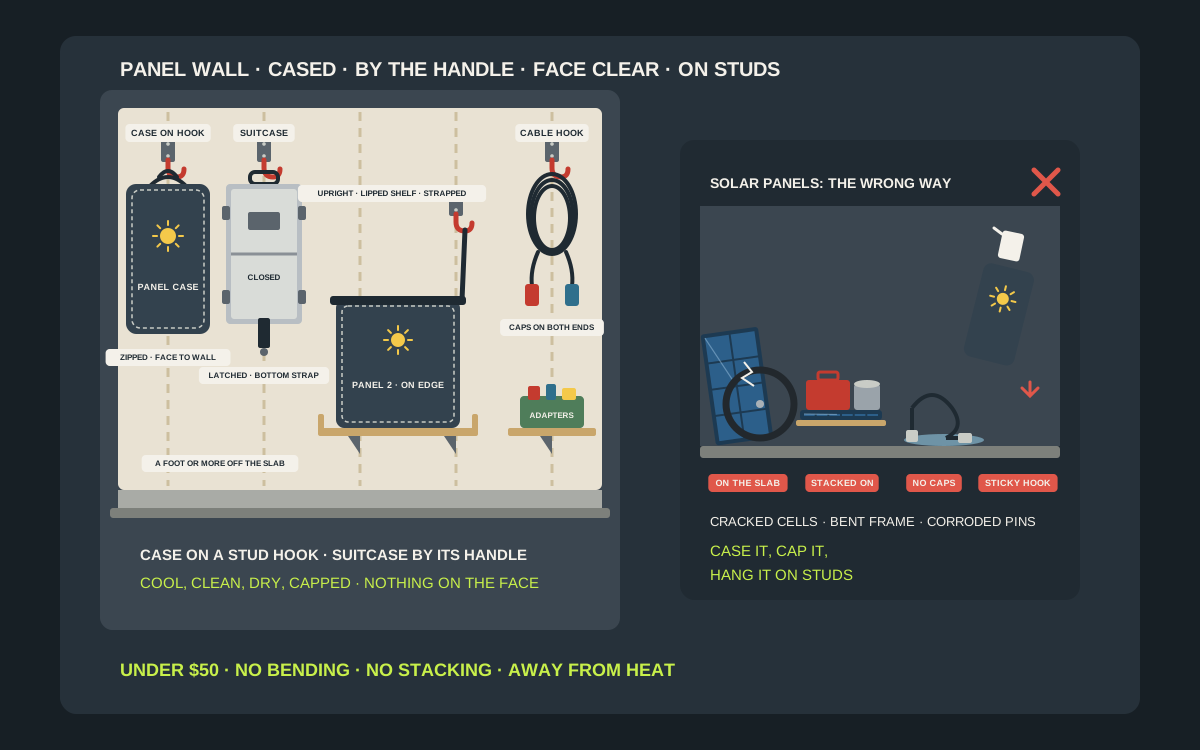
A folding solar panel is one of the most expensive pieces of camping gear most people own, and it is also one of the easiest to break at home. It comes back from a trip in its case, gets leaned against the garage wall, and then spends the off-season with a bike pedal, a cooler lid or a bag of potting soil pressing on it. The cells inside are thin, the makers warn plainly against bending, stepping on or dropping a panel, and a cracked cell is not something you fix with tape. The good news is that giving a portable panel a safe home costs well under $50: a deep padded hook in a stud, a strap, a short shelf, a cable hook and a pair of connector caps. This guide is about storing a portable panel on a wall between trips, not mounting it to charge. Jackery’s SolarSaga 100 manual says the panel cannot be fixed for installation and should be put away in strong wind or hail, so the wall is where it rests, not where it works. Below you will find which wall setup suits which kind of panel, what the makers actually say about bending, heat, cleaning and connectors, and where the panel wall belongs at home and in the rig.
Shop padded garage utility hooks on Amazon
Who this is for
- RV owners, van builders and campers with a folding 100 W to 220 W panel that rides along to charge a portable power station
- Owners of a framed solar suitcase with latches, a handle and fold-out legs who are tired of it sliding around a garage corner
- Home-backup and tailgate users who keep a panel ready for outages and want it, its cable and its adapters in one grab-and-go spot
Quick answer
For most people, the best under-$50 portable solar panel storage is the panel folded and zipped into its own case, hung by the case handle from a deep, coated utility hook screwed into a stud, with its charging cable coiled on a separate hook beside it and both connector ends capped. A framed solar suitcase can hang by its own carry handle from a padded hook, with a strap at the bottom so it cannot swing into the wall. If you own two panels or a bulky kit, give them a short shelf where they stand upright on edge or lie flat with nothing stacked on top. Whatever you choose, keep the panel off the floor, out of the path of bikes and car doors, dry, and well away from heaters and flames. Check the hook rating, the case size and the current price on the listing before you buy.
Quick comparison
| Setup | Best for | How it holds | Trade-off |
|---|---|---|---|
| Panel in its case on a stud hook | Folding panels that came with a carry case | Case hangs by its handle from a deep coated hook | The case must close fully |
| Suitcase panel by its own handle | Framed suitcase panels with latches | Carry handle on a padded hook, strap at the bottom | Latches must be closed |
| Upright on a lipped shelf | Two panels, or panels with no hanging handle | Panel stands on its long edge, strapped to the wall | Needs a shelf about 4 in deep |
| Flat on a dedicated shelf | Bulky multi-fold kits and loose cases | Panel lies flat with nothing stacked on top | Uses a whole shelf |
| Cable hook with capped ends | Solar charging cables and extension leads | Loose coil on its own hook, caps on both ends | Holds cables, not the panel |
| Adapter and clamp bin | Adapters, branch connectors, clips and controllers | Small open bin on a shelf or rail | Holds the small parts only |
Solar connector dust capsHeavy-duty storage strapsWall-mounted cable hooks
What to look for
Sized for the folded panel and its case
Folded portable panels are flatter than people expect but wider than most hooks assume. Jackery lists the SolarSaga 100 (JS-100F) at 610 by 552 by 35 mm folded, about 24 by 21.7 by 1.4 inches. EcoFlow lists its NextGen 220W bifacial panel at 24.2 by 23.2 by 1.3 inches folded, and BLUETTI lists the PV200 at 23.2 by 24.8 by 1.7 inches. A padded case adds an inch or two all round. Measure the panel in its case before you choose a hook depth, a shelf depth or a strap length.
Rated well above the weight
Panels are not heavy, but the weight varies by a factor of three. Jackery lists the SolarSaga 100 at 3.6 kg, about 8 lb; Renogy lists its Compact Suitcase 100 at 8.82 lb; EcoFlow lists the 220W bifacial at about 15.4 lb and BLUETTI lists the PV200 at 16.1 lb. Renogy’s older 100W suitcase with a Voyager controller weighs 21.2 lb. A hook rated for 50 lb, such as Rubbermaid’s FastTrack utility hooks, leaves comfortable margin for any of them, but only if it is screwed into a stud or into a rail that is.
Supports the panel without bending or pressing it
The makers are blunt about this. Jackery’s SolarSaga 100 safety tips say do not bend the folding panels, do not step on them or place heavy objects on them, and do not drop them, because the material can be damaged internally and the panel rendered unusable. BLUETTI’s PV200 guide repeats the same rules as icons: no fall, no bend, no scratch. A good wall setup carries the panel by its handle, its case or its frame, never by one corner, and leaves nothing leaning on its face.
Screws, not adhesive
A cased panel is pulled down and hung back up in a hurry, often by one hand while the other holds a cable. That is a job for hooks screwed into studs, not stick-on hooks. Command’s indoor strips are rated for roughly 50 to 105°F, and garages swing outside that range for much of the year. A 15-lb panel falling off a peeling adhesive hook is exactly the drop the manuals warn about.
Keeps the cable and connectors with the panel
A panel without its cable is useless at the campsite, and a cable without caps collects dust, grit and moisture in exactly the part that carries the current. The best setup gives the cable its own hook right beside the panel, so it is grabbed in the same move, and keeps the connector ends capped and clean.
Away from heat, flame and traffic
Jackery’s manual says not to use or store the panel near open flames or flammable materials and to keep it away from heat sources such as a fire or heater. In a garage that rules out the wall beside the water heater, furnace or a wood stove. It also rules out the strip of wall where bikes, the lawn mower or the car door swing in, because a scratch or a knock to the face is the easiest way for a stored panel to get damaged.
Know what you are storing
Folding briefcase panels
Most portable panels sold for camping today are folding briefcase panels: two to four rigid or semi-rigid sections laminated in ETFE or glass, joined by fabric hinges, with a kickstand on the back and a junction box or cable pocket at one end. Jackery’s SolarSaga 100 folds in half to about 24 by 21.7 by 1.4 inches. BLUETTI’s PV200 folds four times to 23.2 by 24.8 inches. EcoFlow’s NextGen 220W folds to 24.2 by 23.2 by 1.3 inches and ships with a storage case. Folded, they are all roughly the size of a large pizza box, which is why they fit so neatly on a wall and so awkwardly on a shelf full of other gear.
Framed solar suitcases
A solar suitcase is two framed panels hinged together, with latches, a carry handle and fold-out legs. Renogy’s Compact Suitcase 100 folds to 20.59 by 24.33 by 1.57 inches and weighs 8.82 lb, and comes with a case. Renogy’s older 100W suitcase with a Voyager charge controller folds to 21.7 by 20.9 by 2.8 inches, weighs 21.2 lb, and its manual describes a rugged protective case that protects the suitcase during storage and transportation. The aluminum frame makes a suitcase sturdier than a fabric-hinged panel, but the glass or cells inside are just as easy to crack with a sharp knock.
Weight is easy; the face is fragile
From about 8 lb to about 21 lb, none of these panels is a serious load for a hook screwed into a stud. What makes them tricky is that the weight sits behind a large, fragile face. A wall setup that lets the panel swing into a stud wall, slide off a shallow hook or rest face-down on a hook tip is worse than a well-chosen spot on the floor. Every setup below is built to carry the panel by a handle, a case or an edge, and to keep the face clear.
Cables, connectors and small parts
Each panel brings a small kit with it. EcoFlow’s box lists the panel, the storage case and a 2.5 m solar to XT60i charging cable. BLUETTI’s PV200 comes with an MC4 cable. Many owners add an extension lead, a branch connector for two panels, an Anderson or 8 mm adapter for a specific power station, and a few clips to hold the panel down in wind. These small parts are what actually go missing between trips, so the wall needs a home for them too.
Rated for weather, not for storage abuse
Being weatherproof in use does not make a panel tough in storage. EcoFlow rates the 220W panel IP68, and BLUETTI rates the PV200 IP65 against water splash but says not to leave it in rain or water for a long time. Neither rating says anything about a toolbox resting on the face, a sharp hook tip or a fall onto concrete. The storage rules come from the safety pages, not the weather rating.
Six ways to store a portable panel on a wall
The panel in its case on a stud hook
This is the best home for most folding panels. Fold the panel along its hinges, zip it into its case and hang the case by its handle from a deep, coated utility hook screwed into a stud at about chest height. Rubbermaid’s FastTrack utility hooks, for example, are rated at 50 lb, several times the weight of a 220 W panel. Choose a hook deep enough that the handle sits well back from the tip, and hang the case so the face of the panel faces the wall. If the case has no handle, a heavy-duty storage strap with a grommet looped around the case does the same job; Wrap-It rates its Heavy-Duty straps at 50 lb for the 10- to 28-inch sizes, for static loads only.
A suitcase panel by its own handle
A framed suitcase is designed to be carried by its handle, so hanging it from that handle on a padded, deep hook loads it the same way carrying it does. Close both latches first, so the halves cannot open on the wall. Then add a short strap or a bungee with a hook-and-loop strap at the bottom edge, anchored to a second screw or a rail, so the suitcase cannot swing out when you brush past it. If the suitcase came with a protective case, hang it in the case; Renogy’s own manual says the case is there to protect the suitcase during storage.
Upright on edge on a short lipped shelf
Two panels, or a panel whose case has no hanging handle, can stand upright on their long edge on a short shelf about 4 inches deep with a lip at the front, the way records stand in a crate. The edge carries the weight evenly along its whole length, nothing presses on the face, and a storage strap from a hook above keeps the panel tight to the wall. Put the shelf at knee to waist height on brackets screwed into studs, and give each panel its own slot so they do not lean face-to-face.
Flat on a dedicated shelf
A bulky multi-fold kit, or a panel stored in a soft case, can lie flat on a wall shelf. The rule is simple and comes straight from Jackery’s safety tips: do not step on the panel or place heavy objects on it. That means the shelf belongs to the panel and nothing else, not the paint cans, not the cooler, not the box of spare camping fuel. A flat shelf takes more wall than a hook, but it is the gentlest option for an older panel with tired hinges.
A cable hook with capped connectors
Coil the charging cable loosely, in loops about a foot across, and hang it on its own cable hook right beside the panel. Do not wrap it tightly around the panel or its kickstand. Stäubli, the company that makes the original MC4 connectors, says unmated connectors must be protected from moisture, dirt and dust with sealing caps, and that its caps protect against dirt and moisture getting in and the corrosion of the metal contacts that follows. Put a cap on each MC4 end, push the plug on the XT60 or 8 mm end into its own cover or a small zip bag, and the cable is ready to plug in next trip.
An adapter and clamp bin
Adapters, branch connectors, spare caps, panel clips and a charge controller all fit in one small open bin on a short shelf or a rail under the panel. Label it with the panel and the power station it belongs to. When you pull the panel off the wall, the bin comes too, and you never arrive at a campsite with the right panel and the wrong adapter.
Where the panel wall goes
The home garage
For most campers the panel lives in the garage between trips. Pick a stud wall near the door you load the vehicle from, away from the water heater, furnace, dryer vent and any wood stove, and out of the arc of the car door and the path of bikes and the mower. Mount the hook so the bottom of the case hangs at least a foot off the slab, where a puddle from a wet car or a spilled bucket cannot reach it. A hot west-facing wall or a spot right under a sunny window is a poor choice too; the panel is built to sit in the sun while it works, not to bake in a closed garage for months.
Sheds and storage units
A shed or storage unit can work if it stays dry and does not get extremely hot. Stäubli’s assembly instructions for its connectors call for storage at a constant temperature between -30 and +60°C, below 70 percent relative humidity, with no direct rain or condensation, which is a good yardstick for the whole kit. An uninsulated metal shed that sweats on cold mornings or turns into an oven in July fails that test. If you must store the panel there, use the same hooks off the floor, keep it in its case, and check the connectors before the first trip of the season.
The RV or van
On the road, a portable panel is safest in its case, flat or upright in a bay or under a bed, tied down so it cannot slide. Renogy pitches its suitcases as easy to store in any gap in an RV or van, and that is the right idea: a snug gap, not a high hook. Do not hang a panel from a wall hook inside a moving rig, where it will swing into cabinets and load thin walls that are not built for it. If you need hooks inside the rig, our guide to mounting hooks in an RV without damaging walls covers what interior walls can take.
Apartments and home backup
If the panel is mainly for outages, keep it inside the house in a closet near the power station, in its case, standing upright against the back wall or lying flat on the floor of the closet with nothing on top. A single hook screwed into a stud inside the closet works the same way as in a garage. The point is that it is dry, clear of heat, and findable in the dark when the power goes out.
Three sample panel walls
Weekend camper with one 100 W panel
One coated hook in a stud for the cased panel, one cable hook beside it for the charging lead, and a small bin on a short shelf below for an adapter and a few clips. The whole station fits in an 18-inch strip of wall, and it can sit right next to the hooks that hold the camping chairs and the cooler, so loading the car is one trip along one wall.
RV owner with two 200 W panels and a suitcase
A short lipped shelf at waist height holds the two folding panels upright on edge, each in its own slot, strapped to the wall. A padded hook to one side holds the suitcase by its handle with a strap at the bottom. Above the shelf, two cable hooks hold the charging cables and the branch connector, capped, and a labeled bin holds the adapters for the trailer’s solar port and the power station. Everything is off the slab and clear of the car.
Home backup kit in a hall closet
One 220 W panel in its case stands upright against the back wall of a closet on the floor or hangs from a stud hook, with its cable coiled on a hook on the inside of the closet door frame and the power station on a shelf beside it. A small flashlight and a printed card with the panel’s connector type and the power station’s input limits live in the same bin. In an outage, everything is in one place.
Setting up the panel wall step by step
- Choose a dry stud wall away from the water heater, furnace, dryer vent and car door swing, and out of direct sun through a window.
- Measure the panel in its case: width, height and thickness, and note the weight on the label or spec sheet.
- Find a stud with a stud finder and confirm it with a small nail where the hook plate will cover the hole.
- Screw a deep, coated utility hook into the stud so the bottom of the cased panel will hang at least a foot above the floor.
- Add a second screw or a short rail below for a bottom strap if you are hanging a framed suitcase.
- Screw a cable hook into the same stud or the next one, and a short shelf or rail with a small bin for adapters and clips.
- Disconnect the panel, let it cool, wipe it clean and dry, fold it along its hinges and zip it into its case.
- Cap both connector ends, coil the cable loosely on its hook, and lift the panel down and back up once to make sure it is a one-person job.
Cleaning, cooling and connector care
Let it cool and disconnect it first
EcoFlow’s manual says to make sure the panel is not connected to a power station or any other load and that its surfaces have cooled to room temperature before cleaning. The same order works before storage: unplug, let it cool in the shade, then clean and fold. A panel folded straight from full sun is hot, and anything trapped in the folds stays warm and damp.
A damp cloth, not a hose
EcoFlow recommends a soft cloth wet with clean water and wrung out, and asks owners to avoid wiping or washing the connectors. Jackery says not to put the panel in water directly and to wipe it gently with a damp cloth, and not to immerse it. Brush off sand and leaves first, wipe the face, let it air-dry fully, and only then fold it. Grit left in the folds is how hinges and faces get scratched in storage.
Secure the cable away from the panel
EcoFlow’s storage advice for long-term storage is to secure the output cable to avoid any contact with the photovoltaic module, then fold the panel and put it back in the case. That is exactly what a separate cable hook does. A cable wound tightly around a folded panel presses connectors into the face and puts a sharp bend in the lead where it exits the junction box.
Treat the connectors as live
Stäubli notes that live parts can remain energized even after a PV system has been disconnected, and a panel in daylight produces voltage the moment its face sees light. EcoFlow warns never to connect a panel’s two output connectors to each other, because that causes a short circuit. Capping each end separately and never clipping the two ends together on a hook removes both risks.
Check it before the first trip
Before the first trip of the season, unzip the case, open the panel flat and look for cracked cells, lifted laminate, bent frame corners or chewed cable. Renogy’s suitcase manual tells owners to inspect for cracks, dents, deformation and other visible abnormalities, keep connector contacts clean, dry and free of dirt and corrosion, and not to use the suitcase if there is visible damage. A two-minute check at home is better than a dead panel at the campsite.
Mistakes to avoid
- Leaning the panel against the garage wall on the concrete floor, where bikes, wheels and car doors can hit its face.
- Stacking a toolbox, a cooler or paint cans on a panel lying flat on a shelf.
- Hanging a cased panel from a single adhesive hook that is rated for indoor temperatures only.
- Hanging the panel by one corner, a hinge or the cable instead of its handle, its case or its edge.
- Folding a panel past its hinges or forcing it into a case that is too small.
- Storing it beside the water heater, furnace, dryer vent or a wood stove.
- Wrapping the charging cable tightly around the folded panel or its kickstand.
- Leaving connector ends uncapped, or clipping the two output connectors together.
- Hanging a panel from a wall hook inside a moving RV or van.
Related guides
Browse the hub: RV & camping storage under $50 - all guides
- Best RV Battery Tender Wall Mounts Under $50
- Best Portable Power Cord Wall Wraps for RVs Under $50
- Best RV Shore Power Adapter Wall Holders Under $50
- Best RV Surge Protector Wall Mounts Under $50
- Best Folding Camp Table Wall Brackets Under $50
- Best Camping Lantern Wall Hooks Under $50 for Cabins
- How to Mount Hooks in an RV Without Damaging Walls Under $50
FAQ
Can you hang a portable solar panel on a wall?
Yes, for storage. Fold it, zip it into its case and hang the case by its handle from a deep, coated hook screwed into a stud. A framed solar suitcase can hang by its own carry handle with a strap at the bottom. Portable panels are not built to be permanently mounted for charging; Jackery’s SolarSaga 100 manual says the panel cannot be fixed for installation.
How should I store a folding solar panel when not in use?
Disconnect it, let it cool, wipe it with a damp cloth, let it dry, fold it along its hinges and put it back in its case. Store it somewhere cool and dry, off the floor, away from heaters and open flames, with nothing heavy on top, and keep the output cable secured away from the panel face.
Is it okay to store a solar panel in a hot garage?
It is better to avoid the hottest spots. Panels are built to work in the sun, but the makers say to keep them away from heat sources, and Stäubli’s storage guidance for its connectors calls for a constant temperature between -30 and +60°C and humidity below 70 percent. Pick a shaded, dry wall away from the water heater and furnace.
Can I store a portable solar panel standing up?
Yes. Standing a folded panel upright on its long edge on a short lipped shelf, strapped to the wall, carries the weight evenly and keeps the face clear. What matters is that nothing presses on the face, the panel cannot tip over, and it is not bent beyond its hinges.
How heavy is a portable solar panel?
Folding 100 W panels weigh roughly 8 to 9 lb; Jackery lists the SolarSaga 100 at 3.6 kg and Renogy lists its Compact Suitcase 100 at 8.82 lb. Larger 200 to 220 W folding panels weigh about 15 to 16 lb, and Renogy’s older 100W suitcase with a controller weighs 21.2 lb. A hook rated for 50 lb in a stud handles any of them.
Do I need caps on MC4 connectors in storage?
It is a good idea. Stäubli, which makes the original MC4 connectors, says unmated connectors should be protected with sealing caps against moisture, dirt and dust, which also prevents corrosion of the contacts. Cap each end separately and never clip the panel’s two output connectors together.
Bottom line
The best portable solar panel storage is the panel folded into its own case and hung by the handle from a deep, coated hook screwed into a stud, with the charging cable coiled on its own hook beside it and both connector ends capped. A framed suitcase can hang by its carry handle with a strap at the bottom, and two panels can stand upright on a short lipped shelf. Keep it off the floor, dry, clear of heat and traffic, with nothing pressing on the face, and check the hook rating, case size and current price on the listing before you buy.