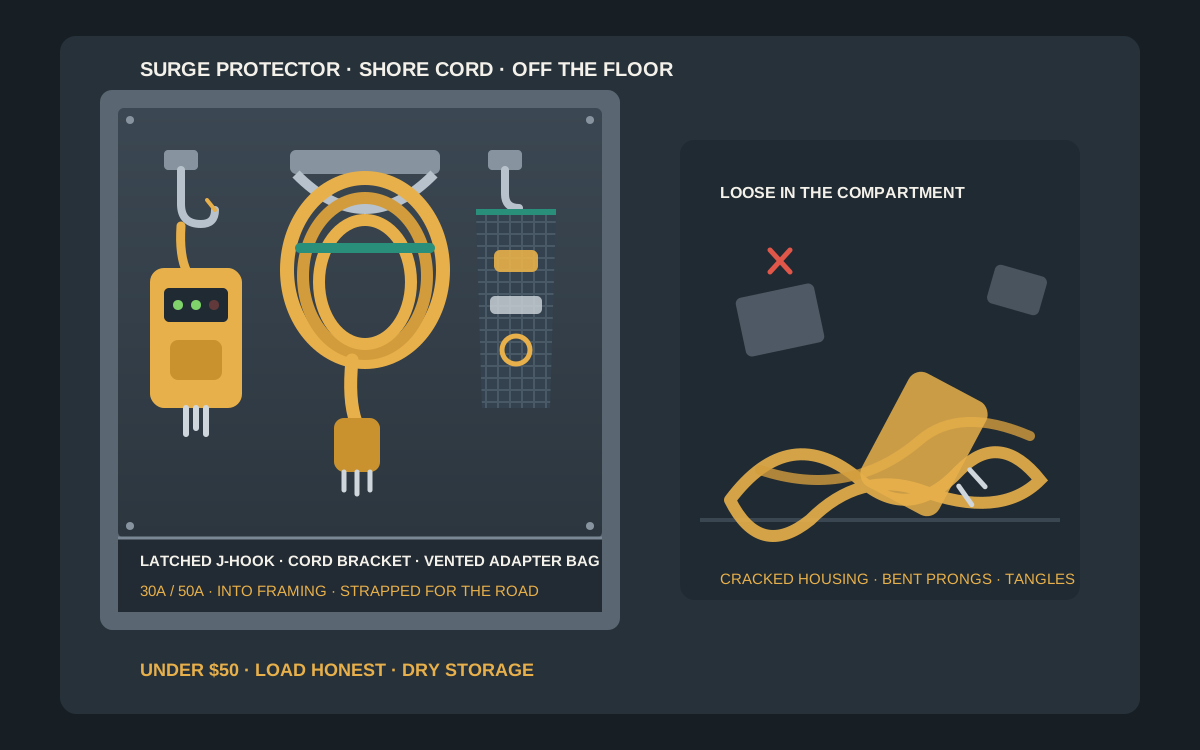
For most rigs, the best under-$50 surge protector "wall mount" is a pair of screw-in, heavy-duty J-hooks or a cord storage bracket on the wall of the basement or utility compartment closest to the shore power inlet: the shore cord coils over the bracket, the surge protector hangs beside it by its handle or rides in a padded storage bag on the next hook, and a strap or latch stops both from bouncing off on washboard roads. A vented wall bin wins when you also carry dogbone adapters and an extension cord; a hanging storage bag wins when the protector is a bulky 50A unit with no good hang point. Screw or bolt into real framing — a 50A cord is far too heavy for adhesive — stow everything dry, keep it out of the propane compartment, and verify live dimensions and price before buying. Check current prices and load ratings on the listing before you buy.
Shop RV surge protector storage on Amazon
Who this is for
- RVers whose portable surge protector or EMS rides loose in the basement compartment, banging against the shore power cord, water hose and leveling blocks
- Owners of 30A and 50A rigs comparing heavy-duty J-hooks, cord storage brackets, wall-mounted bins and hanging storage bags under $50
- Anyone who wants the protector, shore cord and adapters in one dry, latched spot so hookup at the pedestal takes two minutes, not ten
Quick answer
For most rigs, the best under-$50 surge protector "wall mount" is a pair of screw-in, heavy-duty J-hooks or a cord storage bracket on the wall of the basement or utility compartment closest to the shore power inlet: the shore cord coils over the bracket, the surge protector hangs beside it by its handle or rides in a padded storage bag on the next hook, and a strap or latch stops both from bouncing off on washboard roads. A vented wall bin wins when you also carry dogbone adapters and an extension cord; a hanging storage bag wins when the protector is a bulky 50A unit with no good hang point. Screw or bolt into real framing — a 50A cord is far too heavy for adhesive — stow everything dry, keep it out of the propane compartment, and verify live dimensions and price before buying. Check current prices and load ratings on the listing before you buy.
Quick comparison
| Format | Best for | Typical price band | Why it wins |
|---|---|---|---|
| Heavy-duty screw-in J-hooks | 30A protectors, coiled 30A cords | Usually $8–$25 | Simplest hang point; pick latched tips |
| Cord storage bracket / saddle | Heavy 50A shore cords, extension cords | Usually $15–$45 | Deep saddle protects the coil; strap-ready |
| Vented wall-mounted bin | Protector + dogbone adapters + small kit | Usually $12–$35 | Keeps the whole hookup kit together |
| Hanging storage bag / case | Bulky 50A protectors, prong protection | Usually $10–$30 | Padding and dust cover; hangs on a hook |
Heavy-duty J-hooksCord storage bracketsSurge protector bags
What to look for
30A vs 50A: size and weight decide the mount
A 30A setup uses a three-prong TT-30 plug and a single 120V leg; the cord is typically 10-gauge and a portable 30A surge protector is usually a compact, dogbone-style unit you can hang by its cord loop or handle. A 50A setup uses a four-prong 14-50 plug carrying two 120V legs; the cord typically has 6-gauge conductors with an 8-gauge ground and is markedly heavier and stiffer, and 50A protectors are bigger boxes. Size the mount for the heavier 50A case if you might ever switch rigs, and check the actual weight on the product page — never guess.
Cord weight and coil diameter
The shore power cord is the heaviest thing in the station, not the surge protector. A 25–30 ft cord coiled loosely needs a bracket or hook with a deep, rounded saddle so the coil does not kink, and enough clear wall so the plug end can hang without pressing into the compartment door. Do not wind cords tightly around a small hook — a loose figure-eight or over-under coil lasts longer and lays flatter.
Vibration, latches and road shock
An RV compartment is a paint shaker on rough roads. Open hooks let a heavy protector bounce off and crack its housing or bend its prongs. Choose hooks with a safety latch or upturned tip, add a hook-and-loop strap or short bungee over the coil, and mount so nothing can swing into the compartment door seal or the door latch mechanism.
Moisture, dust and heat
Surge protectors live outdoors at the pedestal, then go into a closed box. Wipe off rain, dew and grit before stowing, let a wet unit air out, and keep the plug caps or a small bag over the prongs. Prefer vented or mesh bins and bags over sealed tubs, which trap condensation. Keep the station away from exhaust-side compartments that run hot and never store electrical gear in the propane compartment, which is vented for gas, not for storage.
J-hooks vs cord bracket vs bin vs storage bag
When heavy-duty J-hooks win
For a 30A rig with a compact dogbone-style protector, two screw-in J-hooks are the best under-$50 answer. One holds the loosely coiled shore cord, the other holds the protector by its handle or cord loop, plug-end down so water cannot pool in the receptacle. Pick hooks with a latch or a tall upturned tip so a pothole cannot flip the load off.
When a cord storage bracket is the smarter mount
Once you are hauling a 50A cord, give it a dedicated bracket or saddle — the kind sold for hoses and extension cords. The wide curve spreads the weight and stops the stiff cable from kinking, and most designs leave room to strap the coil down. Hang the surge protector on a separate hook beside it rather than stacking it on top of the cord.
When a wall-mounted bin beats hooks
If your hookup kit includes a 50A-to-30A or 30A-to-15A dogbone adapter, a short extension, a voltage meter and gloves, a vented wall bin keeps it all in one grab. Mount it low on the wall closest to the inlet, choose open mesh or slotted sides for airflow, and add a strap across the top so contents stay put on the road.
When a hanging storage bag makes sense
Bulky 50A protectors often have no handy hang point and hate rattling against metal. A padded zip bag or case hung from a single heavy hook protects the housing and prongs, keeps dust out, and doubles as a carry bag to the pedestal. Let the unit dry before zipping it up.
Build a two-minute hookup station
Mount next to the shore power inlet
Put the station in the compartment closest to your power inlet or cord hatch, so the protector, cord and adapter come out in one reach and go straight to the pedestal.
Stage the hookup order on the wall
Hang items in the order you use them: protector first, then the shore cord, then adapters. Breakers off at the pedestal, protector in, check its status lights or readout, then cord to the rig — the wall layout reminds everyone of the sequence.
Keep the anti-theft lock with the protector
Many portable surge protectors have a loop or bracket for locking them to the pedestal. Store the padlock and key, or a short cable lock, on the same hook so the protector never goes out unlocked at a busy campground.
Leave room to inspect
Mount where you can see the plug blades and the protector housing. Darkened or melted prongs, a cracked case or a status indicator showing a fault are reasons to stop using the unit and follow the maker’s guidance — not to stuff it back on the hook.
Treat under-$50 bands as moving targets
Check the current dimensions, hook depth, wall-type guidance and price on the listing before you buy.
Compartment mounting that survives the road
Know what is behind the compartment wall
Basement compartment walls are often thin composite or luan over aluminum or steel framing, and some hide wiring, plumbing lines or tank walls. Check from both sides before drilling, use a short drill stop, and never drill into an exterior wall without knowing where the skin and studs are.
Use the right fastener for the wall
Screw into framing where you can. On thin panels, through-bolt with large fender washers or use rivet nuts in metal framing so the load spreads instead of pulling through. Adhesive hooks do not belong on a cord or protector station — heat, cold and vibration defeat them, and a 50A cord is simply too heavy.
Seal any new holes
If a fastener breaks into a sealed wall, bed it in a suitable sealant so road spray and dust do not find their way into the compartment or the wall cavity.
Mind the door and the seal
Dry-fit with the compartment door closed. Coils and bags must not press on the door seal or latch, and the plug end should not rest against the door where a slam can crack it.
Mistakes to avoid
- Tossing the surge protector loose in the compartment where it slides into the leveling blocks and cracks.
- Sticking adhesive hooks to a compartment wall and hanging a 50A shore cord on them.
- Storing a wet protector or cord in a sealed tub so condensation sits on the contacts.
- Keeping electrical gear in the propane compartment.
- Winding the shore cord tightly around a small hook until it kinks.
- Drilling into an exterior compartment wall without checking for wiring, plumbing or tanks behind it.
Related guides
Browse the hub: RV & camping storage under $50 - all guides
- Best Portable Power Cord Wall Wraps for RVs Under $50
- Best RV Battery Tender Wall Mounts Under $50
- Adhesive vs Screw-In Hooks for RV Walls Under $50
- Extension Cord Storage Ideas
- Best RV Shore Power Adapter Wall Holders Under $50
- Best Portable Solar Panel Wall Mounts Under $50 for Camping Gear Storage
FAQ
What is the best way to mount an RV surge protector on a wall under $50?
For most rigs, two screw-in heavy-duty J-hooks or a cord storage bracket in the compartment nearest the shore power inlet: the cord coils on the bracket, the protector hangs beside it or in a padded bag, and a strap or latch holds both on the road. Add a vented bin if you also carry adapters.
Can I mount a portable surge protector permanently inside the RV?
A portable unit is designed to plug in at the pedestal, so it should be stored, not wired in. If you want permanent protection, a hardwired EMS mounts near the transfer switch or power center, is installed per the maker’s instructions — usually by a qualified RV technician — and typically costs well above $50.
Do 30A and 50A surge protectors need different wall mounts?
Usually yes. A 30A protector and 10-gauge cord fit on a pair of latched J-hooks. A 50A cord typically uses 6-gauge conductors and is much heavier and stiffer, so it needs a wide cord bracket screwed or bolted into framing, and bulky 50A protectors often store best in a padded bag on a separate hook.
Will adhesive hooks hold a surge protector in an RV compartment?
Not reliably. Compartment heat, cold and road vibration weaken adhesive, and a shore power cord is too heavy for it. Use screws into framing, through-bolts with fender washers on thin panels, or rivet nuts in metal framing.
Where should I store the RV surge protector between trips?
In a dry, vented spot in the compartment closest to the shore power inlet, after wiping it clean and letting it dry, with prong caps or a bag on the plug. Keep it away from hot exhaust-side compartments and never in the propane compartment.
Bottom line
RV surge protector wall mounts under $50 work when the heaviest piece — the shore power cord — gets a real bracket and the protector gets its own latched hook or padded bag right beside it, in the compartment nearest the inlet. Size the mount for 30A or 50A, fasten into framing instead of trusting adhesive, strap everything for the road, stow it dry and out of the propane compartment, and check the current ratings and price on the listing before you buy.