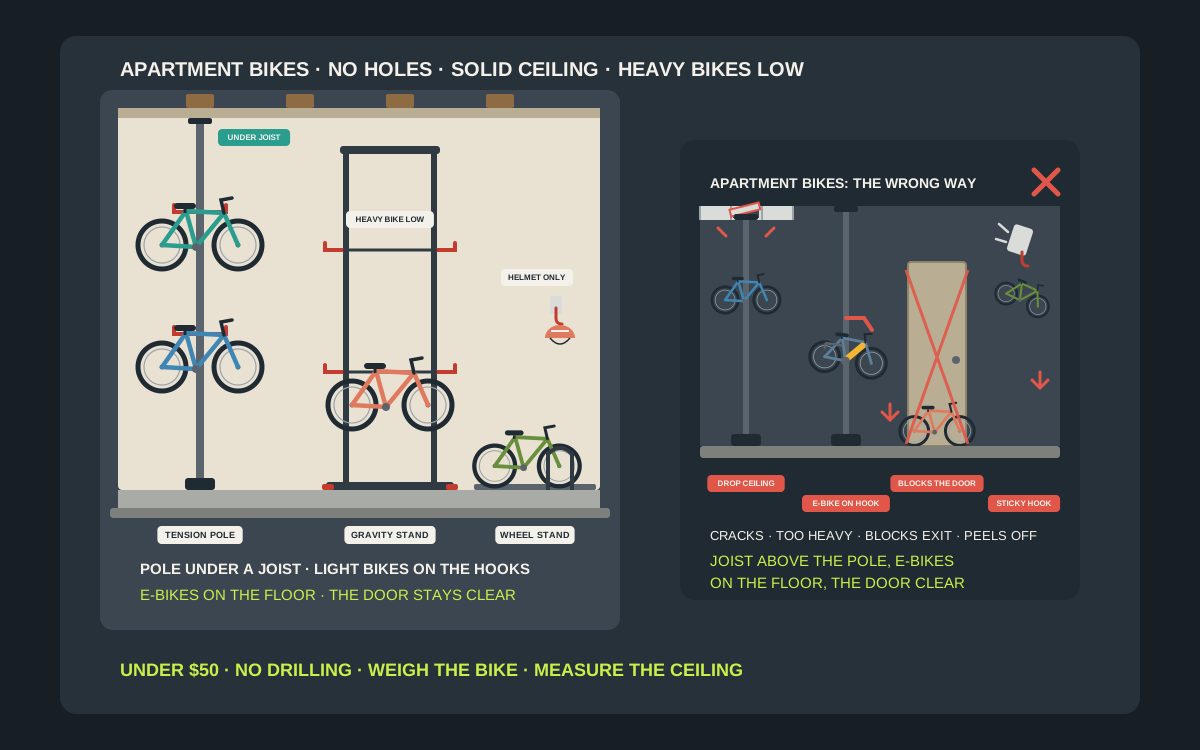
A bike is the most awkward thing most renters own. It is too long for a closet, too dirty for the sofa, too valuable for the building’s bike room and too heavy for anything you can stick to a wall. In a house you would screw two hooks into a stud and be done. In an apartment, the lease, the landlord and the deposit all have opinions about holes, and the bike ends up leaning on the hallway wall, leaving a black tire mark at handlebar height. You do not need a drill to fix that. Bikes can stand in a floor stand, hang from a pole that wedges between the floor and the ceiling, lean on a gravity stand or fold into a closet corner, and none of those needs a single screw in the wall. This guide covers which no-drill setup suits which apartment and which bike, how to measure the ceiling, the floor and the path to the door, what the makers of tension poles and gravity stands say in their manuals, why e-bikes need different rules and how to keep the walls, the floor and your deposit intact.
Shop no-drill apartment bike storage on Amazon
Who this is for
- Renters who cannot or do not want to drill into walls or ceilings to hang a bike
- Anyone whose bike lives in the hallway, scuffs the wall and blocks the way to the door
- Couples and roommates who need two bikes stored in the floor space of one
- E-bike riders who need a heavy bike stored safely and a battery charged by the rules
Quick answer
For most apartments, the best under-$50 no-drill bike storage is a simple floor stand that holds the bike by one wheel, because it works with any ceiling, any wall and nearly any bike, including heavy ones. If floor space is the problem and you have a solid ceiling between about 7½ and 10½ feet, a floor-to-ceiling tension pole stores two light bikes in roughly the footprint of one, as long as the top sits under a joist and each bike stays under the rating per hook. Gravity stands that lean on the wall are another good two-bike option, but most ship with a stabilizing strap meant to be screwed to the wall. E-bikes belong on the floor, not on a pole or a gravity-stand arm, and their batteries should never charge by the door. Check the ceiling range, the weight per bike, the tire width and the current price on the listing before you buy.
Quick comparison
| Setup | Best for | How it holds | Trade-off |
|---|---|---|---|
| Floor wheel-slot stand | One or two bikes, any ceiling, small budgets | Wheel sits in a steel slot on the floor | Uses floor space; narrow slots can bend thin rims if bumped |
| Spring-arm wheel stand | Heavier bikes and wide tires | Cradle plus an arm that grips the tire | Branded versions often cost more than $50 |
| Two-bike gravity stand | Two light bikes against one wall | Leans on the wall; bikes hang on padded arms | Often ships with a wall strap meant to be screwed in |
| Floor-to-ceiling tension pole | Two bikes where floor is scarce | Pole wedged between floor and ceiling, under a joist | Needs a solid ceiling in range; light bikes only per hook |
| Folding bike in a closet | Studios and small one-bedrooms | Bike folds and stands on the closet floor | Only works with a folding bike |
| Over-door rack | Helmets, lights, gloves and pumps | Hooks over the top of a door | Accessories only; never a bike |
| Adhesive hooks | A helmet or a light by the door | Adhesive strips on smooth painted wall | Small loads only; never a bike or a heavy lock |
Floor-to-ceiling tension bike racksFreestanding bike floor standsLeaning gravity bike stands
What to look for
Rated for your bike, per hook
Weigh your bike before you shop. Stand on a bathroom scale holding it, then subtract your own weight. The number that matters on a listing is the limit per bike or per hook, not the total. Topeak rates its Dual-Touch tension stand at 18 kg (39.7 lb) per hook and 72 kg (158.7 lb) per stand. Delta’s assembly sheet for its Michelangelo two-bike gravity stand lists 80 lb total, 25 lb per hook and 50 lb per bike. A road bike fits those numbers easily. A heavy steel commuter with a rack and fenders may not, and most e-bikes do not.
Fits your wheels and tires
Floor stands that hold a wheel have a slot or cradle with a stated tire range. Bike Hand lists its YC-97T floor rack for wheels from 20-inch kids’ bikes to 26 to 29-inch mountain bikes and 700c road bikes, with tires up to 2.5 inches wide. Feedback Sports lists the original RAKK for 20 mm road tires up to 2.25-inch mountain tires, the RAKK XL for 2.3 to 5-inch tires and the RAKK 2.0 for 23 mm to 4.5-inch tires. Measure your widest tire, not the one printed in the catalog, and check whether your fenders clear the cradle.
Fits your ceiling and floor
A tension pole has to match your ceiling height and press against something solid. Topeak lists the Dual-Touch at 190 cm (74.8 in) folded and up to 320 cm (10 ft 6 in) extended, and Delta lists its Tintoretto tension rack for ceilings from 7 ft 6 in to 9 ft 6 in. A floor stand or gravity stand cares about the floor instead: it needs a flat, level patch big enough for the base, with rubber feet that grip your tile, wood or vinyl.
Honest about no-drill
No-drill bike storage comes in three honest forms: things that stand on the floor, things that wedge between the floor and the ceiling, and things that lean on a wall. Each has a catch. A tension pole presses hard on the ceiling and needs a joist above it. A gravity stand can tip, which is why Delta ships a wall stabilizing strap and tells you to screw it to the wall. A floor stand takes up floor. Read how a product holds before you read how many bikes it holds.
Easy on walls, floors and the deposit
Every contact point is a potential mark. Tires leave black rubber smudges on paint, metal feet scratch floors and a tension pole’s top pad can leave a ring on a textured ceiling. Look for rubber feet, padded arms and covered hooks, and plan a tire tray or a washable mat where the wheels touch. Delta includes a peel-and-stick tire tray with its Leonardo wall rack to keep tires off the paint.
Keeps the way out clear
A bike is about as long as a sofa. Wherever it lives, it must not narrow the path from the bedrooms to the apartment door, block the door’s swing or sit in a shared hallway or stairwell. If you ride an e-bike, fire departments add one more rule: the battery should not charge or be stored next to the exit. Choose a spot first, then a stand that fits it.
Measure the apartment before you shop
Weigh the bike, and the heaviest one in the home
Hold the bike, step on a scale and subtract your own weight. Do it with whatever lives on the bike every day: a rack, fenders, a lock bracket, lights and bottle cages add up. Write the number down next to the tire width and the wheel size printed on the tire sidewall, because those three numbers decide which stands are even possible.
Ceiling height and what is above it
For a tension pole, measure from the floor to the ceiling in the exact spot you want it, in two places, because floors and ceilings are rarely flat. Then find out what is above the ceiling. Topeak’s Dual-Touch manual says to install against a ceiling joist or beam, against solid ceiling construction, on a smooth and level surface, and never against a fragile ceiling. A stud finder on the ceiling, or a gentle knock that sounds solid rather than hollow, is a start. A drop ceiling with lift-out tiles, a skylight well or a ceiling with a light fixture in the way rules a pole out.
Floor space, including the handlebars
A bike parked on the floor needs its full length plus room to roll it in and out. For scale, Rad Power Bikes lists its RadCity 5 Plus e-bike at 1,810 mm long, a little under 6 feet. Handlebars are the other dimension people forget: flat mountain bars are often as wide as a doorway is narrow. Mark the footprint on the floor with painter’s tape, then walk around it with a laundry basket to see whether you still can.
The path from the door
Every day the bike has to come in, turn and park. Walk that route with the bike before you buy anything. A stand at the far end of a long hallway means wet tires across the whole floor; a stand right inside the door is convenient but must not block the door’s swing or the way out. Corners just inside the living room are often the best compromise.
The wall behind the stand
Gravity stands and wheel stands both end up touching a wall, either with their own rubber bumpers or with the bike’s tire. Check that the wall is solid, flat and not a radiator, a window or a cabinet door, and plan what will protect the paint where the bike or the stand will rest.
Six no-drill setups that work
A floor stand that holds one wheel
This is the cheapest and most forgiving option. A steel frame on the floor holds the front or rear wheel in a slot or between two loops, and the bike stands upright on its own. Most of the simple ones cost well under $50, and Bike Hand’s YC-97T is a typical design: one rack for wheels from 20 to 29 inches and 700c, tires up to 2.5 inches wide. Single-slot stands are the narrowest; two- and three-bike versions are wider but still need no wall at all. The trade-off is that a thin road rim held only at the bottom can be twisted if someone knocks the bike sideways, so park it where people do not brush past it.
A spring-arm wheel stand for heavier bikes
A better-made wheel stand cradles the tire in a deep tray and closes a spring-loaded arm on top of it, so the bike cannot flop over. Feedback Sports’ RAKK 2.0 is the reference design: it touches only the tire, takes tires from 23 mm to 4.5 inches and wheels from 20 to 29 inches, and is rated for bikes up to 75 lb, which covers many e-bikes. It also folds nearly flat when you take the bike out. Branded spring-arm stands usually cost a little more than $50, but the same idea appears in plenty of budget stands; check the tire range and the weight limit on the listing.
A two-bike gravity stand that leans on the wall
A gravity stand is a tall steel frame with feet on the floor and a top that rests against the wall. The bikes hang horizontally on padded arms, one above the other, which turns two floor footprints into one. Delta’s Michelangelo is the best-known example: its maker describes a stand that leans against the wall with no drilling, with adjustable arms for different frames. It adds only the depth of its feet to the room. Weight is the limit, and so is the wall strap, which the next section covers.
A floor-to-ceiling tension pole
A tension pole is a telescoping tube with rubber pads at both ends. You extend it until the top pad touches the ceiling, then a foot lever or a screw jack locks it tight. Two arms, sometimes four, hold the bikes by their top tubes. Topeak’s Dual-Touch is a good benchmark: two bike mounts in the box, up to four with optional hooks, arms that tilt up to 30 degrees for sloping top tubes, 18 kg (39.7 lb) per hook and 72 kg (158.7 lb) per stand. Delta’s Tintoretto lists 160 lb distributed evenly. Branded poles usually cost more than $50, so under $50 you are mostly looking at generic poles; hold them to the same rules about ceilings, joists and weight per hook.
A folding bike in a closet or corner
If you are choosing a bike for a small apartment, a folding bike solves the storage question at the source. Brompton lists its folded size as 585 mm high, 565 mm long and 270 mm wide, about the size of a carry-on suitcase, which fits in a coat closet or beside a desk. Folding e-bikes are a different story: Rad Power Bikes lists its folding RadExpand 5 at 28 kg, so it folds small but is still heavy to lift. A folding bike needs nothing more than a mat or a small tray under it.
An over-door rack or two adhesive hooks for the gear
The bike is only half the clutter. Helmets, locks, lights, a pump and gloves usually end up on the floor around it. An over-door rack on a coat-closet door, or two adhesive hooks on a smooth painted wall, gives that gear a home at eye level. Keep the loads small: Command lists its Large utility hook at 5 lb, which is fine for a helmet or a set of lights and wrong for a heavy U-lock and chain, never mind a bike. A small basket on the floor stand or a shelf on a nearby bookcase is the better home for locks.
Tension poles: read the fine print
The ceiling is half of the stand
A tension pole holds because it pushes up on the ceiling as hard as it pushes down on the floor. That only works if the ceiling can take it. Topeak’s manual is explicit: install the Dual-Touch against a ceiling joist or beam, on a smooth and level surface, never against a fragile ceiling, and keep the pole vertically straight at all times. In an apartment, that rules out drop ceilings with lift-out tiles, thin plaster that already has cracks and textured popcorn ceilings that crumble under a pad. If you are not sure what is above the ceiling, ask the building manager before you set a pole against it.
Snug, not cranked
Topeak’s instructions have the ceiling pad just touch the ceiling before the foot lever locks the pole. Over-tightening a pole does not make it safer; it makes it more likely to crack plaster or dent drywall. Lock it, then test it empty by pushing and pulling on the pole, as Topeak’s manual says, and test it again fully loaded before you rely on it. If anything shifts, readjust the height and start over.
Check it, and keep it out of traffic
Topeak also warns against installing the stand anywhere it may be kicked or bumped, and says to recheck it if it gets bumped. It also notes that vibration can make the stand move. Apartments have their own versions: a door that slams nearby, a washer on the other side of the wall, children who swing on things. Topeak’s manual says not to install the stand in any area children have access to. Put the pole in a corner nobody walks through and give it a pull every couple of weeks.
Balance the bikes and hang them by the frame
The Topeak manual says to hang only one bike per hook. Hang the heavier bike lower if the pole allows it, turn the handlebars so they do not hit the wall or the other bike, and use the optional handlebar stabilizer where the maker sells one, so the front wheel does not swing into the room.
Gravity stands and the wall strap
Why the strap is in the box
A gravity stand leans against the wall, and a tall frame with two bikes on it can tip sideways or forward if someone pulls a bike out at an angle. Delta’s assembly sheet for its two-bike gravity stands says a wall stabilizing strap is supplied to avoid accidental toppling, with one end bolted to the rack and the other screwed to the wall with a screw suited to the wall construction. In other words, the stand is no-drill to hold bikes, but the maker still wants one small screw for safety.
What to do as a renter
Use the strap if you can. One screw for a stabilizing strap is a small, easily filled hole, and many landlords will say yes if you ask in writing first, which also gives you a record. If you truly cannot screw anything into the wall, keep the stand in a corner where two walls stop it moving sideways, hang the heavier bike on the lower arms, set the stand’s legs as wide as the instructions allow and choose a floor stand instead if children or pets live in the home.
Respect the per-bike limit
Delta lists the Michelangelo (RS6002) at 80 lb total, 25 lb per hook and 50 lb per bike, and the heavy-duty HDRS6002 at 100 lb total. In its answers to buyers, Delta recommends putting the heavier bike on the bottom. Read those numbers as a rule for every gravity stand: weigh both bikes, add them up and stay under the limit with margin.
E-bikes need their own rules
Too heavy for poles and arms
E-bikes are much heavier than the bikes most poles and gravity stands were designed for. Rad Power Bikes lists its RadCity 5 Plus at 29.5 kg, about 65 lb, and even its folding RadExpand 5 at 28 kg. Compare that with Topeak’s 39.7 lb per hook or the 50 lb per bike on Delta’s Michelangelo. Lifting a 65 lb bike to shoulder height to hang it is also a good way to hurt your back or drop it on your foot. Store an e-bike on the floor, in a wide spring-arm stand rated for its weight, or on its own kickstand on a mat.
Charge where the fire department says
The bigger issue with an e-bike in an apartment is the battery. The FDNY tells e-bike owners not to charge near exits, including the apartment door, bedroom doors and windows, especially a window with a fire escape; not to charge in the bedroom; to charge only on the floor; to plug the charger directly into a wall outlet, never an extension cord; and to store and charge batteries away from anything that can catch fire. The CPSC adds that you should always be present while charging, never charge while you sleep or are away from home, and only use the charger that came with the bike or one the maker recommends.
Watch the battery
The FDNY says to stop using a battery and call 911 if you notice an unusual odor, a change in shape or color, or leaking. The NFPA says to store e-bikes and batteries away from exit doors and heat sources, and not to charge below 32°F (0°C) or above 105°F (40°C). Those rules shape where an e-bike lives: not on a freezing balcony, not next to a radiator, not in the bedroom and not beside the front door.
Your lease, your landlord and your building
Read the lease for bikes, not just holes
Most leases say something about alterations, which is why renters avoid drilling. Many also say something about bikes: whether they can be kept in hallways, on balconies or in a bike room, and whether e-bikes are allowed indoors at all. Read both clauses before you buy. A no-drill stand is pointless if the lease says bikes may not be stored in the unit, and a bike room may be the better answer if your building has one with a lock.
Ask in writing, and keep the answer
If you want to use a gravity stand’s wall strap or set a tension pole against the ceiling, a two-line email to the landlord or manager asking permission costs nothing. Ask what is above the ceiling while you are at it; a building manager often knows where the joists run. Keep the reply with your lease.
Keep shared spaces clear
A bike in a shared hallway, a stairwell or a landing is a trip hazard in the dark and an obstruction when people need to get out fast, and most buildings forbid it for that reason. Keep it inside your own door, and inside the apartment keep it out of the path from the bedrooms to the exit.
Balconies are not storage rooms
A balcony looks like free bike parking, but the weather is hard on chains and saddles, a bike on a balcony is visible to thieves, and some buildings ban storage there. If you use one, cover the bike, keep it away from the railing and never leave an e-bike battery out in freezing weather or in direct sun.
Where the bike should live
Just inside the living room
For most apartments, the best spot is a corner of the living room or dining area near the entry: close enough that you do not wheel a wet bike across the whole floor, far enough from the door that it never blocks the way out. A floor stand on a washable mat, or a tension pole tucked into the corner, works well here.
In a hallway inside the apartment
A wide internal hallway can take a slim wheel stand or a gravity stand against one wall if the bike leaves enough room to walk past comfortably and does not stand in the path from the bedrooms to the front door. Narrow hallways are better left empty.
In a bedroom or home office
A regular bike in the bedroom is fine if it does not crowd the door or the window. An e-bike battery is not: the FDNY says not to charge in the bedroom, so if the bike sleeps there, the battery should charge elsewhere, on the floor and away from the exits.
In a closet
A coat closet fits a folding bike and sometimes a small wheel stand with a kids’ bike in it. A full-size bike rarely fits once the door has to close.
Three sample apartments
Studio with one road bike and 8-foot ceilings
Put a single wheel-slot stand on a mat in the corner nearest the door, with the bike’s rear wheel in the slot and its front wheel against a washable tire tray on the wall. Hang the helmet and lights on an adhesive hook beside it, and keep the U-lock in a small basket on the floor. Total footprint: one bike length, no holes.
One-bedroom with two light bikes and a solid ceiling
Confirm the ceiling height and find the joist with a stud finder, then set a tension pole in the living-room corner, top pad under the joist. Hang the heavier bike on the lower arms, turn both handlebars parallel to the wall and test the pole empty before loading it. If the ceiling turns out to be a drop ceiling or fragile plaster, switch to a gravity stand in the same corner and ask the landlord about one screw for its strap.
Walk-up with a commuter e-bike
Leave the e-bike on the floor in a spring-arm wheel stand rated for its weight, on a mat, away from the apartment door. Charge it on the floor next to a wall outlet in the living room while you are home and awake, with nothing that can burn nearby. Keep the charger in a small tray on the stand, and carry the bike, not the battery alone, up and down the stairs by the frame.
Set it up in an afternoon
- Weigh each bike, read the tire widths and write the numbers down.
- Pick the spot, tape the footprint on the floor and walk the path from the door with the bike.
- For a tension pole, measure the ceiling height in two places and find a joist; for a stand, check that the floor is flat and the wall behind it is solid.
- Choose one setup with those numbers in front of you, and confirm the weight per bike, the tire range and the ceiling range on the listing.
- Assemble the stand on a rug or towel so tools and metal feet do not scratch the floor.
- Lay a washable mat under where the wheels will sit, and add a tire tray or a clear protective film on the wall where a tire touches it.
- For a pole, extend it until the top pad just touches the ceiling, lock it, then pull and push to test it empty; for a gravity stand, spread the legs as the instructions say and fit the wall strap if you have permission.
- Hang or park the heaviest bike first, low, then the lighter one, and turn the handlebars so they clear the wall and each other.
- Hang the helmet, lights and pump on hooks nearby, and check a pole or a gravity stand again after a few days and then every couple of weeks.
Protecting the walls, the floor and your deposit
Tires are the main culprit
Bike tires leave black rubber marks on paint, and wet tires leave grit. Wherever a tire touches the wall, use a tire tray or a sheet of clear protective film, and wipe the tires after a wet ride. A washable mat under a floor stand catches the drips and the grit before they reach the floor.
Pads at every contact point
Check that a gravity stand’s top bumpers and feet are rubber, not bare metal, and that a tension pole’s pads are clean and intact. On soft or textured ceilings, the pad can leave a ring; a thin, clean protector between the pad and the ceiling helps, as long as the pole still locks firmly.
Leave it as you found it
On move-out, a floor stand lifts away, a gravity stand folds down and a tension pole unlocks with its foot lever. Fill any strap screw hole with a little spackle, remove adhesive hooks by pulling the tab slowly straight down along the wall and wipe any tire marks with a damp cloth before the inspection.
Mistakes to avoid
- Setting a tension pole against a drop ceiling, fragile plaster or a spot with no joist above it.
- Cranking a pole so tight that it cracks the ceiling, or hanging bikes before testing it empty.
- Hanging an e-bike, or any bike heavier than the per-hook rating, on a pole or gravity-stand arm.
- Skipping the gravity stand’s wall strap without keeping the stand in a corner and the heavy bike low.
- Parking a bike in a shared hallway, a stairwell or anywhere it blocks the apartment door.
- Charging an e-bike by the front door, in the bedroom or on an extension cord.
- Hanging a bike, or a heavy U-lock and chain, on an adhesive hook.
- Letting wet tires rest against bare paint all winter.
- Buying a stand before weighing the bike and measuring the tire width.
Related guides
Browse the hub: No-drill apartment storage under $50 - all guides
- Best Freestanding Bike Stands for Garages Under $50 (No Wall Mounting)
- Wall Mount Bike Hooks vs Freestanding Bike Stand: Which Under $50 Wins for Garages?
- Best E-Bike Wall Mounts Under $50 for Garage (No-Lift Hooks for Heavy Bikes)
- Vertical vs Horizontal Bike Wall Mounts: Which Under-$50 Setup Fits Your Garage?
- Best Tension Pole Shower Caddies Under $50 for Apartments
- Best Command Hooks for Apartment Storage Under $50 (No Drill)
- Best Freestanding Shoe Racks for Apartments Under $50
FAQ
How can I store a bike in an apartment without drilling?
Use a floor stand that holds one wheel, a floor-to-ceiling tension pole, a gravity stand that leans on the wall or, for a folding bike, a closet corner. A floor stand works almost anywhere; a tension pole needs a solid ceiling with a joist above it, and most gravity stands come with a wall strap the maker wants screwed to the wall.
Are floor-to-ceiling bike racks safe in apartments?
They can be, if the ceiling is solid and the pole is set correctly. Topeak’s Dual-Touch manual says to install against a ceiling joist or beam on a smooth, level surface, never against a fragile ceiling, to keep the pole vertical, to test it before use and to recheck it if it is bumped. Do not use one under a drop ceiling or where people bump into it.
What ceiling height do I need for a tension-pole bike rack?
It depends on the model, so check the listing. Delta lists its Tintoretto for ceilings from 7 ft 6 in to 9 ft 6 in, and Topeak lists the Dual-Touch at 74.8 inches folded and up to 10 ft 6 in extended. Measure your ceiling in the exact spot you plan to use.
Can I hang an e-bike on a tension pole or gravity stand?
Usually not. Rad Power Bikes lists its RadCity 5 Plus at 29.5 kg, about 65 lb, while Topeak rates its Dual-Touch at 39.7 lb per hook and Delta’s Michelangelo allows 50 lb per bike. Keep an e-bike on the floor in a stand rated for its weight, such as a spring-arm stand like the 75 lb-rated Feedback Sports RAKK 2.0.
Will a bike stand damage my apartment walls or floor?
Not if you protect the contact points. Put a washable mat under the wheels, a tire tray or clear film where a tire touches the wall, and make sure feet, bumpers and pole pads are rubber and clean. Wipe wet tires before parking the bike.
Where should I charge an e-bike in an apartment?
On the floor, plugged directly into a wall outlet, away from the apartment door, bedroom doors and windows and away from anything that can burn. The FDNY says not to charge in the bedroom or on an extension cord, and the CPSC says to stay present while charging and never charge while you sleep or are away.
Bottom line
The best no-drill bike storage for an apartment is the one that matches your bike’s weight, your ceiling and your floor: a floor wheel stand for almost anyone, a tension pole under a solid joist for two light bikes, a gravity stand in a corner for two bikes against one wall, and a folding bike if you are still choosing. Keep e-bikes on the floor and their batteries away from the door, keep the bike out of shared hallways and protect every spot a tire or a pad touches. Weigh the bike, measure the room, then check the weight per bike, the tire range, the ceiling range and the current price on the listing before you buy.