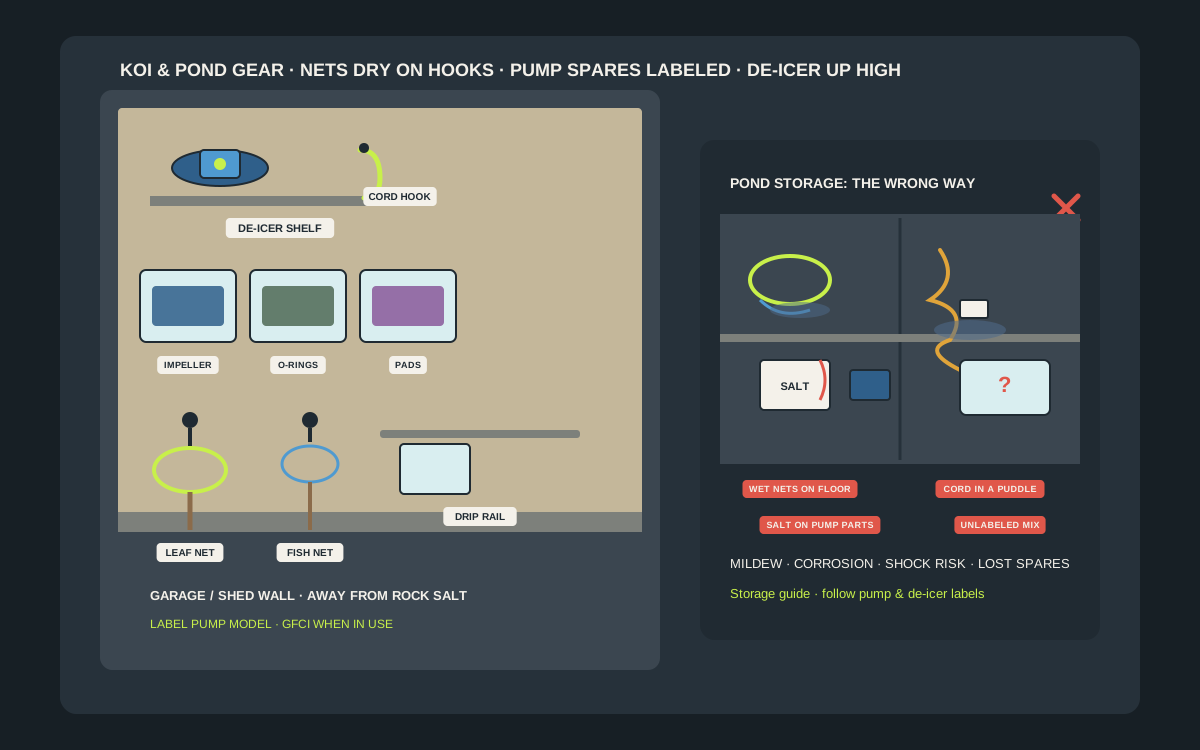
Open the shed after a week of autumn leaves and the story is usually the same: a coarse pond net tangled with a hose, a fine fish net crushed under a bag of ice melt, spare pump O-rings lost in a coffee can and a floating winter de-icer buried behind the mower with its cord in a puddle. A backyard koi or garden pond runs on a short list of outdoor tools that deserve a real wall home in the garage or shed. This guide is that wall station under $50: hooks for nets that can drip dry, labeled bins for spare pump and filter parts, and a high shelf for the de-icer with its cord coiled off the floor. It is not the indoor aquarium rack that holds airline tubing and test kits beside a glass tank. Those guides live on this site too, and they are linked below. Here you will see how to hang outdoor pond nets, how to keep wet-end spares sorted by pump model, where a floating de-icer should live from spring through fall, and why rock salt and brine belong on a different wall from pond metals. It is storage guidance for hobby ponds, not veterinary or electrical advice: follow the labels on your pump and de-icer, and ask a licensed electrician if a cord, outlet or GFCI looks wrong.
Shop pond nets, de-icers and storage on Amazon
Who this is for
- Homeowners with a backyard koi or garden pond who store nets, pump parts and a winter de-icer in the garage or shed
- Anyone whose leaf net currently lives on the floor, behind the mower or tangled with a hose
- Pond keepers heading into freeze season who need the de-icer easy to find and the cord undamaged
- Households that also store ice melt and want pond metals kept away from brine and rock salt
Quick answer
For most backyard ponds, the best under-$50 wall storage is a stud-mounted hook rail for the leaf net and fish net, two or three labeled wall bins for dry spare pump and filter parts, and a high shelf for the floating winter de-icer with its cord coiled on a separate hook. Hang nets to dry after every skimming so they do not mildew. Keep spare impellers, O-rings and pads in their own bin by pump model. Store the de-icer indoors off-season and keep rock salt and ice melt on a different shelf, because brine corrodes metal fittings and is a pet hazard if bags tear. A floating de-icer is meant to keep a small ice-free hole for gas exchange in winter, not to heat the whole pond; follow the maker’s wattage and GFCI guidance. Check ratings, sizes and current prices on the listing before you buy.
Quick picks
- Best overall: a stud-mounted utility-hook rail for pond nets plus two or three labeled wall bins for dry spare pump and filter parts, with a high shelf for the floating winter de-icer and a separate hook for its cord.
- Best for winter: a dedicated high shelf for the de-icer, thermostat and spare fuse, with the power cord coiled on a nearby hook so it never sits in a puddle when you pull it out in January.
- Best for pump spare parts: shallow lidded bins screwed or hung on the wall, labeled by pump model, holding the impeller, O-rings, seals and a spare filter pad so a mid-season failure does not mean a scramble.
- Best for nets: two deep vinyl-coated hooks or a short rail that hold the coarse leaf net and the fine fish net separately, hung to dry after every use so they do not mildew or tangle.
- Best for a shared garage: a clear vertical zone next to the garden tools, with a painted outline or a short French-cleat board so pond gear never migrates onto the ice-melt shelf or the car-wash shelf.
- Best add-on: a laminated card on the wall with the pump model, the de-icer wattage and a short winter checklist, so anyone in the house can find the right part without guessing.
Quick comparison
| Setup | Best for | How it holds | Trade-off |
|---|---|---|---|
| Pair of vinyl-coated utility hooks | Leaf net and fish net | Hoops hang to dry on stud-mounted hooks | Need studs; measure wet net weight |
| Short broom or tool rail | Several nets and a skimmer head | Rails hold multiple handles in a row | Leave space so poles do not block the door |
| Lidded wall bins | Spare impellers, O-rings, pads | Dry parts stay sorted by pump model | Do not store wet pads in a sealed bin |
| High shelf for floating de-icer | Off-season de-icer storage | Bulky unit sits flat with cord on a hook | Shelf must be rated for the unit weight |
| Cord wrap or large hook | De-icer and pump power cords | Keeps plugs off the floor and out of puddles | Coil loosely; do not kink the cord |
| Open drip rail or towel bar | Wet nets and rinsed pads | Lets gear dry before it goes into bins | Needs a drip tray or floor that can take water |
| French-cleat board for the zone | Shared garages with many hobbies | Whole pond station moves as one board | Takes an evening to build; still under $50 in pine |
| Floor pile next to ice melt | Not for pond gear | Bags and nets share a corner | Mildew, corrosion, tangled cords, pet risk |
Pond nets and skimmersFloating pond de-icersWall bins and utility hooks
What to look for
Hooks deep enough for wet nets
A pond leaf net with a telescopic pole is longer and heavier when wet than an aquarium hand net. Choose vinyl-coated utility or broom hooks deep enough for the hoop and rated well above the wet weight, screwed into studs rather than drywall anchors alone. Hang the fine fish net on its own hook so the meshes do not tangle.
Dry, labeled bins for pump spares
Spare impellers, ceramic shafts, O-rings, seals and filter pads fail the day the pump stops, not the day you remember to order them. Shallow lidded wall bins keep those parts dry, off the floor and sorted by pump model. Write the model number on the bin front in large letters.
A dedicated home for the winter de-icer
A floating pond de-icer is bulky, has a long power cord and often includes a thermostat. It needs a high, dry shelf in the garage or shed from spring through fall, and a hook for the coiled cord so the plug never sits in a puddle. When winter arrives, the whole kit should come off that shelf in one grab.
Separation from ice melt and rock salt
Rock salt and ice-melt brine corrode metal pump fittings and are unsafe if pets or wildlife get into a torn bag. Keep pond metals and cords on a different wall section from the ice-melt shelf, with a clear gap so a leaking bag cannot drip onto O-rings or a de-icer plug.
Room to dry before you store
Nets, pads and anything that has been in pond water should drip dry before they go into a closed bin. A short towel rail or open hook under the net rail gives wet gear a place to hang overnight without soaking the labeled spare-parts bins.
Labels a guest can read
Write the pump model, the de-icer wattage and a one-line winter checklist on a card taped to the wall. When you are away, anyone covering the pond should know which bin holds the impeller and which hook holds the leaf net.
Outdoor pond gear is not aquarium kit storage
Different tools, different wall
An indoor aquarium station holds airline tubing, small nets, test kits and bottles of water conditioner on a splash-aware rack near the tank. A koi or garden pond station holds a long leaf net, a fish net, spare pump wet ends, filter pads and a floating de-icer that may weigh several pounds. Mixing the two on one shelf buries the outdoor gear and puts wet pond tools next to dry airline clips they will soak. Keep the rooms honest: tank gear by the tank, pond gear by the yard door.
Why the garage or shed is the right room
Pond nets drip, filter pads smell after a skim and a de-icer cord is long. A garage or shed wall near the back door or the gate to the yard keeps muddy water out of the house and puts the tools on the path you already walk when you skim the pond. Choose a dry wall section, not the strip under a leaky roof edge, and leave walking space so a car door cannot smash a hanging hoop every time someone parks.
Link the aquarium guides without repeating them
If you also keep an indoor tank, use the aquarium supply rack and aquarium net holder guides on this site for that gear, and keep this wall for outdoor pond tools only. The habits are related: hang nets to dry, label parts, keep cords neat. The products, the splash pattern and the room are different, which is why the two article clusters stay separate.
What does not belong on this wall
Bulk fish food, medications, water-test reagents that belong indoors, and bags of rock salt or ice melt all need other homes. Food stays sealed and dry away from heat. Medicines follow veterinary guidance. Ice melt gets its own low shelf by the man-door, away from pond metals, which is the same separation our ice-melt storage guide argues for from the driveway side.
Pond nets: hang them so they dry
Coarse leaf net versus fine fish net
Most pond keepers need both. The coarse leaf net or skimmer pulls floating leaves and duckweed without scooping fish. The fine fish net is for moving koi or goldfish when you must. Hang them on separate hooks so the fine mesh does not snag on the coarse hoop, and so each one can drip dry after use without staining the other.
Hooks that fit a wet hoop
A wet leaf net with a telescopic pole is awkward and heavier than it looks. Two deep vinyl-coated utility hooks, or a short rail with Y-hooks, screwed into studs will hold the hoop and let the pole hang beside it. Measure the hoop diameter and the wet weight before you buy, and choose a rating with comfortable margin. Drywall anchors alone are a poor plan for a swinging wet net.
Dry before you coil
After skimming, hang the net open on its hook until it is dry to the touch. Coiling a wet net into a bin traps moisture and invites mildew and odors that transfer to spare filter pads. A towel on a rail under the hooks catches drips overnight and keeps the floor from becoming a skating rink in January.
Telescopic poles
If your net head comes off a telescopic pole, hang the pole on its own long hook or broom clip so it does not spear anyone walking past. Collapse it fully, wipe grit from the sections and keep it off the floor where it can roll under a car or trip a guest carrying groceries.
Skimmer heads and replacement bags
Some leaf tools use a replaceable mesh bag on a rigid head. Store clean spare bags flat in a labeled bin and hang the head to dry the same way you hang a net. A wet bag sealed in plastic is a smell you will regret in spring.
Spare pump and filter parts on the wall
What to keep on hand
For a typical external or submersible pond pump, a spare impeller or wet-end kit, the matching ceramic shaft if the design uses one, a set of O-rings and seals, and at least one clean filter pad or foam of the right size will cover most mid-season failures. Check your pump manual for the exact part numbers and write them on the bin. Guessing at a garden center on a holiday weekend is how you buy the wrong wet end twice.
Why wall bins beat a drawer
A labeled wall bin at eye level is faster than a mixed drawer under a workbench when the pump has stopped on a warm Saturday. Shallow bins also keep you from burying an impeller under hoses and hose clamps. Use clear or translucent fronts so you can see that the spare is still there without opening every lid.
Keep parts dry and away from brine
O-rings and seals store best clean, dry and out of direct sun. Keep them away from ice-melt bags and from any shelf that gets road-salt drip in winter. Salt brine accelerates corrosion on metal pump housings and fittings if it reaches them, and a white crust on a spare clamp is a hint the wall layout needs a rethink.
Filter pads and media
Store clean, dry spare pads flat in a lidded bin. Used pads that you plan to rinse and reuse should hang on the drip rail until dry, then go into a separate bin marked used-clean. Never seal a soaking pad in a closed bin overnight; the smell migrates into the dry spares beside it.
One bin per pump model
If you run more than one pump, or you have upgraded models over the years, give each model its own bin. Mixing impellers across models is how the wrong wet end ends up in the wrong housing on a cold morning when your hands are already numb.
Hose clamps, unions and a short bits kit
A small zip bag of stainless hose clamps, a spare union gasket and a short length of matching tubing belongs in the same zone, not loose in a coffee can. Label the bag with the tubing diameter so you do not grab irrigation drip parts by mistake.
Winter de-icers: storage, use and safety
What a floating de-icer is for
A floating pond de-icer is designed to keep a small ice-free opening so gases can exchange between water and air when the surface freezes. Pond-keeping and extension guidance commonly stresses that fish still need dissolved oxygen under ice, and that a sealed ice cap can trap harmful gases. A de-icer is not a heater meant to warm the whole pond, and it is not a substitute for a properly sized winter aeration plan if your climate and stocking need one.
Off-season shelf
From spring thaw through late fall, store the de-icer on a high, dry shelf in the garage or shed. Coil the cord loosely on a hook beside it, with the plug end up and visible. Wipe the float and thermostat housing dry before storage so you are not sealing pond water into a carton that will smell until November.
Electrical common sense
Pond de-icers are often high-wattage appliances with long cords used outdoors near water. Use a GFCI-protected outlet as the maker directs, inspect the cord for cuts before every season and never let the plug sit in a puddle on the garage floor. If anything about the outlet, cord or thermostat looks damaged, stop and get help from a licensed electrician rather than improvising with tape and a splitter.
Never use automotive antifreeze in a pond
Automotive antifreeze that contains ethylene glycol is toxic to pets, wildlife and fish. Pond and extension guidance is blunt: do not pour it into a water garden to keep ice open. A purpose-made floating de-icer or a carefully planned aeration setup is the equipment answer this guide covers; chemical shortcuts belong nowhere near koi.
Thermostat and spare fuse
Many floating de-icers include a thermostat so the element runs only when needed. Keep any spare fuse or thermostat that shipped with the unit in the same wall bin as the pump spares, labeled de-icer, so it does not vanish into a junk drawer between seasons.
Staging before the first hard freeze
A week before your usual freeze date, move the de-icer from the high shelf to a staging spot by the door, test the GFCI, and walk the cord path so it will not be pinched by a gate. Putting that ritual on the wall checklist turns a frantic night into a ten-minute job.
Keep ice melt and pond metals apart
Why brine is a problem on this wall
Ice-melt and rock-salt brine are hard on metal pump fittings, hose clamps and de-icer hardware, and a torn bag is a pet hazard in a garage where dogs walk through. Our ice-melt storage guide covers how to keep bags sealed and off the floor for driveway use. On the pond wall, the rule is simpler: give salt its own zone and do not let the two hobbies share a shelf because it looks tidy in a photo.
A clear gap between zones
Put pond nets, pump bins and the de-icer on one stud bay or French-cleat board, and put ice melt on a low shelf by the man-door on another wall. A painted line or a short gap of empty wall is enough to stop a leaking bag from dripping onto O-rings.
Pets and wildlife
Dogs will lick salt brine off a garage floor. Keep bags sealed, wipe spills and do not store open salt beneath hanging pond nets where grit can fall into a bag. If a pet ingests ice melt, contact a veterinarian or a pet poison resource right away.
Shared winter tools
Snow shovels and ice scrapers can hang near the ice-melt shelf. Pond nets should not. Keeping winter driveway tools and winter pond tools on opposite sides of the garage prevents the wrong grab on a dark morning when you meant to free the walk, not skim a hole in the ice.
Building the wall station under $50
Find two or three studs
Use a stud finder or tap-and-measure on a 16-inch layout. Most of the load from wet nets and a de-icer shelf should land on screws into studs. Mark the studs with painter tape while you hang hardware so you do not lose them behind a French-cleat board.
Layout from top to bottom
High shelf for the de-icer and a card with wattage and checklist. Mid-wall for lidded spare-parts bins. Net hooks at a height where you can hang a dripping hoop without it hitting the bins. Drip rail or towel bar below the nets. Cord hook beside the de-icer shelf. That order keeps water falling past dry parts instead of onto them.
Hardware that earns its keep
Vinyl-coated utility hooks, a short rail, two or three plastic or steel wall bins with lids, a simple shelf bracket set and a pack of wood screws will usually land under $50 if you already have a drill and a level. Skip decorative shelves that cannot take a wet net and skip adhesive hooks for anything heavier than a dry towel.
A French-cleat board option
If the garage wall is crowded, screw a pine French-cleat board into studs and hang the hooks and bins from cleats. The whole pond station can then move as one piece when you reorganize, which is useful in a shared space where bikes and holiday bins migrate every month.
Label everything the day you hang it
Bin fronts, hook rails and the de-icer shelf all get large, waterproof labels. Add the pump model, the spare part names and a winter line such as de-icer out before first hard freeze. Future you, wet and cold, will thank present you.
Choosing hooks, bins and shelves that survive wet gear
Coatings beat bare steel for nets
Vinyl-coated or rubber-padded hooks protect net hoops and keep wet metal from staining the wall. Bare steel works in a pinch but rusts faster in a damp shed and can snag fine mesh. If you already own bare hooks, a short length of clear tubing slid over the contact point is a cheap fix.
Lid and depth for spare parts
Choose bins deep enough for an impeller in its bag and shallow enough that you see the bottom at a glance. A lid keeps drywall dust and lawn debris out of O-ring packages. Write the part name on the lid and the front so a bin pulled halfway out still reads correctly.
Shelf rating for the de-icer
Weigh your de-icer or check the package weight, then pick shelf brackets rated above that number when mounted into studs. A floating de-icer with a long cord is an awkward, concentrated load, not a box of feathers, and a sagging shelf is how the unit slides toward the edge.
Leave walking space
Nets and poles stick out. Mount the rail where a car door, a bike or a lawn mower will not hit them every time someone enters. A corner bay or the wall beside a man-door is usually safer than the main parking stall wall.
Seasonal routine for a backyard pond wall
Spring
Take the de-icer down only after ice is gone and nights are reliably above freezing for your area. Inspect the cord, clean the float, and put the unit back on its high shelf with the cord coiled. Restock any impeller or O-ring you used over winter and wipe salt film off nearby hooks.
Summer
Hang nets to dry after every heavy leaf fall. Check that spare pads are still clean and dry. Keep the wall clear of hoses and holiday décor so the station stays usable during algae blooms and heat waves when pumps work hardest and failures are most annoying.
Fall
Before leaf drop peaks, confirm the leaf net and telescopic pole are ready. Before the first hard freeze, move the de-icer to a staging spot by the door, test the GFCI, and refresh the wall checklist. Order any missing spare parts while shipping is still easy and not stuck in holiday backlogs.
Winter
With the de-icer in the pond, the wall holds the empty shelf label, the spare fuse and the nets you still use for snow-free days. Do not store rock salt on the empty de-icer shelf just because it is open; that is how brine and pond metals meet.
Water, electricity and common-sense limits
This guide stops at storage
Mounting hooks and bins is straightforward carpentry. Anything about outdoor outlets, buried cable, pond bonding or GFCI troubleshooting belongs with a licensed electrician. If a cord is cut, a plug is hot or an outlet trips repeatedly, stop and get help.
Fish health is veterinary territory
Storage habits help you find nets and spares quickly. Diagnosing sick koi, dosing treatments or choosing winter aeration for a specific stocking level is a conversation with a veterinarian or a qualified pond professional, not a wall-storage article.
Follow the product label
Pump manuals list the wet-end kits that fit. De-icer manuals list wattage, thermostat behavior and outdoor-outlet rules. When the label and a blog disagree, the label wins, including this one.
Children and curious pets
Hang small parts high enough that a child cannot empty an O-ring bag onto the floor, and keep any pond treatments that are unsafe for pets in a locked cabinet elsewhere. The wall station is for tools and dry spares, not chemicals.
Three sample garage and shed layouts
The one-car garage corner
One stud bay beside the back door: high shelf for the de-icer, two wall bins for pump spares, two coated hooks for nets and a towel bar below. Ice melt stays on the opposite wall by the man-door. Total hardware cost stays under $50 with basic hooks and bins, and the path to the yard stays clear.
The garden shed
A short French-cleat board on the wall nearest the pond gate holds the same kit in a tighter footprint. Hang the telescopic pole vertically beside the door so it does not block shelves of potting mix. Keep fertilizers and chemicals on a different board so a spill cannot reach the spare O-rings.
The shared family garage
Paint a simple outline or hang a labeled pegboard section marked pond so bikes, sports gear and holiday bins stop migrating into the zone. Put the checklist card at adult eye level and a spare carabiner on the net hook for a quick hold when both hands are wet.
Why a wall beats a tote under the bench
Visibility when something fails
A pump that stops on a Saturday afternoon needs a spare you can see without emptying a tote. Wall bins at eye level turn a ten-minute hunt into a thirty-second grab, which matters when fish are waiting on circulation.
Drying space you will actually use
A tote invites you to stuff a wet net on top of dry pads. A hook and a drip rail make the right habit the easy habit, which is the whole point of a station that has to survive a busy household.
Kids, guests and the labeled card
When someone else covers pond chores, a labeled wall with a checklist card is kinder than a verbal tour of three unmarked boxes. Write the pump model once and leave it where wet hands can still read it.
Resale and moving day
Hooks and bins on a French-cleat board come off cleanly when you move, and the same layout reconstitutes in the next garage. A mixed tote of mildewed nets does not travel as well.
How to set it up in an afternoon
- Pick a dry garage or shed wall near the yard door, away from the ice-melt shelf and any leaky roof edge.
- Find two or three studs and mark them with painter tape at shelf height, bin height and net-hook height.
- Weigh the de-icer and a wet leaf net if you can, and buy hooks, bins and shelf brackets rated above those loads.
- Mount the high shelf first, then the cord hook, then the wall bins, then the net hooks, then the drip rail.
- Label every bin with the pump model and part name, and tape a winter checklist card under the de-icer shelf.
- Hang clean nets to dry, load dry spares into bins and set the wiped de-icer on the shelf with the cord coiled.
- Move ice melt and rock salt to their own low shelf if they currently share this corner.
- Walk the path from the door to the pond with the leaf net in hand to confirm nothing snags.
- Set a phone reminder for a week before your usual first freeze to stage the de-icer and test the GFCI.
Mistakes to avoid
- Coiling a wet pond net into a closed bin where it mildews and stinks up the spare pads.
- Storing the floating de-icer on the floor with the plug in a puddle all summer.
- Keeping rock salt bags on the same shelf as pump O-rings and metal fittings.
- Mixing spare impellers from different pump models in one unlabeled coffee can.
- Hanging outdoor pond nets on the indoor aquarium airline rack where they soak dry clips.
- Pouring automotive antifreeze into a pond to keep a hole in the ice.
- Trusting adhesive hooks with a wet leaf net or a de-icer that weighs several pounds.
- Leaving the wall unlabeled so a guest cannot find the spare impeller when the pump stops.
Keeping the station honest through the year
Restock when you use a spare
The week you install a spare impeller is the week you reorder one. An empty bin with a label is a trap for next season, especially if the part has a long shipping lead time.
Wipe salt and mud off the wall
After winter, wipe hooks and shelf brackets so brine film does not sit on hardware all summer. A damp cloth and a dry follow-up are enough for most garages.
Revisit the checklist every fall
Update the wattage, the pump model and the date you last tested the GFCI on the wall card. A two-minute edit prevents a frantic search in the first cold snap.
Photograph the station once
A phone photo of the labeled wall helps you reorder the same bins and hooks later, and it helps a house-sitter understand the layout without a long explanation.
Related guides
Browse the hub: Pet gear wall mounts under $50 - all guides
- Best Aquarium Supply Wall Racks Under $50
- Best Aquarium Net & Tool Wall Holders Under $50
- Best Ice Melt and Rock Salt Storage Shelves Under $50 for Garage Walls
- Best Backyard Chicken Supply Wall Racks Under $50 for Garage & Shed
- Best Aquarium Airline Tube Wall Clips Under $50
- Best Aquarium Thermometer & Test Kit Wall Clips Under $50
FAQ
Where should I store pond nets when I am not using them?
Hang them on deep vinyl-coated hooks or a short rail in the garage or shed until they are dry, then leave them hanging so air can move through the mesh. Do not coil a wet net into a closed bin, and keep nets off the floor where they mildew and tangle.
What spare pump parts should stay on the wall?
A spare impeller or wet-end kit for your exact pump model, matching O-rings and seals, and at least one clean filter pad cover most failures. Label the bin with the pump model and part numbers from the manual.
How should I store a floating pond de-icer in summer?
Wipe it dry, set it on a high shelf indoors in the garage or shed, and coil the cord loosely on a nearby hook with the plug visible. Inspect the cord before the next winter and use a GFCI-protected outlet as the maker directs.
Can I use automotive antifreeze to keep a hole in the pond ice?
No. Antifreeze that contains ethylene glycol is toxic to pets, wildlife and fish. Use a purpose-made floating de-icer or another method your pond professional recommends, never automotive antifreeze.
Why keep ice melt away from pond pump parts?
Salt brine corrodes metal fittings and is unsafe if pets get into a torn bag. Store ice melt on a separate low shelf by the door, and keep pond bins and the de-icer on a different wall section.
Is this the same as aquarium supply wall storage?
No. Aquarium racks hold indoor airline tubing, small nets and test kits near a tank. This station is for outdoor pond nets, spare pump parts and winter de-icers in a garage or shed. Use both setups if you keep both kinds of fish.
Bottom line
The best under-$50 koi and garden pond supply wall is a dry garage or shed station with a hook rail for nets, labeled bins for spare pump and filter parts, and a high shelf for the floating winter de-icer with its cord coiled off the floor. Hang nets until they dry, keep brine and rock salt on another wall, and never pour automotive antifreeze into a pond. Label the pump model and the de-icer wattage on the wall so anyone covering for you can find the right part. Check ratings, sizes and current prices on the listing before you buy.