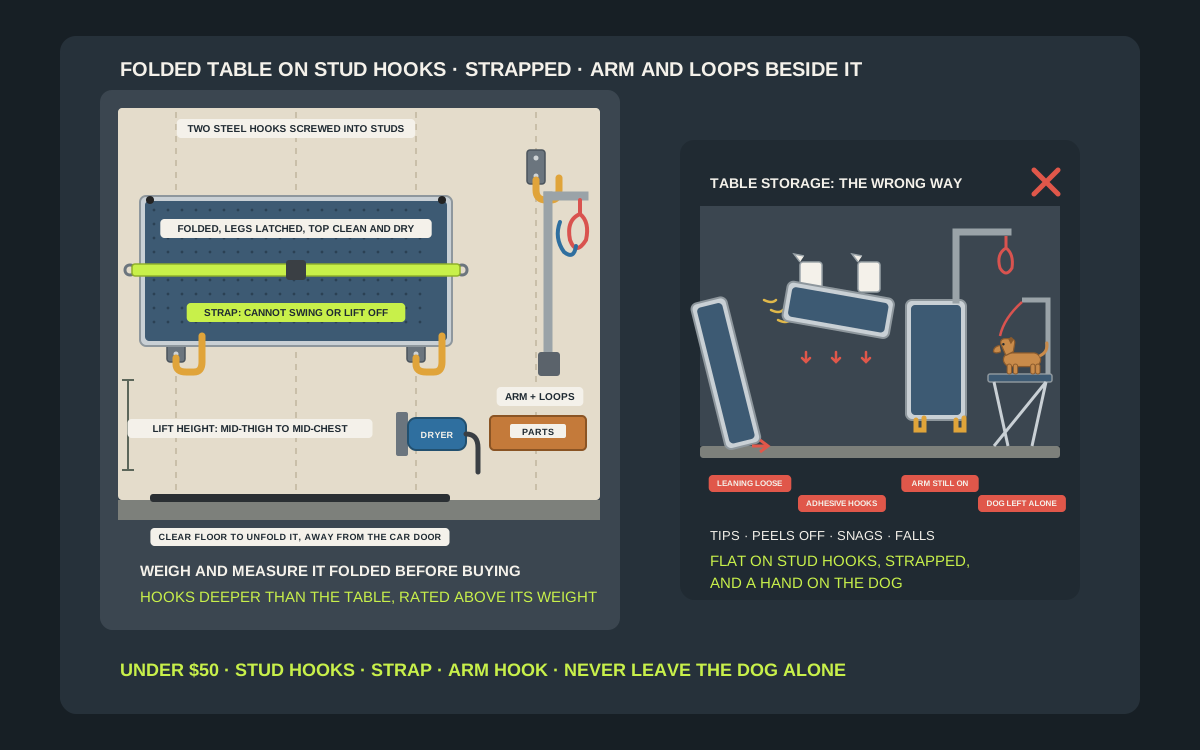
A folding grooming table is the best back-saver a home groomer can buy, and the most awkward thing in the garage the moment the dog is done. Folded, it is a slab of laminated board and steel tube about three to six inches thick and as long as a big dog, and most models weigh somewhere between the low twenties and the mid thirties in pounds. Leaned against the wall it slides, tips into the car door or traps a foot. Laid flat on the floor it collects water, hair and everything else that gets put on top of it. Shoved behind the freezer it is so hard to get out that the next nail trim happens on the kitchen floor again. A wall spot fixes all of that for the price of two good hooks and a strap. Two heavy steel hooks screwed into studs, set at a height you can lift to without straining, hold the folded table flat and still; a strap stops it from swinging; and a third hook next to it keeps the grooming arm and loops together so setup takes a minute instead of a search. This guide covers which under-$50 hangers suit a folding grooming table, how to measure your table before you buy, how to mount the hooks so they hold, how high to hang it so lifting it on and off the wall is safe, how to clean and dry it before it goes up, and the table-safety habits a tidy grooming corner makes easy, using published specifications from table makers, lifting guidance from OSHA and safety advice from professional grooming and veterinary sources.
Shop heavy-duty garage hooks on Amazon
Who this is for
- Home groomers who use a folding table in the garage, laundry room or mudroom and need it out of the way between sessions
- Owners whose table currently leans against a wall, lies on the floor or lives behind the car
- Anyone setting up a small grooming corner next to a dryer and a dog wash station
- Owners of large or double-coated dogs who groom often and want setup to take a minute, not ten
- Renters and homeowners who want a solid, removable hanger rather than adhesive hooks
Quick answer
For most folding grooming tables, the best hanger is a pair of heavy-duty steel utility or ladder hooks screwed into two studs, with a strap around the folded table so it cannot swing or lift off. Weigh and measure the table folded before you buy: you need hooks deep enough for its folded thickness, rated well above its weight, and spaced so the table rests near its ends. Hang it with the legs folded and latched, the arm and loops removed and stored on their own hook, and the bottom edge low enough that you lift between mid-thigh and mid-chest rather than over your head. If your garage already has a track rail, ladder hooks on the rail do the same job. Adhesive hooks are not made for this: a Command Jumbo hook is rated for 7.5 lb, far less than a folded table weighs. Clean and dry the table top first, and keep the corner near your dryer and wash station so the whole routine lives in one place.
Quick picks
- Best overall: Two heavy-duty steel utility hooks, screwed into studs, with a strap across the table. Simple, strong and cheap, and the folded table hangs flat and still.
- Best for a track-rail garage: Ladder hooks on an existing rail, such as the Rubbermaid FastTrack ladder hook, which Rubbermaid rates at up to 50 lb and which can also screw straight to the wall.
- Best for a narrow wall: A vertical slot between two studs: the table stands on end on a rubber mat with two hooks or a strap holding it to the wall, so it takes little more width than its folded thickness.
- Best for the arm and loops: A single deep hook or a short hook rail beside the table, so the clamp-on arm, the loops and any haunch holder stay with the table.
- Best add-on: A heavy-duty hook-and-loop or buckle strap around the table and hooks, so a bump from the car or a dog cannot knock it off.
- Not recommended: Adhesive hooks, a single nail, or hanging the table by its arm or clamp. None of them is meant to carry a folded table’s weight.
Quick comparison
| Hanger | Best for | How it holds | Trade-off |
|---|---|---|---|
| Pair of steel utility hooks | Most tables, any garage wall | Folded table lies across two hooks screwed into studs | You need to find studs and buy screws if none come in the box |
| Ladder hooks (wall or rail) | Long tables, track-rail garages | Long, padded arms cradle the table flat | Check the rated load and that the arms are deeper than the table |
| Track-rail utility hooks | Garages that already have a rail | Hooks slide on the rail to fit the table length | Rail itself must be screwed into studs per its instructions |
| Vertical slot with strap | Narrow walls, tall tables | Table stands on end, strapped to wall hooks | Needs a mat on the floor and a wall clear of door swings |
| Padded bike-style hooks | Tables with a thin folded profile | Coated hooks hold the top edge | Shallow hooks may not fit a thick folded table |
| Storage strap with handle | Holding the table shut, carrying it | Strap wraps the folded table and hangs on a hook | A strap alone on one hook lets the table spin |
| Deep single hook or hook rail | Arm, loops, haunch holder | Arm and loops hang together beside the table | Keep loops off the floor and away from chemicals |
| Adhesive hooks | Not for the table | Adhesive strip on paint or tile | Rated far below a folded table; fine only for a towel |
Ladder hooksStorage strapsGrooming loops
What to look for
Rated load well above the folded table
Look up your table’s weight in its listing or manual before you shop. Published figures for common folding tables run from about 22 lb for a small 32-inch table to around 31 to 34 lb for a 36- to 48-inch model. Choose hooks rated comfortably above that, so two of them share the load with plenty of margin and remember that a rating only applies when the hook is mounted the way its maker describes.
Hook depth that fits the folded thickness
A folded grooming table is not flat like a cutting board. The legs fold against the underside, and the feet, hinges and leg braces stick out. Published folded thicknesses range from about 3.3 inches for one 48-inch table to around 4 to 6 inches for others. Measure your table at its thickest point with the legs latched, then buy hooks whose usable depth is greater than that.
Spacing that matches the table length
The table should rest on its two hooks near its ends, not balance on two hooks bunched in the middle. Measure the folded length, then pick two studs that put the hooks inside the ends by a few inches. On a 16-inch stud layout, a 36- to 48-inch table usually sits well on hooks in studs 32 inches apart.
A coated or padded contact surface
Bare steel can scratch a laminated top and wear through rubber feet. Vinyl-coated or rubber-padded hooks protect the table and stop it from sliding along the hook when the garage door rattles.
A way to stop it swinging
A folded table on two open hooks can lift off when a dog, a bin or a car door bumps it. A strap, a bungee with covered ends or hooks with an upturned tip keeps it in place. This matters more in a busy garage than in a quiet laundry room.
Room for the arm and loops nearby
Most folding tables come with a removable arm that clamps to the table edge and at least one grooming loop. A third hook or a short rail beside the table keeps those parts together, which is half the reason a grooming corner gets used.
Know your table before you buy a hanger
Weigh it, folded
The quickest way is to stand on a bathroom scale holding the folded table and subtract your own weight. Makers’ figures give a feel for the range. VEVOR lists its small GT-202 table, with a 31.8 by 18.1 inch top, at about 22 lb. Yaheetech gives a net weight of 29.5 lb for its 36-inch table. PARPET lists 31.5 lb for its 47.5 by 24 inch table, and Go Pet Club lists its 36-inch GT-102 at about 32 lb. A bone-shaped 36-inch Master Equipment table is listed at 33.6 lb. AEOLUS lists its FT-811 at 10.7 kg and its larger FT-813 at 14.8 kg. In practice, most home tables weigh about as much as a big bag of dog food, and that is what the wall has to hold.
Measure the folded size
Measure the length, width and thickness with the legs folded and latched. Folded sizes vary more than you might expect. PARPET says its 47.5-inch table folds to 3.3 inches thick with the legs flat against the top. AEOLUS lists all three of its FT-81x tables at 10.5 cm folded. Master Equipment’s 36-inch Superior Stainless table is listed at 38.75 by 27.1 by 4.75 inches, and its bone-shaped 36-inch table at 37.5 by 24.5 by 6.3 inches. Write the three numbers down. The thickness tells you how deep the hooks must be, the length tells you how far apart they go, and the width tells you how far the table will stick out from the wall.
Find the handholds
Look at where your hands naturally go when you carry the folded table. Most goal-post-leg tables have a solid edge on each long side and the leg tubes underneath. Hang the table so the edge you grab faces you, and so you can lift it off with both hands close to your body without reaching around a shelf or a dryer.
List the parts that come off
Master Equipment ships its tables with a clamp-on arm made from 3/4-inch square steel and an 18-inch loop; the arm is 36 inches on its 30- and 36-inch tables and 48 inches on its 42- and 48-inch tables. PARPET includes a 48-inch arm and a 20-inch noose, and says its clamp fits tables up to 1.55 inches thick. Yaheetech’s 36-inch table adds a tool shelf rated for 22 lb, and Flying Pig’s tables include a storage basket. Every one of those parts needs a home, or it ends up on the floor.
Hanger types, side by side
Heavy-duty steel utility hooks
This is the default. Two coated steel hooks, each screwed into a stud, hold the folded table flat against the wall with the top facing out. They cost little, they work on drywall over studs, plywood or a French cleat board, and they can be moved later. Choose hooks with a long, flat or slightly upturned arm rather than a small J, so the table sits on a broad surface and does not rock.
Ladder hooks
Ladder hooks are made for long, heavy, flat-sided loads, which is exactly what a folded table is. The Rubbermaid FastTrack ladder hook, for example, is steel with a soft-grip coating, is rated by Rubbermaid to hold up to 50 lb, and can hang on a FastTrack rail or screw directly to the wall. Two of them make a stable cradle. Check the arm depth against your table’s folded thickness before you buy, because ladder rails are thinner than some tables.
Track-rail hooks
If you already have a track rail screwed along a garage wall, the table can share it. Put two utility or ladder hooks on the rail at the right spacing, hang the table and add a strap. The advantage is that you can slide the hooks to fit a new table later. The rail has to be installed into studs as its maker describes, because the rail carries everything hanging on it.
A vertical slot
On a narrow wall between a door and a corner, the table can stand on its end on a rubber mat, legs folded, with its face against the wall. Two hooks or eye screws in a stud hold a strap around the top half so it cannot tip forward. This uses the least wall width and needs almost no lifting, but the floor under it has to stay dry, and it must sit well clear of any door swing.
Padded bike-style hooks
Large vinyl-coated bike hooks can hold a table with a thin folded profile by its top edge, with the bottom edge resting on a mat. They are cheap and easy to fit, but most are not deep enough for a thick table, and a single hook lets the table pivot. Use them only in pairs and only if your table is thin.
Storage straps
A heavy-duty strap with a handle wraps around the folded table and holds the legs shut. Hung on a single hook it is handy for a light table in a closet, but a single point lets the table spin and swing. In a garage, use a strap to secure the table on two hooks rather than as the only support.
Mounting the hooks so they hold
Screw into studs
Hook ratings assume a solid mount. Use a stud finder or tap-and-probe to find two studs at the right spacing, mark their centers and drive the screws supplied, or the size the hook maker recommends, into the middle of each stud. In most framed walls studs are 16 inches apart on center, so for most 36- to 48-inch tables a pair of hooks two studs apart, about 32 inches, leaves the table resting a few inches inside each end. A small 30-inch table may sit better on studs 16 inches apart. Drywall anchors alone are a poor choice for a load you will lift on and off every week, because each lift pulls and twists the fasteners.
Masonry and block walls
On concrete or block, use the masonry anchors and drill bit the hook maker specifies rather than plastic plugs meant for picture hooks. A short board fixed to the masonry first, then the hooks screwed to the board, makes it easier to place the hooks exactly where you want them.
Why adhesive hooks are out
Adhesive hooks are rated for steady, light loads hung gently. 3M rates the Command Jumbo utility hook at 7.5 lb, which is less than a quarter of what many folded tables weigh, and every time you lift the table off you would be prying at the adhesive. Keep adhesive hooks for a towel or a light brush caddy nearby, not for the table.
Add a strap and bumpers
Once the table hangs, run a strap around the table and both hooks, or from one eye screw to another across the table face, so it cannot be bumped off. Stick a couple of felt or rubber bumpers to the wall where the feet or the table edge touch, so wet paint and drywall do not wear through. Check that nothing sticks out into the path of a car door, a bike handlebar or a person carrying a laundry basket.
Hanging height and safe lifting
Hang it in your power zone
OSHA’s guidance on heavy lifting describes a power zone from about mid-thigh to mid-chest, and advises against starting a lift below mid-thigh or ending one above shoulder height. Set the hooks so the folded table hangs with its lower edge near your knees or a little above, and its top edge below your shoulders. Then lifting it on and off the hooks happens where your body is strongest, not at arm’s length over your head.
Keep it close and turn with your feet
OSHA also recommends keeping the load as close to your body as possible, bending at the knees rather than the waist, and turning by moving your feet instead of twisting your torso. With a folded table that means facing the wall, gripping both long edges, pulling the table toward you off the hooks, and then stepping round to carry it, not swinging it sideways.
Two people for big tables
A large stainless or bone-shaped table can weigh well over 30 lb and is long and awkward, which makes it harder to carry than its weight suggests. If yours is a 42- or 48-inch model, or if you have a sore back, hang it lower or ask someone to help, and keep the path between the wall and the grooming spot clear.
Leave space to unfold
Hang the table where there is room to open it on the spot: at least its own length of clear floor in front of the wall. Unfolding the legs right below the hooks means you carry the table only a step or two, and you can set it up next to the outlet for your dryer and clippers.
Storing the arm, loops and small parts
Take the arm off before hanging
A clamped-on arm sticks out several feet, catches on everything and puts a lever on the table edge. Loosen the clamp, lift the arm off and hang it on its own deep hook beside the table, upright or across two hooks. On an adjustable arm, tighten the knobs again so they do not fall out.
Loops on the same hook
Hang grooming loops on the arm or on a hook right next to it, never on the floor or in a bucket with shampoo. Look them over each time: a frayed nylon loop, a cracked clip or a worn slide is a reason to replace it, and spares are inexpensive. Keep at least one loop with a quick-release clip.
A small bin for the bits
Clamp knobs, spare feet caps, a haunch holder and the hex key that came with the table fit in a small wall bin or a zip bag clipped to the arm hook. Label it with the table model so you can find the right replacement parts later.
Tool shelf and baskets
If your table has a tool shelf or basket, empty it before folding. Brushes and clippers go back to their own wall holders, and the shelf or basket hangs with the table or on the arm hook. A loaded shelf adds weight and the contents can fall when the table is lifted.
Table safety a good grooming corner supports
Never leave the dog alone on the table
Kennelwood Pet Resorts, a pet care company with professional groomers, calls this the first rule: never leave an animal unattended on a grooming table, even for a moment; if you must step away, have someone else stay or take the dog off. Groomer to Groomer calls it the golden rule of grooming and lists falls from tables and tubs among the most common avoidable accidents. Hanging the table next to your tools and dryer means everything is within reach, so you never have to walk away.
Loops are for positioning, not for tying a dog up
Los Angeles County’s animal care standards for grooming businesses say tethering devices must have quick-release mechanisms and that grooming nooses must not be used as tethering devices. They also say dogs with a history of neck disc disease or a collapsed trachea must not be restrained in a way that puts pressure on the neck or inhibits breathing, and that grooming arms must be strong enough for the animal. Use a loop only while you are right there with a hand on the dog, choose one with a quick release, and ask your vet before using a neck loop on a dog with neck or airway problems.
Help the dog on and off
Kennelwood advises never letting a dog jump off the table without support and asking for help to lift a dog over about 45 lb, lifting with your legs and without twisting. A ramp or steps help with some dogs. If your dog is large, think about the lift onto the table as well as the lift of the table onto the wall.
Check the table every time it comes off the wall
The AKC’s national educational standards for professional dog grooming expect grooming tables to be safe, sturdy and in good working order, with a non-slip surface that is easy to clean, and expect groomers to check equipment before use. At home, that means checking that every leg latch clicks, the feet are all there, the top is not cracked or peeling and the arm clamp tightens before the dog goes up. A table that wobbles goes back on the wall until it is fixed.
Keep the floor and top clear of hair
Kennelwood also warns that hair on the floor, especially wet hair, is slippery for both people and dogs. Sweep or vacuum around the table during and after a session, and wipe the top before folding so hair and water are not trapped against the wall.
Where the table goes
Next to the dryer and wash station
The best spot is beside the rest of the grooming kit: the dryer on its wall mount, the brushes and clippers in their holders and the wash station if you have one. One short wall then covers wash, dry, brush and trim, and nothing has to be fetched while the dog waits on the table. A grounded outlet within reach of the table spot saves running extension cords across a wet floor.
Away from cars, doors and heat
Keep the table off the wall beside the driver’s door, out of the swing of the house door and clear of a water heater, furnace or space heater. A table that sticks out into a walkway will get knocked, and the laminated top does not like heat.
Garage, laundry room or mudroom
A laundry room or mudroom keeps the table drier and warmer, which is kinder to the top and to the dog in winter. A garage gives more room to work and an easier floor to clean. Either works if the wall is solid and the floor in front is clear.
Clean and dry it before it goes up
Brush, wipe, dry
Brush hair off the top, wipe it with a damp cloth and a mild cleaner that is safe for the surface, then let it dry fully before folding. Water trapped between a folded top and the wall is how mildew and swelling start, especially on boards with a wood or particle core.
Look after the hinges and feet
Wipe the leg hinges and latches when they get wet and check the rubber feet: Master Equipment describes its tables as having steel-reinforced rubber feet, and a missing foot makes a table rock and scratches the floor. Replace worn feet and tighten loose bolts before the table goes back on the wall.
Cover it if the garage is dusty
A light cotton sheet or a drawstring bag over the hanging table keeps sawdust and car grime off the top, so it is ready to use without a full clean each time.
Teaching the dog that the table is a good place
Start with treats and short sessions
VCA Animal Hospitals describes a grooming table with a rubber top as an ideal handling station for a puppy, and suggests lifting the puppy onto the table and feeding treats so it learns the table is a good place. The AKC also recommends keeping handling and grooming sessions short. A table that is quick to get off the wall makes those short, frequent sessions realistic.
A stable, non-slip top matters
Fenzi Dog Sports Academy notes that a grooming table saves your back and that whatever surface you use should be solid, stable and non-slip. A dog that slides or feels the table wobble will remember it. Check the top’s grip and the latches every session, and add a rubber mat if the original surface is worn.
Three sample setups
Two-car garage, one big dog
Two coated steel ladder hooks screwed into studs about 32 inches apart, the 36-inch table hanging face out with its lower edge at knee height, and a buckle strap across it. To the right, a deep hook holds the arm and two loops with a small bin of parts underneath, then the dryer on its mount and a towel hook. A rubber mat on the floor marks the spot where the table opens.
Laundry room, small dog
A small 32-inch table in a vertical slot between the dryer and the wall, standing on a rubber mat and held by a strap to two eye screws in a stud. The short arm and loop hang on a hook above it, and the brushes live in a wall holder by the sink. Setup takes a minute and the table never crosses the room.
Garage with a track rail
Two ladder hooks and one utility hook on the existing rail: the folded table on the ladder hooks, strapped, and the arm and loops on the utility hook. The hooks slide along the rail to fit a bigger table later, and the rest of the rail keeps the grooming kit together.
Setup steps
- Fold the table, latch the legs, remove the arm and loops, and empty any tool shelf or basket.
- Weigh the folded table and measure its length, width and thickness at the thickest point.
- Choose a wall near your dryer and outlet with clear floor in front, away from car doors, house doors and heaters.
- Find two studs that put the hooks a few inches inside each end of the table, and mark a height that keeps the lift between mid-thigh and mid-chest.
- Screw the hooks into the studs with the screws the maker specifies, or mount them on a rail that is screwed into studs.
- Add bumpers where the table touches the wall, then hang the table and check that it sits flat and does not rock.
- Fit a strap or upturned hook tips so the table cannot be bumped off, and test it with a firm push.
- Hang the arm and loops on their own hook beside the table, with a small labeled bin for clamp knobs and spare parts.
- Practice taking the table down, setting it up and hanging it back once without the dog, and adjust the hook height if any part of that feels like a strain.
Mistakes to avoid
- Leaning the folded table against the wall, where it slides, falls on a foot or gets knocked into the car.
- Hanging it on adhesive hooks or a single nail that were never rated for its weight.
- Hanging it by the arm or the clamp, or with the arm still attached and sticking out into the garage.
- Mounting the hooks so high that every lift ends above your shoulders.
- Buying hooks before measuring the folded thickness, then finding they are too shallow.
- Folding the table wet or covered in hair and hanging it with the top against the wall.
- Leaving loops, the arm or the parts bin on the floor, where they get lost or stepped on.
- Stepping away from the table for a moment while the dog is on it and in a loop.
Related guides
Browse the hub: Pet gear wall mounts under $50 - all guides
- Best Pet Grooming Dryer Wall Mounts Under $50
- Best Pet Grooming Tool Wall Holders Under $50
- Best Dog Wash Station Wall Organizers Under $50
- Best Pet Playpen Wall Storage Bags Under $50
- Best Dog Ramp Wall Hooks Under $50 for Garage Storage
- Best Ladder Wall Hooks Under $50 for Garage
- Affordable Garage Track Hooks Under $50: Best Rail Hooks
- Best Folding Chair Wall Hangers for Garages Under $50
- Hook Rail vs Individual Hooks for Garage Walls Under $50
- Best Folding Table Wall Hangers Under $50 for Garage (Holiday Hosting Tables)
FAQ
How much does a folding dog grooming table weigh?
It depends on size and material, but published figures for common home tables run from about 22 lb for a small 32-inch table to around 31 to 34 lb for 36- to 48-inch models. Weigh yours folded on a bathroom scale before buying hooks.
What kind of hooks should I use to hang a grooming table?
Two heavy-duty coated steel utility hooks or ladder hooks screwed into studs, deep enough for the table’s folded thickness and rated well above its weight, plus a strap so the table cannot swing or lift off.
Can I hang a grooming table with Command hooks?
No. Adhesive hooks are rated for light, steady loads; 3M rates the Command Jumbo utility hook at 7.5 lb, which is far less than a folded table weighs, and lifting the table off would pry at the adhesive every time.
How high should I hang the table?
Low enough that lifting it on and off stays in your power zone, which OSHA describes as about mid-thigh to mid-chest. In practice, the lower edge of the folded table hangs near knee height and the top edge stays below your shoulders.
Where should I store the grooming arm and loop?
Take the arm off before hanging the table and keep it, the loops and any haunch holder on their own hook right beside the table, with a small bin for clamp knobs and spare parts. Check loops for fraying each time you use them.
Is it safe to leave a dog on the grooming table for a moment?
No. Professional groomers treat never leaving a dog unattended on the table as the first rule, because falls are among the most common avoidable grooming accidents. Have everything within reach before the dog goes up, and take the dog off if you have to step away.
Bottom line
The best way to store a folding dog grooming table is flat against a solid wall on two heavy steel hooks screwed into studs, at a height where lifting it stays between mid-thigh and mid-chest, with a strap so it cannot be knocked off and the arm and loops on their own hook beside it. Weigh and measure the table folded before you buy anything, skip adhesive hooks, clean and dry the top before it goes up, and put the whole corner next to your dryer and wash station so setup takes a minute and you never have to leave the dog on the table. Measure your table and your wall, then check the rated load, depth and mounting hardware on the listing before you buy.