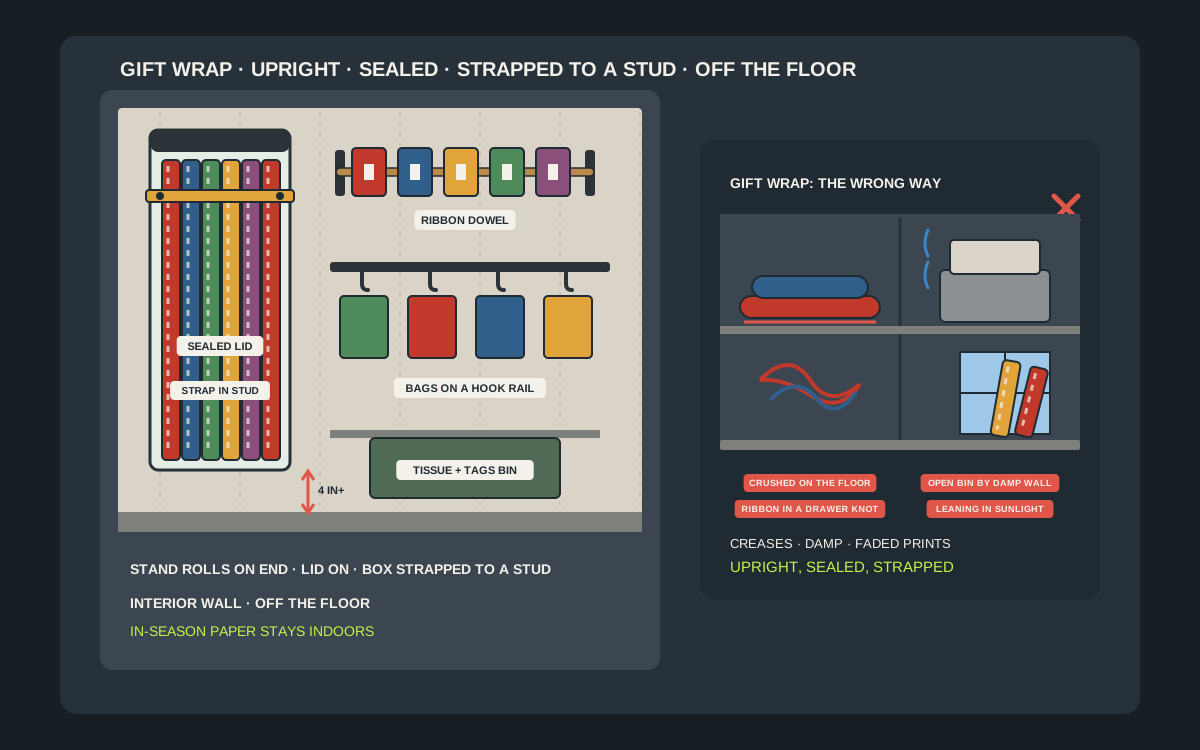
Every household ends up with the same pile in December: half-used rolls of paper, a drawer of ribbon spooled around itself, gift bags that were good enough to reuse and tissue that has been folded and unfolded four times. The pile lives in a closet, under a bed or in a bin in the garage, and by the next holiday the rolls are crushed, the corners are torn and the ribbon is a single knot. A wall organizer fixes most of that for well under $50. Rolls stored on end stay round, bags hung by their handles stay flat, ribbon on a dowel unspools in one clean pull, and everything is visible in one glance when you are wrapping at eleven at night. There is one catch that most guides skip. Paper is happiest in a cool, dry, steady spot, and a garage is none of those things in winter or summer. That does not rule the garage out for off-season gift wrap, but it changes how you store it: sealed, off the floor, on an interior wall and away from the damp. This guide covers the setups that work, the real sizes of common rolls and wrap boxes, how to mount them so they stay up, and a short routine for moving the paper you need indoors for the season and sending the rest back to the wall.
Shop gift wrap wall organizers on Amazon
Who this is for
- Anyone whose gift wrap currently lives in a pile, a drawer or the corner of a closet
- Households with a garage, basement or utility room wall they can spare for off-season holiday supplies
- Crafters and gift-givers who buy wrapping paper in bulk after the holidays
- Apartment renters who need a slim, wall-mounted way to keep paper, bags and ribbon together
Quick answer
For most homes, the best under-$50 wrapping paper organizer is a lidded, upright wrap box or tube anchored to the wall, with a dowel rack for ribbon and a hook rail for gift bags. Standing rolls on end keeps them round and untorn, and a lid keeps out dust and humidity. Measure your longest roll first: Hallmark lists its standard rolls at 30 inches wide, and 40-inch rolls need a taller box. Preservation experts such as the Northeast Document Conservation Center advise keeping paper in a cool, dry, steady interior space and not in garages, so use the garage wall only for sealed, off-season stock, and keep the rolls you are using now inside. Check sizes, ratings and current prices on the listing before you buy.
Quick picks
- Best overall: a lidded, upright wrap box or a rigid wrap tube, fixed to the wall with a strap or two screws into a stud, so every roll stands on end, sealed from dust and humidity and off the floor.
- Best for a lot of rolls: a 40-inch vertical wrap box such as Sterilite’s, listed at 18 1/4 by 13 3/4 by 42 3/4 inches and rated by the maker for up to 32 rolls of 40-inch paper, anchored to a stud so it cannot tip.
- Best for ribbon and tape: a wooden or steel dowel on two wall brackets, so spools turn freely and the ends are always visible, with a small bin below for scissors, tags and tape.
- Best for gift bags and tissue: a hook rail or a few deep hooks for hanging bags by their handles, plus a lidded flat bin on a shelf for tissue, which creases when it is stuffed into a drawer.
- Best for small spaces: a slim over-door or behind-door organizer inside the house, which holds rolls, bags and ribbon in about three inches of depth, the right home for the paper you are using this month.
- Best add-on: a small desiccant pack or a sealed lid in the box and a cheap thermometer-hygrometer on the wall, so you can see when the garage is damper than the paper likes.
Quick comparison
| Setup | Best for | How it holds | Trade-off |
|---|---|---|---|
| Upright wrap box on a wall strap | Many rolls in one sealed box | Rolls stand on end under a lid; strap into a stud | Needs 42 in of height for 40 in rolls |
| Wall-mounted wrap tube or tall bin | Slim wall space and 10 to 20 rolls | Rigid tube or narrow bin screwed to studs | Fewer rolls than a full wrap box |
| Hook rail with gift bag hooks | Reusing gift bags and bows | Bags hang by handles, flat and visible | Open storage collects dust |
| Dowel ribbon rack | Ribbon spools of any size | Spools turn on a rod between two brackets | Rod must fit the spool holes |
| Over-door wrapping organizer | Apartments and the month you are wrapping | Pockets for rolls, tape and bags; hangs on a door | Not for heavy bulk stock; not for garage doors |
| Lidded flat bin on a shelf | Tissue paper, tags and bows | Lid keeps tissue flat, clean and dry | Takes shelf space |
| Wall pegboard with hooks | Scissors, tape, rolls, ribbon in one spot | Pegs hold tools and rods at any height | Open paper still needs a box |
| Adhesive hooks | Light tags and gift bags only | Light items on a clean, smooth wall | Never for a loaded wrap box |
Wrapping paper storage boxesGift wrap organizers for the wallRibbon dowel racks
What to look for
Height that matches your longest roll
A wrap box is only useful if the rolls fit standing up. Hallmark lists its standard rolls at 30 inches wide, 16 feet long and 40 square feet, so a roll stands about 30 inches tall. Wider rolls and rolled kraft or butcher paper run to 40 inches or more. Sterilite’s 40-inch Wrap Box is listed at 42 3/4 inches tall and rated for up to 32 rolls of 40-inch paper. Measure your tallest roll and add an inch or two, or the lid will not close.
A lid that really seals
Open racks look tidy and leave paper to collect dust, light and humidity. A lid or a closed tube keeps the dust out and slows moisture, which matters in a garage. A lift-top lid, like the one Sterilite describes, lets you pull a single roll without taking the whole lid off. Clear panels or a frosted lid let you see colors without opening the box.
A way to anchor tall boxes
A 42-inch box full of rolls is top-heavy. Fix the box to the wall with a strap or bracket screwed into a stud so a bump from a bike or a child cannot topple it. Adhesive hooks are not an option for the box itself: 3M rates its largest Command Jumbo hook at 7.5 pounds, and a full box weighs more than that.
Smooth, snag-free surfaces
Paper tears on rough edges. Look for rounded dividers, smooth plastic, sanded wood dowels and coated hooks. If a hook or rack edge looks rough, cover it with a strip of felt or foam tape before it gets near a roll.
Ribbon you can see and pull
A dowel through the spool centers is the simplest way to store ribbon: the spools turn, the ends stay visible and nothing tangles. Choose a dowel that is slightly thinner than the spool hole and long enough for the ribbons you own; a 12 to 18 inch rod holds a dozen spools.
Hooks that do not crush bags
Gift bags keep their shape when they hang by their handles from wide, rounded hooks and lose it when they are stacked. A hook rail with spacing of about 3 inches holds a bag per hook without crushing the next one.
Why gift wrap needs a wall and a lid
Rolls stored on their sides get crushed
A roll lying in a bin or a drawer is the first to flatten. The weight of everything on top pushes the tube oval, and an oval roll will not unroll straight. Standing rolls on end keeps the weight on the cardboard tube, which is stiff in that direction.
Open storage collects dust and light
Gift wrap is thin and takes on whatever is in the air. Dust settles on open rolls and the sun fades the printed side of any roll that sits near a window. A lidded box or a closed tube solves both.
Ribbon tangles on its own
Ribbon stored loose in a drawer works its way into a single knot. Spools on a dowel keep each one separate and the loose end visible, so you can pull a length without taking the rest with it.
The wall gives you a fixed home
When every item has a place on the wall, you put it back there. A box in one place, ribbon in another, bags on a rail: the setup takes ten minutes to put back at the end of December and ten seconds to find in the next November.
What the garage does to paper
The expert advice is to keep paper indoors
The Northeast Document Conservation Center recommends a cool, dry, stable environment with good air circulation, ideally around 70 degrees Fahrenheit and a relative humidity under 55 percent, and advises against attics, basements and outer walls. The Library of Congress advises the same for paper, listing attics, basements and garages as places not to store it, with relative humidity ideally between 30 and 55 percent. Wrapping paper is not an archive, but the same physics applies: heat dries and embrittles paper, damp curls it, and a mix of heat and damp invites mold and insects.
What that means for wrapping paper
Treat the garage as a place for sealed, off-season stock only. A closed wrap box on an interior wall, up off the concrete, in a garage that stays reasonably dry, is fine for paper you will not touch until next November. The roll you plan to use this month belongs inside the house, in a closet or behind a door, where the temperature and humidity are stable.
Keep it off the floor and away from outer walls
NEDCC suggests keeping stored paper at least four inches off the floor and away from exterior walls, which have the biggest swings in temperature and moisture. In a garage, that means mounting the box so its base is well above the slab and choosing a wall shared with the house, not one backing onto the weather.
Watch the humidity, not just the temperature
A cheap thermometer-hygrometer on the wall near the box tells you what the space is really doing. If it sits above about 55 percent humidity for long stretches, add a desiccant pack inside the box, or move the paper indoors. Take a roll out of a cold garage and let it warm in its box before opening it, so condensation does not form on the paper.
The setups that work under $50
A lidded upright wrap box
This is the default for anyone with more than a handful of rolls. Rolls stand on end in a tall, narrow box. Sterilite’s 40-inch Wrap Box is listed at 18 1/4 by 13 3/4 by 42 3/4 inches, holds up to 32 rolls of 40-inch paper, and has a lift-top lid. Compare the current price and the exact size on the listing. Anchor the box to a stud with a strap or a pair of brackets.
A slim wall tube or tall narrow bin
If you have a few dozen inches of wall and not a corner, a rigid tube or a narrow wall-hung bin keeps ten to twenty rolls upright and takes only a few inches of depth. Look for steel or hard plastic that is screwed to a stud, not hung from a single hook.
A hook rail for bags and bows
Reusable gift bags keep their shape on a hook rail. Screw a rail into two studs, hang a bag from each hook by its handles and keep the bows on a dowel or a small hook beside them. A hook rail is less dust-proof than a lid, so keep it for the bags you will reuse in a season, and bag the rest.
A dowel for ribbon
A 12 to 18 inch dowel on two small wall brackets holds a dozen spools. Slide the spools on and they turn freely. A tape dispenser and a pair of scissors on adjacent hooks make this a one-stop ribbon station.
An over-door wrapping organizer for apartments
If your gift wrap lives in an apartment, an over-door organizer with pockets for rolls, tape and bags works in about three inches of depth and nothing needs to be screwed to the wall. Our guide to over-door organizers for apartments covers how to choose one.
A lidded bin for tissue and tags
Tissue paper creases when it is crammed into a drawer. A flat, lidded bin on a shelf keeps it unfolded and clean. Add tags, bows and gift cards and label the end facing out.
How to mount a wrap box so it stays up
Find studs and set the height
Locate the studs with a stud finder, then mount the strap or bracket so the base of the box rests at least four inches off the floor and the top is at a height you can reach without a ladder. On standard 16-inch spacing, a 14-inch-wide box sits between two studs, so use a strap that reaches one stud, or two short brackets with a board behind them.
Use screws, not adhesives
A full box of rolls is not light, and it gets bumped. Use screws long enough to go through the drywall and about an inch into the stud, or masonry anchors on concrete or block. Adhesive strips are for tags and bags, not for the box.
Strap it near the top
The way a tall box falls is from the top. A strap or bracket near the upper third keeps it vertical even if a bike handle catches the base.
Keep the front clear
Leave about 18 inches in front of the box so the lid can lift and a roll can slide out. If a car door or a bike swings through that space, choose another wall.
Sizing the box for your rolls
Count and measure what you own
Stand every roll up in one place and measure the tallest. A standard roll of 30-inch paper is about 30 inches tall, a longer roll or a roll of kraft paper may be 36 or 40 inches. Count the rolls and add a few for next year’s sales.
Leave room for tubes and a fat roll
A full 40-square-foot roll is thicker than a half-used one, and a box that holds 32 slim rolls may hold far fewer fat ones. Choose a box with a few inches to spare in width and height.
One box is better than three smaller ones
If the paper fits in one box, use one. It is easier to find, easier to anchor and takes up one stretch of wall instead of three.
Ribbon, tape and tags: the small kit
A dowel for spools
Mount the dowel level and about 10 to 14 inches above a counter or bin, so spools hang without touching anything. Keep the heavy spools at the ends, where the brackets hold them, and the light ones in the middle.
A bin for the small things
Tags, bows, stickers and gift cards belong in a lidded shallow bin. Tape and scissors go on adjacent hooks so you never go looking for them while holding a gift.
A wipe-clean shelf
Put a small shelf at counter height so you can wrap on the wall if you need to. Wipe it down in January before the season’s supplies go back.
Gift bags and tissue paper
Hang bags by their handles
Bags keep their shape when they hang. Use wide, rounded hooks and spacing of about 3 inches. Fold the handle end flat and hang the bag with its opening toward you.
Keep tissue flat and dry
Fold tissue once, lay it flat in a lidded bin and keep dark and bright sheets in their own stack so a creased fold never rubs color onto a light sheet.
Reuse and recycle sorting
A small bin for paper too creased to reuse keeps the good stock clean. Check your local rules before putting foil or glitter-coated paper in recycling.
A simple seasonal routine
Before Thanksgiving: bring in this season’s stock
Take the rolls you plan to use, along with the ribbon, tags and tape, out of the garage and into a closet or behind a door. Let anything that has been in a cold garage warm up in its box for an hour or so before you open it.
December: wrap in one place
Set up one station, indoors, with a table, the rolls and the tools. Put everything back in the same box as you go, so there is never a pile.
The week after: buy cheap and sort
Post-holiday sales are the cheapest time to buy paper. Measure first so you buy rolls that fit your box.
January: seal and shelve
Check each roll for creases, fold the ends flat, tape each roll closed so it does not unroll, and put them back upright in the wrap box. Add a desiccant pack, close the lid and put the box back on the wall.
Where gift wrap belongs in the garage
An interior wall, off the concrete
Choose a wall shared with the house, not the outside wall, and mount the box so its base is well off the floor, in line with the NEDCC advice to keep paper off the floor and away from exterior walls.
Away from the water heater, the sink and the door
Keep the box away from a water heater, a utility sink, the garage door seal and any place that leaks. A small drip is a ruined box of paper.
Near the door to the house
If the paper is used indoors, put it near the door that you walk through with a gift in hand.
Gift wrap, holiday decor and the rest of the season
Lights and decorations are their own project
Gift wrap is flat, light and delicate; lights, wreaths and ornaments are bulky and breakable. Our guide to holiday light and decoration storage covers reels, ornament bins and wreath frames, so this page stays focused on paper.
Bins and shelves for the rest
Clear bins hold bows, ribbon and tags in the same way they hold anything else in a garage. Our guide to clear garage storage bins covers how to choose and stack them.
Craft supplies share the same wall
If the same wall holds craft supplies, our guide to glue gun wall holders covers where the tools go; keep hot tools away from paper.
Box, tube, rods or a rail: which one to choose
A box if you own more than a dozen rolls
A lidded upright box is the cheapest way to seal a large collection, and one box covers rolls, tubes of tissue and the odd roll of kraft paper. The trade-off is height: a 40-inch roll needs a box over 42 inches tall, and that is a lot of wall.
A tube or narrow bin if the wall is short
If the wall is narrow, a rigid tube or a narrow wall-hung bin costs less, takes less depth and holds ten to twenty rolls. It will hold fewer than a full box, so decide what you really use each year.
Rods through the rolls if you wrap constantly
Crafters and anyone who wraps year-round sometimes hang each roll on a rod so paper pulls off in one move. Rods give fast access and no lid, so they suit a roll you use weekly and not paper that sits for eleven months.
A rail for everything that hangs
A hook rail takes bags, bows, scissors, tape and a ribbon dowel on brackets. It is the cheapest way to make a wall useful, and it pairs well with a box for the rolls. Our guide to hook rails versus individual hooks covers spacing and screws.
Small, shared and rented spaces
Apartments without drilling
If you cannot put screws in the wall, an over-door or behind-door organizer is the best choice. It holds rolls, bags and tape in the depth of a few inches and comes off with the lease. Keep the weight modest, because a door and its hinges are not made for a heavy load.
Shared garages and storage units
In a shared space, use one lidded box with a label on the front and your name inside the lid. It is easy to find, hard to confuse with someone else’s bin and sealed against dust. If the unit is not climate-controlled, treat it as sealed off-season storage only.
Small garages with one free wall
If the free wall is five feet wide, a box, a dowel and a hook rail fit side by side. If it is less, stack: dowel above the box, hook rail beside it, and bins on a shelf below.
Closets are the best home if you have one
An interior closet has the stable temperature and humidity that paper prefers, which is why the experts recommend an interior room over a garage. A box on a closet shelf or a tube behind the door beats any garage setup, and the wall organizer ideas on this page work there as well.
Looking after the paper itself
Tape the roll closed
A loose roll unrolls and creases inside the box. A short strip of tape on the end of the roll, or a rubber band or hook-and-loop strap around it, keeps the roll tight. Peel the tape slowly so it does not tear the paper.
Rewind a roll that has gone loose
Roll paper back onto its tube with the printed side facing in, so it curls the way the roll naturally wants to. A roll rewound with the print outward tends to spring open.
Keep heat and sun away
Paper dries and fades in heat and light. NEDCC advises keeping stored paper away from heat sources and sunlight, so a box beside a window, a space heater or a hot water pipe is a poor spot.
Check the paper twice a year
Open the box when you swap seasons. Look for damp spots, a musty smell and any sign of insects. If you find any, move the roll indoors and let it dry flat before storing it again.
Getting rolls in and out without a mess
Lift, do not pull
Lift a roll straight up out of the box, instead of dragging it past its neighbors, where the edges catch and tear.
Return each roll to its slot
Put a roll back the way it came out, with the loose end taped, so the next person to open the box finds order.
Keep the cutting station beside the wall
A small shelf with a cutting mat or a sheet of cardboard keeps scissors, a tape dispenser and the roll within reach, so you do not carry paper across the garage.
What $50 buys: three budgets
About $20: strap, dowel and rail
A wall strap or two brackets, a wooden dowel and a short hook rail cost less than a restaurant lunch. Pair them with a box you already own, such as a tall bin or a mailing tube, and you have a working system. Check current prices on the listings, because they move through the holiday season.
About $35: a wrap box and a dowel
A basic upright wrap box and a ribbon dowel with two brackets usually fit in this range. Add screws if the box does not come with them, and a strap to hold it to the wall.
About $50: the full set
A wrap box, a dowel, a hook rail, a lidded tissue bin and a thermometer-hygrometer fit in under $50 if you shop for plain versions. Skip anything labeled for a single holiday and buy the plain, neutral version that works for birthdays too.
Where not to spend
A fancy printed box does not protect paper any better than a plain one. Spend the money on a lid that seals and on screws that hold, not on a pattern.
Different papers, different needs
Standard printed rolls
Most printed rolls are thin paper on a cardboard tube. They stand well, crush on their sides and fade in light. These are the rolls the upright box is built for.
Kraft and butcher paper
Kraft paper is heavier and often wider. Check the width before you buy a box, because a 36 or 40-inch roll will not fit a 30-inch tube. Its fibers are sturdy, but it takes on damp as readily as any paper.
Tissue paper
Tissue is the most fragile. Fold it flat, keep it in a lidded bin and do not let anything heavy sit on it. A damp garage will wrinkle it before anything else.
Foil and glitter papers
Metallic and glitter-coated papers crack where they are creased and shed where they rub. Store them on their own, rolled loosely, and keep them away from plain paper so the glitter stays where it belongs.
Three sample setups
The 10-roll apartment setup
An over-door organizer holds ten rolls, a handful of bags and a tape dispenser, and a small adhesive hook holds the scissors. Total cost: well under $30, and nothing is drilled into the wall.
The family garage setup
A 40-inch upright wrap box strapped to an interior wall stud, a 14-inch dowel for ribbon on two brackets beside it, a hook rail with six bag hooks and a lidded tissue bin on the shelf below. Together this fits under $50 if you pick a plain box and wood dowel.
The crafter’s setup
A pegboard panel with hooks for rolls on rods, a dowel for ribbon, a scissors holder and a lidded bin for tags. It costs more than the others, but it holds a year-round craft supply.
How to set it up in an afternoon
- Stand every roll up in one spot and measure the tallest one, then count them.
- Pick the wall: interior, dry, clear of car doors and away from the water heater.
- Mark the studs with a stud finder, and mark the height so the box base clears the floor by at least four inches.
- Screw the strap or brackets into the studs, then set the box and check that it does not wobble.
- Mount the dowel level on two brackets for the ribbon.
- Screw the hook rail into two studs and hang the gift bags by their handles.
- Fold the ends of each roll flat, tape each roll closed and stand it in the box.
- Add a thermometer-hygrometer and a desiccant pack in the box.
- Label the front of the box and the tissue bin, then put the season’s current rolls inside the house.
Mistakes to avoid
- Storing paper flat in an open bin on the garage floor, where weight crushes it and damp reaches it.
- Putting the box on an exterior wall or beside a water heater, where the swings in temperature and moisture are worst.
- Trusting adhesive hooks with a loaded wrap box.
- Buying a 30-inch box for 40-inch rolls, and finding that the lid will not close.
- Leaving the roll ends unsecured, so the paper unrolls and creases inside the box.
- Packing the box so full that pulling out one roll tears the others.
- Skipping the humidity check and finding mold on the paper in spring.
- Keeping this month’s paper in the garage, so you carry cold, damp rolls to the table.
Related guides
Browse the hub: Garage wall storage under $50 - all guides
- Best Holiday Light & Decorations Garage Storage Under $50
- Best Clear Storage Bins for Garage Under $50
- Best Glue Gun Wall Holders Under $50 for Craft Garages
- Best Folding Table Wall Hangers Under $50 for Garage (Holiday Hosting Tables)
- Best Under-$50 Wall Storage Gifts for Garage Organizers (Holiday 2026)
- Best Narrow Garage Shelving Under $50 for Tight Spaces
- Hook Rail vs Individual Hooks for Garage Walls Under $50
- Adhesive Hooks vs Screw-In Hooks for Garage Walls Under $50
- How to Do a Fall Garage Cleanout with Wall Racks Under $50
FAQ
Is it OK to store wrapping paper in the garage?
It is not ideal. The Northeast Document Conservation Center and the Library of Congress both advise against storing paper in attics, basements and garages because of temperature swings and humidity. For off-season gift wrap, a sealed wrap box on an interior wall, well off the floor and in a dry garage, is a reasonable compromise. Keep the paper you plan to use soon inside the house.
How tall does a wrapping paper box need to be?
Tall enough to stand your longest roll. Hallmark lists its standard rolls at 30 inches wide, so they are about 30 inches tall, while 40-inch rolls need a taller box. Sterilite’s 40-inch Wrap Box is listed at 42 3/4 inches tall and holds up to 32 rolls of 40-inch paper.
Should I hang gift wrap rolls or stand them up?
Stand them up in a box or tube. A roll on its side bends under its own weight and the weight of anything on top. If you hang rolls on rods, use a rod through the tube of each roll and choose rods that are long enough to carry the full 30 inches.
What is the best way to store ribbon?
On a dowel or rod through the spools, mounted on two wall brackets. The spools turn independently, the ends are visible and nothing tangles. A 12 to 18 inch rod holds a dozen spools.
Can I use adhesive hooks for wrapping paper storage?
Only for very light things such as tags or a single gift bag. 3M rates its largest Command Jumbo hook at 7.5 pounds, which is less than a loaded wrap box. Use screws into a stud for the box.
How do I stop gift wrap from getting damp or moldy?
Keep it sealed in a lidded box, off the floor and off an outside wall. Add a desiccant pack, check humidity with a thermometer-hygrometer and move the paper indoors if humidity stays high. NEDCC suggests keeping paper below 55 percent relative humidity.
Bottom line
The best wrapping paper organizer under $50 is a lidded upright wrap box anchored to a stud, with a dowel for ribbon and a hook rail for gift bags. Measure your tallest roll, mount the box well off the floor on an interior wall, and keep the paper you will use this season inside the house. Seal the rest, add a desiccant pack and check the humidity now and then, because paper prefers a cool, dry, steady spot to a garage. Do it before the holiday rush, and next year the wrapping takes minutes instead of an evening of untangling. Check sizes, ratings and current prices on the listing before you buy.