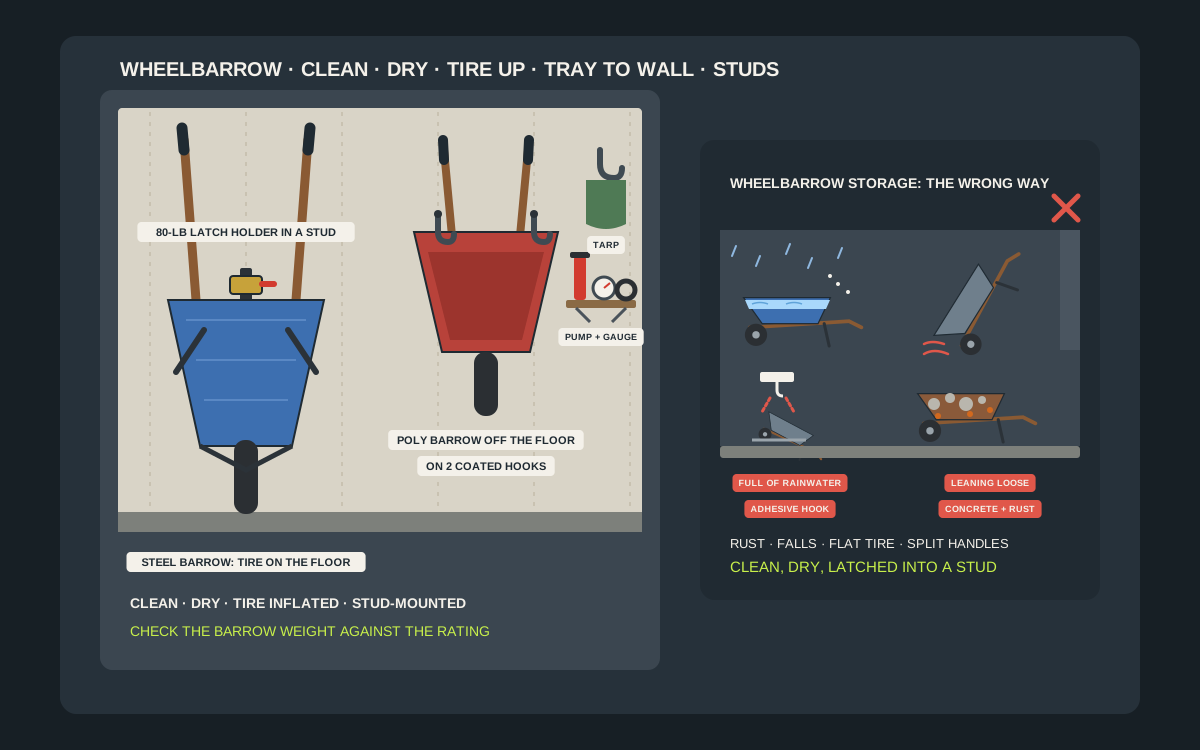
A wheelbarrow is the most awkward thing in most garages and sheds. It is too big to tuck under a bench, too heavy to stack anything on, and it never quite stands still: lean it against the wall and the wheel rolls out, park it on its legs and it takes up a parking-space corner the size of a small table. Leave it outside instead and the tray fills with rainwater, the steel rusts, the wooden handles grey and split, and the tire slowly goes soft. A wall hanger fixes all of that for very little money. Most wheelbarrow holders cost well under $50, take a few minutes to screw into a stud, and let you store the barrow upright, tray to the wall, in a footprint not much bigger than the tire. The catch is that wheelbarrows are heavier than people expect. A typical 6 cubic foot steel contractor barrow weighs roughly 47 to 65 pounds, which is more than many general-purpose garage hooks are rated to carry. This guide covers the four kinds of hanger that work, which one suits a heavy steel barrow, a light poly barrow, a dual-wheel barrow or a folding garden cart, how to mount it so it stays on the wall, and how to clean, dry and look after the barrow before it goes up for the winter.
Shop wheelbarrow wall hangers on Amazon
Who this is for
- Anyone whose wheelbarrow lives in the middle of the garage floor or leaning against the wall where it slides and falls
- Gardeners putting the yard to bed for winter who want the barrow under cover, dry and out of the way of the car
- Shed owners with one clear stretch of wall and a barrow, mower and garden tools competing for floor space
- Homeowners who left a steel barrow outside and found a rusted tray, split handles and a flat tire in spring
Quick answer
For most garages and sheds, the best under-$50 option is a heavy-gauge steel wheelbarrow holder with a spring-loaded lift latch, screwed into a stud at the height that matches your barrow. You tip the barrow up onto its tire with the handles pointing at the ceiling and the open tray facing the wall, push the tray rim into the lower hook and let the latch close over the top. Check the barrow’s weight against the hanger’s rating: many latch holders are listed at 80 pounds, many hooks and rail accessories at 50. A light poly barrow or a garden cart can hang completely off the floor on two coated utility hooks in neighboring studs. Store the barrow clean, dry and with the tire inflated, and never rely on adhesive hooks or drywall anchors alone. Check ratings, fit and current prices on the listing before you buy.
Quick picks
- Best overall: a heavy-gauge steel wheelbarrow holder with a spring-loaded lift latch, screwed into a stud. Several of these are listed at 80 pounds, which covers most single-wheel steel and poly barrows, and you tilt the barrow in rather than lifting it.
- Best for a track rail: a one-piece wheelbarrow hook that snaps onto the rail you already have. Rubbermaid’s FastTrack wheelbarrow hook is listed at 50 pounds, mounts to a stud or the rail, and folds flat against the wall when the barrow is out.
- Best for barrows and ladders: a combined wheelbarrow and ladder hanger such as Racor’s powder-coated steel model, listed at 50 pounds. It suits a lighter barrow that shares a wall with a stepladder or extension ladder.
- Best for light poly barrows and garden carts: two deep vinyl-coated utility hooks screwed into neighboring studs, so a barrow under about 30 pounds hangs completely off the floor by its tray rim.
- Best for a heavy contractor barrow: an 80-pound latch holder fixed with all its screws into solid framing, with the tire left resting on the floor so the hanger only keeps the barrow upright.
- Best for a tiny garage or shed: a folding canvas wheelbarrow that collapses into a long, narrow bundle and hangs from two ordinary hooks, if your loads are leaves, mulch and garden waste rather than concrete and stone.
Quick comparison
| Hanger type | Best for | How it holds | Trade-off |
|---|---|---|---|
| Latch-style wheelbarrow holder | Most single-wheel steel and poly barrows | Lower hook takes the tray rim; spring latch closes over the top | Check fit; many do not suit dual-wheel barrows |
| One-piece rail or stud hook | Barrows in a garage that already has a track rail | Tilt the barrow onto the lower hook and secure the top hook | Often listed at 50 lb; check heavy steel barrows |
| Wheelbarrow and ladder hanger | A lighter barrow sharing a wall with a ladder | Deep powder-coated arms cradle the tray or ladder rails | Often 50 lb; not for the heaviest contractor barrows |
| Rail-system dual hook | Slatwall or channel-rail garages | Two arms take the tray rim; hook locks into the rail | Rail must be screwed into studs; brand-specific |
| Two coated utility hooks | Light poly barrows and garden carts | Tray rim hangs over two hooks; tire off the floor | Lifting a heavy barrow to hook height is hard work |
| Folding canvas barrow on hooks | Small sheds, balconies and light garden work | Folded frame hangs in a narrow bundle from two hooks | Not for concrete, stone or heavy soil |
| Utility hook for accessories | Tire pump, spare tube, tarp and gloves | Small gear hangs beside the barrow | One more screw hole in the wall |
| Short lipped shelf | Gauge, grease, touch-up paint and linseed oil | Maintenance kit lives next to the barrow | Needs studs and a little extra wall |
Wheelbarrow holders with a safety latchHeavy-duty vinyl-coated utility hooksTrack rail wheelbarrow hooks
What to look for
A rating that matches your barrow, with a margin
Wheelbarrows vary a lot in weight. Jackson’s 2024 catalog lists its 6 cubic foot steel M6T22 at 47 pounds, other steel 6 cubic foot models at around 56 to 59 pounds, and its folded-steel M11FFBB at 65 pounds. True Temper’s 4 cubic foot poly PW4UT24 is listed by retailers at about 28 pounds. Latch-style wheelbarrow holders from several brands are listed at 80 pounds; Rubbermaid’s FastTrack wheelbarrow hook, Racor’s wheelbarrow and ladder hanger and Gladiator’s wheelbarrow-style dual hook are each listed at 50 pounds. Weigh your barrow on a bathroom scale or look up its model, then choose a hanger rated comfortably above it.
A shape that fits your tray
Most wheelbarrow holders are designed around a single-wheel barrow with a rolled tray rim. The lower hook catches the rim near the front of the tray, and a top latch or second hook closes over the rim higher up. Some listings say plainly that their holder does not fit dual-wheel wheelbarrows, and some say they do not suit particular brands. Measure the width and depth of your tray rim and compare it with the hook opening and the spacing on the listing before you buy.
A latch, not just a hook
A barrow standing on its tire with the tray against the wall wants to tip forward the moment someone bumps the handles. A spring-loaded lift latch or a closing top hook stops that. Several 80-pound holders use a spring-loaded latch that you lift to release, and Rubbermaid’s one-piece FastTrack hook uses a lower hook plus a top hook. Avoid plain open hooks for a heavy barrow unless the barrow hangs fully off the floor and is well seated.
Fixings that go into framing
The rating on the box assumes the hanger is screwed into solid framing. Garage walls are usually framed with studs about 16 inches apart, and most holders come with screws sized for wood. On concrete or block walls, you need masonry anchors rated for the load. A hanger fixed into drywall alone, or held by adhesive, will not carry a 50-pound barrow being tipped in and out of it.
Height and clearance for the way you store it
A 6 cubic foot barrow with 60-inch handles stands about 5 feet tall when it is tipped up onto its tire, and its listed height of roughly 23 to 27 inches becomes, roughly, its depth out from the wall. Before you mark the wall, check that the handles clear any shelf, light or garage door track above, and that the tray will not stick out into the path of a car door or bumper.
Coatings that protect the barrow and the hanger
A vinyl or rubber coating on the hooks stops them scratching the paint on a steel tray, which matters because a scratch is where rust starts. A powder-coated or galvanized finish on the hanger itself resists rust in a damp shed. Kent’s listing for an 80-pound holder, for example, mentions a mar-proof vinyl coating, and Rubbermaid’s FastTrack hook has a soft dipped coating and a powder-coated finish.
Know your wheelbarrow first
Steel contractor barrows
The classic contractor wheelbarrow has a seamless steel tray of about 6 cubic feet, a steel undercarriage, a 16-inch tire and 60-inch hardwood or steel handles. Jackson’s catalog lists these at roughly 47 to 65 pounds depending on tray, tire and bearings, and a typical example measures around 58 to 62 inches long, 25 to 26 inches wide and 27 inches high. They are the heaviest barrows you are likely to hang, and the ones that most need an 80-pound holder and good fixings.
Poly tray barrows
Poly barrows use a polyethylene or polypropylene tray on a steel undercarriage. They do not rust, they are much lighter and they cost less. True Temper’s 4 cubic foot PW4UT24 is listed at about 28 pounds and 53 inches long, which puts it comfortably inside a 50-pound hook rating and light enough to lift fully off the floor onto two hooks. Larger contractor-style poly barrows can weigh close to their steel equivalents, so check the model.
Dual-wheel barrows and garden carts
Two-wheeled barrows are more stable to push, but they do not tip up onto a single tire, and some latch-holder listings specifically say they will not fit them. Four-wheeled dump carts and garden carts have the same problem. These usually store best on two deep hooks with the cart on its end, against a wall with a strap across it, or flat under a shelf.
Folding and canvas barrows
Folding barrows use a fabric tray on a collapsible steel frame and fold into a long, narrow bundle. They are not built for concrete or stone, but they suit leaves, weeds, mulch and garden waste, and they are by far the easiest kind to store in a small shed or a single garage. Two ordinary coated hooks are enough.
The four kinds of hanger that work
Latch-style holders
A latch-style holder is a heavy steel bracket with a lower hook and a separate top latch. You screw the lower hook into a stud, tip the barrow onto its tire with the tray facing the wall, push the tray rim into the hook, mark where the upper rim sits and screw the latch there. One listing describes exactly that sequence: push the barrow into the bottom hook, push up, mark the height and fix the top lift latch. Several of these holders, sold under brands such as Stinson Storage and Kent, are listed at 80 pounds with a spring-loaded latch that prevents accidental release. They are the best all-round choice.
One-piece hooks
A one-piece wheelbarrow hook combines the lower and upper hooks in a single long arm, so there is nothing to measure. Rubbermaid’s FastTrack wheelbarrow hook is listed at 50 pounds, roughly 45 inches long, and mounts either to a wall stud or onto a FastTrack rail. The product description says you tilt the barrow onto the lower hook and secure the top with the top hook, without lifting it, and that the hook folds up against the wall when it is not in use.
Wheelbarrow and ladder hangers
Some hangers are sold for both wheelbarrows and ladders. Racor’s black powder-coated steel wheelbarrow and ladder hanger is listed at 50 pounds with hardware included. These suit a poly barrow or a lighter steel one, and a garage where the same stretch of wall also holds a stepladder. Our guides to ladder wall hooks and to hanging a ladder safely cover the ladder side.
Rail-system wheelbarrow hooks
If your garage already has a channel rail or slatwall system, look for that brand’s wheelbarrow hook. Gladiator’s dual hook, sold as a wheelbarrow hook, is listed at 50 pounds per hook, based on a lab test of 200 pounds, and Gladiator lists its GearTrack channel at 75 pounds per linear foot. Rail hooks are easy to move, but they only work on the brand of rail they were made for, and the rail must be screwed into studs. Our comparison of track rail hooks explains how the different systems fit.
Matching the hanger to the barrow
Heavy steel barrow, 55 to 65 pounds
Choose an 80-pound latch holder and screw every hole into solid framing. Leave the tire resting on the floor so the hanger is only keeping the barrow upright and tight to the wall rather than carrying its full weight. Do not try to lift a 60-pound barrow onto hooks above waist height.
Lighter steel barrow, 45 to 50 pounds
An 80-pound latch holder is still the safest choice. A 50-pound hook will work only if the barrow is genuinely under that figure and the tire takes part of the load on the floor; check the listing and leave a margin.
Poly barrow, 25 to 35 pounds
Almost any of the four types will work. A latch holder or one-piece hook is quickest to use; two deep coated utility hooks let you hang the barrow fully off the floor so the tire carries no weight over winter.
Dual-wheel barrow or garden cart
Skip the latch holders. Stand the cart on its end against the wall with a strap or bungee across it, hang it by its tray on two deep hooks if it is light enough, or keep it on the floor under a shelf and use the wall above it for the tools that ride in it.
How to hang a wheelbarrow upright, step by step
Pick the wall
Choose a stretch of inside wall near the door you push the barrow through, away from the car bays, the water heater and anywhere snowmelt pools on the floor. Corners work well, because the barrow’s width sits out of the walkway.
Tip the barrow and measure
Tip the empty barrow forward onto its tire and the front of the tray, so the handles point up and the open tray faces the wall. Stand it where it will live and mark the wall at the tray rim, near the bottom, and again near the top. These two marks set the height of the lower hook and the latch.
Find the studs
Use a stud finder to locate the framing, and check behind the wall for wiring and pipes before you drill. Most holders mount on a single stud; a pair of hooks for a fully hung barrow should go into two neighboring studs about 16 inches apart.
Fix the lower hook, then the latch
Screw the lower hook at your lower mark, push the barrow into it, then mark exactly where the upper rim sits and fix the latch or top hook there. Use all the screw holes and the screws supplied or ones of equal size.
Test it gently
Load the barrow into the hanger, let the latch close, and rock the handles gently side to side. Nothing should flex, creak or pull at the screws. If it does, stop and fix the hanger into better framing.
Hanging a light barrow or cart off the floor
Two hooks, two studs
For a light poly barrow or a garden cart, screw two deep vinyl-coated utility hooks into neighboring studs at the same height. Lift the barrow by the tray, rest the rim over both hooks and let the tray hang against the wall with the wheel and handles below. The tire carries no weight, which is easiest on a soft tire over a long winter.
Keep the lift sensible
Set the hooks no higher than you can comfortably lift the barrow with both hands and a straight back. If you cannot lift it to the hooks without straining, it is too heavy to hang this way; use a latch holder with the tire on the floor instead.
Mind the drips
A barrow hung tray-to-wall drains well if it goes up clean and dry. If it goes up damp, water runs down the tray and can mark the wall and puddle on the floor, which is one more reason to dry it first.
Clean, dry and protect it before it goes up
Empty and scrub the tray
Brush out soil, grass and debris after every job, and wash out concrete or mortar straight away. WD-40’s maintenance guide notes that caked-on dirt holds moisture and is where corrosion starts fastest, and suggests washing hard-set dirt off with a hose or pressure washer and soapy water before letting the barrow dry completely.
Dry it completely
Leave the barrow tipped forward or upside down in the sun or a dry spot for a few hours before it goes on the wall. The Conservation Handbooks guide to tool care says wheelbarrows must be stored upright or turned over in dry conditions, never left holding damp items, and never where they can catch rainwater or condensation.
Deal with rust on a steel tray
Wire-brush or sand rust spots back to bare metal, wipe off the dust, prime with a rust-inhibiting primer and finish with metal paint. WD-40’s guide warns that bare steel left unprotected will rust again within weeks, and to pay particular attention to seams, folds and the underside, where water lingers longest.
Look after the handles
Sand rough wooden handles with fine sandpaper and rub in linseed oil, letting it dry fully before storage, as WD-40’s guide suggests. Check for cracks and splinters near the bolts; a split handle is easier to replace in November than in the middle of a spring project. Wipe steel handles with a light coat of a water-displacing spray.
Tighten and lubricate
Go over the nuts and bolts on the tray braces, legs and axle and tighten anything loose. A few drops of oil or a little grease on the axle and bearings, if your barrow has grease points, keeps the wheel turning freely next season.
Tires over the winter
Pneumatic tires
Air-filled tires slowly lose pressure in storage. Check and top up the tire to the pressure printed on the sidewall before the barrow goes on the wall, and again in spring. WD-40’s guide suggests checking the pressure once or twice a year and whenever the tire feels soft. If the barrow stands on its tire all winter, a properly inflated tire is less likely to develop a flat spot or a cracked sidewall.
Flat-free tires
Solid or flat-free tires do not need air and do not mind standing for months, which makes them a good match for a barrow that stands upright on its tire in a latch holder. Many manufacturers sell flat-free replacement wheels for common barrows if punctures from thorns are a recurring problem.
Keep the pump nearby
A small hand pump or a compact inflator, a pressure gauge and a spare inner tube on a shelf or hook beside the barrow mean the tire gets checked when it should. Our guide to portable tire inflator wall mounts covers a few tidy ways to keep that kit together.
Why not just leave it outside
Rain and standing water
A barrow left on its wheel outdoors fills with rainwater, which rusts a steel tray, rots wooden handles and drowns any soil left inside. Standing water is also a mosquito problem: the CDC advises emptying, scrubbing, turning over, covering or throwing out items that hold water once a week. A barrow on a wall under cover never holds water.
Sun and cold
Sunlight fades and embrittles poly trays and dries out wooden handles and tires. Freeze-thaw cycles open small cracks in handles and tires. A garage or shed wall keeps the barrow out of all of it.
If it must stay outdoors
If there is no indoor space, store the barrow upside down or tipped up against a wall so the tray cannot hold water, raise it off wet ground, and cover it with a secured waterproof cover. Gardening columnists and tool-care guides consistently recommend turning the barrow over outside so rain cannot pool in the pan.
Where it belongs in the garage or shed
Near the yard door
Hang the barrow on the wall nearest the door you push it through, so it goes from the wall to the yard without being steered around the car or the mower. In a shed, the wall beside the door is usually best, with long-handled tools beside it.
Next to the gear it carries
Put the garden tools that travel in the barrow on the same wall: rakes, shovels and the leaf blower above or beside it, gloves and tarps on a hook. Our guides to hanging brooms and garden tools and to leaf blower wall hangers cover those. The barrow becomes the bottom of a single yard station.
Out of the car door swing
Even standing upright, a barrow sticks out about as far as its listed height, often around 2 feet. Keep it clear of car doors, the garage door track and the path to the house door, and do not hang it where a reversing bumper can reach it.
Mounting it so it stays up
Studs or masonry, never drywall alone
Screw wheelbarrow hangers into studs. On concrete or block walls, use masonry anchors rated for at least the barrow’s weight. Our comparison of adhesive and screw-in hooks for garage walls explains why adhesive is not an option for anything this heavy, and why drywall anchors on their own are not either.
Use the right screws
Use every hole in the bracket and the screws supplied, or structural screws of the same or greater size. Short or thin screws pull out under the leverage of a barrow being tipped in and out.
Check it every season
Each time the barrow comes off the wall in spring, check that the hanger has not loosened, that the latch springs back, and that the coating on the hooks is intact. Re-tighten screws and replace a worn coating before it starts scratching the tray.
Sheds are different from garages
Thinner walls and lighter framing
Many garden sheds are built with lighter framing than a house garage, sometimes with studs or rails further apart and cladding that is only a thin board or panel. Find the framing members before you drill, and if the uprights are slender, screw a length of solid timber across two or three of them first and mount the hanger onto that board, so the load spreads across the frame instead of a single upright.
Metal and plastic sheds
Metal and resin sheds often have no timber framing at all. Most manufacturers sell their own shelf and hook kits that clip or bolt to the frame, and those are rated for their own walls. If you cannot fix a hanger securely, park the barrow upside down on the floor or on two short timber rails so the tray cannot hold water and the steel is off any damp concrete.
Damp and condensation
Sheds are usually damper than garages. A dry barrow, a hanger with a coated finish and a gap of a few inches between the floor and the tire all help. Leave the shed vents open, and wipe a steel tray with a light coat of a water-displacing spray before winter if condensation is a problem.
Getting it back down in spring
Check the barrow before the first load
Before the first load of the season, lift the latch, tip the barrow back onto its legs and look it over: tire pressure, wheel spin, bolts on the legs and braces, cracks in the handles and any new rust on the tray. Ten minutes in the garage saves a collapsed leg in the middle of a mulch delivery.
Check the hanger too
Look at the wall while the barrow is off it. The screws should be tight, the bracket should not have moved, the latch spring should snap back on its own and the hook coating should still cover the steel. Replace a worn coating with a dip or a length of rubber hose before it scratches a freshly painted tray.
Keep the routine short
The habit that keeps a barrow lasting is simple: tip it out, rinse it, leave it to dry, and put it back on the wall at the end of each job. With a latch holder that takes about the same time as leaning it in a corner, and the barrow is never in the way of the car.
Three sample setups
Two-car garage, steel contractor barrow
A 6 cubic foot steel barrow of about 58 pounds stands on its tire in the corner by the side door, tray to the wall, locked into an 80-pound latch holder screwed into a stud. Above and beside it, a short rail holds a shovel, a rake and a hoe. A small shelf carries a hand pump, a gauge, a spare tube and a can of touch-up paint.
Garden shed, poly barrow and tools
A 4 cubic foot poly barrow of about 28 pounds hangs completely off the floor on two deep coated hooks screwed into neighboring studs beside the shed door. The space under it holds a bag of compost, and the rest of the wall carries long-handled tools and a hose reel.
Single garage, folding barrow
A folding canvas barrow lives as a narrow bundle on two hooks behind the door, next to a leaf blower and a pair of rakes. It handles leaves, weeds and mulch; for the one stone delivery each year, a neighbor’s steel barrow is borrowed.
How to set it up in an afternoon
- Empty, scrub and rinse the barrow, then leave it tipped forward or upside down until it is completely dry.
- Sand and touch up any rust on a steel tray, oil wooden handles and tighten the bolts.
- Check the tire and inflate it to the pressure on the sidewall.
- Weigh the barrow or look up its weight, and choose a hanger rated comfortably above it.
- Pick an inside wall near the yard door, clear of the car, heaters and the garage door track.
- Tip the barrow onto its tire, tray to the wall, and mark the tray rim at the bottom and the top.
- Find the studs, fix the lower hook, seat the barrow and fix the latch or top hook at the upper rim.
- Hang the pump, gauge, tarp and gloves beside the barrow and check the hanger each spring.
Mistakes to avoid
- Leaning a barrow against the wall with nothing holding it, so the wheel rolls out and it falls.
- Buying a hook rated for 50 pounds for a steel contractor barrow that weighs 60.
- Fixing the hanger into drywall alone, or trusting an adhesive hook with a wheelbarrow.
- Hanging the barrow with dried concrete, wet soil or rainwater still in the tray.
- Lifting a heavy barrow onto hooks above waist height and straining your back.
- Expecting a single-wheel holder to fit a dual-wheel barrow or a garden cart.
- Letting a pneumatic tire go flat over winter while the barrow stands on it.
- Mounting the barrow where a car door, bumper or the garage door track can hit it.
Related guides
Browse the hub: Garage wall storage under $50 - all guides
- How to Hang Brooms and Garden Tools on a Garage Wall Under $50
- Best Ladder Wall Hooks Under $50 for Garage
- Best Leaf Blower Wall Hangers for Garages Under $50
- How to Do a Fall Garage Cleanout with Wall Racks Under $50
- Best Affordable Garage Track Rail Hooks Under $50
- Garden Tool Wall Hooks for Rakes & Shovels Under $50
- Best Freestanding Garden Tool Racks for Garages Under $50
- Best Garden Hose Reel Wall Mounts Under $50 for Garages
- Adhesive Hooks vs Screw-In Hooks for Garage Walls Under $50
FAQ
How do you hang a wheelbarrow on a garage wall?
Tip the empty barrow forward onto its tire so the handles point up and the open tray faces the wall. Screw a wheelbarrow holder into a stud with its lower hook at the tray rim, push the rim into the hook, and fix the latch or top hook over the upper rim. A light poly barrow can instead hang fully off the floor on two coated hooks in neighboring studs.
How much weight does a wheelbarrow hanger need to hold?
Enough for your barrow with a margin. Jackson lists its 6 cubic foot steel barrows at roughly 47 to 65 pounds, and True Temper’s 4 cubic foot poly barrow is listed at about 28 pounds. Many latch-style holders are listed at 80 pounds; many hooks and rail accessories are listed at 50.
Should a wheelbarrow be stored upright or upside down?
Either, as long as it is dry and cannot collect water. Tool-care guides recommend storing a barrow upright or turned over, under cover, never holding damp material. On a wall, standing it on its tire with the tray facing the wall keeps it compact and lets the tray drain.
Can I hang a wheelbarrow on drywall without a stud?
Not safely. Wheelbarrow hangers are rated on the assumption that they are screwed into solid framing. Find a stud, or on a concrete or block wall use masonry anchors rated for the load. Adhesive hooks and drywall anchors on their own are not suitable.
Will a wheelbarrow holder fit a dual-wheel wheelbarrow?
Usually not. Most holders are designed for single-wheel barrows that tip up onto one tire, and some listings say plainly that they do not fit dual-wheel models. Store a dual-wheel barrow or garden cart on end with a strap, on two deep hooks if it is light, or on the floor.
How do I stop my wheelbarrow tire going flat in storage?
Inflate a pneumatic tire to the pressure printed on the sidewall before storage and check it again in spring. Hanging a light barrow off the floor takes the weight off the tire. If punctures and soft tires are a constant problem, consider a flat-free replacement wheel.
Bottom line
The best wheelbarrow wall hanger is the one rated comfortably above your barrow’s weight and screwed into a stud. For most single-wheel barrows that is a latch-style holder listed at around 80 pounds, with the barrow standing on its tire, tray to the wall, and the latch closed over the rim. Light poly barrows and garden carts can hang completely off the floor on two coated hooks, and folding barrows need nothing more than two ordinary hooks. Put it up clean, dry and with the tire inflated, keep it clear of the car, and check ratings, fit and current prices on the listing before you buy.