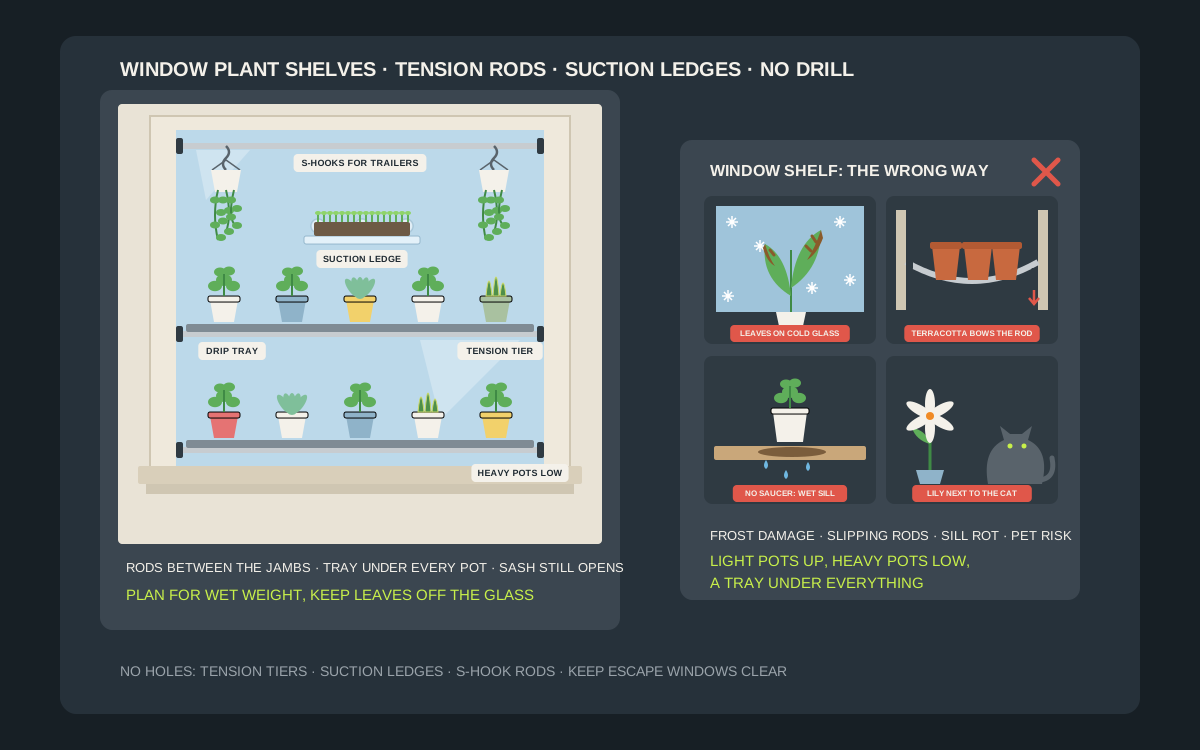
The brightest spot in most apartments is a strip of window a few inches deep, and every plant you own wants to live there. The sill is too narrow for more than two pots, the floor in front of it is where the radiator or the couch goes, and the lease says no holes in the frame. A tension-rod window shelf solves that without a drill: spring-loaded rods wedge between the side jambs of the window, shelves sit on the rods, and three or four tiers of herbs and small houseplants get the same light the sill gets. Add a suction-cup ledge on the glass or a rod with a few S-hooks for hanging pots and a single window can carry a dozen plants. It works well, but only if you respect three things that the product photos leave out. Wet pots are much heavier than dry ones, and a tension rod holds by friction on two small pads. Window glass gets very cold in winter and very hot in summer, and leaves pressed against it get damaged. And a window is a fall risk for small children and, in a bedroom, an escape route. This guide covers which no-drill window shelf suits which window, how much weight these shelves really hold when the plants are watered, how to fit them so they leave no marks on a rental frame, how to water without rotting the sill, what grows in which direction of window, and how to keep children and pets safe around a window full of pots. Most setups cost well under $50.
Shop no-drill tension-rod window plant shelves on Amazon
Who this is for
- Renters with one good window and more plants than sill space, who cannot drill into the frame or the wall
- Anyone growing kitchen herbs, microgreens or succulents who wants them where the light is, not on a dim counter
- Plant owners in small apartments who need to keep pots out of reach of a cat, a dog or a toddler
- People in cold climates who want to know how to keep a window garden alive through winter
Quick answer
For most apartment windows, the best under-$50 option is a tension-rod window plant shelf: two or three spring-tension tiers that fit between the side jambs, set so every pot sits on a drip tray and no leaf touches the glass. Choose one whose width range covers your inside frame measurement, check the per-shelf weight rating, and plan for wet pots rather than dry ones; one all-metal model sold on Amazon, for example, lists 12 pounds per shelf, and suction-cup ledges are usually rated somewhere around 7 to 10 pounds. Use a suction-cup ledge on clean glass for one row of light pots, a single tension rod with S-hooks for two or three small hanging plants, and a freestanding stand in front of the window when the frame is vinyl or too shallow. Keep heavy terracotta low or on the floor, keep bedroom escape windows openable and keep anything climbable away from windows when small children live with you.
Quick comparison
| Shelf type | Best for | How it holds | Trade-off |
|---|---|---|---|
| Tension-rod tiered window shelf | Deep wood or drywall-return frames; several small pots | Spring or twist rods press against the side jambs; shelves sit on the rods | Rating varies widely; keep within the width range; not for hollow vinyl liners |
| Pair of tension rods with a board or acrylic panel | Custom widths and odd windows | Two rods at the same height carry a cut-to-size shelf | Only as strong as the rods; level both carefully |
| Suction-cup acrylic window ledge | One row of herbs, microgreens or succulents | Suction cups on clean, smooth glass; some add support legs | Light loads, often about 7 to 10 lb; recheck the cups regularly |
| Tension rod with S-hooks for hanging pots | Two or three small trailing plants | Rod near the top of the frame; pots hang from hooks | Budget rods rarely state a rating; water at the sink |
| Clamp-on window sill extender | Widening a narrow sill by a few inches | Clamps or brackets grip the sill or the apron below it | Check the sill thickness range; can mark soft wood |
| Freestanding tiered plant stand | Vinyl or shallow frames, or heavier pots | Stands on the floor in front of the window | Takes floor space; can be a climbing aid for toddlers |
| Floor-to-ceiling tension pole plant stand | A corner beside the window | Spring pole between floor and ceiling with trays or hooks | Needs a firm ceiling; side light is weaker than front light |
| Clip-on LED grow light | North windows and dark winter months | Clips to a shelf or rod above the pots | Needs an outlet and a timer; keep cords tidy |
Tension-rod window plant shelvesSuction-cup window plant ledgesWindow sill extender shelves
What to look for
A width range that matches your inside frame
Tension window shelves are sold by span, such as 28 to 43 inches or 43 to 64 inches, and they only grip properly in the middle of that range, not at the very ends of it. Measure the inside of the frame, jamb to jamb, at the height where each tier will sit, because old frames are rarely perfectly square. Then pick a model whose range puts your measurement comfortably inside it. A rod at full extension is at its weakest, and a rod near its shortest setting may not compress far enough to fit.
A real weight rating, per shelf and in total
Many budget tension rods sold for plants state no load rating at all. Prefer the ones that do, and read the rating per shelf and for the whole unit. One all-metal window tension shelf lists 12 pounds per shelf; Veg Ledge rates its suction-cup ledge at 7 pounds, with optional support legs adding about 2 pounds each; and Beautiful Views, which makes cable-hung window shelves, recommends about 10 to 12 pounds per shelf and no more than 40 pounds for a whole unit. Those numbers belong to those products only. Whatever the figure, plan for the wet weight of your pots and stay well under it.
Pads that grip without marking
Tension shelves hold by pressing two small end pads hard against the jambs, so the pads decide both how well the shelf holds and what it leaves behind. Look for wide rubber or silicone end caps rather than hard plastic. They grip better on painted wood, spread the pressure and are less likely to leave a dent or a ring. Some makers warn openly that strongly pressed tension products can leave marks, so if the frame is freshly painted or soft, a freestanding stand is the safer choice.
Shelves that hold water, not just pots
A window shelf is watered more often than any other shelf in the apartment. Solid shelves with a raised lip, or slatted shelves with a drip tray on top, keep water off the sill, the radiator and the floor. Open wire tiers are fine if every pot sits in a saucer. Clear acrylic ledges with a raised edge stop pots sliding off when the window is opened, and some suction ledges add a lip of about an inch for exactly that reason.
Enough depth for your pots, not too much for the window
Measure the depth from the glass to the front of the frame, then compare it with your pot sizes. Many window shelves are only about 4 to 6 inches deep, which suits pots with a base of 4 inches or so. A deeper shelf holds bigger pots but puts more leverage on the rods and blocks more light from reaching the room. If the window opens inward, as casement and tilt-turn windows often do, check that the shelves will not stop the sash from swinging.
A plan for the window you actually have
A double-hung or sliding window with deep wooden jambs is ideal for tension tiers. A casement window that cranks outward usually is too, as long as the crank handle stays reachable. Vinyl replacement windows with hollow jamb liners, shallow metal frames with no flat return and windows with an air conditioner in them are poor matches for tension rods, and suction ledges or a freestanding stand will serve you better. Decide which window you are using before you choose the shelf.
Read your window before you buy
Which way does it face?
Direction decides what will grow. Nebraska Extension puts it simply: if a south window gives 100 percent of the available light, east and west windows give about 60 percent and a north window about 20 percent. A south window is the place for herbs, succulents and anything that likes sun. East and west windows suit most leafy houseplants, with west windows running warmer in the afternoon. A north window will keep low-light foliage plants going but will not grow good basil. A compass app on your phone settles the question in a few seconds.
How close is close enough?
Light falls off quickly as you move away from the glass. Illinois Extension describes the area directly in front of an east or west window as bright light, a few feet back as medium and 3 to 10 feet back as low, and N.C. State Extension notes that a south window can become a low-light spot just 8 feet into the room. That is the whole case for a window shelf: it puts pots inches from the glass instead of on a table across the room. Iowa State Extension adds that the areas just to the side of a window are darker than they look, so a shelf inside the frame beats a stand beside it.
Measure the frame, the sill and the opening
Write down the inside width of the frame at the bottom, middle and top, the depth of the jamb from the glass to the front edge, the depth of the sill, the height of the glass and how the window opens. Note the window lock, the crank handle on a casement and any blind or curtain hardware at the top. Those numbers tell you which shelf width range you need, how deep the shelves can be and where the tiers can go without blocking the lock or the sash.
Check the frame material
Painted wood and plaster or drywall returns give tension rods something firm to push against. Aluminum frames are hard but often shallow. Vinyl replacement windows are the problem: the jamb liners are hollow, and steady pressure from a tension rod can bow them over time. If you see hollow plastic channels on the sides of the sash, use a suction ledge on the glass or a freestanding stand on the floor instead, and keep rods out of the frame.
Note what else lives at the window
A radiator or heating vent under the window will dry out pots on the lowest tier and bake the roots of anything sitting right above it. A window air conditioner rules out that window for shelves. Blinds and curtains need to keep working, and a cordless blind or a curtain that clears the shelf avoids a tangle every time you open them. If the window is in a bedroom, it may be the room’s emergency escape window, which changes the plan; there is more on that below.
Which no-drill shelf suits which window
Tension-rod tier shelves
These are the workhorses: two to four shelves on rods that press between the side jambs, usually with adjustable heights. They suit wide, deep wooden or drywall-return frames and carry the most pots per window. Set the bottom tier a few inches above the sill so you can still use the sill itself, the middle tier at eye level and a top tier for trailing plants that can hang down over the glass. Keep the heaviest pots on the lowest tier, where a slip does the least damage.
Suction-cup ledges on the glass
Clear acrylic ledges stick straight to the window pane with suction cups. They hold a single row of light pots, they block very little light and they work on vinyl windows where tension rods should not go. Their limits are weight and maintenance: ratings are usually somewhere around 7 to 10 pounds per ledge, and the cups need clean, dry, smooth glass and a check every week or two. They are ideal for microgreens, a few herbs or a row of succulents in 3 or 4 inch pots.
A tension rod with S-hooks for hanging plants
A single sturdy rod near the top of the frame, with S-hooks, turns the upper part of the window into a place for trailing pothos, string of hearts or a small fern. Keep it to two or three small pots, hang the heavier ones near the ends of the rod where it is strongest and take them down to the sink to water. A rod in the middle of a wide window will sag long before a short one does.
Clamp-on sill extenders
Sill extenders clamp onto the existing sill, or rest on brackets that hook under it, to add a few inches of depth. They suit narrow sills in good windows and do not touch the jambs at all. Check the range of sill thicknesses the clamp accepts, put a scrap of felt or rubber under any metal jaw that touches painted wood and keep the load modest, because all of it hangs off the front edge of the sill.
Freestanding and tension-pole stands
If the frame cannot take a rod, put the shelf in front of the window instead. A narrow tiered plant stand or a ladder shelf on the floor holds heavier pots than any rod, and a floor-to-ceiling tension pole with trays can fill a corner beside the window. Both lose some light compared with shelves inside the frame, and both are climbable, which matters if you have a toddler. Choose a stand with a wide base and keep it a little back from the glass.
Weight: plan for wet pots, not dry ones
Weigh your plants after watering
The weight on the box is for whatever the maker tested, and your pots weigh far more on watering day than on the shelf in the store. The simplest check is a kitchen or bathroom scale: water each plant, let it drain and weigh it with its saucer. Add up everything that will go on one tier. That total, not the dry weight, is what the rods have to hold, every week, for months.
Pot material makes a big difference
Lightweight plastic nursery pots inside a decorative sleeve are the easiest on a window shelf. Glazed ceramic and terracotta are much heavier, and terracotta soaks up water, so it gets heavier still when wet. If you love terracotta, keep it on the bottom tier or on the floor stand, use smaller sizes and put lighter plastic pots on the upper tiers and the hanging rod.
Spread the load and stay well under the rating
Put heavier pots near the ends of each shelf, close to the jambs, rather than in the middle of the span, and spread them evenly rather than bunching them on one side. Heian Shindo, which makes heavy-duty tension shelves, asks for an even load, no shock loads such as pulling down on the shelf, and a check a few days after installing and then weekly. That is good advice for any tension product. If a shelf states no rating at all, treat it as a shelf for a few light pots only.
Do a test day before you trust it
Load each tier with about half the planned weight for a day, then check that nothing has slipped, bowed or tilted. Then add the rest. Look at the end pads from the side: if one has crept even slightly down the jamb, tighten the rod or move it. Repeat the check after the first few waterings, when the pots are at their heaviest and drips may have reached the pads.
Fitting tension rods without marking the frame
Clean, dry and level
Wipe the jambs where the end caps will sit and let them dry. Dust, cooking grease and condensation all make the pads slip. Set each rod at the height you want, use a small level or a level app on your phone and mark nothing on the paint; a strip of low-tack painter’s tape beside the pad gives you a reference line that peels off later.
Tension it properly, then check again
Follow the maker’s method, whether that is twisting the rod or compressing a spring, until the rod is firmly tight and does not move when you press down on the middle. Do not use the rod at the very end of its extension range. Check the rods again after a few days, because pads settle into paint, and again whenever the season changes, because frames expand and contract with temperature and humidity.
Protect the paint and the jambs
Wide rubber or silicone end caps spread the pressure. A small clear felt or rubber pad between the end cap and a soft painted jamb protects the finish further, as long as it does not make the rod slip. Avoid vinyl jamb liners altogether. When you move out, release the tension slowly and wipe the spots; a faint ring on paint usually comes off with a damp cloth.
Keep the lock, the sash and the blinds working
Before you load anything, open and close the window, work the lock, run the blind up and down and draw the curtains. A shelf that stops the window from opening is not just annoying; in a bedroom it can be a safety problem. If the window has to be opened often, a suction ledge on the fixed pane or a stand in front of the window may be a better fit than tiers inside the frame.
Suction-cup ledges: getting them to stay
Start with clean, smooth glass
Every suction-ledge maker says the same thing: clean the glass first. Veg Ledge says its instructions must be followed and includes alcohol wipes and a microfiber cloth for the job. Wipe the glass with rubbing alcohol, let it dry, then press each cup firmly to push out all the air. Suction cups do not hold on textured glass, frosted film or across the joint between two panes.
Load it slowly and keep it light
Put one pot on, wait a day, then add the rest. Count the ledge, the pots, the soil and the water in the total and keep it under the stated rating. If the maker sells support legs that rest on the sill, use them; Veg Ledge says each of its legs adds about 2 pounds of support. A raised lip at the front keeps pots from sliding off when a sliding window is opened.
Check the cups regularly
Suction cups lose their grip slowly as air creeps in, especially when the glass goes from cold at night to warm in the afternoon sun. Press each cup again once a week or so. When a cup goes cloudy or stiff, one maker’s advice is to wash it in a mild detergent, soak it in warm water for about five minutes and dry it before using it again, or replace it with the spares that often come in the box.
Watering without wrecking the sill
A saucer or tray under every pot
Water that runs out of the bottom of a pot will find the lowest point, which on a window shelf is the sill, the radiator or the floor. Painted wooden sills soften, swell and rot when they stay wet, and that is exactly the kind of damage that comes out of a deposit. Give every pot a saucer, or line each tier with a shallow waterproof tray, and empty standing water after watering so roots do not sit in it.
Water at the sink when you can
Small pots on a window shelf are easy to carry. Taking them to the sink, watering until water runs out of the bottom and letting them drain for a few minutes before putting them back is the cleanest method by far. It also means water never runs down the rods onto the end pads, which is one of the main reasons tension rods slip. Hanging pots on S-hooks come down the same way.
Watch for condensation and mold
Windows are the coldest surfaces in most apartments in winter, so moisture from the room, and from a group of plants, condenses on the glass and runs down to the sill. The U.S. Environmental Protection Agency suggests keeping indoor humidity below 60 percent, ideally between 30 and 50 percent, and fixing the source of moisture when condensation appears. Wipe the glass and the sill when they are wet, open the blinds during the day and leave a small gap between the shelf and the glass so air can move.
Group plants, but not too tightly
Illinois Extension notes that homes often drop below 30 percent humidity in winter and that grouping plants together raises the humidity around them. A window shelf does that naturally. Leave a little space between pots for air, though, so leaves dry quickly after watering and fungal problems have less chance to start.
Winter and summer at the window
Keep leaves off cold glass
Purdue University’s horticulture specialists advise keeping plants on a windowsill far enough back that their leaves do not touch the cold panes in winter, and Illinois Extension warns that cold glass can damage foliage. Plants lean toward the light as they grow, so a pot set a safe distance from the glass in October may be pressed against it by January. Leave a gap of a few inches, turn pots a quarter turn every week or two and check the leaves after a cold night.
Mind the cold pocket behind the curtains
Heavy curtains drawn at night trap a pocket of cold air between the fabric and the glass, which is exactly where a window shelf sits. If your curtains close in front of the shelf, either leave them open on mild nights, move tender tropical plants into the room overnight in the coldest weeks or put the hardiest plants on the window shelf for the winter. Most foliage plants, Illinois Extension says, prefer daytime temperatures of about 65 to 75 degrees Fahrenheit and nights 5 to 10 degrees cooler.
Radiators, vents and drafts
A radiator under the window bakes the pots on the lowest tier and dries their soil within a day. Raise the bottom tier, put a tray of pebbles and water between the radiator top and the pots if you must use that spot, and check the soil more often. Leaky windows and air conditioning vents cause the opposite problem, blasts of cold air that tropical plants dislike. If you can feel a draft with your hand, move the sensitive plants elsewhere.
Summer sun and hot glass
The same window that saves your plants in December can scorch them in July. Missouri Extension notes that plants that do not need bright light can be sunburned in a south window in late spring, summer and early fall, and west windows get strong, hot afternoon sun. Pull sensitive plants back a few inches, use a sheer curtain on the hottest days and water more often. Bleached or brown patches on the side facing the glass are the sign that a plant is getting too much.
Safety: kids, pets and escape windows
Do not build a ladder to an open window
The U.S. Consumer Product Safety Commission recommends keeping furniture away from windows so children cannot climb toward them, never relying on screens to stop a fall and installing window stops so windows open no more than 4 inches. A low, sturdy plant stand in front of a window is exactly the kind of thing a toddler climbs. If young children live with you, use shelves inside the frame that start well above the sill, keep floor stands away from windows that open, and fit window stops or guards; renters should ask the landlord about window guards.
Keep bedroom escape windows usable
In many apartments, the bedroom window is the second way out in a fire, and building codes generally require bedroom escape windows to open from the inside without keys or tools. A shelf, a rod or a heavy stand that stops that window from opening, or that you would have to clear first in the dark, is a bad trade for a few plants. Use a different window for the plant shelf, or choose a suction ledge on a fixed pane that leaves the opening clear.
Know which plants are toxic to your pets
Cats love windows, and a window shelf puts plants right where they lounge. The ASPCA keeps a searchable list of plants that are toxic and non-toxic to cats and dogs. True lilies and daylilies are dangerous to cats even in small amounts and can cause kidney failure, and common houseplants such as pothos and aloe are on the toxic list for both cats and dogs. Spider plants, Boston ferns and many herbs are listed as non-toxic. Check every plant before it goes on a shelf a cat can reach, and keep the ASPCA Animal Poison Control number, (888) 426-4435, handy.
Cords, cables and heavy pots overhead
Corded blinds are a strangulation risk for small children, and the CPSC recommends cordless window coverings in homes with young children. A grow-light cord running down the window frame needs the same care: clip it up and out of reach. Never put heavy pots on a top tier above a bed, a crib or a sofa, and never hang a shelf of plants where a fall would land on someone.
What to grow on a window shelf
South windows
The brightest spot is the place for herbs such as basil, thyme, oregano and rosemary, plus succulents, cacti and anything that flowers. Illinois Extension describes the area directly in front of a south window as direct light. In summer, pull the softer plants back or shade them with a sheer curtain in the hottest hours.
East and west windows
East windows give gentle morning sun and bright light the rest of the day, which suits most leafy houseplants, African violets, mint, parsley and chives. West windows give the same amount of light but more heat in the afternoon, so they suit tougher plants and need more watering. Missouri Extension lists east and west windows as the usual choice for plants in the medium light range.
North windows
A north window gives soft, even light all day but not much of it. Low-light foliage plants such as pothos, philodendron, snake plants and ZZ plants will cope; most herbs will grow thin and pale. If you want herbs in a north window, or anywhere in midwinter, a small clip-on LED grow light on the shelf makes the difference.
Adding a grow light
Missouri Extension advises placing most plants with their tips about 6 to 12 inches from the light source, and Illinois Extension suggests 14 to 16 hours of light a day for plants in low light, but no more than 16. A plug-in timer handles the schedule. Clip the light to the shelf or rod above the pots, keep it out of the water and keep its cord tidy and away from little hands.
Keep pots small and matched to the shelf
Window shelves suit pots with a base of about 3 to 5 inches. Herbs bought in supermarket pots can usually be split into two or three smaller pots, which also helps them grow better. Choose plants that will stay compact or that you can trim, and give trailing plants the top tier so they can hang down rather than reaching across the glass.
Three sample setups
Kitchen herb window, south-facing, double-hung
Two tension tiers between the wooden jambs, the lower one about 6 inches above the sill and the upper one at eye level, each with a lipped tray. Six 4-inch pots of basil, parsley, thyme, chives, oregano and mint sit on the trays, the mint in its own pot so it cannot take over. The sill keeps a slim tray for a seed-starting kit in spring. Everything comes down to the sink to water twice a week, and the sash still opens for air.
Living room window with a cat, east-facing, vinyl frame
No rods in the hollow vinyl jambs. Instead, two clear suction-cup ledges on the lower fixed pane hold a row of cat-safe plants such as a spider plant, a Boston fern and a few calatheas, all checked against the ASPCA list. A narrow freestanding stand to one side holds the heavier pots, and the cat keeps its own window perch on the other window. The suction cups get pressed again every Sunday.
Studio apartment, north-facing, with a toddler
One tension tier set high in the frame, well above anything a child could stand on, holds four small pothos and philodendron pots in a tray, with a clip-on grow light on a timer for the winter. A single top rod carries two trailing plants on S-hooks. Window stops limit the opening to 4 inches, the blind is cordless and the grow-light cord is clipped up the frame out of reach. There is no stand on the floor.
How to set it up in an afternoon
- Check which way the window faces, how it opens and whether it is a bedroom escape window.
- Measure the inside width at the bottom, middle and top, the jamb depth, the sill depth and the glass height.
- Look at the frame material and rule out tension rods if the jambs are hollow vinyl.
- Water your plants, let them drain and weigh them with their saucers to get the real load per tier.
- Choose a shelf whose width range puts your measurement in the middle and whose rating clears your wet weight with room to spare.
- Clean and dry the jambs, fit the rods level and firmly tight, and test the lock, the sash and the blinds.
- Load each tier to about half for a day, check for slipping, then add the rest with heavy pots near the ends.
- Put a saucer or tray under every pot and leave a few inches between the leaves and the glass.
- Recheck the rods after a few days and weekly after that, and check the leaves after cold nights.
Mistakes to avoid
- Planning the load around dry pots and forgetting what they weigh after watering.
- Wedging tension rods against hollow vinyl jamb liners that bow under steady pressure.
- Using a rod at the very end of its width range, where it is weakest.
- Watering pots on the shelf so water runs down the rods onto the end pads and the sill.
- Letting leaves press against the glass on a freezing night.
- Putting a lily or another plant that is toxic to cats on a shelf the cat can reach.
- Placing a climbable stand in front of a window a toddler can open.
- Blocking a bedroom escape window with a shelf or a heavy stand.
Related guides
Browse the hub: No-drill apartment storage under $50 - all guides
- Best Adhesive Plant Wall Planters for Apartments Under $50
- Best Tension Rod Shelves for Apartment Closets Under $50
- Best No-Drill Curtain Rods for Apartments Under $50
- Best Cat Window Perch Mounts Under $50
- How to Hang Curtains in an Apartment Without Drilling Under $50
- Best No-Drill Picture Ledge Shelves for Apartments Under $50
- Best Adhesive Floating Shelves for Apartments Under $50 (No Drill)
- Best Adhesive Window Light Clips for Apartment Holiday Lights Under $50
- Best Tension Rod Under-Sink Organizers for Apartments Under $50
FAQ
How much weight can a tension-rod window plant shelf hold?
It depends entirely on the product, and many budget rods state no rating at all. One all-metal window tension shelf lists 12 pounds per shelf, and Beautiful Views recommends about 10 to 12 pounds per shelf and 40 pounds in total for its hanging window shelves. Weigh your pots after watering and stay well under the stated figure.
Will a tension rod damage my window frame?
On solid painted wood or drywall returns, wide rubber end caps usually leave little more than a faint ring that wipes off. Hollow vinyl jamb liners are different: steady pressure can bow them over time, so use a suction ledge or a freestanding stand on vinyl windows instead.
Do suction-cup window shelves really hold plants?
Yes, for light loads on clean, smooth glass. Ratings are usually around 7 to 10 pounds per ledge; Veg Ledge, for example, rates its ledge at 7 pounds. Clean the glass with rubbing alcohol, press out all the air, load slowly and press the cups again every week or so.
Is a window too cold for houseplants in winter?
It can be. Purdue horticulture specialists advise keeping leaves from touching cold window panes, and Illinois Extension warns that cold glass can damage foliage. Leave a few inches between the leaves and the glass, avoid trapping plants behind closed curtains on the coldest nights and move tender tropical plants into the room if needed.
Which plants are best for a window shelf?
Match the plant to the window. Herbs and succulents want a south window, most leafy houseplants do well in east or west windows, and low-light plants such as pothos, philodendron and snake plants cope with north windows. Small pots with a base of about 3 to 5 inches suit most window shelves.
Is a window plant shelf safe with kids and pets?
It can be with care. Keep tiers high and stands away from windows a child can open, fit window stops so windows open no more than 4 inches as the CPSC recommends, and never block a bedroom escape window. Check every plant against the ASPCA toxic plant list, and keep lilies away from cats entirely.
Bottom line
The best tension-rod window plant shelf for an apartment is the one that fits your frame, holds your pots when they are wet and leaves the window working. For deep wooden or drywall-return frames, that is a two or three tier tension shelf with wide rubber end caps and a stated per-shelf rating; for vinyl frames, it is a suction-cup ledge on clean glass or a freestanding stand in front of the window. Weigh your watered pots, keep heavy ones low and near the jambs, put a tray under everything, keep leaves off cold glass and keep children, pets and escape routes in mind. Measure your window, then check the width range, the weight rating and the current price on the listing before you buy.