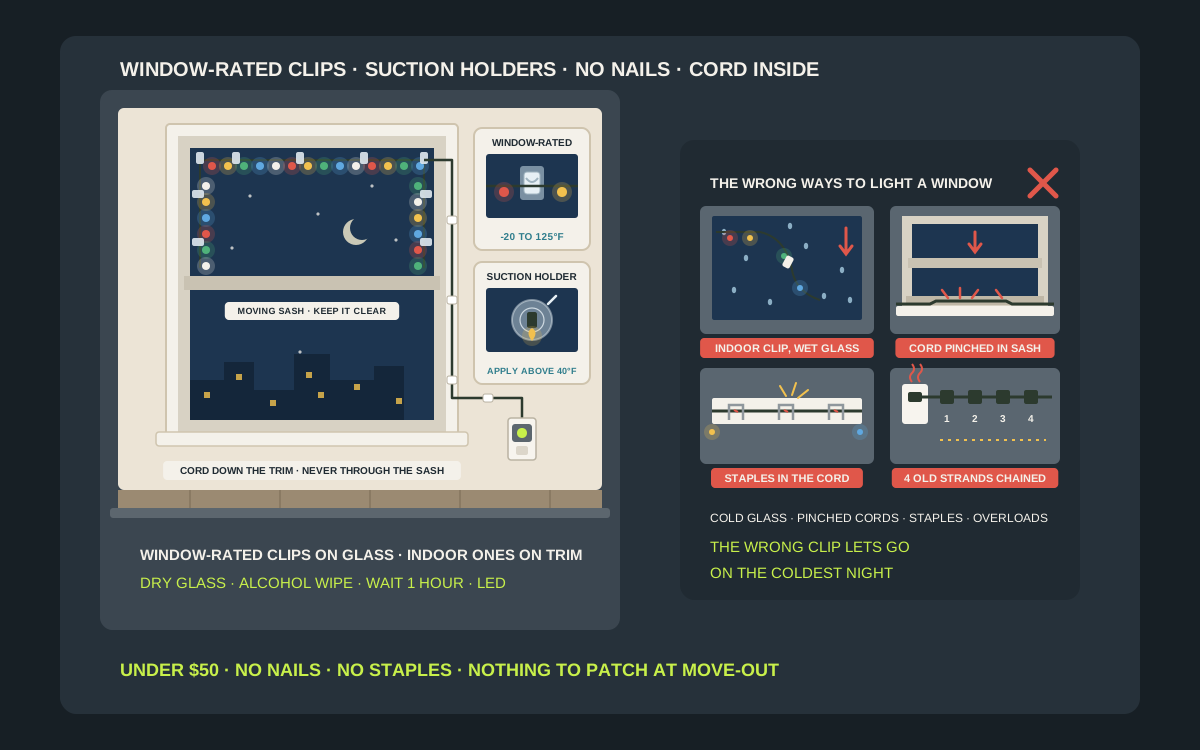
In an apartment, the window is the one place holiday lights can be seen from the street, the courtyard and the sofa at the same time. It is also the hardest surface in the home to stick anything to. In December the glass is cold, often wet with condensation in the morning, and in full sun by the afternoon, and the sash moves every time someone opens it. That is why the cheap clear clips most people grab for lights can let go on a window within days. Command’s own instructions for its indoor Clear Decorating Clips say not to use them on windows at all. The clips that do work on glass are a different family: outdoor-rated adhesive light clips and window hooks, and good suction cups made for lights. Most windows can be outlined for well under $50 with either. This guide covers which clips belong on the glass and which belong on the painted trim, how to put them up so they hold through a cold snap, where the cord should go, how many strands one outlet can take, and how to get it all down in January without leaving a mark on the window or the paint.
Shop window light clips on Amazon
Who this is for
- Renters who want lights around a window without nails, staples, screws or tape marks at move-out
- Anyone whose clear clips keep dropping off the glass on cold mornings and wants to know why
- Small-apartment households planning one or two lit windows from a single outlet, safely
Quick answer
For lights on the glass itself, use clips made for windows. Command’s Outdoor Light Clips use a water- and UV-resistant strip that Command says can be used on windows, and its outdoor products hold from -20 to 125 degrees F once applied to clean, dry glass above 15 degrees F. For a no-adhesive option, suction-cup mini light holders, such as Adams Mini Light Holders, grip the bulb sockets directly and hold from -20 to 120 degrees F when first pressed on above 40 degrees F. Keep indoor Clear Decorating Clips on the painted trim and wall around the window, never on the glass, and use about one clip for every 2 feet of lights. A small pack of any of these costs well under $50. Run the cord down the trim to an outlet, not through a closed window, prefer LED strands, and check the current price and pack count on the listing before you order.
Quick comparison
| Clip | Best for | How it holds | Trade-off |
|---|---|---|---|
| Outdoor-rated clear light clips (e.g. Command Outdoor Light Clips) | Light strands on the glass, inside or out | Water- and UV-resistant clear strip; apply above 15 F, holds -20 to 125 F; made for windows and other smooth outdoor surfaces | Glass must be clean and dry when applied; not for rough brick or rough-sawn wood |
| Outdoor window hooks (e.g. Command Medium and Large Window Hooks) | Anchor points for a light swag, a lighted star or the ends of a strand | Clear hook on a window strip; 2 lb (medium) or 4 lb (large) | Large hook is for windows only; one item per hook; remove by stretching the strip at least 15 in |
| Suction-cup mini light holders (e.g. Adams Mini Light Holders) | Mini light strands spaced bulb by bulb on glass | Suction cup that grips the mini bulb socket; holds -20 to 120 F once applied above 40 F | Needs clean, smooth glass; may need pressing down again in cold or humid spells |
| Suction cups with hooks (e.g. Adams small, medium and large) | Garland with lights, a swag or a lit window decoration | Small 1-1/8 in cup rated 1 lb, medium 1-3/4 in rated 3 lb, large rated 7 lb, on glass | Ratings are for glass; choose the cup by the load, not by looks |
| Indoor clear decorating clips (e.g. Command Clear Decorating Clips) | The painted trim and wall around the window | Indoor clear strip; about 1 clip for every 2 ft of lights; 20 clips and 24 strips per pack | Not for windows or wallpaper; apply above 50 F; may let go above 105 F |
| Curtain lights on the curtain rod | A curtain of light with no adhesive at all | LED curtain strand hung from the existing rod or a spring rod in the window recess | A light spring rod such as Kenney Fast Fit is meant for sheers, about 2 lb |
Outdoor-rated clear light clipsSuction-cup mini light holdersClear window hooks for lights and swags
What to look for
Is the clip actually rated for glass?
This is the question that decides everything else. Command sells two kinds of clear light clip that look almost identical in the pack. The indoor Clear Decorating Clips come with indoor strips, and their instructions say in capital letters not to use them on windows. When a shopper asked whether they would hold on the inside of a window exposed to direct sun and cold outdoor glass, 3M’s support team answered that the adhesive is not temperature or UV resistant and pointed to its window hooks and outdoor light clips instead. Command’s FAQ says all of its outdoor products, and its clear window hooks, can be used on windows. So read the front of the pack, not the photo. If it does not say outdoor or window, keep it off the glass.
The temperature of the glass, not the room
Your living room may be 70 degrees, but a single-pane or older double-pane window on a freezing night can be far colder on its inside face, and the outside of the glass is at outdoor temperature. Command rates its indoor strips for application above 50 degrees F and warns they can lose adhesion above 105 degrees F, which a sunny south window can reach behind a curtain. Its outdoor strips are made to be applied above 15 degrees F and to hold from -20 to 125 degrees F. Adams rates its suction cups to hold from -20 to 120 degrees F, as long as they are first applied above 40 degrees F. Those numbers tell you to install on a mild, dry afternoon, not on the coldest night of the month.
Wet glass and condensation
Warm, humid indoor air condenses on cold glass, which is why so many apartment windows are beaded with water on winter mornings, especially in kitchens, bathrooms and bedrooms. Adhesive strips need a clean and dry surface to bond, and Command’s window hook instructions say to apply only to clean, dry glass. Suction cups also lose their grip as temperature and humidity shift, and Adams says they may need to be pressed down again from time to time. If your windows sweat, pick a dry, mild day, wipe and dry the glass completely, and expect to check suction cups after the first cold week.
How the lights will be held
Most light clips hold the wire between the bulbs. That suits standard mini strands, LED strings and C-style sets. Suction-cup mini light holders work differently: Adams describes its holders as gripping the mini bulb socket itself, so each cup positions one bulb and keeps the strand close to the glass. Rope lights need a clip sized for them, and Command’s outdoor rope light clips take rope lights or cords up to 3/8 inch thick. Look at your strand before you buy clips, and match the clip to the wire, the socket or the rope.
How it comes off in January
Every option here is removable, but only if you take it down the way it was designed. Command’s adhesive clips and hooks release by stretching the strip’s tab slowly straight down along the surface, never by pulling them toward you. Suction cups release with the small tab on their edge. Plan the removal before you install: leave every tab pointing down and reachable, and do not put a clip where a curtain, blind or window lock will cover the tab.
The five kinds of window light clip, compared
Outdoor-rated adhesive light clips: the default for glass
Command’s Outdoor Light Clips are small clear clips on a clear strip that is made to be water and UV resistant, and 3M sells them for doors, windows, soffits, gutters and other sealed, smooth outdoor surfaces. That outdoor formulation is exactly what makes them the right choice for the inside of a cold window as well. Command says its outdoor products should be applied to a clean, smooth, dry surface above 15 degrees F and that they hold strongly down to -20 degrees F and up to 125 degrees F. In the UK, 3M advises one clip for every 60 centimeters, about 2 feet, of lights. For a typical apartment window, a single pack is enough to run a strand across the top and down both sides of the glass, and the clear clips disappear against the window at night.
Outdoor window hooks: for the heavier pieces
A strand of lights weighs very little. A lit star, a garland with lights wrapped through it, or the heavy plug end of a strand weighs more, and that is what Command’s window hooks are for. Command rates its Outdoor Medium Window Hooks at 2 lb and its Outdoor Large Window Hook at 4 lb. The large hook’s instructions say to use it only on windows, to clean the glass with a cloth dampened with water or isopropyl rubbing alcohol rather than a household cleaner, and to press the strip and then the hook for 30 seconds each and wait an hour before hanging anything. Use one hook per item, and keep it to decorations: Command says not to hang valuable or irreplaceable items or framed pictures from it.
Suction-cup mini light holders: no adhesive at all
Suction holders are the oldest answer to lights on glass and still one of the best for renters, because nothing sticks to anything. Adams Manufacturing, a Pennsylvania suction-cup maker whose holiday cups are sold through hardware stores such as Ace and True Value, makes Mini Light Holders whose cup grips the mini bulb socket itself, so you place the strand bulb by bulb and it sits close to the glass. Adams says its suction cups hold from -20 to 120 degrees F if they are first applied above 40 degrees F, and that they work best on dry, clean, smooth, non-porous surfaces such as glass. Its cups also use what it calls light-diffusing rings: earlier suction cups could act like a small magnifying glass in strong sun and scorch whatever sat behind them, which matters on a sunny window with a curtain or sill close by.
Suction cups with hooks: for swags and window decorations
When you want to swag lights or a lighted garland across the top of a window, a row of suction cups with hooks does the job without a single strip. Adams sells small 1-1/8 inch cups rated at 1 lb, medium 1-3/4 inch cups rated at 3 lb and large cups rated at 7 lb, and it is clear that its ratings are for suction cups with hooks on glass. Pick the size by what each cup carries: small for a light strand, medium for a garland section or a lit ornament. Adams also recommends against the newer suction cups that rely on a sticky ring around the rim, which it says can peel paint or leave residue that is hard to remove.
Indoor clear decorating clips: on the trim, not the glass
Command’s Clear Decorating Clips are the most common clip in the holiday aisle, and they are excellent for what they are made for. 3M lists painted walls, smooth ceilings, finished wood, tile and metal among the indoor surfaces they hold on, and recommends one clip for every 2 feet of lights; a standard pack has 20 clips and 24 strips. Around a window, that makes them the right clip for the painted casing and the wall, where you route the cord down to the outlet or carry the strand around the outside of the frame. Their instructions also say not to use them on windows, not to use them on wallpaper, to apply them above 50 degrees F, and that they may lose adhesion above 105 degrees F. They also warn that they may not stick well to vinyl or textured surfaces, and many apartment window frames are vinyl. So keep them on smooth, painted trim and off the glass and the vinyl frame.
Where the lights should go on an apartment window
On the fixed glass, not across the moving parts
Look at how your window opens before you plan the strand. On a double-hung window, the lower sash usually slides up past the upper one. On a slider, one pane runs along a track. A clip on the face of the glass is fine, but a strand that crosses the meeting rail, the track or the gap where the sash moves will be pinched or torn loose the first time someone opens the window for air. Keep the run on the glass of each pane, or on the outer trim, and let the strand go around the moving joint rather than across it.
Inside the glass, not outside
In most apartments the inside face of the window is the only one you can reach safely. Outdoor-rated clips will hold on the outside of the glass, but leaning out of a window above the ground floor to place them is not worth any amount of curb appeal. If you have a ground-floor patio door or a balcony you can stand on, outdoor clips are fine there. Otherwise, light the inside of the glass: from the street, a strand clipped just inside the window reads almost the same.
Leave the bedroom window free to open
U.S. building codes often require sleeping rooms, including many apartment bedrooms, to have an emergency escape and rescue opening, usually a window, that can be opened from inside without keys, tools or special knowledge. Lights clipped around the glass do not change that, but a strand looped over the lock, a garland tied across the sash, or a tension rod wedged in front of the opening can. In a bedroom, keep the latch, the handle and the opening clear, and make sure the window still opens fully with the lights up.
Keep curtains and blinds off the tabs
A curtain that brushes against the clips every time it is drawn will slowly peel the strips. A blind that drops onto the strand can crush it. Place the run just inside the frame where the curtain hangs clear of it, or hang curtain lights from the curtain rod instead of fighting the curtains. Leave the clip tabs pointing down and uncovered so you can reach them in January.
Plan the cord path before the first clip
The plug end is the part people forget. Decide which outlet the window will use, then work backward: the strand should finish at the bottom corner of the window nearest that outlet, and the lead should run down the painted trim and along the baseboard, held by indoor clips, to the plug. It should never pass through a closed window, under a sash or across a sill where the window closes on it.
Putting the clips up so they hold through a cold snap
Install on a mild, dry day
The single best thing you can do for any window clip is to put it up when the glass is dry and not too cold. Adhesive strips bond best when they are applied within their range, above 15 degrees F for Command’s outdoor strips and above 50 degrees F for indoor ones, and Adams suction cups should be first applied above 40 degrees F. A weekend afternoon in late November usually beats the evening after the first hard frost.
Clean with rubbing alcohol, then dry
Wipe the spot with isopropyl rubbing alcohol on a lint-free cloth, then let it dry completely. Command says not to use household cleaners, which leave a slippery film the strip cannot bond to, and the same film stops a suction cup from sealing. For suction cups, Adams also suggests washing the cup itself in warm, soapy water and drying it gently if it is dusty or has been stored in a box of ornaments.
Press, wait an hour, then hang
For adhesive clips and hooks, press the strip onto the glass firmly for 30 seconds, press the clip onto the strip for another 30 seconds, and wait one hour before you clip in the lights, so the adhesive can build its hold. For suction cups, press the whole cup flat against the glass to push the air out. Adams says a tiny dab of petroleum jelly on the rim can improve the seal. Then hang the strand and leave a little slack between clips so the wire is not pulling on any one of them.
Space the clips by the strand, not by eye
Use roughly one clip for every 2 feet of lights on a straight run, and add one at every corner where the strand changes direction. Corners carry the most pull. With suction holders that grip each bulb, you can space them closer for a neat, even line, as long as the cups do not touch.
Check them after the first cold week
Walk past each window a week after you install. Adhesive clips should simply stay put. Suction cups may need to be pressed down again, which Adams calls burping, as air creeps in with temperature and humidity changes. A clip that has slid or lifted at one end will not improve on its own; take it down properly and replace it with a fresh strip on clean, dry glass.
Cords, strands and the outlet
Never run the cord through the window
The Electrical Safety Foundation International (ESFI) warns against cords that are pinched in doors or windows or under heavy furniture, which damages the insulation. A light cord closed in the sash is crushed every time the window shuts and can be cut on the latch. Keep the plug and the lead inside, run them down the trim, and if you are lighting the outside of a balcony door, use a strand and an extension cord marked for outdoor use, plugged into a GFCI-protected outlet, as ESFI advises for outdoor decorations.
No nails, tacks or staples through the wire
ESFI says cords should never be attached with nails or staples, and that light strings should not be mounted or supported in a way that could damage the insulation. That rules out the push pins and staple guns that sometimes end up holding lights to window trim. A clip that holds the wire without piercing it is the whole point.
Count the strands on each outlet
ESFI’s rule is never to connect more than three strands of incandescent lights end to end, because more can blow a fuse and can start a fire. LED strands usually allow more connections, but the number belongs to the manufacturer: read the tag on the strand. Spread the windows across outlets rather than chaining everything into one, and do not overload an outlet with lights, a space heater and a TV on the same plug.
Prefer LED strands near curtains and glass
ESFI points out that LED lights use less energy and run cooler than traditional incandescent lights. On a window, where the strand sits beside curtains and blinds, that matters more than anywhere else in the room. Buy lights tested by a recognized laboratory such as UL, Intertek (ETL) or CSA, check that the label says indoor use or indoor and outdoor use, and inspect every strand for cracked sockets and bare wire before it goes up.
Switch them off at night
ESFI recommends turning off all indoor and outdoor electrical decorations before you go to sleep or leave home. A simple plug-in timer does that for you and keeps the window lit for the evening hours when people actually see it. If you want a candle in the window, use a battery-operated one; ESFI notes that candles start almost half of home decoration fires.
Taking it all down in January
Unclip the lights first
Take the strand off every clip before you touch the strips or cups. A clip still carrying a strand can swing as the strip releases and knock the glass or scuff the trim.
Stretch adhesive tabs straight down, slowly
Hold the clip gently in place without pressing it against the surface, then stretch the strip’s tab slowly straight down along the glass or the wall. Never pull it toward you. Command’s instructions call for stretching at least 6 inches for its indoor decorating clips, and at least 15 inches for its large window hook, before the strip releases. Our adhesive stocking holder guide covers what to do if a tab tears.
Lift suction cups by the tab
Adams cups have a small release tab on the edge. Lift it to let air in and the cup comes away with no residue. Wash the cups in warm, soapy water, dry them, and store them flat so they keep their shape for next year.
Store the strand so it works next year
Wrap each strand on a reel or a piece of cardboard, plug end first, and bag it with its clips and a pack of matching refill strips. Next November, the whole window goes back up in a few minutes. If your building has a storage cage or you share a garage, our holiday light and decoration storage guide covers reels, bins and wall racks for the off-season.
A five-minute plan before you buy
Measure the glass and the trim
Measure the width and height of each pane you want to light. Add them up for the length of strand, and divide by 2 for a rough clip count, plus one for each corner.
Check how the window opens
Open and close the window and note where the sash moves, where the lock sits and where the curtain falls. Plan the run around all three.
Find the outlet
Locate the nearest outlet and count what is already plugged in. Decide which corner of the window the plug end will finish at.
Choose glass clips or trim clips
For the glass, buy outdoor-rated clips, window hooks or suction holders. For the painted trim and the cord path, indoor decorating clips are fine. Most windows need a bit of both.
Mistakes to avoid
- Putting indoor clear decorating clips on window glass, where cold, sun and condensation make them let go.
- Applying clips or suction cups to wet or freezing glass, or cleaning it with a spray cleaner instead of rubbing alcohol.
- Running the strand across the moving sash or the slider track, so it is pinched the first time the window opens.
- Feeding the cord through a closed window or under the sash to reach an outlet.
- Holding lights or cords with nails, push pins or staples.
- Connecting more than three incandescent strands end to end, or more LED strands than the tag allows.
- Covering the lock and the opening of a bedroom window with lights, garland or a rod.
- Pulling adhesive clips outward instead of stretching the tab slowly straight down.
Related guides
Browse the hub: No-drill apartment storage under $50 - all guides
- Best Adhesive Christmas Stocking Holders for Apartments Under $50 (No Mantel)
- Best Over-Door Wreath Hangers for Apartments Under $50
- Best Adhesive Cable Clips & Cord Organizers for Apartments Under $50
- Best Adhesive Power Strip Wall Mounts for Apartments Under $50
- Best No-Drill Curtain Rods for Apartments Under $50
- Best Holiday Light & Decorations Garage Storage Under $50
FAQ
Can I use Command clear decorating clips on windows?
Not the indoor ones. The instructions for Command’s indoor Clear Decorating Clips say not to use them on windows, and 3M has said their adhesive is not temperature or UV resistant. For glass, use Command Outdoor Light Clips, Command outdoor window hooks or suction-cup light holders, and keep the indoor clips on painted trim.
Do suction cups or adhesive clips work better on apartment windows?
Both work on clean, dry, smooth glass. Suction holders leave nothing behind and grip the bulb sockets, but may need pressing down again in cold or humid spells. Outdoor-rated adhesive clips hold more steadily through temperature swings and release cleanly if you stretch the tab straight down.
Why do my light clips keep falling off the window?
Usually because they are indoor clips, or because the glass was cold, wet or cleaned with a household spray when they went on. Reinstall on a mild, dry day with window-rated clips, wipe the glass with rubbing alcohol first and wait an hour before clipping in the lights.
How many clips do I need for one window?
Plan on about one clip for every 2 feet of lights, plus one at each corner. A window about 3 feet wide and 5 feet tall outlined on three sides takes roughly 13 feet of strand and 8 to 10 clips.
Can I run the light cord out through the window?
No. ESFI warns against cords pinched in doors or windows, because it damages the insulation. Run the cord down the trim to an indoor outlet, and use outdoor-rated lights, extension cords and a GFCI-protected outlet for anything outside.
Will window light clips damage the glass or paint?
Not if you use the right clip on the right surface and remove it correctly. Stretch adhesive tabs slowly straight down along the surface, never toward you, and lift suction cups by their tab. Keep indoor clips off wallpaper, vinyl and textured surfaces.
Bottom line
You do not need nails, staples or tape to light an apartment window. Put outdoor-rated clear clips, window hooks or suction-cup light holders on the glass, and keep indoor decorating clips on the painted trim where they belong. Install on a mild, dry day on glass wiped with rubbing alcohol, keep the strand off the moving sash and the bedroom window’s latch, run the cord down the trim to an indoor outlet, and choose LED strands with no more connections than the tag allows. In January, stretch the tabs straight down and lift the suction cups by their tabs, and check the current price and pack count on the listing before you order.