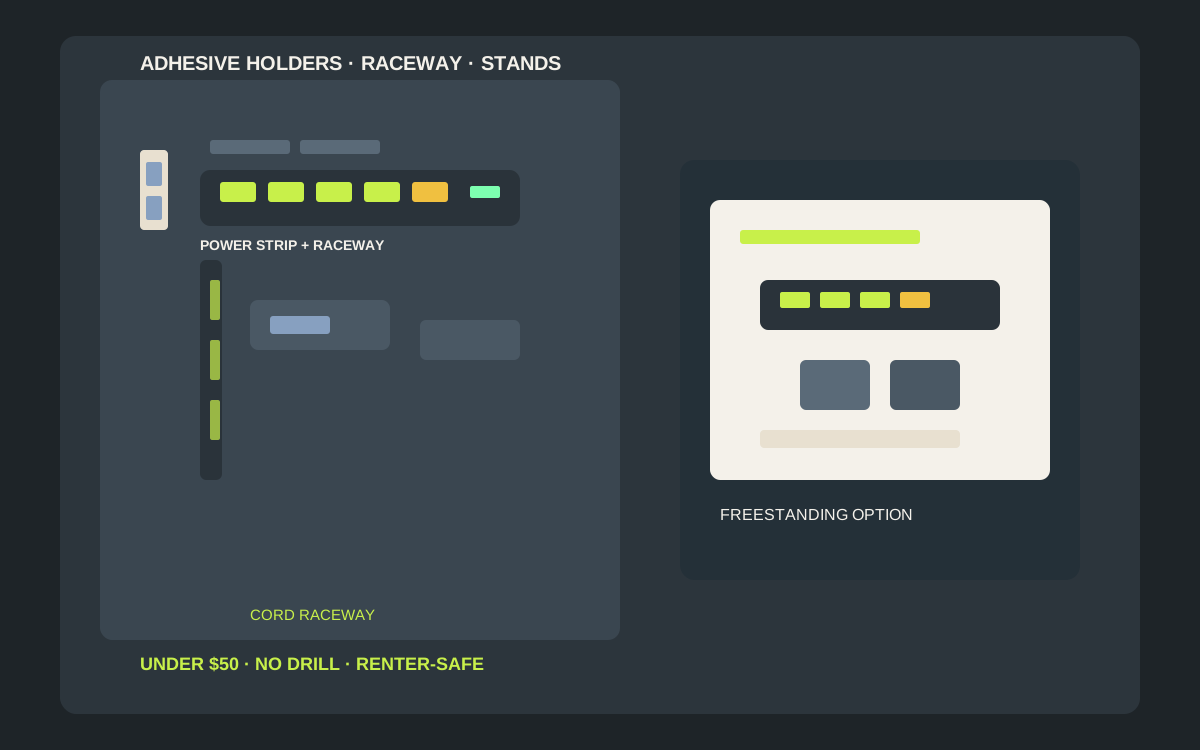
For most apartments, the best under-$50 power-strip upgrade is an adhesive holder or raceway-plus-strip kit that lifts cords off the floor without covering vents or blocking the wall outlet. Match the mount to strip length and plug angle, keep surge and heat ratings honest, and never daisy-chain strips. On weak paint or heavy brick loads, prefer a freestanding stand — check the current dimensions and price on the listing before you buy.
Shop adhesive power strip wall mounts on Amazon
Who this is for
- Renters who want power strips and surge protectors off the floor without drilling studs
- Apartment dwellers comparing adhesive holders, raceway kits, and freestanding stands under $50
- Anyone managing desk, TV, or kitchen counter cord clutter while keeping outlets and GFCI reachable
Quick answer
For most apartments, the best under-$50 power-strip upgrade is an adhesive holder or raceway-plus-strip kit that lifts cords off the floor without covering vents or blocking the wall outlet. Match the mount to strip length and plug angle, keep surge and heat ratings honest, and never daisy-chain strips. On weak paint or heavy brick loads, prefer a freestanding stand — check the current dimensions and price on the listing before you buy.
Quick comparison
| Format | Best for | Typical price band | Why it wins |
|---|---|---|---|
| Adhesive power-strip holders | Lift a slim strip off baseboard clutter | Usually $8–$25 | Fastest no-drill win; check length fit |
| Raceway + strip kits | Hide cord runs to desk/TV/outlet | Usually $15–$40 | Cleaner look; pair or buy combo |
| Outlet-cover / screwless mounts | Anchor strip near the receptacle | Usually $10–$30 | Keep GFCI and plugs reachable |
| Freestanding surge-strip stands | Heavy bricks or weak/textured paint | Usually $12–$35 | Zero wall risk; uses floor/furniture |
What to look for
Weight, cord tug, and adhesive honesty
A loaded strip plus dangling bricks puts peel force on the top edge of every pad. Prefer kits with clear maker guidance for painted drywall, wait the full cure time, and support brick weight with clips or a raceway so cords do not yank the mount. Never assume a load rating — if the strip feels heavy for décor adhesive, use freestanding.
Outlet access and GFCI clearance
Do not bury the wall outlet or GFCI test/reset buttons under a cover plate mount. You still need to unplug for storms, trips, and move-out. Prefer open holders that leave the receptacle face reachable, and keep kitchen/bath GFCI free of plastic shrouds.
Heat, surge ratings, and daisy-chain safety
Covering strip vents or stacking bricks against hot transformers invites heat. Prefer open mounts, follow the strip maker’s surge and wattage guidance, and never daisy-chain strips or plug heaters into a glued décor mount. Check the current product labels on the listing before you buy.
Renter removal and wall finish
Unload plugs first, then warm-strip pads per the maker’s slow-pull method. Adhesive fails fastest on textured, humid, or freshly painted walls. Keep leftover pads with the mount so the next apartment install is ready.
Adhesive holders vs raceways vs freestanding
When adhesive holders win
If you have smooth painted drywall, a slim strip, and light brick load, an adhesive power-strip holder is usually the best under-$50 pick: minutes to install, no holes, and the whole setup leaves with you on move-out.
When raceway kits are smarter
Choose a raceway-plus-strip approach when the mess is the cord path, not just the strip body — desk-to-outlet runs, TV console spaghetti, or nightstand chargers. Support brick weight on the wall path so peel force does not concentrate on one pad corner.
When outlet-cover mounts make sense
Some kits clamp or sit at the receptacle so the strip hangs beside the wall plate. They can look tidy, but only if you can still reach plugs, switches, and GFCI buttons. Skip anything that fully shrouds the outlet face.
When freestanding beats glue
Skip adhesive if walls are textured, humid, freshly painted, or you hang dense surge bricks and multi-plug bricks from one mount. A compact freestanding stand under $50 keeps weight on the floor and still clears baseboards.
How to choose the right capacity
Measure strip length and plug angle
Note overall strip length, whether plugs exit the side or end, and how far bricks hang. A holder sized for a 4-outlet strip may leave a longer surge bar overhanging.
Plan brick support separately
Laptop and router bricks are heavy for their size. Rest them on a second clip, raceway shelf, or furniture — do not let them dangle from the strip while the adhesive takes all peel force.
Keep vents and labels readable
Open mounts beat fully enclosed boxes. You should still read the surge rating sticker and feel airflow around the strip body.
Treat under-$50 bands as moving targets
Check the current dimensions, ratings, and price on the listing before you buy.
Installation that survives rental life
Clean, dry, smooth paint only
Wipe dust and oils, skip damp or cold walls, and follow the maker’s cure window before you load plugs. Adhesive fails fastest on dusty baseboard-height paint and popcorn texture.
Dry-fit cords before final stick
Hold the mount at height with the strip and bricks mock-routed. Confirm the wall outlet stays reachable and the strip will not block a thermostat, light switch, or door swing.
Load light, then add bricks
Start with the strip empty. After cure, add low-draw plugs first. Watch for slow peel at the top edge over the first day before hanging denser bricks.
Move-out without wall scars
Unplug everything, unload the strip, then remove pads with the slow-pull method the brand specifies. Wipe residue; do not pry a loaded mount off painted drywall.
Mistakes to avoid
- Covering strip vents or stuffing the bar inside a closed plastic shroud with zero airflow.
- Daisy-chaining two power strips or plugging a space heater into a décor adhesive mount.
- Blocking GFCI test/reset buttons or burying the wall outlet under a full cover plate.
- Hanging heavy laptop bricks off the strip lip so peel force concentrates on one pad corner.
- Sticking to textured, humid, or week-old paint and skipping the cure time.
- Expecting one $10 glue holder to replace a stud-mounted raceway for a full AV stack.
Related guides
Browse the hub: No-drill apartment storage under $50 - all guides
- Best Adhesive Cable Clips & Cord Organizers for Apartments Under $50
- Best Adhesive Cord Raceway Kits for Apartments Under $50
- Best Adhesive Phone Charging Wall Shelves for Apartments Under $50
- Best Adhesive Router & Modem Wall Shelves for Apartments Under $50
FAQ
What is the best adhesive power strip wall mount for apartments under $50?
An adhesive holder or raceway-plus-strip kit that matches your strip length and keeps the wall outlet reachable is usually the best under-$50 default. Choose freestanding when paint or brick weight is questionable.
Will adhesive mounts hold a surge protector with power bricks?
Sometimes for slim strips on smooth paint when you follow maker guidance, cure times, and support bricks separately. Dense surge bars plus hanging bricks often need freestanding or split support — never assume two ratings add up.
Is it safe to cover a power strip with a wall mount?
Prefer open holders that leave vents and labels clear. Fully enclosing a strip or blocking airflow can trap heat. Follow the strip maker’s guidance and never guess at joule or wattage ratings.
Can I mount a strip over or in front of the wall outlet?
Only if plugs, switches, and GFCI buttons stay reachable. Do not bury the receptacle under a sealed cover. You still need to unplug for trips, storms, and move-out.
Will removing the mount damage rental paint?
Usually not if you unload first and follow the strip’s slow-pull instructions. Damage comes from yanking loaded mounts or sticking to weak, fresh, or textured paint.
Bottom line
Adhesive power strip wall mounts under $50 earn their keep when length, cord tug, and outlet access match the real strip: adhesive holders for slim bars, raceway kits for cord paths, outlet-adjacent mounts only when GFCI stays reachable, and freestanding stands when paint or brick weight says stay off the wall. Cure the adhesive, support bricks separately, never daisy-chain or cover vents, and remove gently on move-out. Check the current ratings and price on the listing before you buy.