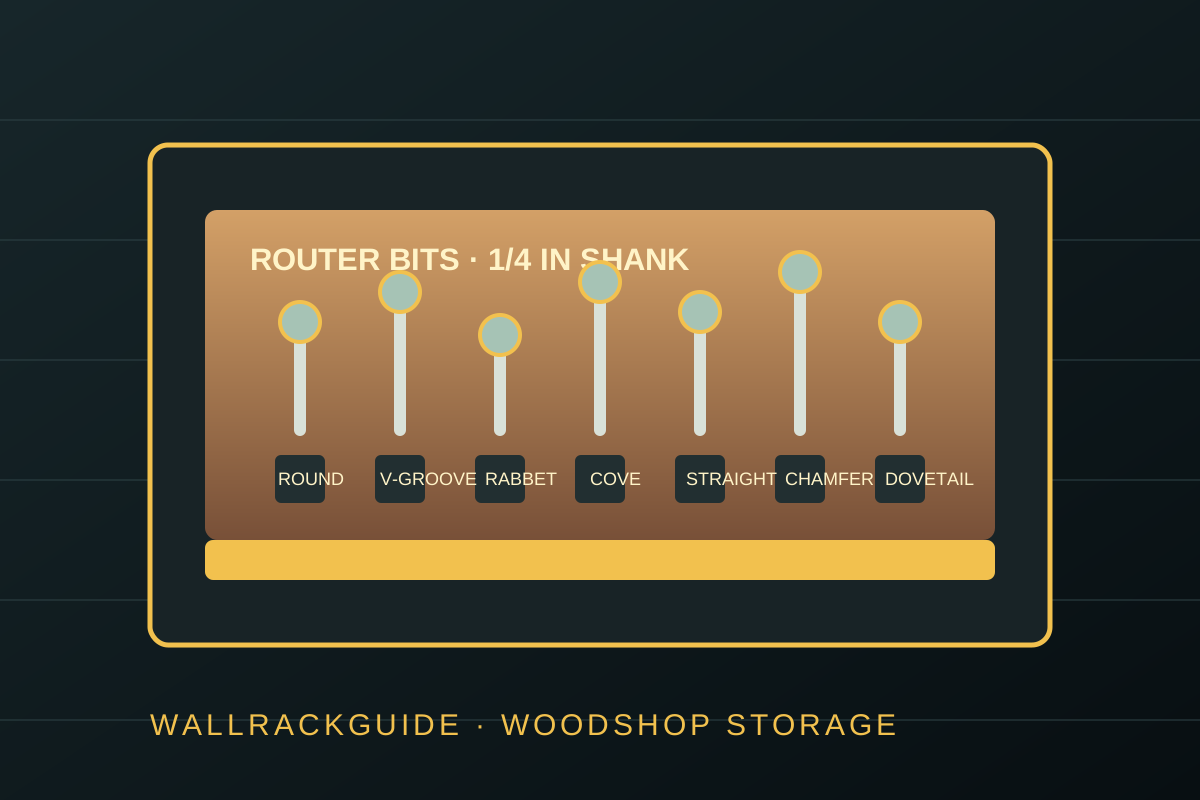
Router bits reward careful storage. Their cutting edges are easy to nick, their profiles are hard to identify from a loose pile, and a 1/4-inch shank does not belong in the same unlabeled row as a 1/2-inch shank. The best wall rack under $50 keeps profiles visible, protects the carbide, and places the bit set close to the router without turning a sharp-tool station into a hazard.
Shop router bit racks under $50 on Amazon
Who this is for
- Woodworkers building a compact router station beside a garage workbench
- DIYers sorting straight, round-over, chamfer, rabbeting, and specialty bits
- Shops that want a visible bit index without dedicating an entire tool cabinet
Quick answer
For most users, start with a lidded indexed case or a rack with deep, individual pockets and a positive front lip. Separate 1/4-inch and 1/2-inch shanks, label profiles where you can read them without removing every bit, and keep cutting edges away from hands and wall traffic. Mount the rack beside—not directly below—the router station, where chips and vibration are easier to control.
What to look for
Shank size and profile fit
Confirm whether the organizer accepts 1/4-inch, 1/2-inch, or both. Then check the longest bit, widest cutter, and any bearing or guide hardware. A pocket sized for a straight bit may not accept a wide round-over cutter.
Edge protection and retention
Router bits should sit upright in individual holes, sleeves, or a closed case. Look for a base that supports the shank and a lip or lid that prevents a bit from tipping out when the wall is bumped. Exposed cutting edges should never face the normal hand path.
Labels that survive shop use
A rack is only useful when you can identify the profile and size before reaching. Large labels, a consistent order, and separate rows for common profiles beat an attractive but anonymous grid.
Dust, moisture, and access
Wood dust settles into open pockets and moisture encourages rust on uncoated steel. Put the rack outside the direct chip stream, use a lid where practical, and leave hand clearance so you do not scrape a neighboring cutter during a quick selection.
Backing and load path
A bit rack is lighter than a router, but daily opening and closing still pulls on its fasteners. Use a stud, solid backer, or properly reinforced pegboard. Do not let a shelf full of bits become top-heavy or depend on a single weak hook.
Quick comparison
| Product type | Best for | Typical price band | Why it wins |
|---|---|---|---|
| Lidded indexed bit case | Complete mixed-profile collections | Usually $20–$40 | Best edge protection and clearest inventory |
| Individual-pocket wall rack | Daily-use bits beside the bench | Usually $15–$35 | Fast selection with a stable upright position |
| Deep shelf with labeled cups | Wide cutters and odd profiles | Usually $25–$45 | Accommodates bulky bits and small accessories |
| Pegboard bit-holder set | Existing reinforced pegboard | Usually under $30 | Modular layout for a changing collection |
Compare current under-$50 router bit racks on Amazon
How to set up a router-bit wall rack
- Inventory by shank and profile: Separate 1/4-inch from 1/2-inch bits, then group common profiles. Remove damaged cutters and note which bits need deeper pockets or a closed case.
- Measure the largest cutter: Check total length, cutter diameter, bearing width, and the clearance needed to lift it straight out. Include the lid or front lip in the measurement.
- Choose a clean wall zone: Place the rack near the router and collet wrench, but outside the direct path of chips, clamps, and swinging workpieces. Keep sharp edges away from shoulder height and walkways.
- Install and load gradually: Use studs, a solid backer, or reinforced pegboard. Mount level, test the widest bit first, and add the rest only after each pocket retains its bit without rubbing.
- Maintain the index: Wipe bits before storage, keep labels readable, and return each profile to its position. A small lidded case for infrequent or expensive bits keeps the open rack quick and safe.
Common mistakes
- Putting 1/4-inch and 1/2-inch shanks together without clear labels
- Choosing a slot by shank size while ignoring cutter diameter and total length
- Leaving sharp bits loose on an open shelf where a hand can find them
- Mounting directly under a sanding or routing area where dust fills the pockets
- Using light anchors for a rack that is opened, closed, and pulled on every day
Related pick: Best Drill Bit Storage & Wall-Mount Organizers Under $50
FAQ
Should router bits be stored in a wall rack or a case?
Use a case for small, expensive, infrequently used, or sharp-profile bits that need maximum protection. An individual-pocket rack is faster for daily-use bits when it retains the shanks and keeps cutting edges away from hands.
Can one rack hold 1/4-inch and 1/2-inch router bits?
Only if it has separate, correctly sized pockets or adapters. Keep the shank sizes in distinct labeled sections; a shared unlabeled row makes selection slower and can leave a bit poorly supported.
How do I keep router bits from rusting on a garage wall?
Store clean, dry bits away from sinks, damp floors, and unsealed concrete. A lidded case adds protection in humid garages, but it should not trap sawdust or moisture inside.
Should a router bit rack be mounted above the workbench?
Mount it beside the router station at a comfortable reach, not where a dropped bit can land on a workpiece or where your arm crosses exposed cutters. Keep the rack outside the main chip stream.
Browse the hub: Garage wall storage under $50 — all guides
Related guides
- Best Router Wall Mounts Under $50 for Woodshop Garage Walls
- Best Drill Bit Organizers Wall Mount Under $50
- Best Chisel Racks Wall Mount Under $50 for Garage Workbenches
- Best Hole Saw Kit Wall Organizers Under $50 for Garage
Bottom line
The best router bit rack under $50 gives every profile a protected, readable home. Choose a lidded case for maximum edge protection, individual pockets for daily access, or a deep labeled shelf for wide cutters and mixed hardware. Separate shank sizes, mount to sound backing outside the chip stream, and keep the cutting edges pointed away from the way you work.