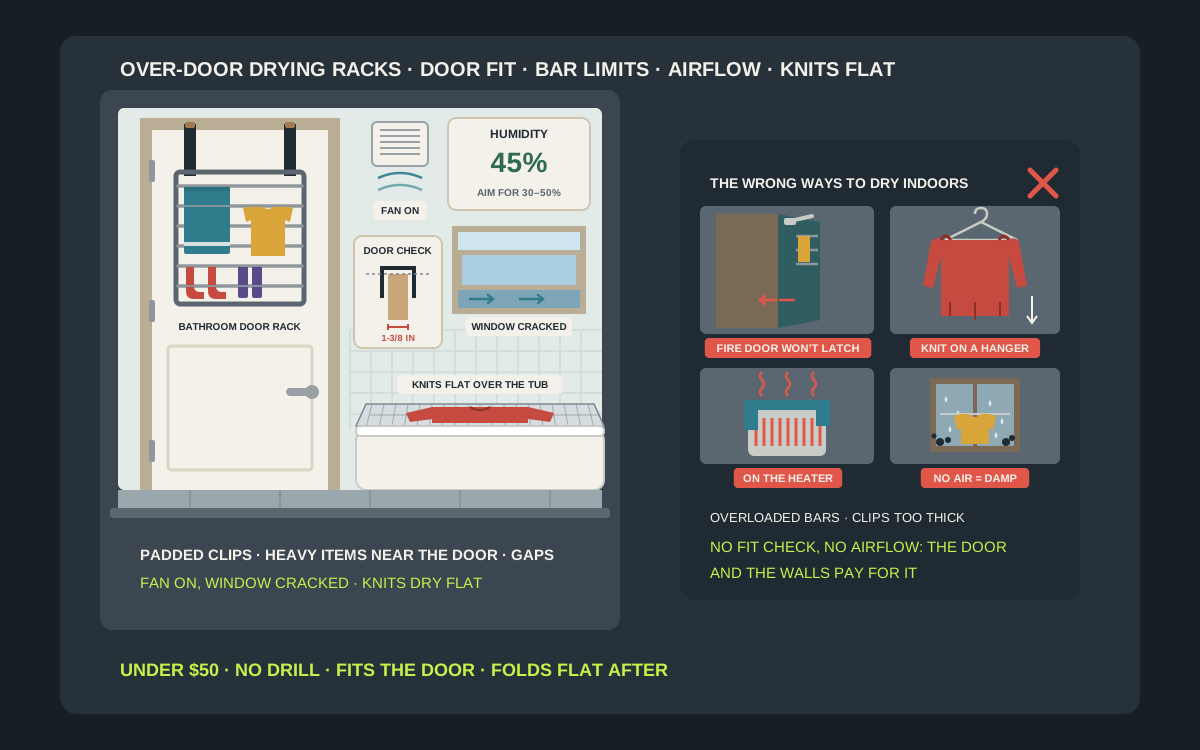
In a small apartment, laundry day ends with a familiar problem: half the load should not go in the dryer, and there is nowhere to put it. Sweaters, workout gear, bras, delicates and anything with a hang-dry label end up draped over chairs, the shower rail and the back of the sofa, and the living room spends the evening looking like a launderette. A folding floor rack helps, but in a studio it eats the only clear stretch of floor you have. An over-door drying rack uses the one surface nobody is using: the back of a door. It hooks over the top edge, so there is nothing to drill and nothing to patch at move-out, and most of the good ones cost well under $50. Choosing one is less about brand and more about fit. Your door has to be thin enough for the clips, the rack has to open without blocking the room, the bars have to carry wet weight, and the room has to cope with the water that comes out of the clothes as they dry. This guide covers the main rack types, how to measure your door, which door to use, how to keep knits in shape and how to dry indoors without inviting damp and mildew.
Shop over-the-door drying racks on Amazon
Who this is for
- Renters with a stacked or shared laundry, or no dryer at all, who need somewhere to air-dry a load without drilling or giving up floor space
- Anyone whose wardrobe includes knits, activewear, delicates and hang-dry labels that should stay out of the dryer
- Studio and one-bedroom tenants who want a rack that folds flat against a door and disappears between washes
Quick answer
For most apartments, the best under-$50 over-door drying rack is a fold-out frame rack that hangs on the bathroom or closet door and folds flat when you are done. Greenway’s stainless steel rack has 10 bars, about 17 feet of drying space and a 50 lb rating, but it is rated at 5 lb per bar and fits doors only up to 1.5 inches thick. Honey-Can-Do’s single-tier rack hangs over a door or screws to a wall, gives 12 linear feet across six bars, holds 40 lb and folds to 3 inches. For sweaters and delicates that have to dry flat, Brabantia’s Hanging Drying Rack hangs from a door on adjustable, padded arms and is designed for flat drying. Before you buy, measure the door’s thickness, check that it still closes and latches with the clips on, and dry in a room where you can run a fan or open a window. Check the current price and fit details on the listing before you order.
Quick comparison
| Rack | Best for | How it hangs and holds | Trade-off |
|---|---|---|---|
| Fold-down frame rack (e.g. Greenway GCL7010SS) | A full small load on a standard interior door | Hooks over the door; 10 stainless steel bars, about 17.3 ft of drying space, 50 lb total | 5 lb per bar; fits doors up to 1.5 in thick only |
| Fold-flat door-or-wall rack (e.g. Honey-Can-Do DRY-09793) | Everyday hang-dry items in a small bathroom | 6 bars, 12 linear ft, 40 lb; opens 18.5 in deep and folds to 3 in | Needs clear swing room in front of the door when open |
| Two-tier fold-flat rack (e.g. Honey-Can-Do DRY-09792) | Bigger households drying most of a load | 12 bars on two tiers, 20 linear ft, 50 lb; about 47.5 in tall | Covers most of the door; can list above $50 |
| Adjustable-arm hanging rack (e.g. Brabantia Hanging Drying Rack) | Sweaters and delicates that must dry flat | Padded adjustable arms over a door; 15 ft (4.5 m) of line, suited to drying delicates flat; 2.6 lb | About half a wash load; no weight rating in pounds |
| Folding hanger rod (e.g. InstaHanger with over-door bracket) | Shirts and blouses drying on hangers | 12 in rod folds out on a foam-lined bracket; 25 lb on the door, 50 lb wall-mounted | For 1-3/8 in doors; hangers only |
| Over-door hook rack (e.g. Spectrum 6 double hooks) | A few hangers or a robe and towel | Flexible padded bracket for doors 1-3/8 to 2-1/4 in thick; 20 x 11.25 x 4.25 in | Home Depot lists the white version at 5 lb; not a full rack |
Collapsible over-door drying racksFlat mesh sweater drying racksOver-door hook racks for hangers
What to look for
Door thickness and the gap at the top
Every over-door rack hangs from clips or brackets that wrap over the top edge of the door, and those clips are made for a specific thickness. Standard interior doors in North America are usually 1-3/8 inches thick, while exterior doors and many solid-core or fire-rated doors are 1-3/4 inches. Greenway’s rack fits doors up to 1.5 inches, so it suits a typical bedroom, bathroom or closet door but not a thicker one. InstaHanger’s over-door bracket is sold for 1-3/8 inch doors. Spectrum’s six-hook rack, by contrast, has a flexible bracket that fits doors from 1-3/8 to 2-1/4 inches. Measure the top edge of your door with a tape measure before you order, then check that there is a small gap between the top of the door and the frame, because the clip has to sit in it while the door still closes.
How far it sticks out when open
A drying rack is useful because it projects from the door so air can move around the clothes. That also means the door may not open fully while the rack is out. Honey-Can-Do lists its single-tier rack at 18.5 inches deep when open and just 3 inches folded, and a bar rack like Greenway’s folds down flat against the door between uses. Open the door you plan to use and look at what it swings toward. If it opens against a wall, a toilet or a vanity, the rack will hit it. Many renters solve this by drying with the door closed, or by choosing a closet door that can stay shut for a few hours.
Bars, linear feet and the per-bar limit
Makers describe capacity three ways: number of bars, total linear feet and a weight rating. Linear feet tell you how much fabric you can spread out. Weight tells you how much the frame carries. The detail most shoppers miss is the per-bar limit. Greenway rates its rack at 50 lb in total but 5 lb per bar, so a soaked pair of jeans and a bath towel belong on separate bars, close to the door. Honey-Can-Do rates its six-bar rack at 40 lb and its two-tier version at 50 lb. Remember that a washed load is heavier than a dry one: in a full-scale study of indoor drying, researchers found about 2 kg (roughly 4.4 lb) of water evaporating from a typical cotton load.
A flat surface for knits
If you wash wool or other knitwear at home, the rack needs somewhere to lay it flat. The Woolmark Company says knitted garments should be dried flat, out of direct sunlight, because hanging them lets the weight of the water stretch them, and hangers can leave humps in the shoulders. Bar racks are fine for T-shirts, socks, leggings and towels. For sweaters, look for a rack that is designed for flat drying, such as Brabantia’s Hanging Drying Rack, or add a separate mesh sweater dryer that rests over the bathtub.
Pads, finish and rust
The rack sits against your door for months, so protection matters as much as capacity. Look for felt pads or foam on the clips and on any part of the frame that rests on the door. Greenway includes adhesive felt pads, InstaHanger lines its stainless bracket with foam and Brabantia covers its arms in a soft protective material. Wet clothes go straight onto the bars, so choose stainless steel or a powder-coated finish that is sold as rust-resistant, and replace the rack if the coating chips and starts to stain fabric.
Frame racks vs fold-flat racks vs flat dryers vs hanger rods
Fold-down frame racks: the most drying space per door
A frame rack hooks over the top of the door and carries a section of drying bars that folds out on supports. Greenway’s stainless steel model is a good example: 10 bars, about 17.3 feet of drying space and a 50 lb rating, with felt pads for the hooks. It folds down flat against the door, or lifts off entirely, when the laundry is dry. The limits are worth reading carefully. Greenway rates each bar at 5 lb and fits doors only up to 1.5 inches thick, so it will not go over a 1-3/4 inch solid door. Put heavy items on the bars nearest the door and lighter pieces on the outer ones, which keeps the frame from tipping away from the door as it loads up.
Fold-flat door-or-wall racks: slim when closed, sturdy when open
Honey-Can-Do’s collapsible racks fold out from the door like a wall-mounted laundry dryer, and they come with both door clips and wall hardware. The single-tier model, DRY-09793, has six powder-coated steel bars, 12 linear feet of drying space and a 40 lb rating. It opens to 18.5 inches deep and folds back to 3 inches, so on a bathroom door it barely shows when it is closed. The two-tier DRY-09792 doubles that to 12 bars and 20 linear feet with a 50 lb rating, but at about 47.5 inches tall it covers most of a standard door, and some retailers list it above $50. Both suit renters who may later want to screw the same rack to a laundry-room wall in a future home.
Adjustable-arm racks: the flat-drying option
Brabantia’s Hanging Drying Rack takes a different approach. Instead of fixed clips, it has adjustable arms covered in soft material that hook over narrow doors and walls up to 4.3 inches thick, and a lock that remembers the last setting. Brabantia lists 15 feet (4.5 meters) of drying line, about half a wash load, and pitches the rack for small in-between jobs and for drying delicate laundry flat. It weighs 2.6 lb and folds its arms away for storage. Brabantia does not publish a weight rating in pounds, so treat it as a rack for a few knits, a set of delicates or a gym kit rather than a full load of towels.
Folding hanger rods: for shirts that dry on hangers
Shirts, blouses and dresses often dry best on their own hangers, where gravity pulls out the creases. A folding hanger rod handles that without bars. InstaHanger’s 12-inch rod folds out from a slim ABS and stainless steel body and comes with an over-door bracket lined with foam. Its specifications are clear about the difference the door makes: Home Depot Canada lists it at 50 lb when screwed to a wall and 25 lb on the over-door bracket, which is sold for 1-3/8 inch doors. Newer listings quote a higher figure, so plan around the lower over-door number. Hang hangers a couple of inches apart so air can reach both sides of each garment.
Over-door hook racks: the minimal answer
If you only air-dry a few pieces, an ordinary over-door hook rack may be enough. Spectrum’s six-hook rack has double hooks, a padded bracket that flexes to fit doors from 1-3/8 to 2-1/4 inches thick and a footprint of 20 by 11.25 by 4.25 inches. Home Depot lists the white version at 5 lb, so use it for a few shirts on hangers or a robe and a towel, not wet jeans. The extra door-thickness range makes it the easiest choice for a thick door that rejects every drying rack with fixed clips.
Which door to use in an apartment
The bathroom door is usually best
The bathroom is built for moisture. It usually has an exhaust fan, its surfaces handle damp, and you can close the door so the humid air stays out of the bedroom. Hang the rack on the inside of the bathroom door, run the fan while the clothes dry and leave the door open afterward to let the room air out. If your bathroom door opens against the vanity or toilet, check the swing before you buy a rack that projects 18 inches or more.
Closet and bedroom doors work too
A closet door that can stay closed for a few hours is a good second choice, because nobody needs to walk through it. A bedroom door works if the room has a window you can open, but avoid drying a full load in the room where you sleep with the window shut, which is where indoor damp builds up fastest. Avoid closets packed with clothes and no airflow, where damp laundry will slowly make everything else smell musty.
Leave the entry door alone
The apartment entry door is the wrong place for a drying rack. It is often thicker than the clips allow, and in many buildings the door that opens onto a shared corridor is fire-rated and fitted with a closer so it swings shut and latches on its own. Anything that stops it latching weakens what keeps smoke out of the hallway in a fire, and our over-door wreath hanger guide covers that latch rule in more detail. A rack also gets knocked every time someone comes home. Keep the entry door clear and dry laundry on an interior door instead.
Check the latch and the closing
Hang the empty rack, then close the door slowly. It should shut with normal pressure and latch every time. If you have to push hard, the clips are too thick for the gap at the top, and forcing the door will wear through the paint on its top edge within a season. Try a rack with thinner clips, a different door, or a hook rack with a flexible bracket.
Drying indoors without damp, mildew or a musty smell
Know how much water you are adding
Air-drying a load indoors puts a surprising amount of water into the room. Researchers at the Mackintosh School of Architecture in Glasgow estimated that one typical drying load adds 2 to 2.5 liters of moisture to a home, and that on a typical laundry day, drying clothes can account for around a third of a household’s moisture. Of the households they interviewed during the heating season, 87% dried washing indoors. A separate 2025 full-scale study found that water leaves a drying load fastest in the first couple of hours, which is when ventilation matters most.
Keep humidity in the healthy range
The U.S. Environmental Protection Agency recommends keeping indoor relative humidity below 60%, and ideally between 30% and 50%, to prevent mold growth. A small humidity gauge from a hardware store shows whether drying a load is pushing your apartment past that range. If you see condensation on windows or walls while clothes are drying, the room has more moisture than it can handle, so open a window, run the fan or move the rack.
Run the fan or open a window
The Glasgow team found that trickle vents alone were not enough in the presence of damp laundry. Run the bathroom exhaust fan, or crack a window, for the first few hours, and close the door so the moist air leaves through the fan rather than spreading through the apartment. In a humid summer, when outdoor air is already damp, a dehumidifier in the same room does the job an open window cannot. If you rent and the bathroom fan does not work, tell your landlord, as the EPA advises tenants to do with any moisture problem.
Keep laundry away from heaters
It is tempting to hang a rack near a heater to speed things up. Don’t drape laundry on or near a space heater. The National Fire Protection Association advises keeping anything that can burn, including clothing, at least 3 feet from heating equipment. Woolmark also warns against drying wool over a radiator, because the part touching the heat dries too fast and can change color. A rack on a door in a ventilated room is slower but safer.
Space the items out
Clothes dry faster and smell fresher when air can move between them. Leave a gap between items on each bar, turn thick pieces such as hoodies inside out, and spread socks across a bar instead of bunching them. If the load does not fit with gaps, it is too big for the rack: split it and run a short dryer cycle for towels and sheets, which tolerate heat better than most hang-dry items.
Loading the rack so clothes dry fast and keep their shape
Read the care label first
Care labels tell you which items belong on the rack and how. On labels that use the international symbols, a square means drying. A circle inside the square means tumble drying, and a cross through it means no tumble drying. A single horizontal line inside the square means dry flat, and a single vertical line means line dry. A short diagonal line in the corner means dry in the shade. Sort the wet load by those symbols before you hang anything.
Heavy items low and close to the door
Weight on the outer bars pulls the top of the rack away from the door and puts strain on the clips. Hang jeans, towels and hoodies on the bars nearest the door, or on the lowest tier of a two-tier rack, and keep T-shirts, socks, underwear and leggings on the outer bars. On a rack with a per-bar limit, give each heavy item its own bar.
Knits go flat, not on hangers
The Woolmark Company recommends laying wool knitwear flat on a pale, lint-free towel or a drying mesh, easing it into shape and drying it out of direct sunlight. Hangers, and wire hangers in particular, can stretch a sweater and leave bumps in the shoulders. If your rack has no flat surface, lay the sweater on a towel spread on a bed or table, or on a mesh dryer over the bathtub. Woven pieces, such as tailored trousers, can go on hangers.
Shirts on hangers, buttoned at the top
Shirts and blouses dry with fewer creases on hangers. Do up the top button so the collar holds its shape, straighten the seams and give each hanger its own space on the rod. Plastic or wooden hangers are kinder to wet fabric than thin wire ones, which can leave dents and bumps in the shoulders.
A five-minute fit check before you buy
Measure the door
Measure the thickness of the door at its top edge and compare it with the rack’s listed range. If the door is 1-3/8 inches, almost every rack will fit. If it is 1-3/4 inches or more, shortlist only racks with adjustable arms or flexible brackets.
Check the gap and the swing
Close the door and look along the top edge. You need a small gap for the clips to sit in. Then open the door fully and note what it hits. Compare that distance with the rack’s open depth, and decide whether you will dry with the door closed.
Count a typical hang-dry load
Lay out what you normally air-dry from one wash. A few knits and delicates fit a flat-drying rack. A dozen T-shirts, leggings and socks need a six-bar rack. Most of a family’s load needs a two-tier rack, or a door rack plus a small floor rack.
Pick the room
Choose the door in the room with the best ventilation, which is usually the bathroom. If it has a working fan and a door that can stay closed for a few hours, you have the ideal spot.
Protecting the door and your deposit
Pad every contact point
Stick the supplied felt pads on the clips before the first use, and add extra pads where the frame rests against the door face. A rack that rattles every time the door moves will slowly scuff the paint. Check the pads every few months and replace any that have worn through.
Keep drips off a wooden door
Spin the load properly before it goes on the rack. Clothes that drip will run water down the door face and into the bottom edge of a wooden door, which can swell and stain. If something is still dripping, hang it over the bathtub or shower until it stops, then move it to the rack.
Fold it away between washes
Fold the rack flat or lift it off once the clothes are dry. A rack left open gets walked into, catches on bags and puts a constant load on the door’s top edge and hinges. Leaving it closed also keeps it from becoming a second wardrobe.
Leave the door as you found it
When you move out, take the rack off, peel the felt pads off the clips, wipe the top edge of the door and touch up any scuffs. A rack with padded clips that was used within its rating should leave nothing behind but a little dust.
Mistakes to avoid
- Buying a rack before measuring the door’s thickness, then forcing clips over a door that is too thick.
- Hanging a drying rack on a self-closing corridor door that then fails to latch.
- Loading a 5 lb bar with wet jeans and a bath towel, or putting the heaviest items on the outermost bars.
- Hanging wet wool sweaters on wire hangers instead of drying them flat.
- Drying a full load in a closed room with no fan or open window.
- Draping laundry over or near a space heater, or drying wool on a radiator.
- Hanging clothes that still drip onto a wooden door.
- Leaving the rack open all week, where it gets walked into and strains the door.
Related guides
Browse the hub: No-drill apartment storage under $50 - all guides
- Best Over-Door Towel Racks for Apartment Bathrooms Under $50
- Best Over-Door Ironing Board Hooks for Apartments Under $50
- Best Over-the-Door Organizers for Apartments Under $50
- Best Camping Clothesline Wall Kits Under $50
- Best Over-Door Wreath Hangers for Apartments Under $50
- Best No-Drill Umbrella Holders for Apartment Entries Under $50
- Best No-Drill Over-Washer Shelves for Apartment Laundry Closets Under $50
FAQ
Do over-the-door drying racks damage doors?
Not if the clips fit the door’s thickness, have felt or foam pads and still let the door close normally. Damage comes from clips that are too thick for the gap at the top, racks that rattle without pads, overloaded bars and dripping laundry running down a wooden door.
How thick a door will an over-door drying rack fit?
Most are sized for standard 1-3/8 inch interior doors. Greenway’s rack fits doors up to 1.5 inches, and InstaHanger’s over-door bracket is sold for 1-3/8 inch doors. For a 1-3/4 inch door, look for adjustable arms, like Brabantia’s Hanging Drying Rack, or a flexible bracket, like Spectrum’s hook rack, which fits 1-3/8 to 2-1/4 inches.
How much weight can an over-the-door drying rack hold?
It varies by model. Greenway rates its rack at 50 lb in total but 5 lb per bar, and Honey-Can-Do rates its six-bar rack at 40 lb and its two-tier rack at 50 lb. InstaHanger lists 25 lb on its over-door bracket. Spread heavy items across bars and keep them closest to the door.
Is it bad to dry clothes indoors in an apartment?
It is fine if you ventilate. A typical load releases around 2 to 2.5 liters of water as it dries, so run the bathroom fan or open a window and aim to keep indoor humidity below 60%, ideally between 30% and 50%, as the EPA recommends.
Can I dry sweaters on an over-door rack?
Only if it can hold them flat. Woolmark recommends drying knitwear flat on a towel or mesh, out of direct sunlight, because hanging can stretch it. A rack designed for flat drying, or a mesh sweater dryer over the bathtub, is the right tool.
Can I put a drying rack on my apartment’s front door?
It is best not to. Entry doors are often too thick for drying-rack clips, and many corridor doors are fire-rated with closers that must swing shut and latch on their own. Use the bathroom, closet or bedroom door instead.
Bottom line
The best over-door drying rack for an apartment is the one that fits your door and your laundry: a fold-down frame rack or a fold-flat door rack for everyday hang-dry items, a two-tier rack for bigger loads, and an adjustable-arm rack for knits and delicates that must dry flat. Measure the door before you buy, make sure it still closes and latches, keep heavy items close to the door, dry in a room with a fan or an open window, and check the current price and fit on the listing before you order.