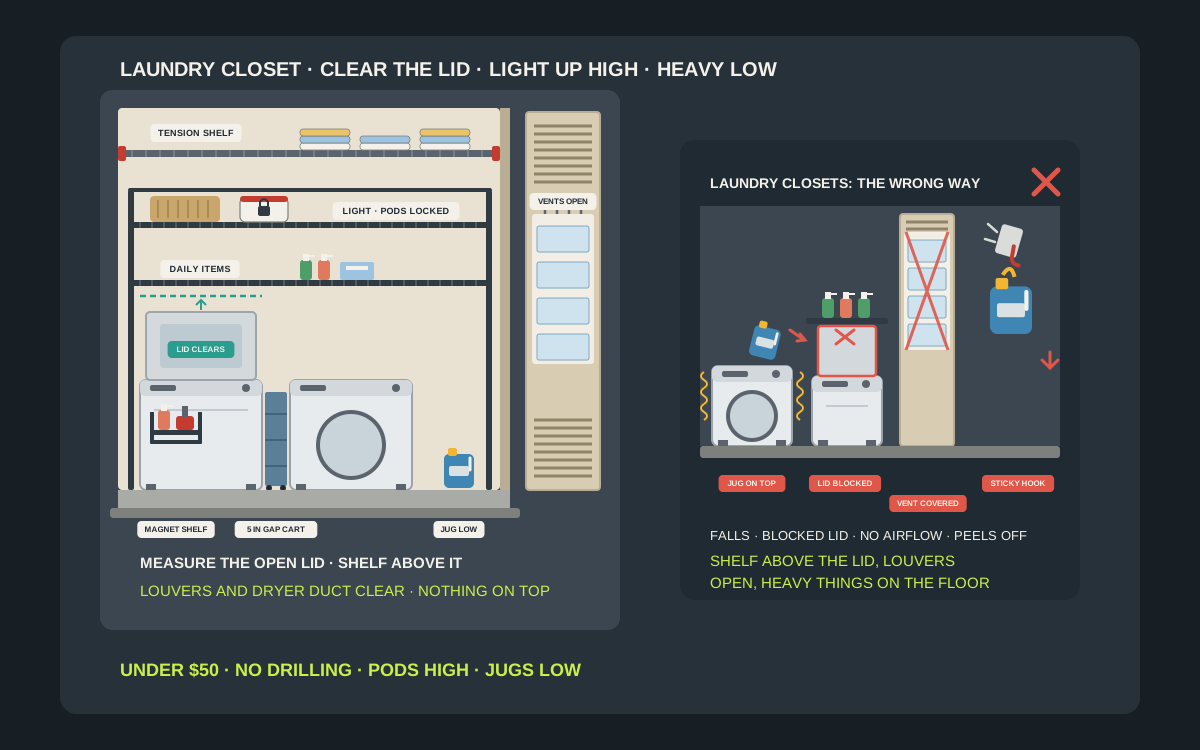
An apartment laundry closet is usually the most wasted storage in the home. Two machines sit behind a bi-fold or louvered door, and above them there is a column of empty air that reaches the ceiling, while the detergent, the stain spray, the dryer sheets and the lint roller live on the lid of the washer or on the floor in front of it. Drilling a row of shelf brackets into the wall would fix it in an afternoon, but most leases frown on that, and plenty of laundry-closet walls hide water lines and a dryer vent. The good news is that you do not need a drill to use that space. For under $50 you can stand a rack over the machines, wedge a tension shelf between the closet walls, stick a magnetic shelf to the side of the washer, slide a slim cart into the gap and hang an organizer on the closet door. This guide covers which of those setups suits which closet, how to measure so the washer lid still opens, what the appliance makers say about vents, clearances and objects on top of the machines, and where each bottle should actually live, from the pods on the top shelf to the jug on the floor.
Shop no-drill over-washer shelves on Amazon
Who this is for
- Renters with a washer and dryer behind a closet door who want shelves without drilling into the walls
- Anyone whose detergent, softener and stain sprays live on top of the washer and slide off every spin cycle
- Households with small children who need laundry pods up high and out of sight, not on the dryer lid
Quick answer
For most apartment laundry closets, the best under-$50 no-drill setup is a slim freestanding over-washer rack or a wall-to-wall tension shelf above the machines for light, soft supplies, a magnetic shelf on the side of the washer for the items you use every load, and a 5-inch rolling cart in the gap for bottles. Measure the washer’s height with the lid open before you buy anything that goes above a top-loader, keep the closet door louvers and the space behind the dryer clear, and store pods in their closed container on the highest shelf. Heavy jugs belong on the floor or the lowest shelf, never on top of a running machine. Check the dimensions, the shelf ratings and the current price on the listing before you buy.
Quick comparison
| Setup | Best for | How it holds | Trade-off |
|---|---|---|---|
| Freestanding over-washer rack | Side-by-side machines with floor space at the sides | Legs stand in the side gaps; shelf spans both machines | Usually ships with anti-tip straps that screw into the wall |
| Wall-to-wall tension shelf | Closets with solid side walls | Spring and screw grips press against two walls | Rating drops as the span gets wider; may leave marks |
| Magnetic washer-side shelf | Daily-use items within reach | Magnets on a flat steel side panel | Light loads only; needs a steel panel a magnet grips |
| Slim rolling gap cart | The narrow gap between the machines | Rolls on casters; nothing touches the wall | Needs a gap about 5 inches wide or more |
| Over-door organizer | Closets with a solid swing door | Hooks over the top of the door | Must not cover vent louvers; awkward on bi-folds |
| Tension rod with hangers | Air-drying shirts and delicates | Spring tension between the closet walls | Clothes only; no bottles on a curtain-style rod |
| Adhesive hooks | Lint roller, small brush, mesh bags | Adhesive strips on smooth painted wall | Small loads; humidity and heat weaken the bond |
Magnetic laundry shelves for washersSlim rolling carts for the washer gapOver-the-washer storage racks
What to look for
Clears the open lid
With a top-loader, the shelf height that matters is not the cabinet height but the height of the open lid. Whirlpool lists the open-lid height of its WTW5015LW at about 55¾ to 56⅜ inches, and its WTW7120HW at about 58½ to 59½ inches. Maytag lists the MVW6230HW at about 57¼ to 57⅞ inches. That spread is nearly four inches between models, so take the number from your own machine, or measure it, and leave a couple of inches more so you can reach in and pull out a sheet. Front-loaders open toward you and only need room for your hands above them.
Fits the closet, not just the machines
A rack has to clear the machines and fit the closet. Measure the combined width of washer and dryer, the gaps beside and between them, the depth from the closet wall to the inside of the door, and the height to the ceiling or the closet header. A rack that straddles the machines needs its legs to land in the gaps at the sides, and a door that closes on a shelf edge is a door that will not close. Write every number down before you open a single listing.
Holds without screws, honestly
No-drill comes in three honest forms: a freestanding frame that stands on the floor, a tension shelf that presses against two walls, and things that hang on a door or stick to steel with magnets. Each has a catch. Many freestanding over-washer racks ship with anti-tip straps that are meant to be screwed into the wall. Tension shelves can leave marks. Magnets only hold on a flat steel surface. Read how a product holds before you read how much it holds.
Rated for the real load
Laundry supplies are heavy. Water weighs about 8.34 pounds per gallon, so a large 150-ounce jug of liquid detergent is close to 10 pounds before you count the bottle. A stack of towels, a box of pods and two spray bottles add up fast. Use the published rating on the listing per shelf, not the frame’s total, and keep a wide margin above a machine that vibrates. Command lists its Large utility hook at 5 pounds, which is why adhesive hooks get brushes and lint rollers, not jugs.
Keeps the closet breathing
A laundry closet is a small room with a hot appliance in it. Whirlpool’s closet installation guidance calls for ventilation openings in the closet door, an upper opening of at least 48 square inches and a lower one of at least 24 square inches, or a louvered door with the same open area. Anything you hang on the inside of that door has to leave the louvers uncovered, and anything you put behind the dryer has to leave its vent duct alone.
Is easy to undo on move-out
The point of no-drill storage is that it leaves with you and leaves the closet as you found it. A freestanding rack and a cart roll out. A magnetic shelf lifts off. A tension shelf comes down with a few turns of its grips, though Heian Shindo warns that a tension shelf can leave marks on the walls, so put it where a mark will not matter or pad the contact points. Over-door hooks come off in seconds. Avoid anything that needs glue on the machine or the wall.
Measure the closet before you shop
Width of the machines and the gaps
Measure the washer and dryer across the front and add up the total, then measure the gap between them and the gap from each machine to the closet wall. A freestanding rack that straddles the pair needs room for its legs in the side gaps. Whirlpool’s closet guidance lists minimum clearances of about 1 inch at the sides, so a rack leg that wants 1½ inches of space will not fit a closet built to the minimum. Check your own machine’s installation instructions, because clearances vary by model and by whether the dryer is gas or electric.
Height with the lid open
For a top-loader, open the lid all the way and measure from the floor to its highest point. Add two or three inches for your hand and the load. That is the lowest a shelf above the washer can sit. For a front-loader, the top of the cabinet is your floor; leave room above it for a hand to rest on the top while you load. If one machine is a top-loader and the other is a front-load dryer, the washer sets the height for the whole shelf.
Depth from the back wall to the door
Machines in a closet sit close to the back wall but not against it, because the hoses and the dryer duct need room. Whirlpool lists about 4 inches behind the machines and about 3 inches in front, between the machines and the closed door, as minimum clearances in its closet guidance. Measure from the wall to the inside face of the closed door, then subtract a shelf’s depth and see what is left for your fingers. A deep shelf that the door catches on is worse than no shelf.
Wall-to-wall width for a tension shelf
If the closet has solid side walls, measure the distance between them at the height you want the shelf, in at least two spots, because old closets are rarely square. A tension shelf has to fall inside its installable range, and its strength depends on that span. Heian Shindo rates its RB-11E shelf at up to 132.2 pounds when installed at 29.6 inches, falling to 88.1 pounds at 47.3 inches; the larger RB-12E is rated at 110.2 pounds at 46.5 inches and only 39.6 pounds at 74.8 inches. Wider spans hold less, and the maker calls these reference values, not guarantees.
Stacked machines
A stacked washer and dryer leaves a tall, narrow column of space beside it and a short space above. The space above a stacked dryer is often too high to reach without a step stool, which makes it good for spare towels and backstock, not for detergent you use twice a week. Beside the stack, a slim cart or a narrow shelf unit is often the more useful upgrade. Freestanding racks designed to straddle a stack exist, but they are tall and most cost more than $50.
Six no-drill setups that work
A freestanding over-washer rack
This is the most storage for the money: a metal frame with legs that stand in the gaps beside the machines and one to three shelves that span over them. Look for a listing that states the machine width it clears, the height to the lowest shelf and the rating per shelf. One SKYSHALO unit sold through Home Depot, for example, lists mesh shelves rated at 44 pounds each, a hanging rod rated at 11 pounds and a height of about 77 inches, with two anti-tip straps in the box. Bigger frames with wood shelves, such as DEXSO’s adjustable 60 to 72 inch rack rated at 100 pounds per shelf, usually cost more than $50, so the under-$50 options tend to be simpler wire or mesh frames. Read the next section about those straps before you assume freestanding means no screws at all.
A wall-to-wall tension shelf
A tension shelf is a steel shelf with spring-loaded end caps and grips that press against both closet walls. It is a true no-screw shelf, and a good one is strong: the Heian Shindo RB-11E mentioned above has a mesh top about 12 inches deep, extends from 29.6 to 47.3 inches and is designed for closets and laundry rooms. Its manual is also unusually honest. It says the shelf should go on walls strong enough to take the pressure, and that on weak walls such as wallboard it should sit where there is a stud or crosspiece, or press against a wooden board used as a spreader plate. It also says not to install it above or near a faucet, above valuable or breakable objects, or above where people normally are, and not in high humidity or direct contact with water. Read that as: put it high, keep it for light, soft things like towels and empty baskets, and do not mount it in a closet where the dryer vents indoors.
A magnetic shelf on the side of the washer
Most washers and dryers have painted steel side panels, which is exactly what a magnetic laundry shelf is made for. Yamazaki’s Tower Washing Machine-Side Magnetic Folding Shelf attaches to the front or side of a machine, including curved surfaces, folds back to about 4 cm deep, and is rated at 1 kg on its tray and 1.5 kg on its shelf. Its Two-Tier Magnetic Laundry Organiser is rated at 2 kg per shelf and 250 g per hook, with a 4.5 kg total, and needs no assembly. Those ratings are honest and small: a magnetic shelf is for stain spray, dryer sheets, a lint brush and a measuring cup, not for a full jug. Check the side panel with a fridge magnet first; some machines have plastic tops and sides that a magnet will not grip.
A slim rolling cart in the gap
The gap between a washer and a dryer is usually a few inches of dead space that collects lost socks. Slim rolling carts are made for it. The Miles Kimball slim storage cart, for example, measures about 5 inches wide, 21 inches long and 28¼ inches high with three shelves, and NORDMIM sells a three-tier cart listed at 5 inches wide. Measure the gap at its narrowest, which is often at the top where the controls or the lid hinge stick out, and leave half an inch of play so the cart slides out without scraping the machines. A cart is the best place for spray bottles and the second jug, because it sits on the floor and holds the weight down low.
An over-door organizer on the closet door
If the laundry closet has a solid swing door, an over-door organizer with clear pockets or wire baskets turns the inside of it into a shelf for small things: clothespins, mesh bags, stain sticks and a sewing kit. Measure the door’s thickness and the gap at the top so the hooks do not stop it from closing. Two cautions are specific to laundry closets. Never cover the door’s ventilation louvers, which the machines need, and be careful with bi-fold doors, which fold in the middle and rarely suit a heavy organizer. A slim organizer on one leaf of a bi-fold can work if it clears the hinge and the door still folds flat.
A tension rod and a few adhesive hooks
A plain tension rod between the closet walls above the machines, set high enough to clear the open lid with a shirt hanging from it, gives you an air-drying rail for hangers. It is for clothes only; a curtain-style rod is not built to hold bottles or a basket. Add two or three adhesive hooks on a smooth painted wall for a lint roller, a small brush and a mesh delicates bag. Command notes that humidity changes are one of the reasons adhesive hooks let go, and its indoor strips are rated for roughly 50 to 105°F, so keep hooks away from the dryer’s hot side and off any wall that sweats.
About anti-tip straps and the no-drill promise
Why the straps are in the box
A tall, narrow frame with weight on its upper shelves can tip forward, and that is why so many over-washer racks ship with anti-tip straps or anchors. The SKYSHALO unit includes two, and Naturefalls lists an anti-tip device with its racks. These are usually meant to be screwed into the wall behind the rack, which is a small hole, but still a hole.
What to do as a renter
Use the straps anyway. A rack that falls onto a machine, or onto a person reaching for a towel, costs far more than a filled screw hole. Some leases allow small picture-hanging holes, and many landlords will say yes to two anchor screws if you ask; a quick email also gives you a record. If you cannot screw into the wall at all, choose a lower rack, keep only light things on its top shelf, or use a tension shelf or a magnetic shelf instead of a tall freestanding frame.
Keep the weight low either way
The less weight up high, the less a rack wants to tip. Put towels and empty baskets on the top shelf, bottles at waist height and anything heavy on the floor. A freestanding frame with a ten-pound jug at the top is the setup the straps were designed for.
Airflow, vents and the space behind the dryer
Do not cover the louvers
The vent openings in a laundry closet door are not decoration. Whirlpool’s closet installation guidance specifies them, and also says a larger gap under the door does not count as a substitute. An over-door organizer, a coat hook full of jackets or a curtain hung across the opening can block them. Keep every louver open, and keep the area just inside them clear.
Leave the dryer duct alone
Whirlpool says the dryer must exhaust outdoors through a 4-inch rigid or flexible metal duct, and the NFPA recommends rigid or flexible metal venting to keep air flowing. That duct runs through the space behind the dryer, which is exactly where people slide a shelf, a basket or a bag of rags. A shelf that crushes the duct slows drying and lets lint build up. Nothing should press against the duct or sit in the gap behind the dryer.
Keep things that burn away from the dryer
The NFPA says the leading cause of home clothes dryer and washer fires is failure to clean them, and its tip sheet says to keep the area around the dryer clear of things that can burn, like boxes, cleaning supplies and clothing. Clean the lint filter before or after every load. In practice that means no cardboard boxes stacked on the dryer, no pile of rags beside it and no shelf of aerosols directly above its exhaust side.
Gas dryers get extra caution
Whirlpool’s closet guidance says no other fuel-burning appliance should be installed in the same closet as a gas dryer. If yours is gas, keep the area around its gas connection clear, and do not store solvents, paint thinner or anything that has soaked up something flammable anywhere near it. The NFPA warns never to dry clothes that have come in contact with flammable substances such as gasoline, cooking oil or alcohol.
Nothing heavy on top of the machines
What the manuals say
It is tempting to treat the washer lid as a shelf. The manuals disagree. An LG front-load washer manual says not to place an object on top of the product, because the object may fall down while it is operating and cause an injury. A Samsung front-load manual says not to place heavy or sharp objects or a detergent box on the washer, and to keep them on a pedestal or in a separate storage box, because they can scratch the top cover or fall off. A spinning washer vibrates, and a bottle on top walks toward the edge.
What that means for your shelves
Anything that sits directly on a machine should be light, soft and unbreakable, and preferably nothing at all. A shelf that spans over the machines without touching them is the answer: the rack carries the weight, not the lid. If a shelf or a cart touches a machine, leave a small gap or a rubber bumper so vibration does not drum it against the cabinet. Whirlpool also says the washer should stand level with all four feet firmly on a solid floor, which is one more reason not to load it with extra weight.
Where each thing should live
Top shelf: light, rarely used and locked away
The highest shelf is for spare towels, empty baskets, backstock dryer sheets and anything children must not reach. That last group includes laundry pods. The U.S. Consumer Product Safety Commission advises keeping liquid laundry packets sealed in their original packaging, locked up and out of a child’s sight and reach, and warns that they dissolve quickly on contact with water, wet hands or saliva. A closed tub on the top shelf, behind a basket, does that. If a packet is swallowed or gets in an eye, call Poison Help at 1-800-222-1222.
Middle: the things you use every load
Waist-to-shoulder height is for what you reach for every wash: stain spray, a measuring cup, dryer sheets, the lint brush. A magnetic shelf on the side of the washer or the lowest shelf of an over-washer rack is ideal. Keep pourable liquids upright and capped, and put a shallow tray under anything that drips.
Low: heavy jugs and bulky boxes
Big jugs of detergent and softener go on the floor, on a cart in the gap or on the lowest shelf of a rack, where a ten-pound bottle cannot fall far. If you buy detergent in bulk, keep the big jug low and decant a week’s worth into a small bottle that lives at waist height. This is also the safest arrangement for a rack without anti-tip straps.
On the door: small and soft
Over-door pockets suit clothespins, mesh bags, a sewing kit, stain sticks and folded reusable bags. Keep anything that could leak out of door pockets, because the door swings and a leaking bottle ends up on the floor. Leave the louvers uncovered.
Three sample laundry closets
Side-by-side top-loader and dryer behind bi-fold doors
Measure the lid-open height, add three inches, and choose a slim over-washer rack whose lowest shelf sits above that line. Put towels and the closed pod tub on its top shelf and dryer sheets and stain spray on its lower shelf. Slide a 5-inch cart into the gap for the detergent jug and spare bottles. Skip the over-door organizer, because bi-folds rarely carry one well, and use two adhesive hooks on the side wall for the lint roller and a delicates bag.
Front-load pair in a hallway closet with solid walls
Front-loaders make the space above them easy to use. Fit a tension shelf across the closet at about head height, inside its rated span and with felt pads if the walls are delicate, and keep it for folded towels and baskets. Below it, put a magnetic shelf on the side of the washer for daily items. If the door is a solid swing door, a slim over-door organizer with clear pockets takes the small things, as long as it leaves the louvers open.
Stacked washer-dryer in a narrow closet
The space above a stack is high and shallow. Use it for backstock only, in a labeled bin you can lift down. Beside the stack, a slim rolling cart or a narrow shelf unit holds the bottles at a reachable height, and a magnetic shelf on the side of the lower machine holds the stain spray and the lint brush. Keep the closed pod tub on the cart’s top shelf only if children cannot reach it; otherwise it goes in the high bin.
Set it up in an afternoon
- Clear the closet floor and the tops of the machines; you do not need to move or disconnect the washer or dryer.
- Measure the machine widths, the gaps, the lid-open height, the wall-to-wall width and the depth to the closed door, and write the numbers down.
- Check the side panels with a fridge magnet and look at the closet door to find the vent louvers.
- Choose one main shelf, either a freestanding rack or a tension shelf, and order it with those numbers in front of you.
- Assemble the rack outside the closet, slide it in from the front so the legs land in the side gaps, and check that it does not touch the machines or the dryer duct.
- Fit anti-tip straps if the rack has them and your lease or landlord allows, or keep the top shelf for light things only.
- For a tension shelf, clean the wall contact points, extend it to the exact width, tighten both grips evenly and test it with a firm push before loading it.
- Load the top shelf light, the middle with daily items and the floor or cart with the heavy jugs, then run a full wash and spin and watch for anything that rattles or creeps.
- Check a tension shelf again after a few days and then weekly, as Heian Shindo recommends, and retighten if it has settled.
Protecting the walls, the floor and your deposit
Pads at every contact point
Put felt or rubber pads under the feet of a freestanding rack so it does not scratch vinyl or tile, and under the end caps of a tension shelf if the paint is soft. A pad also stops a rack from drumming against the wall when the washer spins.
Watch for water
Laundry closets see the odd leak, and the floor under the machines is where it shows first. Keep the floor around the machines clear enough that you would notice a puddle, and do not stack cardboard boxes on it. If a cart sits in the gap, lift it out once a month and wipe underneath.
Leave it as you found it
On move-out, a freestanding rack and a cart roll out, a magnetic shelf lifts off and a tension shelf comes down with a few turns. Remove adhesive hooks by pulling the strip tab slowly straight down along the wall, and fill any anchor holes from anti-tip straps with a little spackle. A clean laundry closet with no new holes is one less line on the move-out inspection.
Mistakes to avoid
- Buying a rack for a top-loader without measuring the height of the open lid.
- Leaving a detergent jug or a box of pods on top of a running washer.
- Putting heavy jugs on the top shelf of a tall freestanding rack without anti-tip straps.
- Covering the closet door’s vent louvers with an organizer, coats or a curtain.
- Pushing a shelf, a basket or a bag of rags into the space behind the dryer where the duct runs.
- Fitting a tension shelf beyond its rated span, or on a soft wall without a stud or a spreader board.
- Hanging a full bottle from a small adhesive hook, or sticking hooks on the hot side of the dryer.
- Keeping laundry pods anywhere a child can see or reach them.
- Stacking cardboard boxes and cleaning supplies right next to the dryer.
Related guides
Browse the hub: No-drill apartment storage under $50 - all guides
- Best Over-Door Drying Racks for Apartments Under $50
- Best Tension Rod Shelves for Apartment Closets Under $50
- Best Over-Door Ironing Board Hooks for Apartments Under $50
- Best Over-the-Toilet Storage for Apartments Under $50 (No Drill)
- Best Over-the-Door Organizers for Apartments Under $50
- Best Tension Rod Under-Sink Organizers for Apartments Under $50
- Best Command Hooks for Apartment Storage Under $50 (No Drill)
FAQ
Can I put shelves over my washer without drilling?
Yes. A freestanding over-washer rack stands on the floor, a tension shelf presses against the closet walls, and magnetic shelves stick to the side of the machine. The one catch is that many tall freestanding racks ship with anti-tip straps that screw into the wall; use them if you can, or keep only light things on the top shelf.
How high should a shelf be above a top-load washer?
Above the height of the open lid, plus two or three inches for your hand. Open-lid heights vary by model: Whirlpool lists about 55¾ to 56⅜ inches for its WTW5015LW and about 58½ to 59½ inches for its WTW7120HW. Check your own machine’s specifications or measure it.
Is it safe to keep detergent on top of the washer?
It is better not to. An LG front-load manual says objects on top can fall during operation, and a Samsung manual says not to put heavy or sharp objects or a detergent box on the washer. Keep heavy jugs on the floor or a low shelf and use a shelf that spans over the machines without resting on them.
Do magnetic laundry shelves hold?
On a flat, painted steel side panel, yes, for light items. Yamazaki rates its two-tier magnetic laundry organizer at 2 kg per shelf and 4.5 kg in total. Test the panel with a fridge magnet first, and keep full jugs elsewhere.
Can I hang an organizer on a louvered laundry closet door?
Only if it leaves the louvers uncovered. Appliance makers specify vent openings in closet doors for washers and dryers, and Whirlpool says a larger gap under the door does not replace them. A slim organizer on a solid section of the door is fine; one that covers the louvers is not.
Where should I store laundry pods in a small laundry closet?
High up and closed. The CPSC advises keeping liquid laundry packets sealed in their original packaging, locked up and out of a child’s sight and reach. A lidded tub on the top shelf of an over-washer rack works; the top of the dryer does not.
Bottom line
The best no-drill over-washer shelf is the one that clears the open lid, fits the closet and keeps the weight off the machines: a slim freestanding rack or a tension shelf for light supplies, a magnetic shelf for daily items and a 5-inch cart in the gap for the jugs. Keep the door louvers and the space behind the dryer clear, lock pods away on the top shelf, and keep anything heavy low. Measure first, then check the dimensions, the shelf ratings and the current price on the listing before you buy.