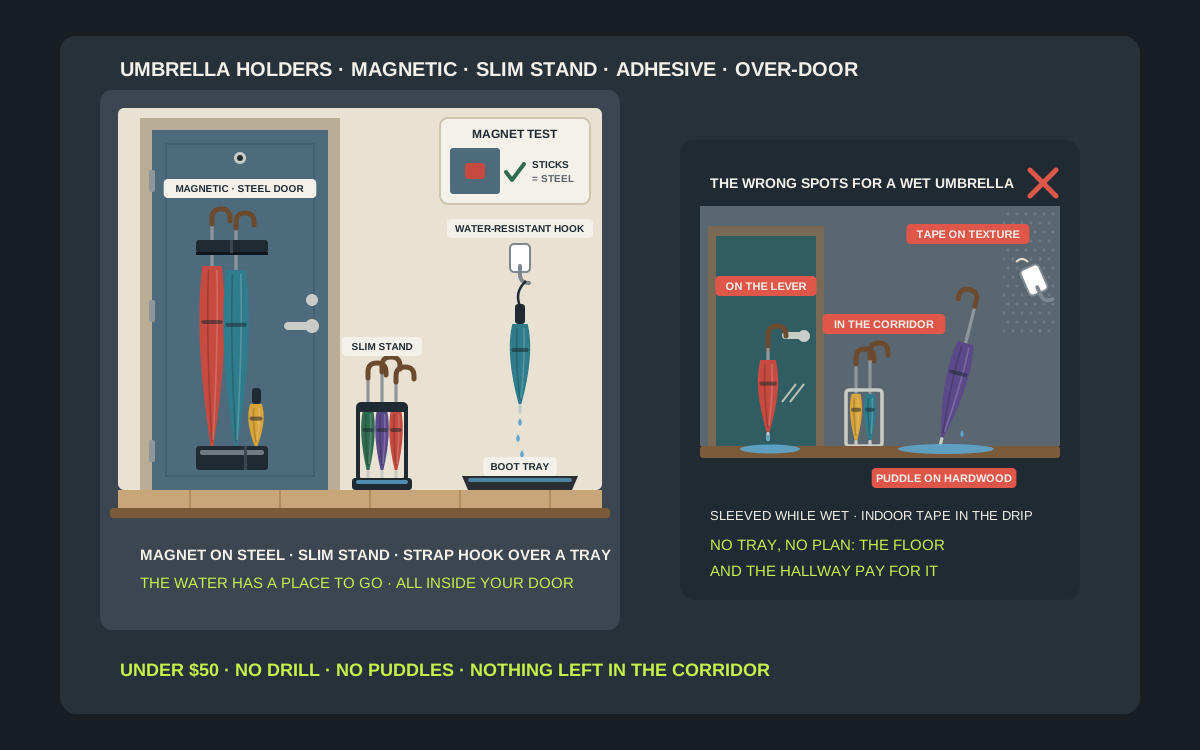
Wet umbrellas are the one piece of entry clutter that actively does damage. A closed umbrella leaned in a corner leaves a ring of water on the floor every rainy evening, and over a season that puddle can lift the finish on hardwood, swell the edges of laminate and leave a dark stain on the baseboard that your deposit pays for. In a house you would screw a rack to the wall by the door and be done. In an apartment you usually cannot drill, the entry is often a single strip of floor between the door and the kitchen, and the hallway outside belongs to everyone. The good news is that umbrellas are light, and the no-drill options are cheap. Magnetic holders that ride on a steel entry door, slim stands with drip trays, water-resistant adhesive hooks and simple over-door hooks all cost well under $50. Which one fits comes down to four questions you can answer in a few minutes: is your door steel, how much floor you can spare, how many long and folding umbrellas the household owns, and where the water will go once they are hung up.
Shop slim umbrella stands with drip trays on Amazon
Who this is for
- Renters who want a dedicated place for wet umbrellas by the front door without screws, anchors or holes in the wall
- Anyone with a tiny entry, a door that opens straight into the living room or a floor finish that marks easily when water sits on it
- Households juggling long stick umbrellas, compact folding umbrellas and rain boots who want one tidy drop zone for under $50
Quick answer
For most apartment entries, the best under-$50 no-drill umbrella holder is the one that matches your door and your floor. If the entry door is steel and you have no floor to spare, use a magnetic holder on the inside of the door: Yamazaki’s Tower Magnetic Umbrella Stand splits into an upper holder that steadies the shafts and a lower holder that catches the tips, holds up to four umbrellas and is rated for about 2 kg (4.4 lb). If you have a strip of wall beside the door, a slim stand with a removable drip tray keeps water off the floor; Yamazaki’s Tower Slim stand is only 12 cm (about 4.7 in) deep and holds up to eight umbrellas. For compact umbrellas that hang by a wrist strap, a water-resistant adhesive hook such as Command’s Bath Large Hook, rated at 5 lb, works on smooth walls, tile and door faces. Whichever you choose, give the water somewhere to go, keep the setup inside your own door rather than in the shared corridor, and check the current price and rating on the listing before you buy.
Quick comparison
| Holder | Best for | How it mounts | Trade-off |
|---|---|---|---|
| Magnetic door holder (e.g. Yamazaki Tower Magnetic) | Steel entry doors and entries with no spare floor | Two magnetic holders on the inside face of the door: upper steadies the shafts, lower catches the tips | Steel doors only; about 2 kg (4.4 lb) and up to four umbrellas |
| Slim stand with drip tray (e.g. Yamazaki Tower Slim) | Several long umbrellas and a strip of wall beside the door | Freestanding; 22 x 12 x 50 cm (about 8.7 x 4.7 x 19.7 in), removable tray | Uses floor space; prices vary by seller, so confirm it is still under $50 |
| Wire stand with weighted base (e.g. Umbra Holdit) | One or two umbrellas in a very narrow entry | Freestanding; 6 x 3-1/4 x 16-1/2 in, slots below and loops on top for wrist straps | Open design dries fast but needs a mat or boot tray underneath |
| Round stand with water tray (e.g. Umbra Hub) | Households with both long and compact umbrellas | Freestanding; about 8-3/4 in across and 27 in tall, four tall slots plus two hooks for compacts | Largest footprint here and near the top of the budget |
| Water-resistant adhesive hook (e.g. Command Bath Large Hook) | Compact umbrellas hung by the strap on smooth walls, tile or door faces | Water-resistant adhesive strip, rated 5 lb per hook | Smooth, sealed surfaces only; wait an hour before hanging anything |
| Over-door hook rack | Doors with a gap at the top and walls nothing will stick to | Hooks over the top edge of an interior or entry door | Needs clearance above the door; drips run down the door face |
Magnetic umbrella holders for steel doorsWater-resistant adhesive hooksRubber boot trays for wet entries
What to look for
Plan where the water goes
This is the question most umbrella holders quietly ignore. A long umbrella that has just come in from a downpour can shed a surprising amount of water as it drains, and all of it runs to the tip. A stand with a removable drip tray catches it; an open wire stand or a hook does not, so it needs a tray or mat underneath. On hardwood, laminate and vinyl plank, standing water is the enemy, so plan the drip zone first and choose the holder second. Empty the tray after every rainy day so it does not overflow or start to smell.
Door material and spare floor
Touch a fridge magnet to the inside face of your entry door. If it sticks firmly, the door is steel and a magnetic holder becomes the most space-efficient option, because it uses door area that is otherwise empty. If it does not stick, the door is wood, fiberglass or composite, and you are choosing between a freestanding stand, an adhesive hook on the wall or an over-door hook. Then measure the floor beside the door, and open the door fully to see where it swings. A stand only works where the door, the closet and everyone’s feet will not knock it over.
Long umbrellas, compacts or both
Count what the household actually owns. Long stick umbrellas need to stand on their tips, so they belong in a stand or a two-part magnetic holder. Compact folding umbrellas are short enough to fall through most stands; they either sit in a dedicated short compartment, such as the lower holder of Yamazaki’s magnetic stand, or hang by their wrist strap from a hook. If you own both, choose a holder that handles both or pair a stand with one hook rather than forcing compacts into slots made for long umbrellas.
Stability with one umbrella or five
An umbrella stand is most likely to tip when it is nearly empty or overloaded on one side. Look for a weighted base, a tray that sits low, dividers that stop a lone umbrella from leaning, and enough height to hold long umbrellas upright. Yamazaki gives its Tower Slim stand a 50 cm (about 19.7 in) height for exactly that reason, and its magnetic holder has a center divider so the last umbrella does not flop sideways. In homes with toddlers or large dogs, a low, heavy stand or a door-mounted holder is safer than a tall, light one.
Rust, mats and finishes
Umbrella holders live with water, so materials matter. Powder-coated steel is common and fine as long as the coating is intact; resin bases, such as the one on Umbra’s Holdit and Hub stands, are chosen because they do not rust. A silicone or rubber mat in the bottom of a stand stops metal umbrella tips from skating around and from chipping the tray. A finish that matches your door hardware or entry furniture, usually matte black or white, keeps a holder that stays out all year from looking like clutter.
Magnetic vs freestanding vs adhesive vs over-door
Magnetic door holders: the space saver for steel doors
Many apartment entry doors are steel, and the inside face of that door is the most underused storage surface in the home. Yamazaki’s Tower Magnetic Umbrella Stand uses it well. It comes as two separate powder-coated steel holders, each held by magnets, so you set the spacing to suit your umbrellas: the upper holder steadies the shafts, and the lower holder catches the tips on a rubber mat. The lower holder also has a divider, so a folding umbrella can sit in it, and the whole setup holds up to four umbrellas with a load rating of about 2 kg (4.4 lb). Yamazaki also sells a lighter Smart version in ABS plastic with the same 2 kg rating, listed for up to four long and four folding umbrellas. Both only work on steel, and both put drips at the bottom of the door, so keep a mat on the floor beneath the lower holder.
Slim stands with drip trays: the default if you have floor
A slim stand is the simplest answer when you have a few inches of wall beside the door. Yamazaki’s Tower Slim Umbrella Stand is 22 cm wide, 12 cm deep and 50 cm tall (about 8.7 x 4.7 x 19.7 in), holds up to eight umbrellas and has a removable steel drip tray with a silicone mat. That depth is the point: it sits flush against the wall in a corridor-style entry where a round stand would be in the way. Prices for imported Yamazaki pieces vary a lot from seller to seller, so check that the listing you choose is still under $50 before you order.
Wire stands: light, airy and quick-drying
Umbra’s Holdit is a different take: a wire frame on a weighted resin base, listed at 6 x 3-1/4 x 16-1/2 inches. Long umbrellas stand in its slots, and anything that hangs by a wrist strap can go on the loops at the top. Because the frame is open, umbrellas dry faster than they do packed into a solid bin. The trade-off is that Umbra describes the resin base as moisture-proof and rust-free but does not list a drip tray, so on a wood or laminate floor, set it on a boot tray or a washable mat.
Round stands with a tray: for mixed collections
If the household owns several long umbrellas and a couple of compacts, Umbra’s Hub stand handles both. It has four slots for tall umbrellas, two small hooks inside the upper ring for compacts, a water tray and a resin base, and it measures about 8-3/4 inches across and 27 inches tall. It needs the most floor of any option here and sits near the top of a $50 budget at some retailers, but it is the one stand in this guide that gives every type of umbrella its own place.
Water-resistant adhesive hooks: for compacts and strap-hung umbrellas
A hook is the cheapest umbrella holder there is, and for compact umbrellas it is often the best. Use a hook with a water-resistant strip rather than a standard indoor one, because a wet umbrella drips onto the adhesive. Command’s Bath Large Hook comes with a water-resistant strip and is rated at 5 lb; its standard Large Utility Hook has the same 5 lb rating but is sold as an indoor, non-water-resistant product. For a hook outside a door that faces the weather, Command lists its outdoor metal hooks for -20°F to 125°F. Hang compacts by their straps, open the canopy tie so air reaches the folds, and put a tray beneath them.
Over-door hooks: when nothing will stick and nothing is steel
An over-door hook rack hangs on the top edge of a door, so it works on wood and fiberglass doors where magnets fail and on textured walls where adhesive will not hold. It suits strap-hung umbrellas, especially on a closet door near the entry. Check that the door still closes easily with the hooks in place and that a self-closing entry door still latches, which our over-door wreath hanger guide covers in detail. Keep in mind that water will run down the face of the door, so this is a better spot for umbrellas that have already drained.
Rental rules and the shared corridor
Keep it inside your own door
It is tempting to park an umbrella stand in the hallway outside your door so the water never comes in. In most buildings that is the wrong spot. Corridors are shared exit routes, fire codes generally require them to stay clear, and many leases and house rules ban personal items in common areas outright. A stand in the hallway also invites neighbors to borrow from it and maintenance staff to remove it. Set your umbrella station just inside the door, where it is yours.
Respect the door swing and the closer
Open the entry door fully before choosing a spot. A stand placed in the arc of the door gets knocked over every time someone comes home, and a magnetic holder placed too close to the hinge edge can collide with the frame or the closer arm. On the door itself, keep holders below the peephole and clear of the handle, the deadbolt and any security chain.
Never hang umbrellas on the door handle
A wet umbrella hooked over a door lever is the default storage spot in many apartments, and it is a bad one. It drips onto the floor at the threshold, scratches the door each time the door moves and can work the lever loose over time. Give the umbrella a proper holder a few inches away instead.
Plan for move-out day
Magnetic holders and freestanding stands leave nothing behind. Adhesive hooks can, if they are pulled off the wrong way. Command’s instructions are to stretch the tab slowly straight down along the wall rather than pulling it toward you, which is the difference between a clean wall and a missing patch of paint at inspection.
Drying umbrellas without mildew or puddles
Dry it open when you can
Umbrella makers are consistent on this. Shed Rain, BLUNT and Sapor all say to let an umbrella dry completely, ideally fully open, before you put it away, and never to close it up or zip it into its sleeve while it is still wet, because trapped moisture leads to mildew, odors and stains. An open umbrella in a bathtub or shower is the easiest way to do that in an apartment, and the water goes straight down the drain.
If space is tight, release the tie
When there is no room to leave it open, BLUNT suggests standing the umbrella with the handle up and the canopy tie released, and Clifton suggests leaving it partially open without fastening the strap. Either way, air reaches the folds. That is why a stand or a strap hook is better than a sealed bin or the bottom of a closet.
Give the drips a tray
A rubber boot tray under a stand or hook catches what the drip tray misses, along with the water from boots and shoes, and it rinses clean in the shower. A washable mat with a waterproof backing is the alternative where a tray looks out of place. Wipe up any water that lands on bare wood the same day.
Empty and clean the tray
Empty the drip tray after each rainy day and wipe it out every week or two during the wet season. Standing water in a tray soon smells musty and can mark the floor beneath it if it overflows. A tray with a silicone mat should have the mat lifted and dried as well.
A five-minute fit check before you buy
Run the magnet test
Touch a fridge magnet to the inside of the entry door at the height where the holder would go. A firm hold means a magnetic holder is an option; a weak hold, or none, means the door is not steel or has a thick finish panel, so plan on a stand or a hook.
Measure the floor and the door arc
Measure the width and depth of the floor you can spare beside the door, then open the door fully and mark where it swings. Compare that space with the stand’s footprint before ordering. A 12 cm deep stand fits where a round stand does not.
Count the umbrellas
Count the long umbrellas and the compacts the household actually uses, then add one for guests. That number decides whether a four-umbrella magnetic holder, an eight-umbrella slim stand or a stand plus one hook is the right setup.
Check the wall
If you plan to use an adhesive hook, run your hand over the wall or door. Smooth, sealed paint, tile and glass are good candidates; textured walls, wallpaper, unsealed wood and fresh paint are not, so choose a stand or an over-door hook there.
Matching the holder to your entry
Studio with no entry at all
When the front door opens straight into the living space, a magnetic holder on a steel door or a slim stand tucked against the hinge-side wall keeps umbrellas out of sight lines. A small boot tray beneath either defines the entry zone without a single piece of furniture.
Narrow corridor entry
In a long, narrow entry, depth matters more than width. A slim stand or a wire stand against the wall leaves room to pass, while a round stand turns into a trip hazard. Keep the station within a step of the door so nobody walks a wet umbrella down the hall.
Entry closet
If there is a coat closet by the door, an over-door hook rack on the inside of the closet door or a slim stand on the closet floor hides umbrellas completely. Leave the closet door ajar after a rainy day so trapped moisture can escape.
Rainy climates and big households
Where it rains for weeks at a time, or where four people come home with wet gear, choose capacity and drainage over looks: an eight-umbrella slim stand with a removable tray, plus a boot tray big enough for shoes, plus one hook for compacts. Treat it as a small mudroom.
Installing adhesive and magnetic holders properly
Prep the surface for adhesive
Command’s instructions are specific: clean the spot with rubbing alcohol rather than a household spray cleaner, which can leave a film, press the strip firmly for about 30 seconds and wait an hour before hanging anything on the hook. Standard indoor strips are meant for temperatures between 50°F and 105°F, and Command’s instructions also say to wait seven days after painting.
Respect the rating, wet weight included
An umbrella is light, but a soaked one carries water, and a hook loaded with three of them is a different load from one dry compact. Stay well inside the published rating and give each umbrella its own hook rather than stacking them.
Lift magnets, do not slide them
Magnets hold best when nothing sits between them and the steel. Place the holder exactly where you want it and lift it off to reposition it, because sliding a magnet across painted steel drags grit across the finish. If the door has a decorative panel or a thick layer of paint, test the hold with an umbrella in place before you trust it.
Set the gap for your umbrellas
With a two-part magnetic holder, set the lower holder first, stand your longest umbrella in it, then place the upper holder so it grips the shaft below the handle. Shorter umbrellas will still be steadied, and compacts can go in the lower holder alone.
Mistakes to avoid
- Leaning wet umbrellas in a corner on hardwood or laminate with nothing to catch the water.
- Putting an umbrella stand in the shared hallway, where it blocks the exit route and breaks most house rules.
- Hanging a wet umbrella on the door lever, where it drips on the threshold and scratches the door.
- Using a standard indoor adhesive strip where water drips onto it, or sticking any hook to a textured wall or fresh paint.
- Trusting a magnet on a wood or fiberglass door without testing it first.
- Zipping an umbrella into its sleeve, or stuffing it in a closet, while it is still wet.
- Choosing a stand without checking where the door swings.
- Forgetting to empty the drip tray until it overflows onto the floor.
Related guides
Browse the hub: No-drill apartment storage under $50 - all guides
- How to Organize an Apartment Entryway with No-Drill Hooks Under $50
- Best Adhesive Purse Hooks for Apartment Entries Under $50
- Best Freestanding Coat Racks for Apartments Under $50
- Best Removable Key & Mail Wall Organizers for Apartment Entries Under $50
- Over-Door Coat Rack vs Adhesive Hook Rail for Apartments Under $50
- Best Over-Door Wreath Hangers for Apartments Under $50
FAQ
How do you store umbrellas in a small apartment entry without drilling?
Use a magnetic umbrella holder on the inside of a steel entry door, a slim freestanding stand with a drip tray against the wall beside the door, or a water-resistant adhesive hook for compact umbrellas hung by their straps. Put a boot tray or waterproof mat underneath anything without its own tray.
Do magnetic umbrella holders work on apartment doors?
Yes, if the door is steel; test it with a fridge magnet first. Yamazaki’s Tower Magnetic Umbrella Stand, for example, uses separate upper and lower magnetic holders, holds up to four umbrellas and is rated for about 2 kg (4.4 lb). It will not work on wood, fiberglass or composite doors.
Can Command hooks hold a wet umbrella?
A compact umbrella, yes, as long as you use a water-resistant strip and a smooth, sealed surface. Command’s Bath Large Hook includes a water-resistant strip and is rated at 5 lb. Clean the spot with rubbing alcohol, press for 30 seconds and wait an hour before hanging anything.
Can I keep an umbrella stand in the hallway outside my apartment?
Usually not. Shared corridors are exit routes that fire codes generally require to stay clear, and many leases and house rules ban personal items in common areas. Keep the stand just inside your own door instead.
How do I stop a wet umbrella from damaging my floor?
Give the water somewhere to go: a stand with a removable drip tray, a rubber boot tray under a hook or wire stand, or a waterproof-backed mat. Empty the tray after each rainy day and wipe any water off bare wood the same day.
Should you dry an umbrella open or closed?
Open. Umbrella makers such as Shed Rain, BLUNT and Sapor recommend letting an umbrella dry completely, ideally fully open, and never closing it up or putting it in its sleeve while wet. If there is no room, stand it handle-up with the canopy tie released so air can reach the folds.
Bottom line
The best no-drill umbrella holder for an apartment entry is the one that fits your door, your floor and your umbrellas: a magnetic holder for a steel door with no floor to spare, a slim stand with a drip tray where there is a strip of wall, and a water-resistant adhesive hook for compacts hung by the strap. Plan where the water goes before you buy, keep the station inside your own door, dry umbrellas open whenever you can, and check the current price and rating on the listing before you order.