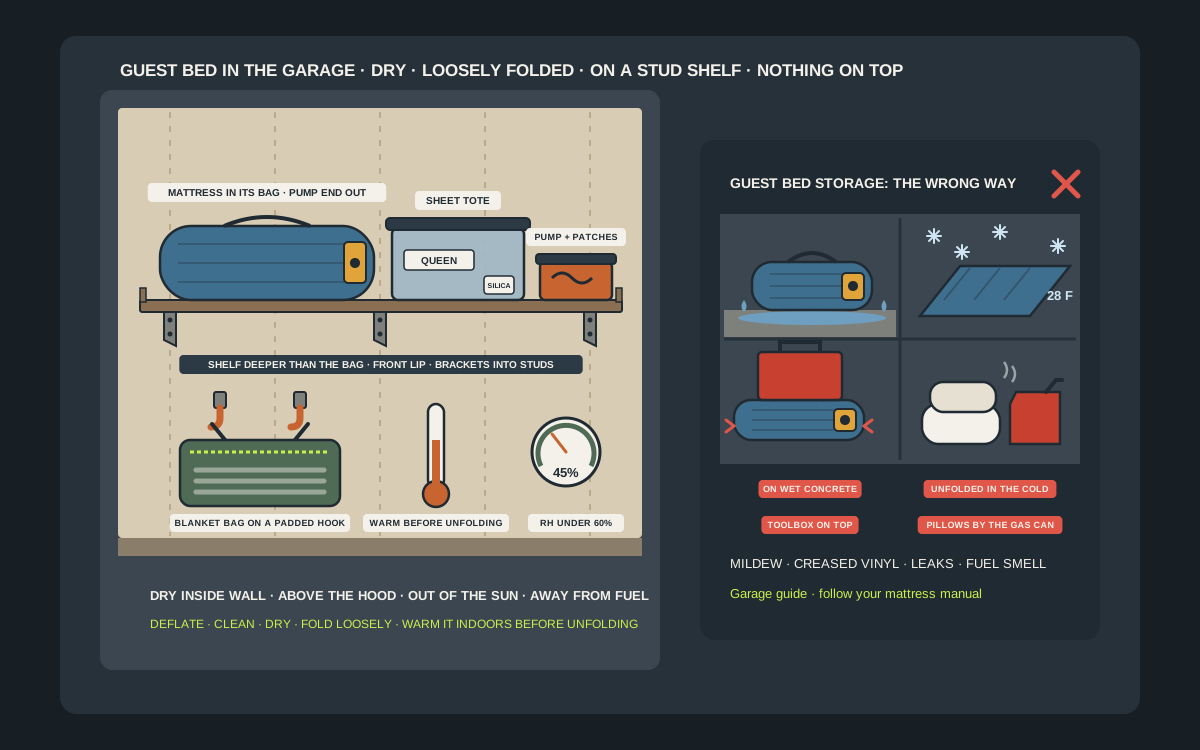
Every November the same thing happens in homes that host for the holidays. Someone remembers the air mattress two days before the guests arrive, and it turns out to be in three places: the mattress is wedged behind the lawn mower, the pump is in a kitchen drawer, the fitted sheet that actually fits it is lost somewhere in the linen closet, and the patch kit vanished last year. The garage looks like the natural home for a guest bed you use a few times a year, and it can be, if you store it the way the makers ask and keep the bedding protected from the things garages do to fabric. Intex tells owners to store an airbed in a safe, dry and cool place, folded loosely without sharp bends, and SoundAsleep tells owners never to unfold or inflate its mattress in temperatures below freezing. This guide shows the under-$50 wall storage that turns the mattress, pump, sheets, pillows and blankets into one grab-and-go guest-bed kit, explains what should stay indoors, and walks through the routine before and after a visit so the bed is never the last-minute crisis again.
Shop heavy-duty garage wall shelves on Amazon
Who this is for
- Hosts who put up family on an air mattress a few times a year and want it ready in minutes, not hours
- Anyone heading into the holiday season with a guest bed, a separate pump and a pile of sheets scattered around the house
- Owners of an attached or insulated garage with an empty strip of stud wall above the car’s hood
- Renters and small-home owners with no spare closet who need the guest bed out of the living space between visits
Quick answer
Store the air mattress fully deflated, clean, completely dry and folded loosely in its own carry bag, lying flat on a stud-mounted wall shelf about 12 to 16 inches deep with a front lip, pump side facing out and nothing on top. Put the guest sheets in one labeled, lidded tote beside it, wrapped in a clean pillowcase with a silica gel pack, hang blankets in a zippered bag on a wide padded hook, and keep the pump cord and patch kit in a small bin on the same shelf. Keep the whole kit off the concrete and away from fuel, paint and car exhaust. If your garage freezes, bring the bag indoors and let it warm up before you unfold it, because cold vinyl is the part makers warn about. If the garage is damp, keep pillows and the good comforter in the house and let the garage hold only the mattress.
Quick picks
- Best overall: a stud-mounted wall shelf about 12 to 16 inches deep with a front lip, holding the bagged air mattress lying flat with the pump side facing out and a lidded tote of guest sheets beside it. Everything for the guest bed comes down in one trip, and nothing heavy ever sits on the mattress.
- Best for guest sheets and pillowcases: one lidded plastic tote per bed, labeled with the mattress size, with the sheet set folded inside a clean pillowcase and a silica gel pack tucked in the corner. The lid keeps out dust and mice, and the cotton wrap gives the fabric a little breathing room.
- Best for blankets and a spare comforter: a zippered fabric blanket bag hung on a wide padded hook screwed into a stud. A soft bag hung by its handles keeps its shape, stays off the slab and is easy to grab with one hand.
- Best for a renter or a block wall you cannot drill: a freestanding shelving unit with a published per-shelf rating, set against the wall and anchored if the maker tells you to. It does the same job as a wall shelf without new holes.
- Best small add-on: a small lidded bin for the separate pump, charging cord, patch kit and a printed note of the mattress size. The night before the guests arrive, the bits that usually go missing are all in one place.
- Best moisture add-on: a pack of rechargeable silica gel in the bedding tote plus a cheap humidity meter on the wall, so you know whether the garage is actually dry enough for fabric.
Quick comparison
| Option | Best for | How it stores the guest bed | Trade-off |
|---|---|---|---|
| Stud-mounted shelf with a front lip | Most garages with a dry wall above the hood | Bagged mattress lying flat, pump side out, bedding tote beside it, nothing on top | Needs studs, brackets rated for the load and a shelf deeper than the bag |
| Lidded plastic tote | Guest sheets, pillowcases, a mattress pad | Sheet set wrapped in a pillowcase with silica gel, labeled with the mattress size | Fabric must be fully dry before the lid goes on |
| Wide padded utility hooks | Blanket bags, a spare comforter, a light twin mattress bag | Soft bags hang by their handles and keep their shape off the slab | Hooks must go into studs or a rated rail; not for a heavy queen with a built-in pump |
| Zippered fabric blanket bag | Blankets and a synthetic comforter | Breathable bag on a hook keeps dust off while letting air through | Not mouse-proof, so skip it in a garage with a pest problem |
| Freestanding shelving unit | Renters, block walls, garages with no free stud wall | Mattress bag and tote on a mid-height shelf, nothing heavy above | Takes floor space, so check the per-shelf rating and anchoring advice |
| Track rail with shelf and basket add-ons | Garages already running a rail system | Basket or shelf add-on for the mattress, hooks for blanket bags on the same rail | Each add-on has its own rating, and a deep bag needs a deep accessory |
| Small lidded parts bin | Separate pumps, cords, patch kits, valve caps | Everything that goes missing lives next to the mattress | One more item on the shelf, so leave room in the load |
| Silica gel and a humidity meter | Garages that hover near the damp line | Packs in the bedding tote absorb moisture; the meter tells you when to worry | Packs fill up and need recharging or replacing |
Air mattress storage bagsLidded storage totes for beddingAir mattress patch repair kits
What to look for
A garage that is dry enough for fabric
The mattress itself is vinyl, but sheets, pillows and blankets soak up damp and smells. The EPA says to keep indoor humidity below 60 percent, ideally between 30 and 50 percent, and notes that a humidity meter is a small, inexpensive instrument. Hang one beside the spot you plan to use and check it for a couple of weeks, including after rain and after a wet car comes in. If it lives above 60 percent, keep the fabric indoors and store only the mattress in the garage. Our suitcase guide walks through the same dry-garage test in more detail.
A shelf sized to the bagged mattress
Measure the mattress in its carry bag before you buy anything. A folded queen with a built-in pump is a dense, boxy bundle, and the pump end is the stiffest part. Choose a shelf at least an inch deeper than the bag so nothing hangs over the edge, and long enough to hold the bag lying flat plus the bedding tote beside it. If you have two mattresses, plan for two bags side by side rather than stacked.
A load rating with room to spare
Air mattresses are heavier than people think. SoundAsleep’s Dream Series queen with a built-in pump is listed at 19 pounds, and a tote of sheets, a blanket bag and a second mattress add up quickly. Someone will also lean on the shelf to pull a bag down from above head height. Pick brackets and a shelf rated well above what you plan to put on them, and screw the brackets into studs, not just drywall.
A lip or strap at the front
A smooth bag on a smooth shelf creeps toward the edge every time the garage door rattles. A raised front edge, a front rail or a simple strap stops that. It also stops the bag sliding when you pull out the tote next to it.
Lids and labels for the bedding
A garage is dusty and it is where mice look for nesting material. The CDC advises sealing up gaps in garages and keeping things rodents want in thick plastic, metal or glass containers with tight lids. Sheets in an open basket on a garage shelf are an invitation, so use a lidded tote and write the mattress size on the end of it.
Breathable wrap inside, not plastic against fabric
Textile conservators prefer fabric to breathe. University of Georgia Extension warns that wrapping textiles in plastic can trap moisture and cause mold and mildew, and the Smithsonian advises against sealing fabrics in airtight plastic because of condensation. In a garage you still want the tote for pests and dust, so wrap the sheet set in a clean cotton pillowcase inside the tote, only pack it when it is completely dry, and add a silica gel pack.
Should the guest bed live in the garage at all?
What the mattress makers say
Intex’s instructions are simple: make sure the airbed is completely deflated, clean and dry, fold it loosely while avoiding sharp bends, corners and creases, and store it in a safe, dry and cool place. Intex’s German support page adds that it should not be stored in extreme temperatures or high humidity, and should be protected from sunlight, heat sources and pets. SoundAsleep’s manual says never to unfold or inflate the mattress in temperatures below freezing, to avoid long exposure to the sun and to protect it from sharp objects and rough surfaces. None of that forbids a garage. It tells you which garage, and how to handle the bed when it comes down.
The cold-garage rule
The risky moment is not the storage, it is unfolding cold vinyl. If your garage freezes in December, leave the mattress folded in its bag on the shelf, carry the whole bag indoors the day before the guests arrive and let it warm to room temperature before you open it. Intex’s manual also says the bed should be inflated in a warm, well-ventilated room, and notes that air contracts in the cold, so a bed that felt firm in a cold room will feel soft. Inflating indoors and topping it up once it has warmed solves both problems.
The hot-garage rule
Summer matters too, because the bed stays out there all year. A garage that bakes under a dark roof or has a sunny window over the shelf is the wrong spot. Keep the shelf on a shaded inside wall, away from the water heater and any heater, and out of direct sun. If the only free wall gets afternoon sun, put the mattress in a closed tote or cabinet rather than on an open shelf.
What to keep indoors no matter what
Pillows and a good comforter are the items that suffer most in a garage. They are bulky, they hold on to smells from fuel, exhaust and paint, and they are what guests notice first. If you have any indoor space at all, keep those in the house and let the garage hold the mattress, the pump and the sheet tote. Keep the mattress indoors too if the garage regularly sits above 60 percent humidity, has a mouse problem you have not solved, or gets hot enough to soften plastic.
Build one guest-bed kit, not five piles
The mattress in its own bag
Most air mattresses ship with a carry bag, and it is the right container. It is sized for the folded bed, it keeps grit off the vinyl and it has handles for carrying the bag indoors. If yours is torn or lost, buy a replacement bag sized for your mattress rather than stuffing the bed into a plastic sack. Write the mattress size on a piece of tape on the bag so nobody has to unfold it to check.
The pump, cord and patch kit
A built-in pump travels with the mattress, but separate pumps, rechargeable pumps, chargers and car adapters go missing. So do patch kits and valve caps. One small lidded bin on the same shelf holds all of them. Check the patch kit when you put the bed away, because the time to find out it is empty is not 10 p.m. on the night the guests arrive.
Sheets that actually fit
A raised air mattress is much deeper than a normal mattress, and SoundAsleep’s queen is 19 inches high. A standard fitted sheet may pop off the corners of a bed that tall, so check the pocket depth on the sheet packaging against the height of your mattress. Once you have a set that fits, keep it with that mattress and do not let it drift back into the house rotation.
Mattress pad, pillows and blanket
SoundAsleep suggests properly sized sheets, a breathable blanket, supportive pillows and a light mattress pad or topper to make the surface feel more familiar and less cool, and recommends keeping the bedding with the mattress so setup is fast. In a dry garage, the pad and blanket can live in the kit. Pillows are better indoors, as above.
One label, one checklist
Tape a short list inside the tote lid: mattress size, sheet set, pad, blanket, pillowcases, pump, cord, patch kit. When the kit comes down, you can see at a glance what is missing, and when it goes back up, you know it is complete.
Planning the wall: space, budget and more than one bed
How much wall the kit needs
For one mattress, plan on a single shelf long enough for the bag lying flat plus a tote beside it, with a padded hook or two underneath for the blanket bag. That is usually one stretch of wall between two or three studs. Leave a little headroom above the bag so you can slide it out without lifting it over a bracket, and keep the shelf away from the path of the garage door track and opener.
Where the $50 goes
In most garages the money is best spent on a sturdy shelf board with stud-mounted brackets, then a lidded tote, a pair of padded hooks and a pack of silica gel. A humidity meter is a small extra that tells you whether the fabric can stay out there at all. Overhead ceiling racks look tidy but most cost more than $50 and mean lifting a heavy bag above your head, which is the riskiest part of garage storage.
Two mattresses, kids’ beds and cots
If you keep a queen for adults and a twin for kids, give each one its own bag, its own spot on the shelf and its own labeled sheet tote, so the right sheets always go with the right bed. A folding camping cot used as a spare bed belongs on its own hanger, not on top of the mattress bag. Sleeping bags for the kids hang loosely in large stuff sacks on hooks rather than staying compressed for months.
Keep the heat sources and chemicals away
Intex’s manual warns never to expose the airbed to flammable materials and to keep open flames and electrical heat sources away from it. In a garage that rules out the shelf above the gas cans, the paint shelf, the space next to a fuel-burning heater or water heater, and the wall where the mower and leaf blower are refueled.
How to fold and bag the mattress so it lasts
Deflate it completely
Use the pump’s deflate setting until no more air comes out, then close the valve or switch the pump off as your manual describes. A mattress with air left in it will not fit its bag and gets folded too tightly to make it fit, which is exactly what the makers warn against. Electric pumps have a run-time limit too: SoundAsleep’s manual says not to run its pump for more than 5 minutes of continuous inflation or deflation, so follow your own manual if it tells you to stop and let the pump rest.
Clean it with mild soap only
Intex says to clean only with a mild soapy solution, and its manual warns against aggressive cleaners and metal or nylon brushes. SoundAsleep says the same: mild soap and water. Wipe the flocked top and the bottom, paying attention to the bottom if it sat on a dusty floor, and never put the mattress in a washing machine.
Dry it fully before folding
This is the step most people skip. A damp mattress folded into a bag and left on a garage shelf for a year is how you get a musty smell and spots. The EPA notes that wet materials should be dried within 24 to 48 hours to prevent mold growth. Let the bed dry inflated or laid out flat indoors until both sides are dry to the touch, including the seams and around the valve.
Fold loosely and keep the pump end out
Intex says to lay the bed flat with the sleeping surface facing up and fold it loosely, avoiding sharp bends, corners and creases. Follow the folding diagram in your own manual, because models differ. SoundAsleep suggests storing the pump side facing up or clearly visible so you do not have to unfold the whole mattress to find the controls, which also tells you which end to grab when you carry it.
Nothing heavy on top
Intex’s care guide says to avoid placing heavy objects on top of a deflated mattress in storage. On a garage shelf that means no toolboxes, paint cans or bins stacked on the bag, and no second mattress piled on the first for months. Give each bag its own spot on the shelf.
Mounting it: shelves, hooks and what holds what
The wall shelf
Find the studs, mark them, and fit at least two brackets into solid wood, three for a longer board. Choose a height you can reach from the floor or from a sturdy step stool: lifting a 19-pound bag above your head off a ladder is where garage storage gets dangerous. Above the hood of the car is a good zone, as long as the shelf clears the car door and the bag does not hang over the parking space.
Hooks for the soft bags
Wide padded hooks or a rated hook rail are the right home for blanket bags and a spare comforter. Check the published rating on the hook and screw it into a stud or the rail’s mounting points. A light twin mattress in a bag with strong handles can hang the same way, but a queen with a built-in pump is heavy and dense at one end, so put that on the shelf.
Adhesive hooks are not the answer here
Adhesive hooks are rated for specific temperatures and surfaces, and a garage wall swings through cold and heat. A guest bed is heavy enough and valuable enough that screws into studs are the only sensible choice.
Renter or block wall
A freestanding metal or resin shelving unit with a published per-shelf rating does the same job without drilling. Put the mattress bag and tote on a middle shelf, keep the heavy items low, and follow the maker’s instructions on tipping straps. On a concrete block wall you are allowed to drill, use the anchors made for block rather than drywall plugs.
Before the guests arrive: the 48-hour routine
Two days out: test inflate indoors
Bring the bag inside, let it reach room temperature, and inflate the bed in the room where it will be used. Leave it overnight. If it is noticeably softer in the morning, check the valve first, then look for a puncture with soapy water and use the patch kit. Both Intex and SoundAsleep note that new vinyl stretches during the first use and the bed may need topping up, so one top-up on a new mattress is normal. A bed that goes flat twice is not.
One day out: wash or air the bedding
Sheets that spent months in a tote, however clean, benefit from a wash or at least a few hours of fresh air. Make the bed with the deep-pocket sheet, add the pad and blanket, and bring the pillows from wherever they live.
Set the room up for the bed
SoundAsleep suggests measuring the space, leaving walking room around at least one side and keeping the pump side accessible. Keep the bed away from heaters and from anything with a sharp edge, and do not run the pump cord across the walkway.
After the guests leave: put it away properly
Strip, wash and dry the bedding
Wash the sheets and pillowcases and make sure everything is completely dry before it goes back into the tote. Damp cotton sealed in a lidded bin is the fastest route to mildew.
Clean, dry, deflate, fold
Wipe the mattress with mild soapy water, let it dry, then deflate, fold loosely and bag it, pump side out. If you patched a hole during the visit, follow your patch kit’s curing time before you fold the bed.
Restock the kit
Put the pump, cord and patch kit back in their bin, replace a used patch kit, recharge or swap the silica gel, and check the label on the tote lid. Then everything goes back up on the shelf in one trip.
Three garage setups that work
Attached, insulated garage
The easy case. One stud-mounted shelf above the hood holds the mattress bag, the bedding tote and the small parts bin, with a blanket bag on a padded hook below. Pillows stay in the house. Check the humidity meter once a season.
Cold detached garage
Store only the mattress, pump and patch kit out there, in the bag, on a shaded inside wall. Keep all the fabric indoors. Bring the bag in the day before you need it so it warms up before you unfold it.
Small or shared garage
If wall space is tight, a narrow freestanding unit or a track rail with a basket add-on keeps the kit together in one vertical column. One labeled tote and one mattress bag is the whole footprint.
Common mistakes
- Folding the mattress while it is still damp and leaving it in a bag for a year
- Unfolding or inflating cold vinyl in a freezing garage instead of letting it warm up indoors first
- Folding tightly to force the bed into its bag instead of deflating it fully and folding loosely
- Leaving the bag on the concrete floor, where it picks up damp, grit and whatever the car drips
- Stacking a toolbox, paint cans or a second mattress on top of the bag for months
- Keeping sheets in an open basket where mice and dust can reach them
- Sealing damp sheets into a lidded tote with no desiccant
- Storing pillows next to the gas can, the mower or the paint shelf
- Losing the separate pump, cord or patch kit because they live somewhere else in the house
- Hanging a heavy queen with a built-in pump on an adhesive hook in a cold garage
Related guides
Browse the hub: Garage wall storage under $50 - all guides
- Best Suitcase & Luggage Wall Storage Under $50 for Garage (Holiday Travel Season)
- Best Folding Table Wall Hangers Under $50 for Garage (Holiday Hosting Tables)
- Best Clear Storage Bins for Garage Under $50
- Best Camping Sleeping Pad Wall Bags Under $50
- Best Camping Cot Wall Hangers Under $50 for Garage
- Best Folding Chair Wall Hangers for Garages Under $50
- Best Sleeping Bag Wall Stuff-Sack Hooks Under $50 for Camping
- Best Freestanding Plastic Garage Shelves Under $50 (Resin Units)
FAQ
Is it OK to store an air mattress in the garage?
It can be, if the garage stays reasonably dry and does not bake in summer. Intex says to store an airbed in a safe, dry and cool place, and SoundAsleep says never to unfold or inflate its mattress below freezing. Keep it deflated, clean, dry and loosely folded in its bag on a shelf, and bring it indoors to warm up before you unfold it in winter.
Can an air mattress be damaged by cold?
Cold vinyl is stiffer and the risk is in unfolding and inflating it while it is cold. SoundAsleep tells owners never to unfold or inflate its mattress in temperatures below freezing. Store it folded and let it warm to room temperature indoors before opening it.
Should I store guest sheets in the garage?
Only if the garage is dry. Use a lidded tote for pests and dust, wrap the sheets in a clean cotton pillowcase inside, make sure they are completely dry before packing, and add a silica gel pack. Keep pillows and good comforters indoors if you can.
How should I fold an air mattress for storage?
Deflate it completely, clean it with mild soap, let it dry fully, then lay it flat with the sleeping side up and fold it loosely following your manual, avoiding sharp creases. Put it in its carry bag with the pump end where you can see it.
Can I hang an air mattress on a wall hook?
A light twin in a bag with strong handles can hang on a wide padded hook screwed into a stud. A queen with a built-in pump is heavier and denser at one end, so a shelf is the better home.
What humidity is too high for storing bedding?
The EPA suggests keeping indoor humidity below 60 percent, ideally between 30 and 50 percent. A small humidity meter beside the shelf tells you whether your garage stays in that range.
Why does my air mattress go soft the first night?
Both Intex and SoundAsleep note that new vinyl stretches during first use, and cooler room temperatures make the air inside contract. Top it up once. If it keeps going flat, check the valve and look for a puncture.
Should I put something on top of a stored air mattress?
No. Intex advises avoiding heavy objects on top of a deflated mattress in storage. Give the bag its own spot on the shelf with nothing stacked on it.
Bottom line
The best garage home for a guest bed is one stud-mounted shelf that holds the whole kit: the mattress deflated, clean, dry and loosely folded in its bag with the pump end out, a labeled lidded tote of sheets with a silica pack, and a small bin for the pump cord and patch kit, with a blanket bag on a padded hook below. Keep it off the slab, away from fuel and exhaust, out of the sun and out from under anything heavy. In a freezing garage, bring the bag indoors to warm up before you unfold it, and if the garage is damp, keep the fabric in the house and let the wall hold only the mattress. Do that, and the guest bed takes ten minutes to set up instead of an evening.