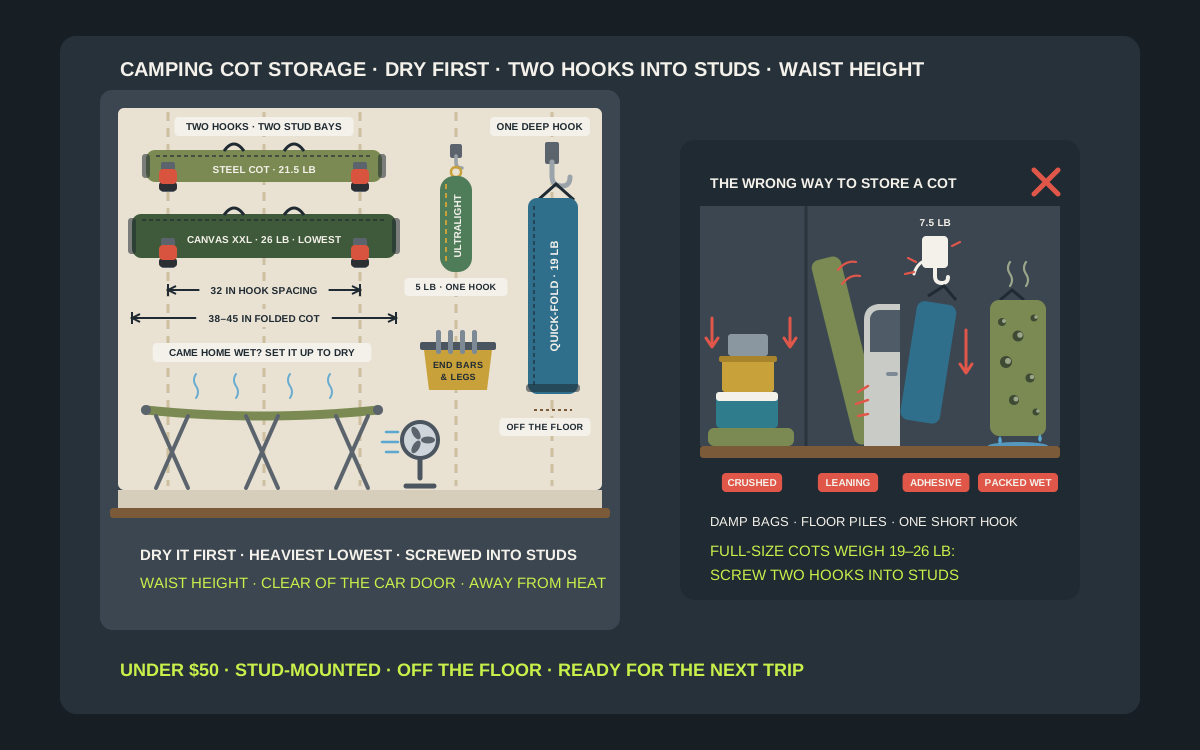
A camping cot is the most comfortable thing in the camping pile and the most awkward thing to store. Even folded, most full-size cots are a little over three feet long, they weigh roughly 19 to 26 pounds, and the bag never quite closes neatly over the end bars. So the cot ends up flat on the garage floor under a stack of bins, leaning against the wall behind the car, or riding around in the trunk until the next trip. None of that is good for the cot, and the leaning version eventually lands on a bumper or a shin. A wall spot fixes this for well under $50. Two padded ladder hooks screwed into the studs hold most folded cots, a deep hook or a heavy-duty strap handles a cot that has to stand upright, and a single small hook is enough for an ultralight cot in its case. What decides whether the setup works is the part the cot box never mentions: the weight you are actually lifting, the folded length against your stud spacing, and whether the fabric is truly dry before it goes up. This guide covers which hanger suits which kind of cot, where it belongs in a garage, cabin or RV setup, and how to keep the cot ready for the next trip.
Shop padded ladder hooks for cots on Amazon
Who this is for
- Car campers and families with two to four folding cots who want them off the garage floor and out from under the storage bins
- Hunters, anglers and cabin hosts with heavy canvas cots for camp or guest beds who need a spot that safely holds 20-plus pounds
- RV and van travelers who keep an ultralight or spare cot at home between trips and want it dry, with its bag and parts, and easy to load
Quick answer
For most garages, the best under-$50 setup is two padded ladder or utility hooks screwed into neighboring studs, with the folded cot in its bag lying flat across both hooks at about waist-to-chest height. Full-size folding cots weigh roughly 19 to 26 lb, so a hook such as Rubbermaid’s FastTrack Ladder Hook, rated at 50 lb, leaves plenty of margin, and Rubbermaid notes that horizontal storage takes two hooks. If the cot has to stand upright, use one deep hook through the bag’s carry handles or a heavy-duty storage strap. An ultralight cot that packs to the size of a tent bag can hang from one small hook by its loop. Whatever you choose, the cot has to be dry before it goes up: Helinox, Teton and Go-Kot all say not to store a cot damp. Check the hook rating, the hook depth against your bag and the current price on the listing before you buy.
Quick comparison
| Hanger | Best for | How it holds the cot | Trade-off |
|---|---|---|---|
| Two padded ladder hooks | Full-size steel and canvas folding cots | The bagged cot lies flat across two hooks one or two stud bays apart | Needs 3 to 4 ft of clear wall |
| One deep utility hook | A single cot standing upright in a narrow spot | The bag hangs by its carry handles from one deep, upturned hook | Relies on the bag handles; can swing |
| Heavy-duty storage strap | Cots with a torn bag or no bag at all | A hook-and-loop strap cinches the folded frame and hangs by its grommet | Check the strap rating and length |
| Small hook or rail peg | Ultralight pole-and-sheet cots | The packed case hangs from its loop or D-ring on one hook | Only for cots of about 5 lb or less |
| Rail with cot hooks | A full camp furniture wall | Cot hooks share a stud-mounted rail with chair, table and pad hangers | Rail plus hooks can pass $50 |
| Overhead rack or high shelf | Spare cots used once or twice a year | The cot lies flat across the joists or on a deep top shelf | Awkward lift; keep heavy cots low |
Heavy-duty utility hooksHeavy-duty storage strapsGarage track rail kits
What to look for
It is rated for the cot you are actually lifting
Cots look light in their bags, and the bigger ones are not. Coleman lists its steel-framed Trailhead II at 21.5 lb, Kamp-Rite lists its Standard Kwik Cot at 19 lb (Home Depot’s listing says 22 lb), and Teton lists its Outfitter XXL at 26 lb. Ultralight cots are a different category: Helinox’s Cot One Convertible weighs just under 5 lb packed, and Therm-a-Rest’s UltraLite Cot under 3 lb. Weigh yours in its bag on a bathroom scale, then pick hardware with a wide margin. A steel hook rated around 50 lb, like Rubbermaid’s FastTrack Ladder Hook, is a sensible floor for a full-size cot, because sliding it on and off adds a jolt that a resting load does not. Command’s Jumbo Utility Hook, one of the strongest common adhesive hooks, is rated at 7.5 lb, which rules adhesive out for anything but the ultralights.
The hook spacing fits the folded length
Measure the folded cot in its bag. The Coleman Trailhead II folds to roughly 38 to 40 inches long depending on the listing, the Kwik Cot folds to 39 by 8 by 7 inches, and Teton’s Outfitter XXL packs into a tote about 42 to 45 inches long. Garage studs usually sit 16 inches apart on center, so two hooks one stud bay apart give 16 inches of support and two hooks two bays apart give 32 inches. For a 38- to 45-inch cot, 32 inches leaves roughly 3 to 7 inches of overhang at each end, which is about right: the cot sits level, the ends do not tip, and you can lift it from the middle. Hooks 16 inches apart also work, but the bag droops at the ends and is happier with a strap around it.
The hook is deep enough for a bagged cot
A folded cot in its bag is somewhere around 4 to 13 inches deep, depending on the model, and the carry bag adds handles, buckles and a drawstring that like to slide off a short hook. Look for a ladder or utility hook whose listed depth clears your bag with room to spare, and whose tip turns up so the bag cannot creep off when the garage door rattles. Vinyl- or rubber-coated hooks keep the bag fabric from wearing through at the contact points. That matters more for a cot than for a ladder, because the same two spots carry it every time it goes up.
It lets the fabric breathe
Moisture is what ruins cots. Teton says moisture trapped in the fabric, whether from condensation, rain or plain humidity, is the fastest way to get odor or mildew, and that a cot should air out and dry fully after every trip. Helinox is just as direct: gear should never be stored damp or wet, and its anodized frames cannot protect themselves for long if they are packed away wet and left that way. A wall hook already beats a sealed tote, because air reaches the bag on every side. A cot that went up dry, a bag that breathes and a wall away from the damp corner do the rest.
Screws in the studs, not adhesive or bare drywall
A full-size cot pulls on two small points every time you lift it on or off, so fasten the hooks into studs, a stud-mounted rail or a wood cleat screwed across the studs. Drywall anchors on their own are a poor bet for a 20-plus-pound load that gets yanked around twice a season. In an unheated garage, adhesive has a second problem: Command’s indoor strips are made for about 50°F to 105°F, and many garages sit outside that range for months. Save adhesive for an ultralight cot in a heated room, and even there a single screw costs less than repairing the drywall after a fall.
Know your cot before you buy hooks
Folding steel-frame cots
The classic camp cot has folding legs and end bars that pull the fabric tight. Coleman’s Trailhead II is a typical example: rated for 300 lb, 21.5 lb on the scale, and folded into a bag a little over three feet long. These are the cots most families own, and they are the reason two hooks beat one. They are heavy enough that a single short hook is a strain, and long enough to sit nicely across a pair of hooks two stud bays apart. Keep the end bars in the bag, or in a labeled bin right next to it, because a cot missing one bar is just a pile of fabric at camp.
Quick-fold cots
Some cots fold up in one piece, much like a camp chair, instead of coming apart. Kamp-Rite’s Standard Kwik Cot folds to 39 by 8 by 7 inches, weighs about 19 lb and is rated for 300 lb. Because nothing comes off, these are the easiest cots to store: fold, bag, hang. They are thicker than a bar-style cot when folded, though, so check that the hook depth clears the bag and that the hook will not rub against a buckle or a frame joint.
Oversized and canvas cots
Big cots built for hunting camps, tall sleepers or guest beds are another step up. Teton’s Outfitter XXL weighs 26 lb, is rated for 600 lb, has an 80 by 35.5 inch sleeping surface and packs into a tote bag. The heavy polyester canvas on cots like this also takes longer to dry than thin ripstop. These belong on the lowest, strongest hooks in the garage, ideally around waist height, where you can slide the cot on without lifting 26 lb over your head.
Ultralight pole-and-sheet cots
Backpacking and motorcycle cots assemble from shock-corded aluminum poles and a fabric sheet, much like a tent. Helinox’s Cot One Convertible packs into a zippered cylinder case about 21 by 6 by 5.5 inches, with a daisy chain and a D-ring, and weighs just under 5 lb packed. Therm-a-Rest’s UltraLite Cot packs to about 16 by 4 inches and under 3 lb. Hang these from the case loop on a single hook next to the tent and sleeping pad, rather than on ladder hooks meant for a 20-lb cot.
Six ways to store a camping cot on a wall
Two padded ladder hooks, cot lying flat
This is the default for most garages. Screw two coated ladder or utility hooks into studs at the same height, one or two stud bays apart, and lay the bagged cot across them with the zipper or drawstring facing out. A cot lying flat spreads its weight across both hooks, sticks out only as far as the bag is thick, and comes off with a two-handed lift from the middle. With two or three cots, give each one its own pair of hooks, one pair above the other, with the heaviest cot on the lowest pair. Stack two cots on one pair only if the hooks are deep enough to keep the top bag inside the lip and rated for the combined weight.
One deep hook, cot standing on end
When the only free wall is a narrow strip by the door, a cot can hang upright from one deep, upturned utility hook through the carry handles of its bag. It takes up about eight inches of wall width instead of three feet. The trade-off is that everything rides on the bag’s handles and seams, so check them for wear first, and keep the bottom of the bag a few inches above the floor so it does not sit in whatever drips off the car. If the bag swings or spins, a second hook or a strap lower down holds it against the wall.
A heavy-duty storage strap on a hook
Cot bags tear, get lost or never fit again once the cot has been folded by someone in a hurry. A heavy-duty hook-and-loop storage strap wrapped around the folded frame, with its grommet over a screwed hook, is a cheap fix. Wrap-It rates its heavy-duty straps at up to 50 lb in the 10-, 13- and 17-inch sizes and up to 25 lb for the 7-inch size, so pick a length that goes around the folded cot with overlap to spare. Cinch it around the middle of the frame rather than a loose end bar, and add a second strap lower down if the legs fan out.
A small hook or rail peg for an ultralight cot
An ultralight cot in its case weighs about what a tent body does, so it needs nothing more than a single hook, a rail peg or a pegboard hook. Hang it by the case loop or D-ring next to the tent and sleeping pad so the whole sleep system lives in one place. This is the one cot where an adhesive hook can work: indoors, in a heated room, with a rating comfortably above the packed weight. In an unheated garage, use a screw.
Cot hooks on a camp furniture rail
If the garage already has a track rail, or you are planning one, cot hooks can share it with the chair hangers, the folding table bracket and the pad bags. The rail is screwed into the studs once, and the hooks slide to wherever the cot’s length needs them. It keeps every piece of camp furniture together, which is what Coleman suggests for bulky camping gear: carry bags where you have them, shelving or wall storage to save floor space, and the big pieces grouped so nothing gets left behind. The catch is cost. A rail plus a full set of hooks can pass $50, so price the whole kit, and start with the two cot hooks if the budget is tight.
An overhead rack or high shelf for spare cots
Spare cots that come out once or twice a year can go up high, across the joists on an overhead rack or on a deep top shelf. That is the right home for the guest cot and the wrong one for a cot you use every month, because lifting 20-plus pounds down over your head from a step stool is how cots, and people, fall. Keep the heaviest cots low and the light ones high, and push each cot all the way back so a bag strap is not dangling over the car.
Drying and care before the cot goes up
Set it up at home if it came back wet
A cot packed up in morning dew or rain is damp inside the bag even when the outside looks dry. Go-Kot’s advice is simple: if your cot gets soaked on a trip, set it back up at home so it can dry out completely. Do it in the garage, on the porch or in a spare room, run a fan if the air is humid, and fold the cot only when the fabric, the seams and the bag all feel dry. Ten minutes of setup now beats a musty cot next spring.
Clean the fabric gently
Helinox says its cot fabrics and carry bags are not machine washable and recommends cleaning dirty spots gently with warm water. Go-Kot suggests a damp cloth and a little mild soap mixed into water rather than poured straight onto the fabric, and says not to use a dryer. Teton recommends a periodic wipe-down with mild soap and water so dirt and body oils do not wear the fabric out early. Shake out sand and leaves first, wipe, then let the cot air-dry fully. If your cot’s care tag says something different, follow the tag.
Look after the frame
Rinse off salt spray and beach sand. Helinox says frames exposed to salt water should be rinsed with fresh water and left to dry before they are packed for storage. Look over the legs, joints and bolts as you fold the cot, the check Teton recommends before each trip, so a cracked leg or a loose bolt shows up in the garage instead of at camp after dark. If a cot squeaks, Go-Kot’s tip is to rub bar soap, not liquid soap, on the side poles.
Store it loose, not crushed
Teton warns that steady pressure on a folded cot over months of storage can weaken the frame or fabric, and says to store a cot somewhere dry rather than compressed under heavy gear. That is the best argument for the wall. A cot on hooks carries only its own weight, while a cot on the floor under two coolers and a bin of lanterns carries all of it. Coleman also suggests checking stored camping gear once or twice during a long off-season for moisture, pests and missing parts, which is easy when the cot is at eye level.
Where the cot hooks should go
Low enough to lift safely
Mount the hooks so the cot sits between waist and chest height for whoever usually puts it away. A 20- to 26-lb cot is easy to slide onto hooks at that height and awkward to wrestle onto hooks at head height. Leave a clear spot on the floor below, so you can set the cot down instead of lowering it onto a bike or the lawn mower.
Out of the car-door swing and the walkway
A bagged cot sticks out several inches from the wall, and a thick canvas cot can stick out a foot. On a garage side wall, that is right where the driver’s door opens, so open the door fully and measure before you drill, and keep the cot out of the path between the car and the door to the house. Buckles and loose bag straps catch on mirrors and sleeves, so tuck them in.
Dry, shaded and away from heat
Coleman says a garage is fine for camping gear as long as it stays reasonably dry and protected from persistent moisture, and it lists leaving equipment in a vehicle for long periods among the common storage mistakes. Helinox warns to keep its products away from excessive heat that might deform them. So skip the wall shared with the water heater, the dryer vent or a sunny west window, skip the damp corner where snowmelt pools, and do not let the car trunk become the cot’s home between trips.
Into studs, or a cleat across them
Find and mark the studs before you settle on hook spacing. Most garage walls are framed 16 inches on center, which gives you 16- or 32-inch spacing. If your cot needs a spacing that does not land on studs, screw a 1x4 or plywood cleat across two or three studs and mount the hooks to the cleat. On concrete or block walls, use masonry anchors rated for the load.
Garage, cabin, RV or apartment
Garage
Most cots live here, next to the rest of the camp furniture. Put the cot hooks on an inside wall near the chairs and the camp table, at waist height, with the heaviest cot lowest. If the garage is unheated, skip adhesive entirely, and keep the cot off any wall that sweats in winter.
Cabin
Cabin cots double as guest beds, so they come out more often, including in the off-season. A pair of hooks in a closet, mudroom or utility room keeps them close to where they get set up. A cabin closed up for the winter can turn damp, so store cots dry, in breathable bags, and not pressed against a cold exterior wall.
RV and van
On the road, a cot rides in a storage bay, under the bed or in a closet, not on an open hook, because anything hanging swings and falls on rough roads. Strap it flat so it cannot slide into anything, and dry a wet cot at camp before it goes back in. Between trips, bring it into the garage or the house rather than leaving it in a closed bay that bakes in the sun.
Apartment or condo
No garage? An ultralight cot fits on a closet shelf or a hook inside the closet, and a full-size cot can stand upright in its bag in a closet corner with a strap to keep it from tipping. If the cot is mainly a guest bed, a quick-fold model is the easiest to put away, because nothing comes apart.
Mistakes to avoid
- Folding and bagging a cot that is still damp from dew or rain.
- Leaving the cot flat on the garage floor under coolers and bins.
- Leaning a folded cot against the wall where it slides into the car.
- Hanging a 20-plus-pound cot from one short hook or an adhesive hook.
- Spacing the hooks so far apart that the ends hang off, or so close that the cot tips.
- Storing heavy cots overhead and lifting them down from a step stool.
- Leaving the cot in a hot car trunk or a closed RV bay all summer.
- Losing the end bars, leg extensions or bag straps because they were stored somewhere else.
Related guides
Browse the hub: RV & camping storage under $50 - all guides
- Best Camping Chair Wall Hangers Under $50 for Cabins
- Best Folding Camp Table Wall Brackets Under $50
- Best Camping Sleeping Pad Wall Bags Under $50
- Best Sleeping Bag Wall Stuff-Sack Hooks Under $50 for Camping
- Best Ladder Wall Hooks Under $50 for Garage
- Best Garage Track Rail Hooks Under $50
FAQ
What is the best way to store a camping cot in the garage?
Dry it, fold it into its bag and lay it flat across two padded ladder or utility hooks screwed into neighboring studs at about waist height. Two hooks spread the weight and keep the cot level, and the setup costs well under $50.
Can I hang a camping cot on one hook?
Yes, if the bag has strong carry handles and the hook is deep, screwed into a stud and rated well above the cot’s weight. Full-size cots weigh roughly 19 to 26 lb, so a single short hook or an adhesive hook is not enough.
How far apart should cot hooks be?
Measure the folded cot first. Most full-size cots fold to about 38 to 45 inches long, so hooks two stud bays apart, about 32 inches on a typical wall framed 16 inches on center, leave a few inches of overhang at each end.
Can I use adhesive hooks for a cot?
Only for an ultralight cot indoors. Command’s Jumbo Utility Hook is rated at 7.5 lb, and its indoor strips are made for about 50°F to 105°F, so a full-size cot, or any cot in an unheated garage, calls for screws.
Do I need to dry a cot before storing it?
Yes. Helinox, Teton and Go-Kot all say not to store a cot damp. If it came home wet, set it up and let the fabric, the seams and the bag dry completely before you fold it.
Is it bad to store a cot under other gear?
It shortens the cot’s life. Teton warns that steady pressure on a folded cot over months of storage can weaken the frame or fabric. On a wall hook, the cot carries its own weight and nothing else.
Bottom line
The best camping cot wall hanger is the one that matches the cot’s weight and folded length: two padded ladder hooks in the studs for full-size steel and canvas cots, one deep hook or a heavy-duty strap when the cot has to stand upright, and a single small hook for an ultralight cot in its case. Dry the cot before it goes up, mount it at a height you can lift from, keep it out of the car-door swing and away from heat, and check the hook rating, depth and current price on the listing before you buy.