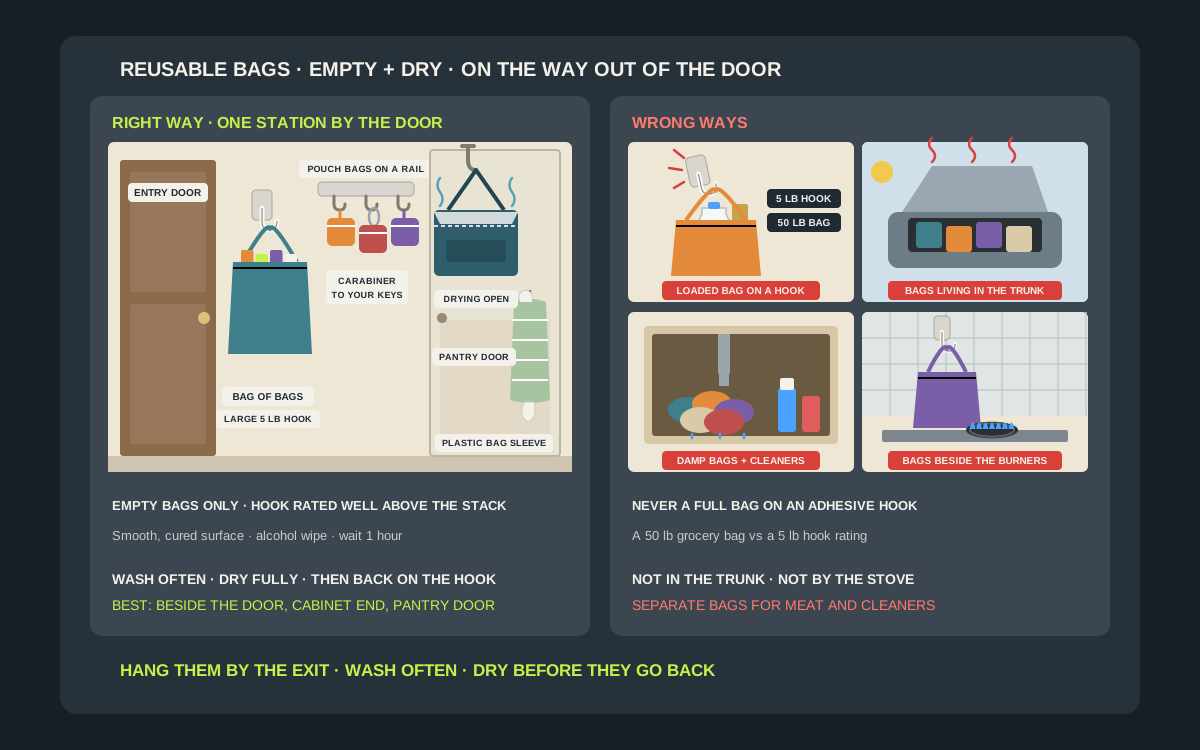
Every apartment with reusable grocery bags has the same problem: the bags pile up somewhere, and that somewhere is never where you are standing when you leave for the store. They end up stuffed in a drawer, wedged beside the fridge, balled up under the sink or living in the trunk of the car, and then you buy another bag at the checkout because yours are at home. A bag holder fixes that for very little money. One rated hook, a short rail or an over-door hook gives the bags a single home on the way out of the door, so they leave with you and come back to the same place. This guide covers where reusable bags should live in a rental, which under-$50 adhesive and no-drill holders really carry them, how to store compact pouch bags, canvas totes, insulated bags and saved plastic bags, and how to keep the bags clean enough to put food in. It uses the weight ratings and instructions Command publishes for its hooks, the specifications Baggu and ChicoBag list for their bags, food-safety guidance from the USDA and the California Department of Public Health, and a peer-reviewed study on what grows in unwashed grocery bags, and it ends with setups for studios, galley kitchens and shared apartments.
Shop reusable grocery bag holders on Amazon
Who this is for
- Renters who keep forgetting their reusable bags at home because the bags live in a drawer or a pile instead of by the door
- Small-kitchen households with a mix of fold-up pouch bags, canvas totes and one insulated bag that never fits anywhere
- Roommates and couples who want one shared bag station that stays tidy, dry and out of the way of the stove
Quick answer
For most apartments, the best reusable bag holder is a single large adhesive hook or a short hook rail on a smooth wall or cabinet panel near the door you leave by, holding empty, folded bags only. Gather thin bags into one tote and hang that bag of bags on a hook rated well above its weight: Command rates its Large Hook at 5 lb and its Jumbo Hook at 7.5 lb, which is far more than a stack of empty nylon or polyester bags weighs. Clip compact pouch bags such as a ChicoBag, which has its own carabiner, onto a rail or a key hook so one can go straight into a pocket. On textured or freshly painted walls, use an over-door hook on a pantry or closet door instead. Never hang a loaded grocery bag on an adhesive hook: a Standard Baggu is rated to carry up to 50 lb, ten times what a large adhesive hook is rated to hold. Wash the bags often, let them dry fully before they go back on the hook, and keep them out of the car trunk. All of this costs far less than $50; check the rating and current price on the listing.
Quick comparison
| Option | Best for | How it holds | Trade-off |
|---|---|---|---|
| Large adhesive utility hook | One tote stuffed with folded bags beside the entry door | Adhesive strip on smooth, clean paint, laminate, tile or finished wood; 1-hour wait | Empty bags only; Command rates Large Hooks at 5 lb and Jumbo Hooks at 7.5 lb |
| Adhesive hook rail | Two or three totes plus a pouch bag on a carabiner | Several hooks on one base, mounted with strips | The rating covers the whole rail; Command’s small key rail is 2 lb in total |
| Over-door hook | Bulky canvas totes and an insulated bag on a pantry or closet door | Hook over the top edge of the door, no adhesive | Door must still latch; check door thickness against the hook opening |
| Over-cabinet-door hook | A bag of bags inside a base or pantry cabinet door | Hook over the top of a cabinet door, no adhesive | Out of sight is easy to forget; pick the cabinet you pass on the way out |
| Adhesive wall caddy or pocket | Pouch bags with no loop, folded flat | Open basket on adhesive strips | Command rates its Clear Large Caddy at 4 lb; keep it light and dry |
| Plastic bag sleeve or dispenser | Saved plastic shopping bags for reuse or store drop-off | Fabric or plastic tube on a hook, strip or screw | Made for thin plastic bags, not totes; empty it before it overflows |
| Magnetic hook | One compact pouch bag on the painted side of a fridge | Magnet on painted steel | Many stainless fronts are not magnetic; slides when tugged sideways |
Large adhesive utility hooksOver-door hooks for pantry doorsPlastic bag holder sleeves
What to look for
A rating sized for empty bags, with margin
A holder only ever carries empty bags, but a stack of them is heavier than it looks. Thin ripstop nylon and polyester pouch bags weigh almost nothing; a ChicoBag Original stuffs into a pouch only 3 by 4 inches. Heavy cotton canvas totes, laminated woven bags and insulated cooler bags are a different load, and a dozen of them stuffed into one tote can reach several pounds. Weigh the full bag of bags on a kitchen scale before you choose. Command publishes its ratings clearly: Small Hooks 1 lb, Medium Hooks 3 lb, Large Hooks 5 lb, Jumbo Hooks 7.5 lb. Pick a hook rated at least double what you weigh, because bags get yanked off the hook on the way out of the door.
A spot by the exit, not by the stove
Reusable bags only get reused if they are in your hand when you leave. The best holder sits on the route out of the apartment: beside the entry door, on the end of the cabinet run nearest the door, or inside a pantry or closet door on the way out. A kitchen corner beside the range is the worst spot: bags hanging there are out of the way of your exit and inside the zone where fire safety agencies say anything that can burn should not be kept.
A surface the strip can grip
Adhesive holders need a smooth, clean, cured surface. Command lists painted walls, finished wood, laminate, tile, glass and metal, and warns against wallpaper and walls painted within the last seven days. In many rentals, that rules out textured entry walls and makes the smooth laminate end panel of a cabinet, the side of a tall pantry cabinet or the back of a door the better candidates. If no surface qualifies, choose an over-door or magnetic option from the table instead of forcing a strip onto a wall it will not hold.
A shape that fits how bags hang
Bags hang by their handles, and handles are long, soft loops that slide off shallow decorative hooks. A deep, rounded J hook or a utility hook with an upturned tip keeps a tote’s straps in place when you brush past. For pouch bags, a hook with a narrow tip takes a carabiner or a small loop, and a clear caddy or wall pocket holds pouches that have no loop at all. Holders sold as grocery bag dispensers are usually a fabric or plastic sleeve that you stuff from the top and pull from the bottom; those are made for thin plastic shopping bags, not for canvas totes.
Removal you can live with at move-out
In a rental, a holder is only as good as its exit. Command strips come off cleanly when you stretch the tab slowly, straight down along the surface; over-door hooks and magnetic hooks leave nothing behind but a possible scuff. Avoid freshly painted walls and flaking paint, which are the two surfaces most likely to lift with the strip, and take a photo of each surface before you mount anything on it.
Where reusable bags should live in an apartment
On the way out, not in the back of a drawer
Most people who own reusable bags still forget them, and the reason is almost always where the bags are kept. Bags put away after unpacking go wherever there is room, which is rarely on the route to the door. Move the holder to the last surface you pass before you leave: the wall beside the entry door, the cabinet end nearest the door, or the inside of a pantry or closet door in the hallway. When the bags hang next to your keys and your coat, taking them becomes part of leaving rather than something you have to remember.
Out of the burner zone
Fabric and plastic bags burn, and a kitchen corner beside the range is a tempting place to stuff them. The National Fire Protection Association says to keep anything that can catch fire away from the stovetop, and a tote hanging on the backsplash beside the burners is exactly that. Keep bag hooks well outside the reach of the cooktop, off the oven door handle and away from the toaster. Our apron and oven mitt hook guide covers burner-safe placement in a small kitchen in detail; the same rules apply to bags.
Not in the car trunk
Keeping bags in the car sounds like the obvious fix for forgetting them, but food-safety agencies advise against it. The California Department of Public Health says storing reusable grocery bags in the trunk is not recommended, because higher temperatures in warmer months can promote the growth of bacteria already on the bags. A peer-reviewed study in Food Protection Trends found the same thing in practice: when researchers added meat juices to bags and left them in car trunks for two hours, bacteria in the bags increased tenfold at a trunk temperature of 47 degrees C, about 117 degrees F. A clean, dry hook by the apartment door is the better habit, and a pouch bag clipped to your keys covers the unplanned stop.
Away from pets, chemicals and the floor
The same CDPH guidance says to store grocery bags away from pets, children and chemicals. In an apartment, that rules out the floor beside the pet bowls, the shelf under the sink next to cleaning sprays, and the bottom of a closet where the dog sleeps. A hook at chest height on a clean wall keeps the bags off the floor and out of reach of paws, and keeps them apart from anything you would not want touching food.
Matching the holder to the bags you own
Compact pouch bags
Fold-into-a-pouch bags are the easiest to store and the most likely to be in your pocket when you need one. Baggu says its Standard Baggu folds into its own flat 5-inch by 5-inch pouch, and ChicoBag sews a 3-inch by 4-inch pouch inside the seam of its Original tote and adds a metal carabiner so the bag can clip to keys, a backpack or a belt loop. Store these on a small rail or a key hook by the door, clipped by their carabiners or hung by their pouch loops, so you can grab one with your keys. A clear wall caddy works for pouches with no loop; drop them in flat, not crammed.
Thin nylon and polyester totes
Unfolded thin totes are light but bulky, and a row of them on separate hooks looks messy and takes a lot of wall. The tidiest solution is the bag of bags: fold each tote flat, stand them upright inside one larger tote, and hang that tote by both handles on one large hook. Six or eight thin totes this way weigh very little, take one hook’s worth of wall, and let you pull out as many as the trip needs. Put the strongest tote on the outside, because it carries the others.
Canvas and cotton totes
Heavy canvas and cotton totes are durable but heavier, they hold moisture longer after washing, and three or four of them can outweigh a dozen nylon bags. Hang them on a large hook or an over-door hook by their straps rather than folding them into a bag of bags, so air can reach the fabric. If you own more canvas totes than you use, keep two by the door and store the rest flat in a closet; they do not need prime wall space.
Insulated cooler bags
An insulated bag is the hardest to store well. It is bulky, it collects condensation from frozen food, and if it is zipped shut while damp it starts to smell. Wipe it out after each trip, leave it unzipped until the lining is completely dry, and then hang it open by its handles on an over-door hook or a large utility hook where air can circulate. Do not hang it inside a closed cabinet, and do not stuff other bags inside it while it is still damp.
Saved plastic shopping bags
Many apartments also collect thin plastic shopping bags from deliveries and quick stops. A fabric or plastic bag sleeve keeps them contained: you stuff bags in at the top and pull one out at the bottom, and it hangs on a single hook or inside a cabinet door. Keep a few for reuse as liners, and take the rest back. The U.S. Environmental Protection Agency says plastic bags, wraps and films should not go in curbside recycling bins, because they tangle in sorting equipment; clean, dry bags can go to retail drop-off bins instead. A sleeve that is full is a reminder to take a bundle to the store.
Never hang a loaded bag on an adhesive hook
The rating gap
This is the single most important rule for bag holders. A reusable grocery bag is built to carry far more than any adhesive hook can hold. Baggu rates its Standard Baggu to hold up to 50 lb, and ChicoBag gives its Original a 25 lb carrying capacity. Command’s Large Hook is rated at 5 lb and its Jumbo Hook at 7.5 lb. Hang a full bag of groceries on a bag hook while you unlock the door or kick off your shoes, and you are asking a strip rated for a few pounds to hold a load several times that size.
What a hook sees when you yank a bag
Adhesive ratings describe a steady, static load. Grabbing a bag off a hook in a hurry, or catching a strap with your arm as you walk past, adds a quick sideways and outward pull the rating never accounted for. That is why the hook should be rated well above what the empty bags weigh, why the hook should sit flat to the wall out of the walking line, and why the bag holder must never double as a drop point for groceries.
Give full bags a floor or a counter
When you come home, put the loaded bags on the floor by the door, a bench or a clean counter, unpack them, and only then fold the empty bags and hang them up. If you want a spot for a full bag while you deal with the lock, use the floor or a sturdy entry bench, not a hook. A single screw-in hook in a stud can hold more, but most leases limit what you can drill, and this guide is about holders you can remove without a trace.
Choosing between the seven options
When one large adhesive hook is enough
For most one- or two-person apartments, one large utility hook beside the door, holding a bag of bags, is the whole solution. It costs a few dollars, takes a few minutes, and the 5 lb rating of a Command Large Hook covers a tote full of folded nylon bags with plenty of margin. Choose a utility-style hook with a deep, upturned tip so the handles stay put, and mount it at a height where the bottom of the hanging tote clears the floor and any light switch.
When a hook rail is smarter
A rail lines up several hooks on one base, so the bags, a pouch bag on a carabiner and maybe a reusable produce bag pouch all hang in one tidy row. It is the best fit by the entry when two people share the bags or when you split food bags from non-food bags. Read the rating carefully: rails are usually rated for their total load, not per hook. Command’s small key rail is rated at 2 lb for the whole rail, which suits pouch bags and keys, not a stack of canvas totes.
When an over-door hook wins
Hooks that hang over the top edge of a door need no adhesive, which makes them the answer for textured walls, freshly painted apartments and bulky canvas or insulated bags. A pantry door or a hallway closet door on the way out is ideal. Measure the door thickness against the hook’s opening, check that the door still latches with the hook in place, and add a felt pad where metal touches paint. Over-door hooks also suit the insulated bag, which needs air around it to dry.
When the bags go inside a cabinet door
An over-cabinet-door hook inside a pantry or base cabinet keeps bags completely out of sight, which some people prefer in a small open-plan kitchen. The risk is that out of sight becomes out of mind, so use the cabinet you open most often, ideally the one nearest the door. Avoid the cabinet under the sink, where cleaning products live, and any upper cabinet beside the range that swings open over the cooktop.
When a wall caddy or pocket makes sense
Small adhesive caddies and wall pockets hold compact pouch bags that have no loop, and a clear caddy lets you see at a glance how many bags are left. Command rates its Clear Large Caddy at 4 lb and its Clear Medium Caddy at 2 lb. That is plenty for pouches, but a caddy is an open basket: do not drop damp bags into it, and do not let it become a catch-all for receipts and keys that eventually tears it off the wall.
When a plastic bag sleeve is worth it
If you collect plastic bags faster than you reuse them, a sleeve or dispenser stops them spilling out of a drawer. It is a container, not a strategy: give it a fixed capacity, empty the extra bags at the store’s drop-off bin when it fills, and do not mount it where it will be full of food smells, such as next to the trash can. For dispensing kitchen trash bag rolls, our adhesive trash bag dispenser guide covers a different kind of holder.
When a magnetic hook is enough
A magnetic hook on the painted side of the fridge can hold one compact pouch bag clipped by its carabiner, which keeps it in the kitchen without sticking anything to a wall. Magnets hold far less when they are pulled sideways than when they are pulled straight off, and pulling a bag off a hook is a sideways pull, so keep the load to a single pouch. Test the fridge with an ordinary magnet first, since many stainless fronts are not magnetic.
Keeping reusable bags clean enough for food
What grows in unwashed bags
Reusable bags carry raw meat packages, unwashed produce and the occasional leaking container, and most people never wash them. The 2011 Food Protection Trends study by researchers from the University of Arizona and Loma Linda University collected bags from shoppers in California and Arizona and found that reusable bags are seldom if ever washed. Large numbers of bacteria were found in almost all of the bags, coliform bacteria in 51 percent, and E. coli in 8 percent. The good news from the same study: hand or machine washing reduced the bacteria in bags by more than 99.9 percent.
Wash often, and after any leak
The USDA Food Safety and Inspection Service says that if you use reusable bags for groceries, you should wash them after each use with hot water and soap. The California Department of Public Health asks for frequent machine or hand washing and says to wash and dry a bag thoroughly whenever food has leaked into it. Check the care label first: ChicoBag says to wash its Original cold and hang it to dry, while Baggu lists the Standard Baggu as machine washable. Wipe insulated bags inside and out if the label does not allow machine washing.
Dry completely before the hook
A damp bag folded into a bag of bags stays damp, and a damp bag is where smells and mildew start. CDPH says to dry bags in a clothes dryer or let them air dry; whichever you choose, make sure the seams and the bottom panel are dry before you fold the bag. In practice, that means hanging just-washed bags open on an over-door hook or a drying rack overnight, and only then folding them into the holder.
Separate bags for meat, food and everything else
The USDA and CDPH both say to keep raw meat, poultry and seafood in separate bags from produce and ready-to-eat food, and CDPH adds that non-food items such as detergents and household cleaners should go in separate bags too, or that you can use one color of bag for food and another for non-food. A bag holder makes that easy to keep up: hang the meat bag on its own hook, keep the cleaning-supply bag on a different hook, and wash the meat bag after every trip.
Clean where the bags land
Bags pick up whatever is on the car floor, the cart and the checkout belt, and then they land on your counter. CDPH recommends cleaning the areas where you put bags while unpacking groceries, especially the kitchen counter and the table. If your counter space is tight, unpacking from the floor by the door and wiping down the bench or counter afterwards keeps the bags’ bottoms away from the surfaces you prepare food on.
Setups that fit different apartments
Studio with one door
In a studio, the kitchen is often a few steps from the only door, which makes the bag station easy. Put one large adhesive hook on the wall beside the door at the latch side, hang one tote stuffed with folded bags on it, and clip a pouch bag to your key hook. If the wall is textured, use a single over-door hook on the inside of the entry door instead and make sure the door still closes against its weather strip.
Galley kitchen off a hallway
In a galley, the end panel of the cabinet run nearest the hallway is the natural home. A short hook rail there takes a bag of bags and a pouch bag, and it is on the way out without reaching into the cooking zone. Keep the rail flat to the panel and at about chest height so a hip or a laundry basket does not snag the straps in the narrow aisle.
Kitchen with a pantry door
A pantry door is the best bag station in many apartments. An over-door hook on the outside face takes canvas totes and the insulated bag, and a plastic bag sleeve can hang on the inside face out of sight. Check that the door still closes fully with everything on it, and keep the total load light enough that the hooks do not bend or dig into the top edge of the door.
Shared apartment or roommates
When roommates share the shopping, give the bags one shared station near the door and agree on two rules: empty bags come back to the hook, and the meat bag gets washed after each trip. A rail with four hooks works well: one for the shared bag of bags, one for the meat bag, one for the cleaning-supply bag and one for whoever’s pouch bags are clipped there. Everything together costs far less than $50 at typical listings.
Car-free apartments
If you walk, bike or take transit to the store, the bags have to be on you, not on a wall. Keep the main stash by the door, but add a pouch bag clipped to your keys or your backpack, which is what a ChicoBag-style carabiner is for. For a bigger shop, take a second pouch from the hook on the way out. The holder is still the home base; the pouch is the backup.
Installing adhesive bag holders
Pick and prep the spot
Choose a smooth, cured surface on the way out: a painted wall at least seven days after painting, a laminate cabinet end or the glazed face of a single tile. Command says to clean the surface with isopropyl rubbing alcohol, not household cleaners or water, because cleaners can leave a film the strip cannot grip. Entry walls collect hand oils and kitchen walls collect cooking grease, so if the spot looks dull, wash it with a little dish soap and water first, rinse, dry completely and then do the alcohol wipe.
Press, wait, then load
Command’s instructions are short and worth following exactly: press the strip to the hook, press the hook to the wall firmly for 30 seconds, and wait one hour before hanging anything. Indoor strips are rated for 50 to 105 degrees F, so keep holders away from radiators, heat vents and the range. Load in stages: hang the empty tote alone for a day, then fill it with folded bags. If a strip is going to let go, it usually does so early.
Height and clearance
Mount the hook at a height where the bottom of the hanging tote clears the floor, a baseboard heater and any light switch or thermostat on the wall, which usually means around chest height for a full-size tote. Keep it out of the arc of the door and out of the main walking line so straps are not caught by passing arms, bikes or strollers. For a rail, leave enough room between hooks that taking one bag does not drag its neighbor along.
A simple routine that keeps the bags coming back
Unpack, shake out, check
Unpack the groceries, then turn each bag inside out over the sink or the trash and check it. A bag with crumbs goes back on the hook after a shake; a bag with a leak, a wet spot or a smell goes straight to the wash. This takes a minute and is the step most people skip.
Fold and return the same day
Fold dry bags and put them straight back in the bag of bags or on the rail before you put away the last of the groceries. The habit is what makes a holder work: a hook by the door with no bags on it is just a hook. Put the pouch bag back on your keys at the same time.
Rotate and retire
Use the bags in rotation rather than always taking the top one, so they get washed on a similar schedule. Retire bags with torn handles, split seams or a bottom panel that will not come clean, and keep the number of bags to what you actually use in a week or two. A holder that has to carry thirty bags is a sign that it is time to donate some.
Move-out without damage
Remove strips the right way
Command’s removal instructions are the difference between a clean wall and a torn patch of paint. Empty the hook, hold the base gently, then pull the strip tab slowly, straight down along the wall, never out toward you. The instruction sheet for Command Medium Hooks says to stretch the strip at least 12 inches to release it. If a tab breaks, our Command hooks guide covers what to do next.
Over-door, cabinet and magnetic hooks
These leave no adhesive behind, but metal hooks can scuff the top edge of a door and magnets can mark a fridge. Check each spot after removal and wipe away marks with a soft cloth. Felt pads under over-door hooks prevent most scuffs in the first place.
Photos before and after
Take a photo of each surface before you mount a holder and again after you remove it. It takes a minute and gives you something to point to if a deposit question comes up about a wall you never damaged.
Mistakes to avoid
- Hanging a full bag of groceries on an adhesive bag hook while you unlock the door or take off your shoes.
- Putting the holder in a kitchen corner by the range instead of on the way out of the apartment.
- Keeping the bags in the car trunk, where heat can help bacteria already on the bags grow.
- Folding damp bags into the bag of bags, or zipping an insulated bag shut before the lining is dry.
- Using the same bag for raw meat, produce and cleaning supplies without washing it in between.
- Choosing a small decorative hook that lets tote handles slide off, or a rail rated for 2 lb total for a stack of canvas totes.
- Sticking a holder on textured paint, wallpaper or a wall painted less than a week ago.
- Putting plastic shopping bags in the curbside recycling bin instead of a store drop-off bin.
Related guides
Browse the hub: No-drill apartment storage under $50 - all guides
- Best Adhesive Trash Bag Dispensers for Apartment Kitchens Under $50
- Best Adhesive Apron & Oven Mitt Hooks for Apartment Kitchens Under $50
- How to Organize an Apartment Entryway with No-Drill Hooks Under $50
- Best Over-Cabinet Kitchen Organizers for Apartments Under $50 (No Drill)
- Best Over-Door Pantry Organizers for Apartments Under $50
- Best Command Hooks for Apartment Storage Under $50 (No Drill)
FAQ
Where should you keep reusable grocery bags in a small apartment?
On the way out of the door: beside the entry, on the cabinet end nearest the door or inside a pantry or closet door you pass when you leave. Keep them off the floor, away from the range and away from cleaning chemicals, and not in the car trunk, which the California Department of Public Health does not recommend.
Can a Command hook hold reusable grocery bags?
Empty ones, yes. Command rates its Large Hook at 5 lb and its Jumbo Hook at 7.5 lb, which is far more than a tote full of folded nylon or polyester bags weighs. Weigh heavy canvas or insulated bags first. Never hang a loaded grocery bag on an adhesive hook.
How do you store a lot of reusable bags neatly?
Fold each bag flat and stand them upright inside one larger tote, then hang that bag of bags by both handles on a single rated hook. Clip compact pouch bags by their carabiners to a rail or key hook, and keep only the bags you use in a week or two by the door.
How often should you wash reusable grocery bags?
Often. The USDA says to wash reusable grocery bags after each use with hot water and soap, and the California Department of Public Health says to wash and dry any bag thoroughly after food has leaked into it. Follow the care label for water temperature and drying.
Is it OK to keep reusable bags in the car?
It is not recommended. CDPH says warm trunk temperatures can promote the growth of bacteria on bags, and a peer-reviewed study found bacteria in bags with meat juices increased tenfold after two hours in a car trunk at about 117 degrees F. Keep the bags on a hook by the door and a pouch bag on your keys.
What should I do with plastic grocery bags I have saved?
Keep a few in a bag sleeve for reuse and take the rest to a store drop-off bin. The EPA says plastic bags, wraps and films should not go in curbside recycling bins because they tangle in sorting equipment.
Bottom line
The best reusable grocery bag holder for an apartment is cheap, simple and on the way out of the door. One large adhesive hook or a short rail on a smooth wall or cabinet end, holding a bag of bags and a couple of pouch bags, covers most apartments for well under $50, with over-door and cabinet-door hooks for walls that will not take adhesive and a sleeve for saved plastic bags. Hang empty bags only, never a loaded one, size the hook well above what the empty bags weigh, and keep the station away from the range, the pets and the cleaning shelf. Wash the bags often, dry them completely before they go back on the hook, keep separate bags for meat and for non-food items, and leave the trunk empty. Check the rating, the surface list and the current price on the listing before you buy.