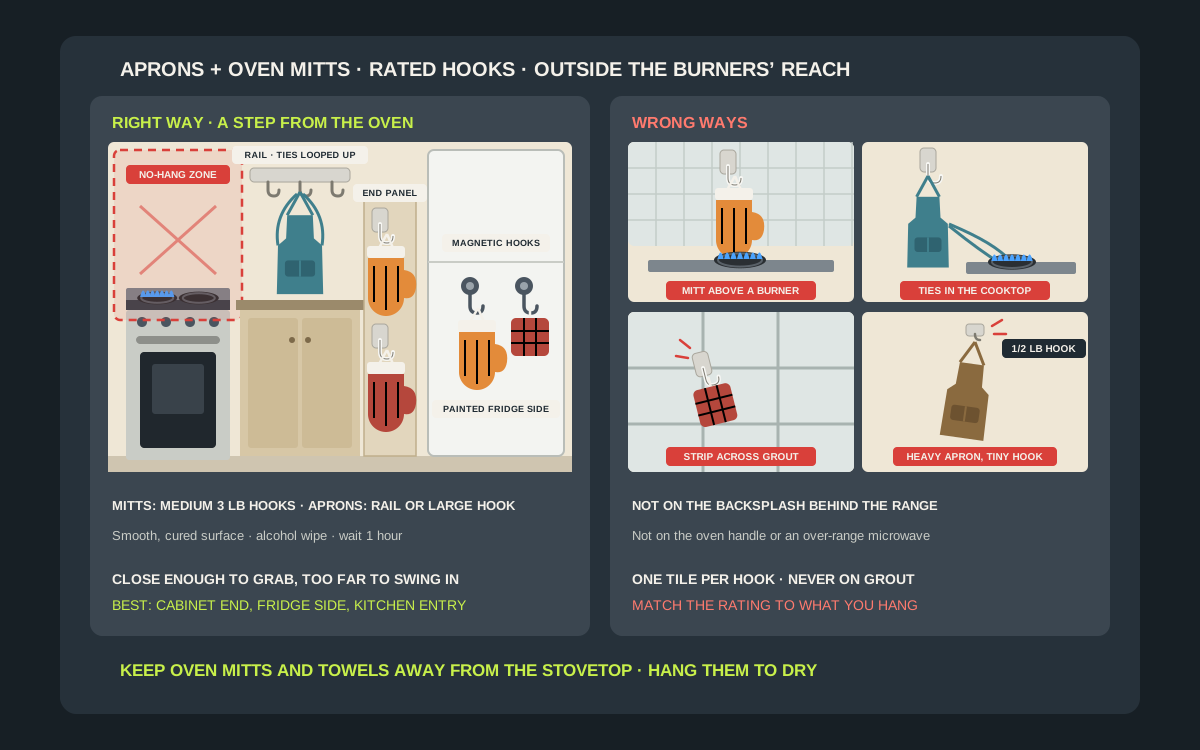
In most apartment kitchens the oven mitts live in a drawer that is always one drawer too far away, and the apron lives on the back of a chair. A couple of good hooks fix both problems for a few dollars, without a drill and without a conversation with the landlord. The catch is that a kitchen is the one room where the obvious spot for a hook can be the dangerous one: the backsplash right beside the burners is exactly where fire safety agencies tell you not to keep oven mitts, towels and anything else that can catch fire. This guide covers where aprons and mitts should hang in a small rental kitchen, which under-$50 hooks really hold them, and how to stick those hooks to kitchen paint, tile and cabinet panels so they survive daily use and still come off cleanly at move-out. It uses the weight ratings and instructions the hook makers publish and the cooking-safety advice from the National Fire Protection Association and the U.S. Fire Administration, and it ends with simple setups for galley kitchens, studios and shared kitchens.
Shop adhesive apron and oven mitt hooks on Amazon
Who this is for
- Renters who want oven mitts and pot holders within reach of the oven without drilling cabinets or tile
- Home cooks and bakers with one or two aprons that keep ending up on a chair, a doorknob or the counter
- Small-kitchen households and roommates who need a shared spot for aprons and mitts that stays out of the way of the stove
Quick answer
For most apartment kitchens, the best setup is two or three medium adhesive hooks or one adhesive hook rail on a smooth, painted wall or cabinet end panel, a step or two from the oven but well outside the reach of the burners. Command rates its Medium Hooks at 3 lb each and its Small Hooks at 1 lb, which covers a quilted mitt or a cotton apron with a wide margin; a heavy canvas apron with loaded pockets belongs on a large 5-lb hook. Skip tiny utensil hooks, which Command rates at half a pound. If your walls are textured or the paint is fresh, use over-cabinet-door hooks inside a pantry or base cabinet door, or magnetic hooks on the painted side of the fridge. Never hang mitts or aprons on the backsplash behind the range, on the oven handle or from an over-the-range microwave, and keep the indoor-strip temperature limit of 50 to 105 degrees F in mind. All of these options together cost far less than $50; check the rating and the current price on the listing.
Quick comparison
| Option | Best for | How it holds | Trade-off |
|---|---|---|---|
| Medium adhesive hooks | One apron or one or two mitts per hook on a wall or cabinet end | Adhesive strip on smooth, clean paint, laminate, tile or finished wood; 1-hour wait | Indoor strips are rated 50 to 105 degrees F; keep them away from the range |
| Adhesive hook rail | Two aprons plus a pair of mitts at the kitchen entry | Several hooks on one base, mounted with strips | The rating covers the whole rail, not each hook; check the total |
| Over-cabinet-door hooks | Mitts and pot holders inside a pantry or base cabinet door | Hooks over the top edge of the door, no adhesive | Door must still close; pick a door that does not swing over the cooktop |
| Magnetic hooks | Mitts and pot holders on the painted side of a fridge | Magnet on painted steel | Many stainless fronts are not magnetic; slides when tugged sideways |
| Over-door hook rack | Several aprons on a kitchen or pantry door | Hooks over the top of a full-height door | Needs a door near the kitchen and clearance at the frame |
| Suction hooks | Light mitts on a single glazed tile or glass | Suction cup on smooth, non-porous surface | Fails on grout lines and textured tile; re-seat regularly |
Adhesive hook railsOver-cabinet door hooksMagnetic hooks for fridge sides
What to look for
A rating that covers the real load
Kitchen textiles are light, but not equally light. A quilted cotton mitt or a flat pot holder weighs a few ounces, a pair of thick silicone mitts weighs noticeably more, and a canvas or denim apron with a thermometer and a phone in the pocket can pass a pound. Weigh what you plan to hang on a kitchen scale. Command publishes clear ratings: Small Hooks hold 1 lb, Medium Hooks 3 lb, Large Hooks 5 lb, and its clear Utensil Hooks only half a pound. Pick a hook rated well above the weight, because mitts get yanked off in a hurry, and a yank adds force the static rating never sees.
A surface the strip can grip
Adhesive hooks need a smooth, clean, cured surface. Command lists painted walls, finished wood, laminate, tile, glass and metal, and warns against wallpaper and walls painted within the last seven days. In a kitchen that rules out textured or orange-peel paint behind the stove area, rough brick-look panels and unfinished wood shelves. The good news is that most rental kitchens have at least one excellent surface: the smooth laminate or painted end panel of a cabinet run, the side of a tall pantry cabinet, or a single glazed tile.
A hook shape that fits a loop
Most mitts and pot holders have a fabric loop at the cuff or corner, and most aprons hang by the neck strap. A hook with a deep, rounded J keeps those loops from sliding off when you brush past; a shallow decorative hook lets them pop free. Rounded, smooth tips matter too, because a sharp wire end can snag quilted fabric. If a silicone mitt has no loop at all, use a clip hook or a small spring clip so it hangs by its cuff instead of balancing on a hook.
Heat, steam and the indoor temperature window
Command gives its indoor hooks a temperature range of 50 to 105 degrees F and says humidity and temperature changes are among the common reasons a hook falls off. In a kitchen, that means keeping adhesive hooks away from the range, the toaster and the steam from a kettle or a dishwasher vent. If the only good spot is near the sink, Command’s water-resistant bath hooks, such as its Medium Bath Hooks rated at 3 lb, are a better match than standard strips.
Removal you can live with at move-out
In a rental, the hook is only as good as its exit. Adhesive strips with a pull tab come off the wall cleanly when you stretch the tab slowly, straight down along the surface; over-door hooks and magnetic hooks leave nothing behind but a possible scuff. Before you commit, decide which surfaces you are happy to test, and avoid freshly painted walls and old flaking paint, which are the two surfaces most likely to lift with the strip.
Where aprons and oven mitts should hang
Out of the burner zone
Start with the rule every fire safety agency repeats. The National Fire Protection Association says to keep anything that can catch fire, naming oven mitts, wooden utensils, food packaging, towels and curtains, away from the stovetop, and the U.S. Fire Administration gives the same list and adds paper towels. That rules out the most tempting spot in a small kitchen: the backsplash right behind or beside the burners. A simple test helps. If a mitt or an apron tie swinging off its hook could touch a burner, a pan handle or the range top, the hook is too close.
Near the oven, not on it
The oven door handle and the handle of an over-the-range microwave look like built-in hooks, but both are part of the cooking zone. Anything draped on the oven handle hangs inches below the burners, sits in the path of spills, and on a front-control range ends up right next to the knobs. A mitt hanging from a microwave above the range hangs directly over the cooktop. Put the hooks a step or two to the side instead, on the nearest wall or cabinet panel that is outside the reach of the burners, so the mitts are close enough to grab without leaning over a hot pan.
Cabinet doors that stay clear of the cooktop
Inside a cabinet door is a tidy, invisible place for mitts and pot holders, and over-cabinet-door hooks need no adhesive at all. Choose the door carefully, though. An upper cabinet right beside the range often swings its door out over the cooktop, so anything hanging inside it dangles above the burners every time you open it. A pantry door, a base cabinet door on the far side of the sink, or an upper door that opens away from the range is the better home.
The kitchen entry for aprons
Aprons are put on before you cook and taken off when you are done, so they belong where you walk into the kitchen, not next to the stove. A short adhesive hook rail on the wall by the doorway, the end panel of the cabinet run nearest the entry, or an over-door rack on a pantry door keeps aprons visible and out of the cooking zone. It also keeps them away from the sink splash, so they stay dry between uses.
Matching the hook to what you hang
Quilted cotton mitts and pot holders
These are the easy case. A classic quilted mitt or a square pot holder weighs a few ounces and usually has a loop, so one Small or Medium adhesive hook per item is plenty. Give each one its own hook rather than stacking three loops on one; a single hook with a pile of mitts is hard to grab from in a hurry, and the bottom mitt never dries. Space the hooks about the width of a mitt plus an inch or two so they hang flat side by side.
Silicone mitts and long gauntlets
Silicone mitts and long oven gloves are heavier and stiffer, and some have no loop. Weigh the pair; if it comes close to a pound, use Medium Hooks at minimum, one per mitt. For loopless mitts, a hook with a built-in spring clip or a small binder-style clip on a hook holds the cuff without anything to thread. Long gauntlets also hang lower, so mount their hooks higher than the quilted mitts so the cuffs do not rest on the counter.
Bib aprons, waist aprons and canvas shop aprons
A cotton bib apron hangs neatly by its neck strap from one Medium hook; loop the waist ties up over the same hook so they do not trail down onto the counter or a toaster. A waist apron folds in half over a hook. Heavy canvas, denim and waxed-cotton aprons are a different load, especially with pockets full of a thermometer, a pen and a phone. Empty the pockets before hanging, and give these aprons a Large 5-lb hook or a spot on a rail rated for the combined weight.
Grill gloves and holiday baking extras
Many apartments collect a second set of heat gear: long grill gloves for a balcony grill, a pair of extra mitts for holiday baking, a spare apron for guests. These do not need prime space beside the oven. Hang them on one shared hook inside a pantry or closet door, or on a hook by the balcony door if that is where the grill lives, and keep only the everyday pair at the cooking station. Fewer items near the stove means fewer things that can drift toward a burner, and the everyday mitts are always the ones within reach.
Kitchen towels on the same strip
Dish towels usually end up next to the mitts, and the same placement rules apply, because towels are on the fire agencies’ list too. A towel on a hook dries better than one balled up on the counter, but a damp towel also adds weight and moisture to an adhesive strip, so give it a separate hook away from the strip that holds dry mitts. For a long towel bar or a bathroom setup, our no-drill towel bar guide covers wet-towel loads in detail.
Choosing between the six options
When plain adhesive hooks win
Individual adhesive hooks are the default for a reason. They go exactly where you want them, one per mitt or apron, and each one carries its own rating, so a 3-lb Medium hook really can hold its own 3 lb. They suit smooth painted walls, laminate cabinet ends and glazed tile, and value packs make them the cheapest way to hang four or five items. Their limits are the surface and the heat: textured paint, fresh paint and the wall beside the range are all off the table.
When a hook rail is smarter
A rail puts several hooks on one base, so the hooks line up neatly and you only prep one patch of wall. It is the tidiest choice at a kitchen entry where two or three aprons hang together. Read the rating carefully, though. A rail is usually rated for its total load: Command’s small key rail, for example, is rated at 2 lb for the whole rail. Two cotton aprons fit easily; two canvas aprons with full pockets may not, so weigh them first.
When over-door and over-cabinet hooks win
Hooks that hang over the top edge of a door need no adhesive, which makes them the answer for textured walls, freshly painted kitchens and renters who want zero risk to the paint. Over-cabinet-door hooks suit mitts and pot holders inside a base or pantry door, and a full-height over-door rack takes several aprons. Measure the door thickness against the hook’s opening, check that the door still latches with the hook in place, and keep them off any door that swings over the cooktop.
When magnetic hooks make sense
Magnetic hooks are ideal on the painted steel side of a refrigerator, and they move in seconds when you rearrange the kitchen. They are best for light items, because a magnet holds far less when it is pulled sideways than when it is pulled straight off; magnet makers commonly put sideways hold at only a fraction of the pull rating. A quick grab of a mitt is a sideways pull, so choose a hook with a rubber-coated base, which resists sliding and protects the finish. Test the fridge with a plain magnet first, since many stainless fronts are not magnetic.
When suction hooks are worth a try
Suction hooks only work on smooth, non-porous surfaces: a large glazed tile, glass or a glossy laminate panel. On those, a good suction hook can hold a light quilted mitt or a pot holder, and it comes off without a trace. They lose grip on grout lines, textured tile and anything slightly curved, and they need to be pressed back down from time to time. Treat them as a light-duty option for one or two mitts, not as an apron hook.
Setups that fit different apartment kitchens
Galley kitchen
In a galley, the range is usually halfway down one run of cabinets, so the end panels at either end of that run are natural hook spots. Put two Medium adhesive hooks for mitts on the end panel nearest the range, as long as it is outside the burners’ reach, and a short rail for aprons on the opposite wall near the entry. Keep the walking lane clear; hooks on the narrow aisle side should sit flat to the wall so you do not catch a hip on them.
Studio kitchenette on one wall
When the whole kitchen is one wall, the stove may sit only a couple of feet from the fridge and the sink. That is the case where magnetic hooks on the painted side of the fridge earn their place: they keep the mitts at arm’s length from the oven without sticking anything to the wall. Hang aprons on an over-door hook on the closet or bathroom door nearest the kitchenette, and keep the strip of wall beside the range bare.
Kitchen with a pantry door
A pantry door is the best apron and mitt station in many apartments. An over-door hook rack takes several aprons without adhesive, and a pair of over-cabinet-door hooks or a small adhesive rail on the inside face holds mitts and pot holders. Check that the door still closes fully with everything on it, and add felt pads where the hooks touch the door edge so they do not scuff the paint.
Two cooks, one kitchen
When roommates or partners share the kitchen, give each person their own apron hook and agree on one shared mitt station. Two Medium hooks for aprons and a three-hook rail for mitts and pot holders together stay far below the $50 line at typical listings. A shared station also makes it obvious when a mitt goes missing into someone’s drawer, which is how most kitchens end up with one mitt.
Installing adhesive hooks in a kitchen
Degrease first, then wipe with alcohol
Kitchen walls carry a thin film of cooking grease even when they look clean, and grease is what makes adhesive hooks fail. Command says to clean the surface with isopropyl rubbing alcohol, not household cleaners or water, because cleaners can leave a slippery film. On a greasy wall, wash the spot with a little dish soap and water first, rinse it, let it dry completely, and then do the alcohol wipe the instructions call for.
One tile, never the grout line
Tile is a good surface for adhesive and suction hooks, but only on the glazed face of a single tile. A strip or a suction cup that straddles a grout line touches the surface only on two edges and lets air in under the rest. Measure the hook base against the tile before you choose a spot, and skip textured or tumbled tile entirely.
Press, wait, then load in stages
Command’s instructions for its hooks are short and worth following to the letter: press the strip to the hook, press the hook to the wall firmly for 30 seconds, and wait one hour before hanging anything. For a two-piece hook, slide the hook off and press the base for another 30 seconds. Hang a light mitt first and leave it for a day before adding the apron. If a hook is going to fail, it usually fails early, and it is better to find out with a pot holder than with a full apron.
Height and spacing
Hang mitt hooks around chest height so you can grab one without bending or reaching over anything, and hang apron hooks high enough that the hem clears the counter, a toaster and any outlets on the backsplash. A bib apron usually hangs well over two feet below its hook, so measure your longest apron from the neck strap down before you pick the height. Leave enough space between hooks that taking one item off does not drag its neighbor along.
Keeping mitts dry and ready to use
Dry mitts only
Storage is about safety as much as tidiness. The U.S. Fire Administration warns that hot cookware can heat moisture in a potholder or hot pad and cause a scald burn, so it says to use dry oven mitts or potholders. That is a strong argument for hooks over a drawer: a mitt that hangs in open air dries between uses, while a damp mitt stuffed in a drawer stays damp. If a mitt gets wet while cooking, hang it on its own hook away from the range and use a dry one.
Wash and rotate
Cotton mitts and aprons pick up grease and food stains, and greasy fabric is not what you want near a burner. Wash them on the schedule the care label gives, and keep a second pair of mitts so one set can dry while the other hangs ready. Silicone mitts usually wipe clean with soap and water; let them dry fully before they go back on the hook.
Retire worn and scorched mitts
A mitt that is scorched, thinned at the palm or torn through the quilting no longer protects the way it did. Swap it for a new pair rather than doubling up worn ones. When you buy, choose mitts with a sturdy hanging loop; it makes every hook option in this guide work better.
Move-out without damage
Remove adhesive strips the right way
Command’s removal instructions are the difference between a clean wall and a torn patch of paint. Hold the hook base gently in place, then pull the strip tab slowly, straight down along the wall, never out toward you. The instruction sheet for Command Medium Hooks says to stretch the strip at least 12 inches to release it. If a tab breaks, our Command hooks guide covers what to do next.
Over-door and magnetic hooks
Over-door hooks and magnetic hooks leave no adhesive behind, but they can scuff. Check the top edge of each door and the side of the fridge where the hooks sat, and wipe away any marks with a soft cloth. Felt pads under over-door hooks prevent most scuffs in the first place.
Photos at move-in and move-out
Take a photo of each surface before you stick a hook to it and again after you remove it. It takes a minute and gives you something to point to if a deposit question comes up about a wall you never damaged.
Mistakes to avoid
- Hanging oven mitts on the backsplash right behind or beside the burners because it is the closest wall.
- Draping mitts and aprons over the oven door handle or the handle of an over-the-range microwave.
- Using tiny utensil hooks rated for half a pound for a heavy canvas apron with full pockets.
- Sticking a hook across a grout line, on textured paint or on a wall painted less than a week ago.
- Cleaning the spot with a household spray instead of rubbing alcohol, leaving a film the strip cannot grip.
- Hanging a full apron one minute after pressing the hook instead of waiting the hour the instructions call for.
- Putting mitts inside an upper cabinet door that swings out over the cooktop.
- Pulling an adhesive strip straight out from the wall at move-out instead of stretching it slowly downward.
Related guides
Browse the hub: No-drill apartment storage under $50 - all guides
- Best Adhesive Utensil Holders for Apartment Kitchens Under $50
- Best Adhesive Mug Hooks for Apartment Kitchens Under $50
- Best Command Hooks for Apartment Storage Under $50 (No Drill)
- Best Stick-On Pegboard Panels for Apartment Kitchens Under $50
- Best Over-Cabinet Kitchen Organizers for Apartments Under $50 (No Drill)
- Best No-Drill Towel Bar Wall Mounts for Apartments Under $50
- Best Adhesive Reusable Grocery Bag Holders for Apartment Kitchens Under $50
FAQ
Where should you hang oven mitts in a small kitchen?
Close to the oven but outside the reach of the burners: a cabinet end panel, the painted side of the fridge or inside a pantry or base cabinet door that does not swing over the cooktop. The NFPA and the U.S. Fire Administration both say to keep oven mitts and towels away from the stovetop.
Can Command hooks hold an apron?
Yes. Command rates its Medium Hooks at 3 lb and its Large Hooks at 5 lb, which covers a cotton apron easily. Use a Large hook for a heavy canvas or denim apron with full pockets, and skip the clear Utensil Hooks, which are rated at half a pound.
Is it safe to hang oven mitts on the oven door handle?
It is not a good habit. The handle sits just below the burners and in the path of spills, and the mitts end up next to the knobs on a front-control range. A hook a step or two to the side is just as quick to reach and keeps the mitts out of the cooking zone.
Do adhesive hooks work on kitchen backsplash tile?
They work on the smooth, glazed face of a single tile, cleaned with rubbing alcohol. They do not hold well across grout lines or on textured tile. Keep them on tile away from the range, since indoor strips are rated for 50 to 105 degrees F.
Will magnetic hooks work on my refrigerator?
Usually on the painted steel sides, often not on stainless fronts, many of which are not magnetic. Test with a fridge magnet first. Magnetic hooks hold far less when pulled sideways than straight out, so use them for mitts and pot holders rather than heavy aprons.
How do I remove adhesive hooks at move-out without peeling paint?
Hold the hook base, then pull the strip tab slowly straight down along the wall, never toward you. Command’s instructions for its Medium Hooks say to stretch the strip at least 12 inches until it releases. Do not use strips on paint that is less than seven days old.
Bottom line
The best apron and oven mitt hooks for an apartment kitchen are cheap, simple and in the right place. Two or three medium adhesive hooks or one hook rail on a smooth cabinet end or wall, a step or two from the oven, cover most kitchens for well under $50, with over-cabinet-door hooks and magnetic fridge hooks for walls that will not take adhesive. Keep everything out of the reach of the burners, off the oven handle and away from an over-the-range microwave, match the hook rating to what you really hang, and let mitts dry in open air between uses. Prep the surface with rubbing alcohol, wait the full hour before loading, and stretch the tabs slowly downward when you move out. Check the rating, the surface list and the current price on the listing before you buy.