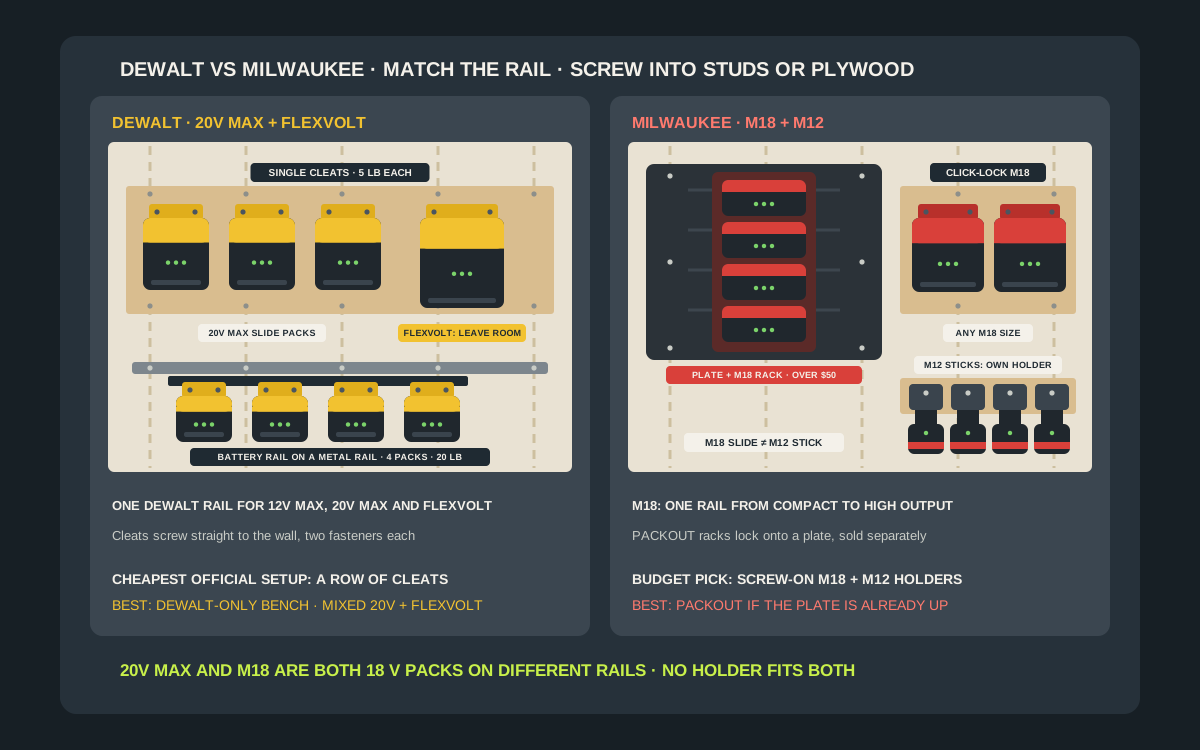
DeWalt and Milwaukee are the two cordless platforms you are most likely to find side by side in an American garage, often because one came with a drill kit and the other came with a deal on an impact driver. Their spare batteries look like they should share a wall holder. They do not. A DeWalt 20V MAX pack and a Milwaukee M18 pack are both 18-volt batteries under the label, yet they slide onto completely different rails, and Milwaukee’s M12 packs are not slide packs at all. That is why this decision is about the battery, not the brand logo: the right holder is the one molded for the exact rail your packs use, at a load rating that matches what they really weigh. This guide compares the under-$50 ways to hang each brand, from DeWalt’s own single cleats and Milwaukee’s PACKOUT battery racks to the click-lock mounts that third-party makers sell in six-packs. It uses the specifications the makers publish, the pack weights in their battery charts and the storage rules in their manuals, and it ends with a plan for a garage that runs both brands on one wall.
Shop DeWalt and Milwaukee battery mounts on Amazon
Who this is for
- DeWalt owners with a growing pile of 20V MAX and FlexVolt packs who want them on the wall instead of on the bench or stacked on the charger
- Milwaukee owners with M18 slide packs, M12 stick packs, or both, deciding between PACKOUT racks and screw-on holders
- Two-brand garages where a DeWalt kit and a Milwaukee kit share one workbench and every spare pack needs an obvious home
Quick answer
Buy holders for the rail, not the brand name. DeWalt says its single battery cleat mounts directly to a wall and holds one 12V MAX, 20V MAX or FlexVolt pack with a 5-lb rating, so a row of those cleats is the cheapest official DeWalt setup and stays well under $50 for four or more packs. Milwaukee’s PACKOUT M18 battery rack holds four M18 packs of any size and the M12 version holds four M12 packs, but both lock onto a PACKOUT mounting plate, and a rack plus a plate lands above $50 unless you already own the plate. If you want the same kind of holder for both brands, click-lock six-packs such as StealthMounts are sold separately for DeWalt 20V, Milwaukee M18 and Milwaukee M12, each listed well under $50. No holder fits both brands, and an M18 holder will not take an M12 pack. Screw every holder into a stud or a plywood backer, keep the station on a shaded interior wall next to the charger, and check fit and the current price on the listing.
Quick comparison
| Setup | Packs it fits | How it mounts | Trade-off |
|---|---|---|---|
| DeWalt single battery cleats | One DeWalt 12V MAX, 20V MAX or FlexVolt pack per cleat | Screws straight into the wall; two fasteners included | One pack per cleat; 5-lb rating per cleat |
| DeWalt battery rail | Four DeWalt 12V MAX, 20V MAX or FlexVolt packs | Latches onto a DeWalt metal workshop rail, sold separately | Rail plus battery rail together sit right around $50 |
| Milwaukee PACKOUT M18 battery rack | Four M18 packs of any size, clip-in | Locks onto a PACKOUT mounting plate or slides onto a PACKOUT lid | Rack plus mounting plate goes above $50 |
| Milwaukee PACKOUT M12 battery rack | Four M12 stick packs of any size | Locks onto a PACKOUT mounting plate | Rated at 6 lb; same plate cost applies |
| Click-lock six-packs, by brand | DeWalt 20V, Milwaukee M18 or M12, sold as separate sets | Two countersunk screws each; hardware not included | Buy one set per rail; sets never cross brands |
| Lipped shelf for odd packs | Any brand, any size | Shelf brackets into studs | Packs sit loose; protect the terminals |
DeWalt 20V MAX battery holdersMilwaukee M18 battery holdersMilwaukee M12 battery holders
What to look for
The rail, not the voltage
The numbers on the label are marketing, and they confuse more battery holder purchases than anything else. DeWalt notes that its 20V MAX packs are 18 volts nominal and its 12V MAX packs are 10.8 volts nominal; the higher figure is the maximum initial voltage with no load. Milwaukee simply calls its 18-volt line M18. So a 20V MAX pack and an M18 pack are the same class of battery, but each brand uses its own slide rail and latch, and a holder copies one of them. The only question that matters is which rail is on the bottom of the packs you own.
Every pack size on the same rail
Within one brand, pack sizes share a rail but not a shape. DeWalt’s 2025 battery chart runs from a compact POWERSTACK pack at 0.7 lb and a 2.0Ah 20V MAX pack at 0.8 lb to the 5.0Ah DCB205 at 1.4 lb, the 6.0Ah FlexVolt DCB606 at 2.4 lb and the 15.0Ah FlexVolt at 4.5 lb. Milwaukee’s M18 line runs from compact packs to the HIGH OUTPUT HD12.0, which weighs about 3.4 lb. Bigger packs are taller and deeper, so the holder has to grip the rail and still leave room under any shelf above it and beside the next slot.
How the holder keeps the pack
There are two styles. Cleats and racks that copy the tool’s rail let the pack slide on until its own latch clicks, so you remove it the same way you remove it from a tool, by pressing the release. Click-lock mounts such as StealthMounts work the same way, and the maker says they hold a pack at any angle, even upside down under a shelf. Friction cradles and open hooks are cheaper but let packs creep loose when a ladder or a broom brushes the wall. On a busy garage wall, latching retention is worth paying for.
A load rating that matches real pack weights
Ratings vary far more than pack weights do. DeWalt rates its single cleat at 5 lb, which clears even its 4.5-lb 15.0Ah FlexVolt pack, and its four-cleat battery rail at 20 lb in total. Milwaukee’s US product page rates the PACKOUT M18 battery rack at 20 lb for four packs, while its Australian listing gives 6.8 kg, about 15 lb, and the M12 rack is rated at 6 lb. A retailer listing for StealthMounts’ M18 mount gives 30 lb per mount. Any of these handles real packs; the weak point is almost always the screws and the wall behind them.
The system you already own
Both brands sell battery storage that belongs to a larger wall system. DeWalt’s battery rail and its TOUGHSYSTEM 2.0 DXL accessory kit hang on DeWalt’s metal workshop rails, and Milwaukee’s PACKOUT racks lock onto PACKOUT mounting plates and also slide onto PACKOUT tool box lids. If you already have the rail or the plate on the wall, the brand’s own battery rack is the neatest add-on. If you do not, the rail or plate is the expensive part, and plain screw-on holders are the better value.
DeWalt 20V MAX and FlexVolt: what fits
One rail covers three DeWalt families
DeWalt keeps its holders simple: the company lists its single battery cleat, its four-cleat battery rail and the cleats in its TOUGHSYSTEM 2.0 DXL power tool storage kit for DeWalt 12V MAX, 20V MAX and FlexVolt packs. That matters because FlexVolt packs run in 20V MAX tools, so many DeWalt garages mix the two on one bench. A wall of DeWalt cleats takes both without sorting. Third-party lines are less uniform; StealthMounts, for example, sells separate mounts for DeWalt 10.8V and 12V packs and for DeWalt 20V packs, so a DeWalt owner with 12V tools needs to check which set covers them.
The cheapest official setup
The single cleat is the one DeWalt part in this comparison that needs nothing else. DeWalt says it mounts directly to the wall, is made of metal, carries 5 lb and comes with two wood or drywall fasteners. Home centers list single cleats for a few dollars each, so a row of four to six cleats stays well under $50. Because each cleat is separate, you can space them to suit the packs you own: tighter for compact 2.0Ah packs, wider where a 9.0Ah or 15.0Ah FlexVolt pack needs elbow room.
When the rail system makes sense
DeWalt’s battery rail is a steel bar with four cleats, rated at 5 lb per cleat and 20 lb in total, that latches onto DeWalt’s metal workshop rail rather than the wall. The rail itself is a separate purchase, and a 48-inch rail plus a battery rail sit right around the $50 line at typical listings. That only pays off if you plan to hang more DeWalt storage on the same rail, such as tool holsters or the charger mount in the TOUGHSYSTEM 2.0 DXL kit, which DeWalt rates at 11 lb for one desktop charger or two compact chargers.
FlexVolt packs need more room than you think
A FlexVolt pack slides onto the same rail as a 20V MAX pack but stands taller and deeper, and it weighs more. DeWalt’s 2025 battery chart lists the 6.0Ah FlexVolt at 2.4 lb, the 9.0Ah and 12.0Ah at 3.2 lb and the 15.0Ah at 4.5 lb, against 1.4 lb for a 5.0Ah 20V MAX pack. Leave a full pack’s height of clear wall above each FlexVolt slot so you can lift it off the rail, and put the heaviest packs at the end of a row where your hand does not have to reach past them.
Milwaukee M18 and M12: what fits
M18 is one rail from compact to HIGH OUTPUT
Every M18 pack slides onto the same rail, from compact 1.5Ah and 2.0Ah packs to the extended XC5.0, which Milwaukee lists at about 1.5 lb, and the HIGH OUTPUT HD12.0 at about 3.4 lb. Milwaukee says its PACKOUT M18 battery rack takes four M18 packs of any size, and a retailer listing for StealthMounts’ M18 set says it fits compact, standard and HIGH OUTPUT packs from 2.0Ah to 12.0Ah. As with FlexVolt, the big HIGH OUTPUT packs need more height and spacing than the compact ones, so size the row to the largest pack you own or plan to buy.
M12 packs are a different shape entirely
M12 packs are slim sticks that slide up into the tool’s handle instead of onto a rail under it, so no M18 holder will take one. Milwaukee sells a separate PACKOUT M12 battery rack for four M12 packs of any size, rated at 6 lb and only 2.6 inches deep, and StealthMounts sells a separate M12 set that a retailer lists for 2Ah to 6Ah packs. M12 packs are light, with the XC4.0 at about 0.88 lb, so they suit a short strip right beside the M12 charger rather than space on the main battery wall.
What PACKOUT really costs on a wall
The PACKOUT battery racks are the neatest way to hang Milwaukee packs, but they are not standalone wall holders. Milwaukee says they deliver the most secure mounting when paired with PACKOUT wall plates, and the 48-22-8485 mounting plate is a separate purchase that costs more than the M18 rack itself at typical listings. The rack alone is listed well under $50; the rack and the plate together go above $50. If a plate is already on your wall for PACKOUT boxes, the rack is an easy add-on; if not, screw-on M18 holders get the same packs on the wall for far less.
Color as a charge signal
Third-party sets come in colors that match each brand: StealthMounts sells yellow mounts for DeWalt 20V, red for M18 and black for M12. One customer quoted on the StealthMounts site uses black mounts for charged packs and red mounts for packs that need charging, which turns the wall into a fuel gauge you can read from the garage door. It works for either brand, and it is free once you buy two colors.
Head to head: the cheapest path for each brand
Four packs, nothing on the wall yet
For DeWalt, four single cleats screwed to a stud or a plywood strip is the cheapest official answer, well under $50 with money left for a charger shelf. For Milwaukee M18, a six-pack of click-lock M18 mounts costs less than the PACKOUT rack and plate together, and it leaves two spare slots for the next packs you buy. On price alone, DeWalt owners have the easier official route, and Milwaukee owners save the most by skipping the plate.
Six to twelve packs
Large collections are where spacing matters more than brand. Six full-size packs side by side take roughly two feet of wall at comfortable spacing, more for FlexVolt or HIGH OUTPUT packs, so a dozen packs wants a plywood backer that spans three or four studs. Group packs by size, with the compact packs in one row and the big FlexVolt or HIGH OUTPUT packs in another, so tall packs do not block the slot above. Our general cordless battery rack guide covers slot counts, spare slots and the best wall for the station.
You already own a PACKOUT plate or DeWalt rails
Then the brand’s own rack wins. A PACKOUT M18 or M12 battery rack clips onto a plate that is already rated and screwed to your studs, and it moves to a PACKOUT lid when you take batteries to a job. DeWalt’s battery rail latches onto the metal rail you already hung, next to the holsters and charger mount from the same system. You pay only for the rack, and the wall stays in one consistent system.
You want one look for both brands
Buy matching click-lock sets for each rail: a DeWalt 20V set, an M18 set and, if needed, an M12 set. They share one mounting style, two countersunk screws per mount, so the rows line up on one backer and read as one station. Each set is listed well under $50, so even a three-set wall can stay near the budget if you buy only the sets you need.
Planning for the way you use the packs
Packs that leave the garage
If batteries travel to job sites or a second property, the holder should travel too, or at least let packs come off in seconds. This is where PACKOUT earns its price: Milwaukee says its battery racks lock onto wall plates and also slide onto PACKOUT tool box lids, so the same four packs ride on the box and hang on the wall without being handled one by one. DeWalt owners get a similar habit from single cleats, because each pack comes off with the same latch press as a tool. Whichever brand you own, keep the travel packs at the end of the row nearest the door.
Yard tools on the same platform
Both brands sell string trimmers, blowers and mowers that run on their 18-volt packs, and those tools tend to use the biggest batteries: FlexVolt packs on the DeWalt side, HIGH OUTPUT packs on the Milwaukee side. Those large packs work hard for a season and then sit for months. Give them their own row with wider spacing, ideally on the coolest wall, and follow your brand’s long-storage advice from the section below before winter. Tagging them with the season they were last used makes the spring check quick.
Count before you buy
Lay every pack you own on the bench and sort it by brand and rail before you order anything. Count the DeWalt slide packs, the M18 slide packs and the M12 sticks separately, then add one or two empty slots per row for the packs that will arrive with the next tool kit. A six-pack of holders for a brand where you own three packs is fine; a set for the wrong rail is the only real waste. Then measure the wall beside each charger, because the station only works if it sits where the packs already go.
Running both brands on one wall
Separate rows, separate chargers
Give each brand its own row and put each row beside its own charger. A DeWalt charger charges DeWalt packs and a Milwaukee charger charges Milwaukee packs, so mixing the rows only makes you hunt. A simple layout is DeWalt on the left, Milwaukee on the right, chargers on a shelf below each row, and a gap between them so a pack from one brand never ends up on the other’s holder by habit. Our charger wall mount guide covers shelves that hold the chargers themselves.
Skip the cross-brand adapters
Adapters that let one brand’s pack run another brand’s tool are sold widely, but neither maker supports them. DeWalt’s battery safety page tells owners to use only authentic DeWalt batteries for safe compatibility with DeWalt tools and chargers, and Milwaukee’s manual says to use Milwaukee packs only on compatible Milwaukee tools and to use only attachments recommended or sold by the battery or charger maker. Build the wall around two platforms rather than around an adapter, and you never wonder which pack is safe in which tool.
Label and date every pack
With two brands on one wall, write a number and the purchase month on each pack with a paint pen. It takes two minutes and tells you which pack is the oldest when runtime starts to drop, which matters more as the collection grows. Use the same numbers on both brands so a dead pack is easy to report: M18 number four, FlexVolt number two.
One lipped shelf for everything else
Outdoor-tool packs, a third brand’s packs or a pack that does not fit any holder can sit on one short lipped shelf at the end of the station. Keep the terminals capped or facing down onto a clean surface, and keep the shelf away from hardware bins. Milwaukee’s manual explains why: a pack short circuits if a metal object bridges its contacts, and it warns against placing packs near coins, keys or nails.
Storage rules both makers agree on
Cool, dry and out of the sun
Both manuals say the same thing in different words. DeWalt’s top tips say to store and charge batteries in a cool, dry location and avoid extreme temperatures. Milwaukee says to store packs at room temperature away from moisture, not in damp places where the terminals can corrode, and never where temperatures may exceed 120 degrees F, naming direct sunlight, vehicles and metal buildings in summer. In a garage, that means a shaded interior wall, never the wall behind a water heater or a window that catches the afternoon sun.
Charging temperatures in a cold garage
DeWalt’s battery and charger manuals say to charge only when the pack and air are above 40 degrees F and below 104 degrees F, with 65 to 75 degrees best, and its chargers pause a pack that is too hot or too cold until it reaches a safe temperature. Milwaukee’s battery manuals give 40 to 105 degrees F for charging. In an unheated garage in winter, a wall station still works for storage, but bring cold packs indoors to warm up before they go on the charger.
Long breaks: the brands differ
Here the two makers give slightly different advice. DeWalt says to take the battery out of the tool before storing it for extended periods and to fully charge it before storing it longer than six months. Milwaukee says its packs hold their charge during storage longer than other pack types, and that after about a year of storage you should charge the pack as normal. Follow your own brand’s manual, and either way, store packs on the wall rather than in the tools.
Retire damaged packs
A pack that is cracked, swollen, leaking or has been dropped hard does not go back on the wall. DeWalt says not to use batteries with visible damage or cracks and offers disposal through its service centers, and Milwaukee says not to use a pack that has received a sharp blow, been dropped, run over or damaged in any way. Before recycling a pack, Milwaukee recommends covering the terminals with electrical tape, because even a discharged pack holds some energy.
Mounting either brand safely
Studs or a plywood backer
A battery holder rarely fails on its own; the wall behind it does. Screw holders into studs or into a 3/4-inch plywood strip that spans at least two studs, and mount the holders on the plywood wherever the packs need to be. StealthMounts says its mounts can go on drywall with anchors, but a row of loaded holders that gets bumped every day is better on wood. DeWalt includes two wood or drywall fasteners with each single cleat; on a garage wall, drive them into the backer or a stud.
Follow the plate instructions to the letter
PACKOUT plates come with precise rules. Milwaukee’s installation guide for the 48-22-8485 says to attach to 16-inch-center studs whenever possible, fasten into at least two studs, put fasteners in every mounting hole, and use 1/4 x 1-1/4-inch lag screws into 2x4 lumber or 3/4-inch plywood. On concrete or drywall it calls for anchors rated to at least 50 lb each, and it warns against self-tapping or drywall screws.
Height and reach
Mount the battery row between waist and shoulder height so a pack comes off with a straight pull, and leave a full pack’s height of clear wall above each row. Keep the lowest packs above the reach of small children and out of the splash zone of a mop bucket or a car washed in the garage. If you hang a shelf above the row, measure from the top of your tallest pack, not the compact ones.
Keep the charging zone clear
Chargers sit right beside the battery row, so treat the whole station as a charging area. Milwaukee asks for at least one inch of clearance around charger vents, a well-ventilated spot, no extension cord unless it is absolutely necessary, and unplugging the charger and removing packs when not in use. Keep sawdust, oily rags and solvent cans off that stretch of wall.
Mistakes to avoid
- Buying an M18 holder for DeWalt 20V MAX packs, or the reverse, because both are 18-volt batteries.
- Ordering M18 holders for M12 stick packs, which slide into the handle and need their own holder.
- Buying a PACKOUT battery rack without a mounting plate and expecting it to screw straight to the wall.
- Spacing holders for compact packs, then buying a FlexVolt or HIGH OUTPUT pack that blocks the slot above it.
- Mixing both brands in one row, so packs end up on the wrong charger shelf and every swap starts with a search.
- Building the wall around cross-brand adapters that neither maker supports.
- Hanging the station behind a water heater, in a sunny window or on a wall that bakes in summer.
- Screwing a loaded row of holders into drywall alone instead of a stud or a plywood backer.
Related pick: Best Power Tool Battery Wall Mounts & Racks Under $50
Related guides
Browse the hub: Garage wall storage under $50 - all guides
- Best Cordless Tool Battery Racks Under $50 (Wall Mount)
- Best Battery Charger Wall Mounts under $50 (Charging Station Shelves)
- Best Cordless Drill Organizers for Garage Walls
- How to Mount a Cordless Drill Organizer on a Garage Wall Under $50
- Best Reciprocating Saw Wall Mounts under $50 (Milwaukee, DeWalt & Universal)
- Best Flashlight & Headlamp Wall Chargers Under $50 (Garage Mount)
FAQ
Do DeWalt battery wall mounts fit Milwaukee M18 packs?
No. DeWalt 20V MAX and Milwaukee M18 are both 18-volt packs, but each brand uses its own slide rail and latch, and holders are molded for one rail. Buy a DeWalt holder for DeWalt packs and an M18 holder for M18 packs.
Will one DeWalt holder take both 20V MAX and FlexVolt packs?
Yes, if it is made for the DeWalt rail. DeWalt lists its single battery cleat and battery rail for 12V MAX, 20V MAX and FlexVolt packs. FlexVolt packs are taller and heavier, so leave extra room above and beside each slot.
Do M18 battery holders fit M12 batteries?
No. M12 packs are slim sticks that slide into the tool’s handle, while M18 packs slide onto a rail. Milwaukee sells a separate PACKOUT M12 battery rack, and third-party makers sell separate M12 sets.
Can you mount a Milwaukee PACKOUT battery rack directly to a wall?
Milwaukee designs its PACKOUT M18 and M12 battery racks to lock onto PACKOUT mounting plates, which it says gives the most secure mounting, and they also slide onto PACKOUT tool box lids. The plate is a separate purchase, so a rack plus a plate costs more than $50.
How much weight does a battery wall mount need to hold?
Less than most ratings. DeWalt’s chart lists its 20V MAX 5.0Ah pack at 1.4 lb and its largest FlexVolt pack at 4.5 lb, and Milwaukee’s HD12.0 weighs about 3.4 lb. DeWalt rates its single cleat at 5 lb, so the screws and the wall behind them matter more than the holder.
Is it OK to store DeWalt and Milwaukee batteries on a garage wall?
Yes, on a cool, dry, shaded wall. Milwaukee says not to store packs where temperatures may exceed 120 degrees F, and both brands say to charge only between about 40 and 104 or 105 degrees F, so warm cold packs indoors before charging them in winter.
Bottom line
DeWalt versus Milwaukee is not really a contest for battery storage, because you do not get to choose: your packs already decided. DeWalt owners have the simplest official route, a row of single cleats that hold 12V MAX, 20V MAX and FlexVolt packs and screw straight to the wall for well under $50. Milwaukee owners get the tidiest system in PACKOUT battery racks, but the mounting plate pushes the total above $50, so screw-on M18 and M12 holders are the budget pick unless a plate is already on the wall. For a two-brand garage, give each platform its own row and its own charger, skip the adapters, and keep the whole station on a cool, shaded wall screwed into studs or plywood. Check the rail, the pack sizes and the current price on the listing before you buy.