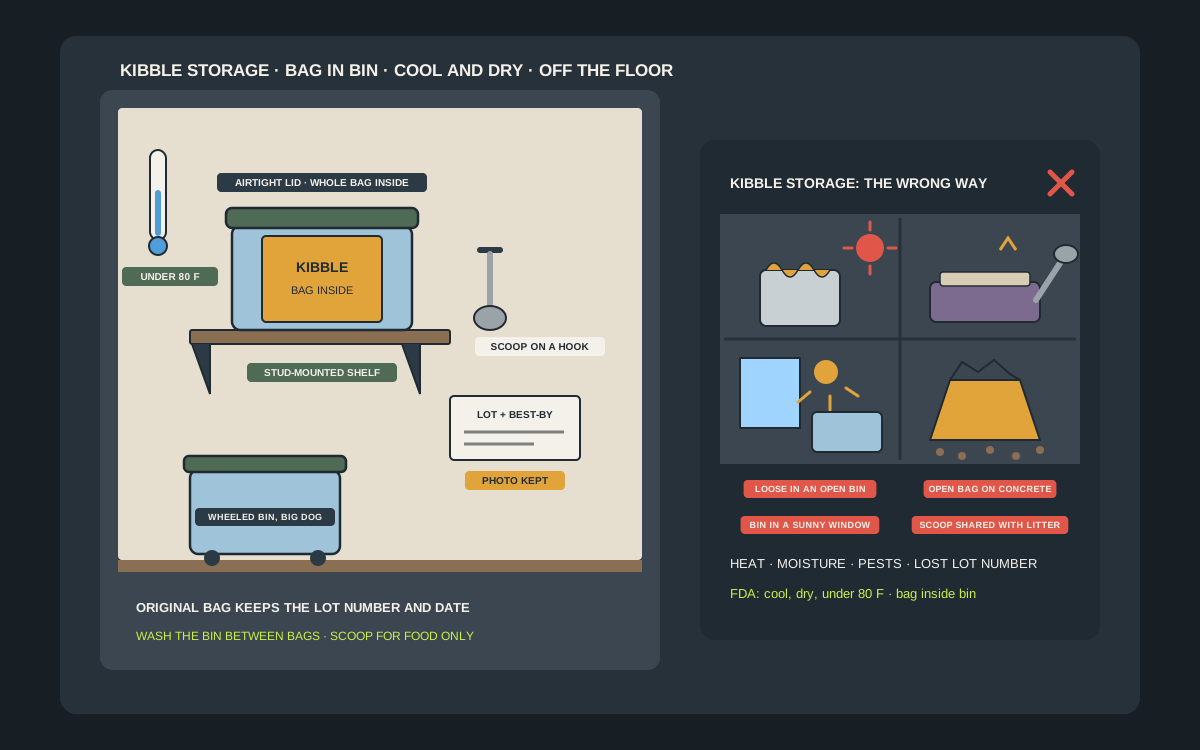
There is a particular kind of pet household where the dog food lives in the open bag it came in, rolled down, leaning against the wall, with a coffee scoop buried in it and a faint smell of stale fat. It works, until the bag splits, the ants find it, the kibble tastes flat by week four or someone asks which bag was recalled. Better storage is cheap, and a lot of it is simply getting the food off the floor and into something that closes. This guide covers the three things people usually mean by a wall-mounted pet food dispenser: airtight kibble bins, shelves and brackets that carry them, and gravity-style feeders. It shows which is worth buying under $50, and what the FDA, the AVMA and veterinary guidance actually say about keeping dry food fresh and safe.
Shop airtight pet food storage containers on Amazon
Who this is for
- Dog and cat owners whose kibble currently lives in an open bag on the floor or a hot garage shelf
- Anyone tired of bugs, rodents, stale food or spilled kibble around the feeding corner
- Owners of a large dog who buy a 30 lb bag at a time and want a bin and a place that suit the weight
- Small-space households who want the food, the scoop and the bowls in one tidy, wall-based feeding corner
Quick answer
For most homes, the best setup under $50 is a lidded airtight bin that holds the whole kibble bag, kept somewhere cool and dry below 80 F, with the scoop hung on a hook beside it. If you want it off the floor, put the bin on a stud-mounted shelf or heavy brackets rated for the full weight, or use a wheeled bin instead of lifting a heavy bag. Treat a wall-mounted gravity dispenser as a convenience for one pet’s daily food, not as the main storage. Keep the original bag inside the bin, or photograph the lot number and best-by date, wash and dry the bin between bags, and never store the bulk food in a hot garage.
Quick picks
- Best overall: a lidded airtight bin that holds one whole bag, standing on a sturdy shelf or low platform. FDA and the AVMA both say the best way to store dry food is in its original bag, inside a clean, dedicated airtight container.
- Best for a big dog and a 30 lb bag: a bin on locking wheels or a floor-level platform. A full bag weighs what it says on the front, and lifting it up to a wall shelf every few weeks is a good way to hurt your back.
- Best wall-mounted option: a stud-mounted shelf or heavy-duty brackets with a lip, carrying a smaller bin or the daily-use canister. The wall does the lifting; the bin does the sealing.
- Best gravity-style dispenser: a wall or shelf gravity feeder for one pet that is already fed on a free-feeding plan agreed with your vet. It is a refill system, not a storage system, so the main supply still lives in a sealed bin.
- Best for a small pet or a cat: a small airtight canister that holds one or two weeks of food, topped up from the sealed main bin, with the scoop hanging beside it. Less air contact, less stale food, nothing heavy on a bracket.
- Best for a garage or shed: nothing, unless it is cool. FDA says dry food belongs in a cool, dry place below 80 F, and an uninsulated garage in summer is often above that. Keep the bulk food inside the house and use the garage wall for the gear.
Quick comparison
| Option | Best for | How it stores the food | Trade-off |
|---|---|---|---|
| Airtight bin that holds the whole bag | Most homes with one or two pets | Original bag stays inside a lidded bin, lot number and best-by date stay with the food | Takes floor or shelf space, needs washing between bags |
| Wheeled airtight bin | Large dogs, 30 lb bags | Same as the bin above, but you roll it instead of lifting the bag | Wheels add height and the bin needs a flat floor |
| Stud-mounted shelf with a bin | Garage-adjacent utility rooms, laundry rooms | Lifts the bin off the floor and away from spills, rodents and floods | Needs studs and brackets rated for the full load |
| Small daily-use canister | Cats, small dogs, one-pet homes | Holds one or two weeks of food, refilled from the main bin | One more thing to wash, label and keep full |
| Wall-mounted gravity dispenser | One pet on a free-feeding plan | A hopper feeds a bowl as it empties; the food sits in the hopper | Not airtight storage, can overfeed, must be cleaned and kept dry |
| Shelf gravity feeder | Rooms where wall mounting is not allowed | Same hopper design, but standing on a shelf or counter | Same cleaning and portion issues, less wall use |
| Rolled bag with a clip, off the floor | Small bags, short term, cool dry room | Original bag, top rolled and clipped, kept off the floor | Weakest against pests and air, no lid |
| Lockable cabinet or latch bin | Clever dogs, climbing cats, toddlers | A closed cabinet keeps the bin and treats out of reach | Costs more than a plain bin, so check the latch holds |
Airtight pet food storage binsWall-mounted gravity pet food dispensersPet food storage bins with wheels
What to look for
Airtight beats fancy
Look for a lid with a gasket or a locking seal that actually closes around the whole rim. PetMD notes that sealed storage keeps food fresher and protects it from insects, rodents, water, curious pets and children, and that minimizing the food’s contact with air and the elements is the best way to keep it fresh. A decorative bin with a loose lid does none of that.
Big enough for one bag, not much more
PetMD suggests buying a container big enough for one bag of food but not much more. A bin that is far too large lets old kibble hide at the bottom for months. Compare the bin’s stated capacity in pounds with the bag you really buy, and leave a little room so the lid closes without squashing the bag.
Original bag inside the bin
FDA and the AVMA both say to store dry pet food in the original bag and, if you want another container, to put the whole bag inside it rather than pour the kibble in. The bag carries the UPC, lot number, product name, manufacturer and best-by date that you need for a recall or a complaint, and FDA says fewer than half of the complaints it receives include the lot number.
Food-safe and easy to wash
FDA says to wash and dry the container between one bag and the next, to remove residual fat and crumbs. Pick smooth plastic or metal with few crevices, and a lid that comes off cleanly. If you do pour kibble in, buy a bin that is dry and clean first.
Weight the wall can carry
A shelf for a bin has to hold the bin, the kibble and the scoop. A full 30 lb bag is 30 lb on its own, before the container. Anything that heavy belongs on stud-mounted brackets or a shelf rated well above the load, not on adhesive hooks or a hollow-wall anchor in thin drywall.
Cool, dry and out of reach
FDA and the AVMA say dry pet food belongs in a cool, dry place, at less than 80 F, because excess heat or moisture may break down the nutrients. FDA also tells owners with persistent pets to keep food somewhere the pet cannot reach, and the AVMA says to keep all pet food out of reach of very young children.
Where kibble should actually live
Not in the hot garage
FDA says dry pet food and unopened canned food belong in a cool, dry place at less than 80 F. A closed garage in a warm month can go well above that, and heat and moisture are what break down the nutrients and encourage stale, off-tasting food. If your garage is the only free space, put the bulk food in the house, a basement or a utility room that stays cool, and use the garage for the scoop, the wall hooks and the empty bin, if at all.
Off the floor
PetMD suggests keeping the bag off the floor in a cool, dry place, and keeping it sealed against insects, rodents and water. A low shelf, a sturdy platform or a wheeled bin all work. The floor of a laundry room, a garage or a mudroom is where spills, damp towels and mop water end up.
Out of reach
FDA tells owners whose pets are persistent or clever to keep the food in a secure place the pet cannot get to, and the AVMA says to keep all pet food away from very young children. A latch, a closed cabinet or a high shelf does that, and treats deserve the same rule: FDA says to keep them where the pet cannot eat the whole supply at once.
Original bag in a bin, or kibble poured in?
Put the whole bag in the bin
This is the advice from FDA, the AVMA and PetMD. Keep the kibble in its bag, fold or roll the top, and set the bag inside a clean, dedicated airtight bin. The bag is built to protect the food, and PetMD points out that rolling the top over gives a second layer of protection for free. You also keep the lot number and best-by date next to the food.
If you do pour it in
FDA says that if you must pour kibble into a container, it should be clean, dry and have a lid that fits snugly, and that you should save the UPC code, lot number, product name, manufacturer and best-by date. You can tape it on the outside of the bin, as long as you change it when you open a new bag, or cut it out and keep it somewhere easy such as the inside of a cabinet door. The least messy option, FDA notes, is a dated photo on your phone.
Wash between bags
Fat and crumbs stay on the walls of a bin. FDA says to wash and dry the container between finishing one bag and filling it with another. Do not top up an old bag with a new one: the old kibble stays at the bottom, and so do the crumbs.
Buy what you will finish
PetMD suggests buying a new bag at least every four to six weeks, so you are not working through the same bag months after its best-by date. If you have one small dog and a 30 lb bag, buy the smaller bag. A bigger bin does not make old food younger.
What a wall-mounted dispenser actually is
Gravity feeders
A gravity feeder is a hopper with a tray: food drops into the bowl as the pet eats. Some are designed to mount on a wall, many sit on a shelf. They are convenient and save refilling, but they are free-feeding systems, which means the pet decides how much to eat. Many pets, especially dogs, will eat more than they need, so talk to your vet before you switch a pet to open feeding.
Storage is not the same as dispensing
A hopper is open to the air at the bottom, exposed to light, and not designed to be washed with the care you give a food bin. Use it for the amount your pet will finish in a few days, not as your main supply, and keep the sealed bin and the original bag for everything else.
Cleaning
FDA says to wash and dry pet food bowls after each use, and to wash and dry scoops and measuring utensils after each use, using them only for pet food. A hopper with a tray makes that harder, so look for parts that come apart without tools. If you cannot take it apart, you cannot clean it.
Wall-mounted does not mean light
A wall-mounted hopper, when full, carries a pound or more of food, and a pet that jumps or paws at it adds load. Mount it on a stud or a rated anchor, at the height of the pet’s head, and test it with your full weight on the bracket before you fill it.
How to mount a shelf for the food bin
- Decide the bin first. Measure the bin’s width, depth and height with the lid on, and weigh it full: the bag plus the container. That number sets the bracket size.
- Find the studs with a stud finder and mark them. Two brackets into two studs is the minimum for a shelf that carries a bin; three is better for a long shelf.
- Pick brackets with a stated load rating well above your full weight, with a lip or a rear rail so the bin cannot slide off, and a shelf board at least as deep as the bin.
- Set the shelf height so the lid opens without hitting the underside of the next shelf, and so you can lift the bag out without a step stool. Lower is safer than higher.
- Drive the screws into the studs with pilot holes, check the shelf is level, and press down hard on it before loading. If anything flexes, stop and fix it.
- Put the bin on a non-slip mat, hang the scoop on a hook within arm’s reach, and tape or clip the lot number card where you will see it.
- Wipe the shelf when you wash the bin between bags, and check the brackets every few months for loosening.
Scoop, measure, bowl: the rest of the feeding corner
Hang the scoop beside the bin
A scoop left inside the kibble gets covered in dust and fat, and it brings the hands in with it. Hang it on a hook next to the bin, wash and dry it after each use, and use it only for pet food, as FDA advises. Our pet food scoop holder guide covers the options.
Wash your hands
FDA and the AVMA point out that pet food and treats, like other foods, can be contaminated with bacteria that cause foodborne illness. Wash your hands with soap and water after handling food, scoops and bowls, especially before you touch your own food or a child.
Wet and leftover food
The AVMA and FDA say to cover and refrigerate leftover wet or moist food at 40 F or below, or throw it out. PetMD says opened wet food keeps in the refrigerator for up to a week, and can be frozen in meal-size portions for several months.
Water belongs nearby
A food corner works best with a water bowl or fountain close by. FDA says to wash water bowls daily. If the corner is on a wall, mount the fountain shelf at the pet’s drinking height and keep the cord out of the way.
Plastic, steel or glass
Food-grade plastic
The default for a reason: light, cheap, available in every size and with gasket lids. Look for smooth walls and a lid that clips on all four sides. Plastic can hold on to fat and odor, so washing it between bags matters more than with other materials, and a bin left in sun can warp at the lid.
Stainless steel
Heavier and sturdier, and easy to wipe clean, which suits a household where the bin is moved a lot or chewed at. It costs more per pound of capacity, so check that it still fits under $50 in the size you need. A dented rim stops the lid sealing.
Glass and ceramic jars
Good for treats and a small daily supply on a shelf, because you can see the level. Too heavy and breakable for bulk kibble, and a bad idea above a floor that a clumsy dog crosses. Keep them for the small canister, not the main bin.
What not to reuse
Do not store kibble in a bucket or tub that held paint, chemicals, garden products or cleaning supplies. Even a washed container can hold residue, and the food-safe label is the point of buying a storage bin.
Treats, toppers and supplements
Treats follow the same rule
FDA says to keep treats in a secure place so the pet cannot eat the entire supply at once, and the same original-package advice applies: the treat bag has its own lot number and best-by date. A jar on a wall shelf is fine for a few days of treats, as long as the main bag stays sealed.
Toppers and supplements
Powders, oils and chews each have their own storage instructions on the label, and some need the refrigerator once opened. Do not mix them into the kibble bin, because a single contaminated batch then spoils everything.
Medication
Keep pet medication apart from food, in its own closed container out of reach, and follow the label. Our pet medication cabinet guide covers that setup.
Match the bin to the bag you actually buy
Read the bag, then the bin
Pet food comes in a wide range of bag sizes, from a few pounds to 30 lb and more. The bin’s listing states a capacity, and the sensible habit is to compare that number with the weight on the front of your bag, then leave a margin. A bin sold for a given weight of loose kibble may not take the whole bag with its folded top, so if you plan to keep the bag inside, choose one size up from the listed number and check the listing’s dimensions against the bag’s width and height.
One small dog or one cat
A small bag, a small canister and a lid that seals will serve a household with one small pet. The bag will be finished in the four to six weeks PetMD suggests, the bin stays light enough to lift without thought, and it fits on a basic shelf without anything heroic in the way of brackets.
One large dog
A large dog can go through a large bag quickly, so a big bin with wheels earns its place. Mount nothing heavy on the wall. Put the bin on the floor of a cool room, on a mat that keeps moisture away, and keep a small scoop-and-bowl canister on a wall shelf for the daily top-up so you are not lifting a full bag every morning.
Two or more pets
Use one bin per food. Different formulas have different lot numbers and best-by dates, and mixing them in a single container makes a recall check impossible. Label each bin with the pet’s name and the food, and keep the scoops separate so a pet with a sensitive stomach does not get the wrong kibble.
Moving from an open bag to a bin, step by step
- Photograph the front, the back and the lot number area of the current bag, including the best-by date, before you do anything else.
- Check the food. If it smells off, looks damp or has bugs in it, bag it tightly, throw it out with the household rubbish and start with a new bag.
- Wash and dry the new bin completely, because any moisture left in the bin will go into the food.
- Fold or roll the top of the bag, set the whole bag inside the bin, close the lid and make sure it clicks all the way round.
- Put a card on the lid with the pet’s name, the food, the opening date and the best-by date, or note them in your phone.
- Hang the scoop beside the bin on a hook, with a small bowl or canister if you use one for daily top-ups.
- On the day the bag runs out, empty and wash the bin, let it dry fully and start the next bag the same way.
A simple upkeep routine
Every feeding
Wash and dry the bowls, as FDA advises, and wash the water bowl daily. Return the scoop to its hook, and make sure the lid is closed all the way.
Every bag
Wash and dry the bin, the lid and the gasket. Note the new lot number and best-by date. Check the shelf brackets and the wheels if the bin has them.
Every season
Check the temperature where the food lives. If it hits 80 F, move the food. Look for crumbs and signs of pests under and behind the bin, and wipe the shelf.
After any recall news
Pull the photo of the lot number and compare it with the notice. This is where keeping the bag inside the bin, or the photo, pays off.
Budget plans under $50
The minimal plan
A single lidded bin sized for your bag, a scoop on an adhesive-free hook screwed into a stud or a cabinet side, and a phone photo of the lot number. This covers almost everything FDA and the AVMA recommend, and it is the setup most households need.
The big-dog plan
A wheeled airtight bin, a stud-mounted bracket pair for a small daily canister and a scoop hook. Keep the heavy supply on the floor on a mat and the light daily food on the wall.
The apartment plan
A smaller airtight bin that fits in a closet or under a counter, kept away from the stove and a sunny window, with a tension-rod or door hook for the scoop. No drilling is needed and the food stays cool.
The garage-wall plan
Keep the bulk food indoors, and use the garage wall for the empty-bin storage, hose and leash hooks and the washing-up kit for the pet gear. If a garage shelf is the only space available, use a bin you can seal, a thermometer, and move the food in summer.
Special cases
Multi-pet homes
Different foods need different bins, or the lot numbers and best-by dates become impossible to keep straight. Label each bin with the pet’s name, and use a separate scoop for each. If one pet needs a prescription food, store it apart and keep the other pet from reaching it.
Cats and small dogs
A cat eats little. A 30 lb bin is a lot of time for kibble to sit. Buy a small bag, keep a small canister for each week and refill it from the sealed main bin, and the food stays fresher.
RVs and travel
In an RV, dry food needs a spot that does not heat up. Lockers above the road wheels and the cab can run hot in summer. A closed cabinet in the living area, with the bag inside a latched bin, is a better answer than a gravity feeder rattling on a wall.
Rodents and insects
If you have seen mice or insects near the feeding corner, move the food into a lidded bin of hard plastic or metal and clean up crumbs. Pest control is a household issue, but the bin and the shelf are the part you can fix first.
Mistakes to avoid
- Pouring kibble into a bin and throwing the bag away, so the lot number and best-by date are lost.
- Storing the food in a hot, uninsulated garage, where heat and moisture can degrade it.
- Topping up an old bag of kibble with a new one, so stale food and crumbs stay at the bottom.
- Buying a bin so large that the kibble is months old by the time it is used.
- Hanging a full wall hopper from adhesive hooks or a drywall anchor.
- Using a gravity feeder as the main storage, or switching to free feeding without checking with your vet.
- Sharing one scoop between the kibble bin and the litter box, or leaving it in the food.
- Forgetting to wash and dry the bin, the scoop and the bowls between bags and meals.
Related guides
Browse the hub: Pet gear wall mounts under $50 - all guides
- Best Pet Food Scoop Wall Holders Under $50
- Best Dog Bowl Wall Mounts Under $50
- Best Pet Water Fountain Wall Shelves Under $50
- Best Cat Food Puzzle Feeder Wall Shelves Under $50
- How to Mount a Wall Pet Feeding Station Under $50
- Freestanding vs Wall-Mount Dog Bowls Under $50
- Best Treat Jar Wall Shelves Under $50 for Mudrooms
- Best Pet Medication Wall Cabinets Under $50
FAQ
What is the best way to store dry dog food?
FDA and the AVMA say to keep it in its original bag, put the whole bag inside a clean, dedicated airtight container, and store it in a cool, dry place at less than 80 F. That keeps the lot number, UPC and best-by date with the food and protects it from air, moisture and pests.
Is it OK to pour kibble into a storage bin?
It is acceptable if the bin is clean, dry and has a snug lid, but FDA prefers the whole bag inside the bin. If you pour, save the UPC, lot number, product name, manufacturer and best-by date, by taping them to the bin, cutting them out or taking a photo.
Can I keep pet food in the garage?
Only if the garage stays cool and dry. FDA says dry pet food belongs in a cool, dry place under 80 F, and many garages go above that in warm weather. Keep the bulk food indoors if you can.
How often should I wash a kibble bin?
FDA says to wash and dry the container between finishing one bag and filling it with another, to remove residual fat and crumbs. Wash the scoop and bowls after each use.
Are wall-mounted gravity pet feeders a good idea?
They are convenient for one pet that is already on a free-feeding plan, but they are not airtight storage, they can lead to overeating, and they need careful cleaning. Check with your vet before you move a pet to open feeding, and keep the main supply in a sealed bin.
How big should a pet food storage container be?
PetMD suggests one big enough to hold a single bag of food but not much more. Compare the capacity in pounds with the bag you really buy and leave room for the lid to close.
How long can I keep an opened bag of kibble?
There is no single number, because it depends on the food, the heat and the seal, but PetMD suggests buying a new bag at least every four to six weeks and checking the best-by date on the label.
Bottom line
The best pet food storage is plain: the original bag inside a clean, lidded bin, kept cool and dry, off the floor, with a scoop on a hook beside it. A stud-mounted shelf or a wheeled bin makes that easier to live with, a gravity feeder is a convenience for the daily portion and not a place to keep the supply, and the hot garage is the one place the bulk food should not live. Photograph the lot number, wash the bin between bags, buy a bag you will finish, and the food your pet eats in week five tastes like the food from week one.