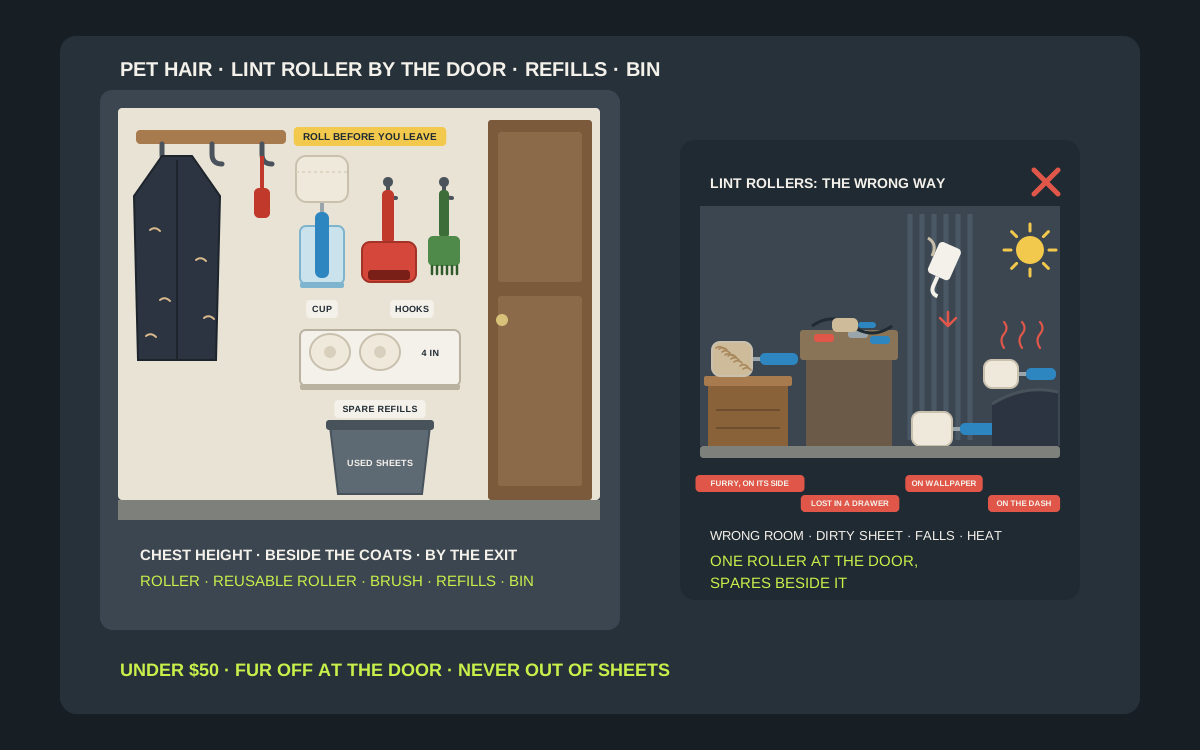
Every pet owner owns a lint roller. The trouble is finding it. It is on the dresser upstairs when you are at the front door in a black coat, in the car when you are in the bedroom, or in a drawer under a tangle of chargers, with the top sheet so furry that it no longer picks anything up. So you leave the house with the dog on your trousers and the cat on your sleeve. The fix costs a few dollars. A lint roller works best when it lives exactly where fur becomes a problem, which is the last few steps before you walk out of the door, the spot where clothes go into the wash and the corner of the couch where the cat sleeps. A cup holder or a hook on the wall at those points, a couple of spare refills within reach and a small bin for the used sheets turn a five-minute search into a ten-second roll. This guide covers which holders suit sticky rollers, reusable fur rollers and rubber brushes, where each one belongs, how to mount them in a rental without drilling, how to keep the station stocked through shedding season and what a lint roller can and cannot do about pet allergens. Everything here usually costs under $50, and most of it costs under $15.
Shop lint roller holders and wall caddies on Amazon
Who this is for
- Dog and cat owners who keep leaving the house covered in fur because the lint roller is never where they are
- Renters who want a fur station by the door without drilling into the walls
- Households with a heavy shedder, a dark wardrobe or a work uniform that has to look clean
- Anyone setting up a mudroom, entry or laundry corner and wondering where the fur tools should go
Quick answer
For most homes, the best under-$50 lint roller setup is a small adhesive cup holder or hook right beside the door you leave by, at chest height next to the coats, holding one full-size sticky roller handle-down so the sheet stays clean. Add a hook for a reusable fur roller or rubber brush if you have a heavy shedder, a small wall caddy or shelf for two spare refill rolls, and a slim bin underneath for used sheets. Put a second roller where clothes go into the wash and a mini roller in the car. Use screws for anything that holds refills plus a bin, and follow the adhesive maker’s steps for anything stuck to paint. Check the roller diameter, the holder size and the current price on the listing before you buy.
Quick comparison
| Holder | Best for | How it holds | Trade-off |
|---|---|---|---|
| Adhesive cup holder | One full-size sticky roller by the door | Roller stands handle-down in a cup stuck to the wall | Check the inner diameter against a full refill |
| Adhesive hook and handle loop | Rollers or brushes with a hang hole | Roller hangs by its handle so the sheet touches nothing | Needs a hole or loop on the handle |
| Small wall caddy or ledge | Roller plus two spare refills | Caddy or ledge screwed or stuck to the wall | Heavier caddies need screws |
| Over-door pocket organizer | Closets and bedroom doors in rentals | Hooks over the door, roller and refills in pockets | Can stop the door closing fully |
| Magnetic holder or hook | Washer, dryer or a steel entry door | Magnet grips a steel panel; no adhesive | Only on steel a magnet sticks to |
| Coat rack with a spare hook | Entries that already have a rack | Roller hangs from the end hook beside the coats | Roller must have a loop or hang hole |
| Wall hook for a reusable fur roller | Couches, dog beds and car seats | Wide head hangs from a hook by the handle | Bulkier than a sticky roller |
| Slim wall bin under the station | Used sheets and fur clumps | Small bin or bag on a hook or ledge below | Needs emptying, especially with a curious dog |
Adhesive lint roller holdersPet hair lint roller refillsReusable pet hair rollers
What to look for
A holder that fits your roller
Lint rollers are not one size. A standard pet roller has a handle about the length of a hand and a sticky roll about 4 inches wide; Scotch-Brite lists its refills as 4 inch sheets, sold in rolls of 30, 56 and 70 sheets. Mini travel rollers are much smaller, and reusable fur rollers have a wide, boxy head. Before you buy a cup holder, measure the widest part of the roller you actually use, including a fresh, full refill, which is fatter than a nearly finished one. A holder sold for a specific brand is the safest fit; a universal cup should list its inner diameter.
Handle-down storage that keeps the sheet clean
The sticky surface is the business end, and it picks up dust and hair from anything it leans against. The best holders let the roller stand handle-down in a cup or hang by the handle so the sticky roll touches nothing. Many rollers come with a snap-on cover; keep it, because a covered roller can sit in a holder, a drawer or a bag without losing its tack. A roller lying on its side on a shelf is a roller you will have to peel before you can use it.
Placement on the last few steps out
A lint roller is used in the ten seconds before you leave, so the holder has to be within arm’s reach of the exit, at a height you can see without bending. Beside the coat hooks, on the side of a mirror by the door or on the inside of a closet door all work. A holder in another room is the same as no holder. If more than one door gets used, a second cheap holder by the other one beats carrying a roller back and forth.
Room for refills and a bin
A roller with no sheets left is worse than useless, because you discover it at the door. A small shelf, pocket or caddy beside the holder that keeps one or two spare refill rolls makes changing the roll a ten-second job. A slim bin or bag under the station takes the used sheets so they do not end up stuck to the floor or the dog. This is the part most single-cup holders leave out.
A mounting method your wall can take
A lint roller weighs a few ounces, so almost any hook or cup holds it. The question is the wall. Adhesive hooks are fine on smooth, painted drywall, tile or glass if you follow the maker’s steps. Command, for example, says to wipe the wall with rubbing alcohol, press for 30 seconds, wait one hour before hanging anything, wait 7 days after painting and avoid wallpaper. Anything that carries refills, a brush and a bin is better screwed into the wall or hung over a door.
Something for heavy shedders, too
A sticky roller is the right tool for clothes, but a reusable fur roller or a rubber brush is faster on a couch, a dog bed or car seats, and it never runs out of sheets. If your pet sheds heavily, plan a hook for one of those as well. A station with one sticky roller, one reusable roller and a spare refill covers almost every fur job in a typical home for well under $50.
Know the fur tools you are storing
Sticky lint rollers and refills
The classic lint roller is a handle with a roll of adhesive paper on a spindle. You roll it over fabric, the top sheet fills with hair, and you tear it off along the perforation to expose a fresh one. Scotch-Brite, which calls itself America’s top lint roller brand, sells refills in rolls of 30, 56 and 70 sheets, and markets its 56-sheet pet roll specifically for pet hair. Sticky rollers are the right tool for clothes, because they are gentle on fabric and easy to use while you are wearing the garment. Their weakness is that they run out, and every sheet goes in the bin.
Reusable static rollers
Reusable fur rollers, of which the ChomChom is the best-known example, have no adhesive at all. Short back-and-forth strokes rub fabric strips inside the head, which builds a mild electrostatic charge that lifts hair, and the return stroke sweeps it into a chamber that you empty with a button. They never need refills and they are excellent on couches, dog beds and other upholstered surfaces. Reviewers note two limits: they do little on slick leather or vinyl, and the bulky head is awkward on a sleeve while you are wearing the shirt. That makes them a partner for a sticky roller, not a replacement.
Rubber brushes, squeegees and velvet brushes
Rubber fur brushes and rubber-bladed squeegees grip hair by friction and roll it into clumps, which makes them fast on car upholstery and carpeted stairs. Velvet lint brushes, the kind with a soft pile pad that you sweep in one direction, are refill-free and good for coats and wool. Both are flat, light and easy to hang by a loop or a hole in the handle. A damp microfiber cloth handles leather, where both static rollers and brushes struggle.
Mini rollers and travel sizes
Mini rollers fit in a glovebox, a desk drawer or a bag, and they are what you want in the car and at work. They are too small for a full outfit check, so treat them as a backup to the full-size roller at the door. 3M says its Scotch-Brite pet refill is made to resist heat so it can be stored in a car, but a roller left on a dashboard in summer sun is still asking for trouble; the glovebox or door pocket is kinder to any adhesive.
Where the fur station belongs
Beside the door you actually leave by
The single most useful place for a lint roller is next to the door, at chest height, beside the coat hooks or the mirror. That is where you notice the fur, while you are putting on a dark coat or checking your reflection before a meeting. If the household leaves through the garage, the holder goes on the house side of the garage entry door. If you use the front door for work and the back door for the dog, put a roller at the front and a rubber brush at the back.
Where clothes go into the wash
Pet hair in the washer has a way of ending up back on the clothes, in the drum and in the lint screen. A quick roll over the worst garments before they go in removes a lot of it. A second holder in the laundry room, on the side of a shelf or on a magnetic hook on the side of the machine, keeps a roller where you sort the clothes. Our guide to no-drill over-washer shelves covers that closet, including where a lint roller and a small brush can hang on adhesive hooks.
In the closet or bedroom
If you dress in the bedroom and the pet sleeps on the bed, a roller on the inside of the closet door lets you check an outfit before you walk out of the room. An over-door pocket organizer is the renter-friendly choice here, because it holds a roller, a spare refill, a velvet brush and a couple of the dog’s toys without touching the walls. Make sure the door still closes with the organizer on it.
Near the couch or the pet bed
Fur collects where the pet rests. A reusable static roller hung on a hook on the side of a bookcase or near the couch means a quick pass over the cushions becomes part of tidying up rather than a weekly chore. It also keeps the bulky roller out of the entry, where space is tighter. Do not hang anything at nose height for a dog that chews.
In the car and at the garage door
Dog owners who drive their dogs often fight fur in the car more than in the house. A mini roller in the glovebox and a rubber brush in the door pocket handle seats and floor mats between proper cleanings. In the garage, a hook by the entry door for a rubber brush lets you de-fur car seats or a seat cover before they come inside. Our guide to dog car seat cover wall hooks covers where the cover itself should hang.
Choosing the holder
Adhesive cup holders
A cup holder is a small open-topped cylinder or box that sticks to the wall, and the roller drops into it handle-down. It is the cheapest and simplest option, and it keeps the sticky roll off every surface. Some are sold as lint roller holders, others as toothbrush or utensil cups; either works as long as the inner diameter clears a full refill. Clear plastic cups let you see how much roll is left without taking the roller out. Choose one with a drain hole or open bottom if it might be used in a humid bathroom.
Hooks and handle loops
Many lint rollers, rubber brushes and reusable rollers have a hole or loop at the end of the handle. If yours does, a small hook is all you need, and the roller hangs with the sticky end down and free. If it does not, a short loop of cord or a key ring through a handle cap can add one, as long as it does not interfere with the grip. Small adhesive hooks are usually rated for about a pound, which is plenty for a roller.
Small caddies and ledges
A small wall caddy, wire basket or narrow ledge holds the roller, two spare refills and a mini roller in one place. This is the right choice when you want the whole station, not just the roller. Because a loaded caddy is heavier and gets knocked when you reach in, screw it into the wall or use an adhesive product rated for the total weight with a margin. A ledge with a lip stops refills rolling off.
Over-door pockets
Clear over-door pocket organizers hang from hooks over the top of a door and hold a surprising amount: a roller in one pocket, refills in another, a velvet brush, a mini roller for your bag and even the dog’s poop bags. They need no tools and no adhesive, which makes them the easiest option for renters. The trade-off is that the hooks can stop a tight door closing, and the pockets swing when the door slams.
Magnetic holders
Washers, dryers, steel entry doors and some metal shelving will hold a magnet. A magnetic hook or small magnetic cup on the side of the dryer keeps a roller where you sort laundry, and a magnetic hook on a steel front door puts one right at the exit with no adhesive and no holes. Check that a fridge magnet grips the surface first, because many doors and appliance panels have steel on one side and plastic on the other.
Built-in hooks you already own
Before you buy anything, look at the entry. A coat rack with a spare end hook, a key rack with a spare peg or the side of a mirror often has room for a roller on a loop. Using a hook that already exists means no new marks on the wall, and it puts the roller in the one place you already look every morning.
Mounting it without drilling
Prep the wall the way the maker says
Most adhesive hook failures come from skipped prep. Command’s instructions are specific: wipe the wall with rubbing alcohol rather than household cleaners or water, which leave a slippery residue, press the strip and hook firmly for 30 seconds, and wait one hour before hanging anything. For two-piece hooks, slide the hook off and press the base for another 30 seconds. That one hour wait is the part most people skip, and it is why a hook that held fine in the shop falls off on the first morning.
Check the wall, the paint and the temperature
Command says to wait 7 days after painting, not to use its hooks on wallpaper, and to keep indoor hooks within about 50 to 105 degrees Fahrenheit. Its bathroom products add textured walls, brick and rough surfaces to the list to avoid. In practice, that rules out a freshly painted entry, a wallpapered hall and the wall next to a radiator. On a cold garage entry wall in winter, look for a product rated for outdoor temperatures; Command lists its outdoor hooks at about minus 20 to 125 degrees Fahrenheit.
Remove it without peeling the paint
When you move out or move the station, adhesive strips come off cleanly only if you pull the tab slowly, straight down along the wall, stretching it for up to about 12 inches until it releases. Pulling toward you is what tears paint and drywall paper. Keep the instructions, or a photo of them, in the caddy with the refills.
When to use screws instead
Screws are the better choice for a caddy holding refills and a mini roller, a station with a bin hanging below it and any wall that is textured, freshly painted or in a damp spot. A small screw into drywall with a plastic anchor is plenty for a few ounces of roller and refills, and the hole is easy to fill when you leave. Many leases allow small picture-hanging holes; check yours.
Keeping the station stocked
Do the refill math
A refill roll is not as big as it looks. If two people each use three or four sheets on the way out every weekday, a 56-sheet roll lasts about two weeks, and a heavy shedding season can halve that. Keeping two spare rolls in the caddy, and adding refills to the shopping list when you open the last one, means the roller is never empty at the door. Refill multipacks usually cost far less per sheet than buying new rollers each time.
Buy refills that fit your handle
Refills are made for specific handles. A Scotch-Brite refill fits Scotch-Brite handles, and other brands have their own sizes and spindles. Write the refill size on a small label inside the caddy, or keep the empty packaging there, so whoever does the shopping buys the right one. If you switch brands, switch handles at the same time.
Tear sheets cleanly and bin them
Find the perforation, peel back the used sheet and tear along it so the next sheet starts clean. Used sheets are sticky, and dropped ones end up on shoes, carpet and dog paws. A small bin or a bag on a hook right under the station solves that. Choose one with a lid if your dog investigates rubbish, because a sheet full of fur and crumbs is interesting to a dog and is not something it should eat.
Clean the reusable tools
A static roller needs emptying after each session, and the strips occasionally need a pluck or a pass with a vacuum to clear lint. Rubber brushes rinse clean under the tap and should dry before they go back on the hook. A velvet brush can be cleaned by brushing it against the grain over a bin. Hanging all of them by the handle keeps the working surface off the wall and lets it dry.
Fur, dander and what a roller can do
Fur carries the allergens
The U.S. National Institute of Environmental Health Sciences explains that fur itself is not the main cause of pet allergies; it is a carrier for dander, tiny flecks of skin, along with proteins from saliva. Those particles stick to hair and fabric. The Asthma and Allergy Foundation of America notes that cat allergens are especially sticky and that people carry pet allergens on their clothing into homes, classrooms and workplaces where pets have never been.
Rolling helps, but it is not a cure
Rolling fur off your clothes at the door removes the visible hair and some of what clings to it, which is courteous to friends and colleagues with allergies. It does not remove all allergens, and it is no substitute for washing clothes, vacuuming with a HEPA filter or medical advice. If you are visiting someone with a serious pet allergy, the AAFA suggests changing clothes and washing your hands, not just rolling.
Keep the station away from where the pet is groomed
Brushing a pet throws hair and dander into the air, and it settles on whatever is nearby, including a lint roller and your clean coat. Groom the pet in the laundry room, garage or outdoors, away from the coat hooks and the fur station. Our guide to pet grooming tool wall holders covers where the brushes, combs and clippers should live.
Plan for shedding season
Spring and fall are the big months
The American Kennel Club says dogs that shed seasonally usually shed most heavily in spring and fall, losing the thick winter coat in spring and the lighter summer coat in fall to make room for winter insulation. Double-coated breeds such as Labradors, huskies and German shepherds can drop a startling amount of undercoat in a few weeks. That is when the roller at the door runs out fastest.
Stock up and brush more
Before shedding season, buy an extra refill multipack, empty and clean the reusable roller and check that every holder is still stuck firmly to the wall. The AKC recommends more frequent brushing during heavy shedding, and every hair that comes out on the brush outdoors is a hair that does not end up on your trousers. A rubber brush on a hook by the back door makes a quick outdoor de-fur easy after a walk.
Cats shed too
Indoor cats often shed lightly all year rather than in two big bursts, and their fine hair weaves into fabric. A sticky roller by the door and a static roller near the cat’s favorite chair are a good pair. If the cat sleeps on clean laundry, a lidded basket helps more than any roller.
Match the tool to the fabric
Dark wool and work clothes
Wool coats, suits and uniforms show every pale hair. A sticky roller in short, overlapping strokes from the shoulders down is the quickest fix, and a velvet brush swept in one direction finishes the job on wool without leaving any residue. Roll with light pressure; there is no need to press hard, and a fresh sheet picks up more than a crowded one.
Upholstery and dog beds
Couches, cushions and pet beds hold a lot of fur, and a sticky roller fills its sheets in seconds there. A reusable static roller in quick back-and-forth strokes, or a rubber brush that rolls hair into clumps, is faster and cheaper on these big surfaces. Save the sticky sheets for clothes and finish the furniture with the reusable tool from its hook by the couch.
Leather, vinyl and car seats
Smooth leather and vinyl give a static roller nothing to grip, and fur slides around on them. A slightly damp microfiber cloth gathers hair into a clump you can lift off, and a rubber brush works well on fabric car seats and carpeted floor mats. Keep a cloth with the rubber brush in the car or by the garage door.
Delicate and knit fabrics
Fine knits, silk and loose weaves can snag on stiff bristles. A sticky roller with light pressure is usually the gentlest choice, and Scotch-Brite says its refills are suitable for delicate fabrics. Test any new tool on an inside seam first, and leave the rubber brush for sturdier fabrics.
Three sample setups
Apartment entry, one cat, no drilling
A clear adhesive cup holder sits at chest height beside the coat hooks by the front door, holding a full-size sticky roller handle-down. A small adhesive hook below it holds a mini roller for the bag. Two spare refills and the refill size label live in a small over-door pocket on the inside of the hall closet door, which also holds a velvet brush for wool coats. Total cost is well under $20.
Mudroom with two Labradors
On the mudroom wall by the garage door, a small wire caddy screwed into the wall holds a sticky roller, two refills and a mini roller, with a lidded slim bin hung on a hook beneath it for used sheets. A rubber brush and a reusable static roller hang on two hooks beside it, ready for the car seats and the dog beds. A second sticky roller lives in a magnetic cup on the side of the dryer. Our guide to building a mudroom pet station shows how the leash, towel and treat zones fit around it.
Small bedroom closet, work uniform
An over-door pocket organizer on the closet door holds a sticky roller, a spare refill and a velvet brush at eye level, so the uniform gets checked before it leaves the room. A small hook inside the car door pocket holds a mini roller for the last check before work. The dog’s bed sits on the other side of the room so its fur does not drift into the closet.
How to set it up in ten minutes
- Pick the door you leave by most often and find a clear spot at chest height beside the coats or the mirror.
- Measure your roller with a full refill on it, then choose a cup holder or hook that fits.
- Wipe the spot with rubbing alcohol, let it dry, mount the holder and press it for 30 seconds.
- Wait at least one hour before loading it, or use screws if the wall is textured, damp or freshly painted.
- Add a small caddy, ledge or pocket beside it for two spare refill rolls and a label with the refill size.
- Hang a slim bin or bag below for used sheets, with a lid if the dog explores rubbish.
- Add a hook for a reusable fur roller or rubber brush if you have a heavy shedder.
- Put a second roller where clothes go into the wash and a mini roller in the car.
Mistakes to avoid
- Keeping the only lint roller in a different room from the door you leave by.
- Storing a roller on its side so the sticky sheet collects dust before you use it.
- Buying a cup holder that fits a half-used roll but not a fresh, fat refill.
- Sticking a hook to wallpaper, fresh paint or a textured wall, or loading it before the adhesive has set.
- Running out of refills because the spares live in a cupboard nobody checks.
- Dropping used sheets on the floor where shoes and paws pick them up.
- Leaving a roller on the car dashboard in summer sun.
- Grooming the pet beside the coat hooks, so fresh fur settles on clean coats and the roller.
Related guides
Browse the hub: Pet gear wall mounts under $50 - all guides
- Best Pet Vac Wall Mounts Under $50 for Fur Cleanup
- Best Pet Grooming Tool Wall Holders Under $50
- How to Build a Mudroom Pet Station Under $50
- Best Dog Leash Wall Hooks Under $50
- Best Dog Coat & Towel Wall Hooks Under $50
- Best Dog Car Seat Cover Wall Hooks Under $50
- Best No-Drill Over-Washer Shelves for Apartment Laundry Closets Under $50
- Best Command Utility Hooks for Light Garage Gear Under $50
FAQ
Where should you keep a lint roller?
Beside the door you leave by, at chest height next to the coats or the mirror, so you can roll off fur in the last few seconds before you go out. A second roller where clothes go into the wash and a mini roller in the car cover the other places fur turns up.
How do you mount a lint roller holder without drilling?
Use an adhesive cup holder or hook on smooth, painted drywall, tile or glass. Command says to clean the wall with rubbing alcohol, press for 30 seconds, wait one hour before loading, wait 7 days after painting and avoid wallpaper. Over-door pocket organizers and magnetic hooks on steel doors or appliances need no adhesive at all.
Is a reusable pet hair roller better than a sticky lint roller?
They do different jobs. Reusable static rollers such as the ChomChom are fast on couches, dog beds and upholstery and never need refills, but they struggle on leather and are awkward on clothes you are wearing. Sticky rollers are better for a quick outfit check. Most pet owners do best with one of each.
How many sheets are on a lint roller refill?
It depends on the brand. Scotch-Brite sells refills in rolls of 30, 56 and 70 sheets, with 4 inch wide sheets. If two people use a few sheets each on weekday mornings, a 56-sheet roll lasts roughly two weeks, so keep two spares in the holder’s caddy.
Can I keep a lint roller in the car?
Yes, a mini roller in the glovebox or door pocket is handy for car seats and a last check before work. 3M says its Scotch-Brite pet refill is made to resist heat for car storage, but keep any roller off the dashboard and out of direct sun.
Does a lint roller remove pet allergens?
It removes visible fur and some of the dander attached to it, which helps, but it does not remove all allergens. The AAFA notes that pet allergens are sticky and travel on clothing. Washing clothes, HEPA vacuuming and, for serious allergies, changing clothes are more effective.
Bottom line
The best pet hair lint roller holder is the one that puts a roller in your hand at the door. For most homes that is a small adhesive cup or hook at chest height beside the coats, a caddy or pocket with two spare refills, a slim bin for used sheets and, for heavy shedders, a hook for a reusable fur roller or rubber brush. Add a second roller in the laundry and a mini one in the car, mount everything the way the maker says, and restock before spring and fall shedding. Measure your roller with a full refill, then check the holder size, mounting method and current price on the listing before you buy.