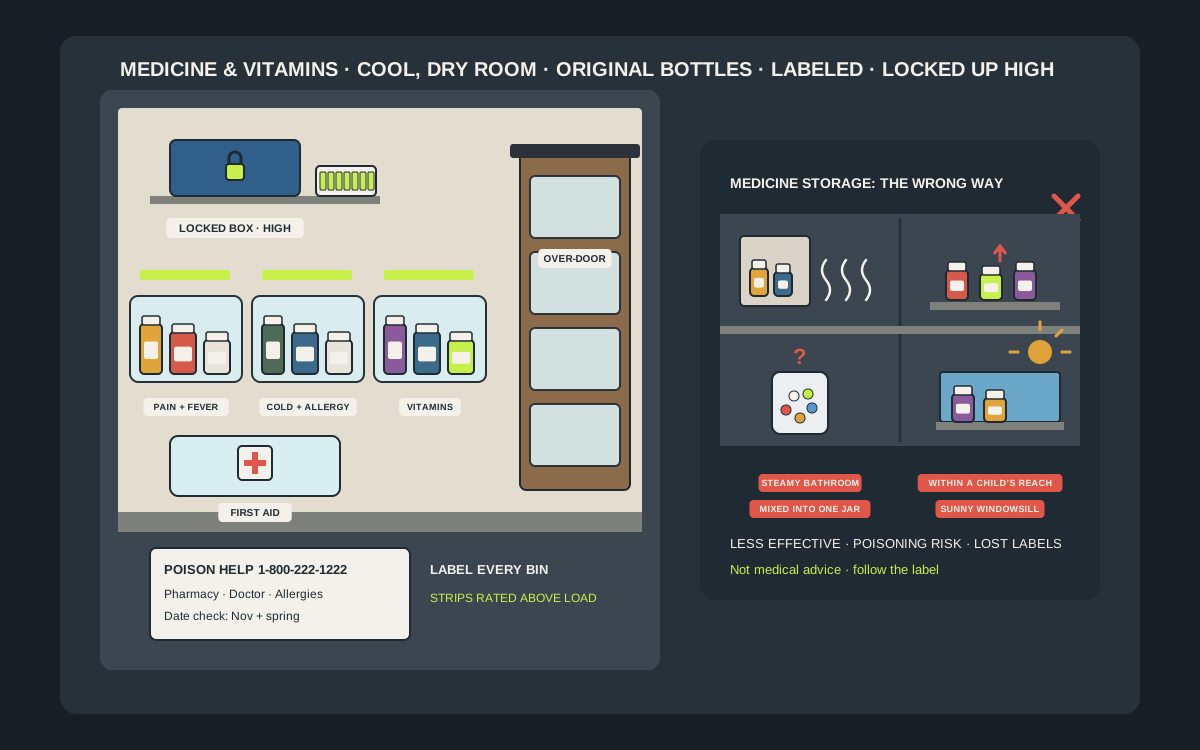
Open almost any apartment medicine cabinet and the story is the same: a tangle of half-used boxes, a vitamin bottle with no lid, three kinds of pain reliever and a cold remedy that expired two winters ago. It lives in the bathroom because that is where everyone assumes it belongs, and that is exactly the problem. The FDA and the National Library of Medicine’s MedlinePlus both say that heat and moisture from a shower, bath and sink can make medicines less effective, and both point to a dresser drawer, a closet shelf or a storage box in a cool, dry place instead. So the best medicine organizer for a rental is usually not a mirrored cabinet over the sink at all. It is a small, tidy station in a drier room, built without drilling, with everything labeled and the risky items out of reach. This guide covers where medicine and vitamins should and should not live, the no-drill setups that work under $50, how to organize them by use, what a wall organizer can and cannot do about child and pet safety, and a simple routine for checking dates as cold and flu season starts. It is general storage guidance, not medical advice: for anything about your own medicines, the label and your pharmacist come first.
Shop medicine and vitamin organizers on Amazon
Who this is for
- Renters who cannot drill into walls and want medicine, vitamins and first aid in one place
- Anyone whose bathroom is small, steamy or has no cabinet at all
- Roommates and couples who need to tell their products apart at a glance
- Households with children, visiting grandchildren or pets who need a safer arrangement
Quick answer
For most apartments, the best under-$50 medicine and vitamin organizer is a no-drill shelf, removable wall bins or an over-door pocket organizer in a cool, dry room, with a small lockable box for anything that must be out of children’s reach. Keep every product in its original container, because the label carries the directions, and sort by use rather than by person or brand. Skip the steamy bathroom cabinet, keep storage away from the stove, the sink and sunny windows, and never trust adhesive with more than a fraction of its rating. Check the label for special instructions such as refrigeration, and check dates twice a year. Check ratings, sizes and current prices on the listing before you buy.
Quick picks
- Best overall: a no-drill shelf or removable wall bin set in a cool, dry room such as a bedroom hall or hallway closet, holding labeled bins for pain and fever, cold and allergy, stomach, vitamins and first aid, with every product still in its original box or bottle.
- Best for homes with children or pets: a lockable medicine box on a high shelf or in a closet, because a wall organizer is for finding things quickly and a lock is what keeps small hands out. Use the wall organizer for bandages, thermometers and other items that are safe to leave in sight.
- Best for small rooms: an over-door pocket organizer on a bedroom or closet door, with clear pockets sorted by use, which stores a surprising amount without touching the wall and comes down with the lease.
- Best for daily vitamins and prescriptions: a weekly pill organizer in a lidded bin on a dry shelf, next to the original bottles, so the routine is easy and the labels stay close by for every refill.
- Best for renters who cannot use screws: a tension-pole or freestanding narrow shelf beside a dresser, or removable adhesive strips rated well above the load, holding bins rather than loose bottles so the weight stays low.
- Best add-on: a small labeled card inside the bin with the Poison Help number, your pharmacy and your doctor, so whoever is helping in a hurry does not have to hunt for them.
Quick comparison
| Setup | Best for | How it holds | Trade-off |
|---|---|---|---|
| Removable wall bins on adhesive strips | A dry hallway or bedroom wall | Bins hang on rated strips; bottles stay upright | Strip rating limits the load; test first |
| Narrow freestanding or tension-pole shelf | Renters with no wall to spare | Stands on the floor, no adhesive | Uses a little floor space |
| Over-door pocket organizer | Bedroom or closet doors in small apartments | Hooks over the top of the door | Check door clearance; pockets are not child resistant |
| Lockable medicine box on a high shelf | Homes with children, teens or pets | Sits on a shelf or in a closet with a key or code | Not a wall mount; not a safe |
| Lidded bin on a closet shelf | Rooms with no free wall | Stores everything in one dry container | Out of sight, so labels matter more |
| Weekly pill organizer in a small tray | Daily vitamins and prescriptions | Seven compartments in a lidded tray | Not child resistant; keep with the lock |
| Wall pocket for thermometer and first aid | Bandages, gloves and tools | Light pockets on adhesive strips | Only for light, low-risk items |
| Bathroom mirror cabinet | Toothbrushes and razors, not medicine | Fixed cabinet over the sink | Heat and humidity from the shower |
Removable wall binsLockable medicine boxesOver-door pocket organizers
What to look for
A cool, dry location it can live in
The best organizer in the wrong room is still the wrong choice. MedlinePlus says heat, air, light and moisture can damage medicines and suggests a dresser drawer, kitchen cabinet away from the stove and sink, storage box, shelf or closet. The FDA gives a similar list and names a damp bathroom cabinet as a way to lose effectiveness before the expiration date. Before you shop, pick the room: a hallway closet, a bedroom shelf or a dry wall beside the kitchen, not the wall next to the shower.
Bins and pockets that keep the original packaging
Original boxes and bottles carry the directions, strength, warnings and expiration date. The FDA and the Consumer Medication Safety site both stress keeping medicine in the container it came in. An organizer should hold boxes and bottles whole, not invite you to decant tablets into unmarked jars. Look for bins deep enough for standing bottles and tall enough for a boxed cough syrup.
A weight rating well above a full load
Medicine and vitamins are small but dense. A full 100-count bottle can weigh several ounces, a cough syrup bottle close to a pound, and a bin with a dozen products a few pounds. 3M rates its largest Command Jumbo hook at 7.5 pounds, and shelves and bins on adhesive strips have their own ratings. Weigh your loaded bin on a kitchen scale and choose a rating with at least double the margin.
Child-resistant behavior where it matters
Poison-prevention groups point out that organizers, pill boxes and many pocket organizers are not child resistant, and that child-resistant caps are only one layer. Treat the wall organizer as a tidy station for low-risk items and use a lockable box, a high closet shelf or a cabinet with a latch for anything a child must never reach.
Labels you can read in a hurry
A clear label with large type on each bin is the cheapest feature on the list. A strip of tape and a marker is enough: pain and fever, cold and allergy, stomach, vitamins, first aid. When someone is sick at two in the morning, they should not need to read twelve boxes to find a thermometer.
Clean removal when the lease ends
Everything in this guide has to come off the wall without damage. Adhesive strips release when pulled slowly along the wall, removable bins hang on those strips, and tension poles and freestanding shelves leave no mark at all. Test any adhesive on an inconspicuous spot first and give it the time on the package before loading it.
Where medicine and vitamins should and should not live
Why the bathroom cabinet is the wrong place
The medicine cabinet is named for what people put in it, which is the problem. MedlinePlus says the heat and moisture from a shower, bath and sink can make medicines less potent, or cause them to go bad before the expiration date, and it notes that aspirin tablets break down in damp conditions. The FDA describes a damp bathroom cabinet as an example of improper storage that can decrease effectiveness. None of this means a medicine is ruined overnight. It means a hot, steamy room is a poor home for something you may need to work as printed on the label.
Better rooms in a small apartment
The recommended places are plain: a dresser drawer, a storage box, a closet shelf, or a kitchen cabinet away from the stove, sink and hot appliances. In an apartment that usually means the top of a hallway closet, a shelf in the bedroom, or a bin in the coat closet. A wall near the kitchen can work if it is away from the stove and dishwasher, because those two are the hot, humid spots of the room.
Light, air and sun matter too
A windowsill gets both sun and temperature swings, which is why it is a bad place for a vitamin bottle even though it looks cheerful. Keep caps closed, keep products out of direct light, and leave desiccant packets inside the bottles they came in, since they exist to keep moisture away. MedlinePlus also suggests removing the cotton plug from a pill bottle, because cotton can draw moisture into it.
Read the label for special instructions
Some products are meant to be refrigerated, and some should not be exposed to high temperatures at all. The label or the pharmacist will say which. A wall organizer is for the ordinary room-temperature products; the refrigerated ones belong in the refrigerator in a labeled box, away from food, and not in the door where the temperature swings.
The no-drill setups that work under $50
Removable wall bins on adhesive strips
A row of two or three shallow bins on removable adhesive strips is the classic renter solution and, mounted in a dry hallway or bedroom, it works well. The key is the load: choose a bin and strip combination whose rated capacity is well above what you will put in, keep the bins shallow so bottles stand upright and are easy to see, and weigh the loaded bin once. If it feels heavy in your hand, it is too heavy for the strips.
A narrow freestanding or tension-pole shelf
If the wall has to stay untouched, a narrow floor shelf or a tension-pole unit between floor and ceiling holds bins at eye level with no adhesive at all. Place it away from radiators, vents and windows, put the heaviest products on the lowest shelf and anchor tall units according to the maker’s instructions.
An over-door pocket organizer
Clear pockets on a hook that goes over the top of a door are surprisingly good for first aid: bandages, wipes, thermometers, tweezers and ointments each get a pocket and a label. Make sure the door can still close with the organizer on it, and use a closet or bedroom door rather than a bathroom or kitchen door, for the humidity reasons above. Pockets are not child resistant, so they are for low-risk items only.
A lockable medicine box on a high shelf
A lockable medicine box is the one product here that actually controls access. It sits on a shelf rather than a wall, so it fits any renter. Pick one with a key or a combination, large enough for your bottles and the weekly organizer, and keep the key or code out of the reach of children. It is a safety layer, not a safe: it keeps curious hands out, but it is not designed to stop a determined adult.
A lidded bin on a closet shelf
For a flat with no free wall at all, a lidded plastic bin on a closet shelf, labeled on the front, is the cheapest and most flexible option. Use smaller bins inside it to separate categories, and keep it where you can reach without a chair but a toddler cannot.
What a wall organizer cannot do for safety
Child-resistant caps are not child-proof
Poison-prevention organizations are blunt about this: a child-resistant cap slows a child down but does not stop one. Putting medicine up and out of sight is the first layer, and a lock is the second. Most wall bins, pocket organizers and weekly pill boxes are open containers with no resistance at all.
Up, away and out of sight
The FDA’s medicine-safety guidance says to keep medicine out of reach and sight of children and pets, and that a locked box, cabinet or closet is best. Height alone is not a lock: a child can climb on a stool or a toilet seat. Combine a high position with a latch or lock for anything that could hurt a child.
Visitors and grandchildren
Many accidental ingestions happen when a visitor’s bag, a grandparent’s pill organizer or a purse is left within reach. If guests with medicines are coming, give them a high shelf or a lockable box to use, and put their own bags out of reach of small children.
Know the Poison Help number
In the United States, Poison Help is 1-800-222-1222 and is free, confidential and open all day, every day. Put the number on a card in your organizer and in the contacts of your phone, along with your pharmacy and your doctor. In an emergency, call 911.
Vitamins and supplements
Treat gummies and chewables with extra care
Gummy and chewable vitamins look like candy, and children are drawn to them. Poison-control data for pets shows the same pattern with flavored chews: animals eat the whole container. Keep every vitamin, adult or children’s, in the same locked or high place as medicine, not in a pretty jar on the counter.
Keep them in their bottles
The bottle carries the lot number, expiration date and any warnings, and many supplements are sensitive to humidity. Leave them in their containers with the desiccant packet, close the cap firmly and store them in the same cool, dry bin as the medicine, not beside the stove or on the sill.
Not everything belongs in the same bin
Keep daily vitamins in their own bin or section so they are not mixed up with something you take only when sick. If you share an apartment, one bin per person works better than one bin per category, so no one reaches for the wrong bottle.
Talk to a pharmacist about interactions
A storage guide cannot tell you what to take with what. A pharmacist can check your list of prescriptions, over-the-counter products and supplements for interactions, and will usually tell you about storage at the same time.
Mounting without drilling
Know the real load first
Put the loaded bin on a kitchen scale before it goes anywhere near a wall. A bin with twelve small products often weighs two to four pounds; a bin with liquids, larger bottles and a thermometer case weighs more. Compare it with the rated capacity on the package, which the maker rates for a specific surface and a specific number of strips.
Clean, dry, smooth and given time
Adhesive strips work best on a clean, dry, smooth painted wall. Wipe the spot with rubbing alcohol, let it dry fully and follow the package for how long to press and how long to wait before loading. Textured walls, flat paint and walls that were recently painted are the usual reasons strips fail, so give new paint the time the maker recommends.
Keep the weight low and the bins shallow
Shallow bins hold less, but they keep the weight close to the wall and the products visible. A tall deep bin invites you to stack bottles in it, and the heaviest ones sink to the bottom and pull the strips away from the wall.
Pull strips slowly when it is time to leave
Adhesive strips are designed to release when you pull the tab straight down, slowly, parallel to the wall. Pulling out and away is how paint comes off. Warm the strip with a hair dryer for a few seconds if it resists.
When to ask the landlord
If a heavier shelf with screws would solve the problem, ask your landlord. Many allow small holes with a promise to patch them, and a shelf on studs holds far more than any adhesive.
Organizing the station so it works at two in the morning
Sort by use, not by brand
Five bins cover almost everyone: pain and fever, cold and allergy, stomach and digestion, vitamins and daily supplements, and first aid. Put the thermometer and a flashlight in the first bin so you do not hunt for them when it matters. A short label on the front, in letters you can read from a step away, beats a perfect arrangement.
Group by person only when it helps
In a shared apartment, a bin per person for prescriptions and personal products avoids mix-ups and arguments. Keep shared items such as bandages, thermometers and common over-the-counter products in a shared bin.
Keep what you use daily within reach
The weekly pill organizer, the daily vitamin and anything taken at the same time every day should sit where the habit happens, whether that is the kitchen or the bedroom. Everything else can be one step further away.
Put the information in the bin
A card with the Poison Help number, your pharmacy, your doctor, your allergies and the dosing reminders from your pharmacist is more valuable than any organizer. Keep a photo of it on your phone as well.
Do not decant tablets
Consumer medication-safety groups warn against putting different tablets into one bottle or spare container, because it is easy to take the wrong ones or the wrong amount. Use a weekly pill organizer only for what you are about to take, and refill it from the original bottles.
Choosing bins, pockets and shelves that earn their place
Clear beats colorful
Clear or translucent bins let you see the label of every box without taking it out, which is the whole point of a station you use half-asleep. Frosted or opaque bins look neater but hide the contents, so they need large front labels. Choose one style and stay with it, so the wall reads as one system rather than a collection of containers.
Depth to match the products
Measure your tallest bottle and your widest box before buying. Cough syrup and liquid vitamins usually need a bin at least six inches tall to stand upright, while blister packs and tubes lie flat in a shallow one. A bin that is too shallow lets bottles fall out of the front when you reach in, and a bin that is too deep buries the small things.
Lids and fronts
A bin with a lid or a high front keeps dust off and keeps products from sliding out when a door slams. Open bins are quicker to use, so the best compromise is open bins for first aid and lidded or lockable containers for everything else.
Rounded edges and a stable base
Anything at head height in a hallway should have rounded corners and sit flat against the wall. A freestanding unit should have a wide base, and should be anchored if the maker supplies hardware. If it wobbles in the shop or in your hallway, return it.
Cold and flu season check-up
Check expiration dates twice a year
Do a full check in early November, before cold and flu season, and again in spring. The FDA says medicine past its date may not work as well, and its advice is not to use expired medicines. Take everything out, check each date, and set aside what has passed.
Look for changes you can see
MedlinePlus advises against taking medicine that has changed color, texture or smell, or tablets that are stuck together, cracked or chipped, even if the date has not passed. If anything looks wrong, ask a pharmacist.
Dispose of old medicine safely
The FDA’s first choice for unused medicine is a drug take-back location or a mail-back envelope. When none is available, check the FDA flush list and follow the instructions for household trash. MedlinePlus describes mixing the medicine with something unappealing such as used coffee grounds or kitty litter in a sealed bag. Do not flush medicine unless it is on the flush list.
Restock thoughtfully
Before you buy anything, check what is left and what you actually use. A small stock of what your household uses is better than a drawer full of half-used boxes. A thermometer, bandages, a few basics from your pharmacist’s recommendation and a printed list of what is in the bin are enough.
Prescriptions, emergency medicines and traveling
Keep prescriptions in their pharmacy bottles
The pharmacy label carries your name, the drug, the dose and the prescriber. Keep those bottles in the lockable box or the high bin rather than on the open wall, and refill your weekly organizer from them. Ask your pharmacist whether a particular prescription needs refrigeration or protection from light.
Emergency medicines need a findable place
Consumer medication-safety guidance notes that some medicines are needed in an emergency, such as an epinephrine auto-injector for severe allergic reactions or naloxone for opioid overdose. They should be stored in a place that is easy for the household to find yet out of the reach of small children, and everyone in the home should know where it is. Ask your pharmacist about the right storage temperature for these products, since they should not sit in a hot car or a steamy room.
A grab bag for travel
A small zip pouch with a few days of daily medicines in their original packaging, a thermometer and basic first aid is easier to pack than raiding the wall. Keep it with the rest of the station and refresh it after every trip, so the dates stay current.
Carry-on thinking for the holidays
If you fly to visit family, keep medicine in your carry-on in its original containers and keep a copy of the pharmacy label on your phone. When you come home, return everything to the station straight away instead of leaving it in a suitcase in the bedroom.
Keeping the station clean and honest
Wipe it down with each check-up
When you do the twice-yearly date check, wipe the bins with a damp cloth, let them dry fully, and look at the adhesive strips. If a corner has lifted, take the bin down, replace the strips and try again after the wait time on the package.
Keep the scale of the station honest
A small station stays useful because it is small. If a bin overflows, that is a signal to sort out and dispose of the old products, not to buy another bin. Keep one bin per category, and when it is full, something goes.
Write down what is in it
A printed list taped inside the closet door, with what is in each bin and the date of the last check, makes the station easy to restock and easy for a visitor or roommate to understand. It also helps if you ever need to tell a doctor or pharmacist exactly what you have.
Small, shared and rented apartments
Studios and tiny apartments
In a studio, the closet is usually the best location. A lidded bin on a high shelf, with a lockable box inside if needed, plus an over-door pocket organizer for first aid on the closet door, uses no wall at all.
Roommates
Agree on which products are shared and which are personal. Label personal bins with a name, keep sensitive prescriptions in a personal lockable box, and avoid sharing prescriptions, which a pharmacist would advise against anyway.
Families visiting for the holidays
From mid-November, relatives arrive with their own bags of medicine. Clear a high shelf for them, move your own bin out of reach and put the Poison Help card where the visitors can see it.
Pets in the house
Dogs and cats can chew through bottles and pill boxes and eat the contents. Keep human medicine out of reach of pets, and use the dedicated pet medication cabinet guide on this site if you also store prescriptions for an animal. Keep human and pet products in separate bins so no one gives the wrong one.
Three sample setups
The studio closet
A lockable box on the top shelf holds prescriptions and anything a visiting child should not reach. A lidded bin below holds over-the-counter products sorted into small bags, and an over-door pocket organizer on the inside of the closet door holds bandages, a thermometer and wipes. Total cost is comfortably under $50 with no wall touched.
The one-bedroom hallway
Two removable bins on adhesive strips at adult eye level on the hallway wall, away from the kitchen, hold cold and allergy products and first aid. Pain, stomach and vitamins go in a lockable box on top of the hallway closet shelf. A card with the Poison Help number is taped inside the closet door.
The shared flat
Each roommate has a personal lidded bin on their own shelf with a card showing the owner and any allergies. A shared bin in the kitchen cabinet, away from the stove, holds common over-the-counter products, bandages and a thermometer. A single lockable box holds anything that needs to be locked when guests are there.
How to set it up in an afternoon
- Pick a cool, dry spot away from the shower, stove, dishwasher, radiator and sunny window, and decide which room it is.
- Take everything out of the old cabinet, drawers and bags, and put it on a table with a good light.
- Check every expiration date and the condition of each product, and set aside what has expired or looks wrong for take-back or safe disposal.
- Group what is left into five categories and discard empty boxes, keeping the original packaging of anything you still use.
- Weigh the loaded bins on a kitchen scale and compare each with the rating on the strips or shelf you plan to use.
- Clean and dry the wall, press the strips on for the time on the package and wait the full time before loading.
- Label every bin in large letters, and put a card with the Poison Help number, pharmacy and doctor in the first-aid bin.
- Move anything that must be out of reach into the lockable box or onto a high shelf, and store the key or code somewhere children cannot find.
- Set a reminder on your phone for the next check-up, six months from now.
Mistakes to avoid
- Keeping medicine in the bathroom because that is where the cabinet is, when the heat and humidity can reduce effectiveness.
- Moving tablets into unmarked jars or one shared bottle, so the label and directions are lost.
- Trusting a pocket organizer or pill box as child resistant when it is an open container.
- Loading adhesive strips beyond their rating, or loading them before the wait time on the package has passed.
- Putting vitamins on a sunny sill or beside the stove where the temperature swings.
- Leaving gummy vitamins on the counter within a child’s reach.
- Keeping expired products because there is still half a box left.
- Skipping the Poison Help number, which takes a minute to save and may be the thing you need most.
Related guides
Browse the hub: Pet gear wall mounts under $50 - all guides
- Best Adhesive Makeup Organizer Shelves for Apartment Bathrooms Under $50
- Best Removable Wall Bins for Apartment Bathrooms Under $50
- Best Pet Medication Wall Cabinets Under $50
- Best Pet First Aid Kit Wall Mounts Under $50
- Best Over-Door Organizers for Apartments Under $50
- Best No-Drill Cleaning Supply Organizers for Apartment Utility Closets Under $50 (Broom, Mop & Spray Bottles)
FAQ
Where is the best place to store medicine in a small apartment?
The FDA and MedlinePlus both recommend a cool, dry place such as a dresser drawer, closet shelf, storage box or kitchen cabinet away from the stove and sink. In a small apartment that usually means a hallway or bedroom closet shelf, with a lockable box if children or pets are around. Check the label for any special instructions.
Is it bad to keep medicine in the bathroom?
It is not ideal. MedlinePlus and the FDA both say heat and moisture from showers, baths and sinks can make medicines less effective, sometimes before the expiration date. A cool, dry room is better, and the label has the final word.
Can I hang a medicine organizer without drilling?
Yes, with removable adhesive strips rated well above the loaded weight, a freestanding shelf, a tension pole or an over-door pocket organizer. Weigh the loaded bin first, apply strips to a clean, dry, smooth wall and wait the time on the package before loading.
Are wall organizers and pill boxes child resistant?
No. Most are open containers. Child-resistant caps help, but poison-prevention groups recommend keeping medicine out of reach and sight, with a locked box, cabinet or closet as the best option.
Should vitamins be stored with medicine?
Yes, in a similar cool, dry and secure place, and out of the reach of children. Gummies and chewables can look like candy, so they deserve the same care as medicine. Keep them in their original bottles with the desiccant packet.
How often should I check expiration dates?
Twice a year is a simple routine, for example in early November before cold and flu season and again in spring. The FDA says medicine past its date may not work as well, and recommends take-back programs or the FDA flush list and trash instructions for disposal.
Bottom line
The best no-drill medicine and vitamin organizer under $50 is a small, labeled station in a cool, dry room, built from removable bins, a narrow shelf or an over-door pocket organizer, with a lockable box for anything that must be out of children’s reach. Keep everything in its original container, skip the steamy bathroom cabinet, weigh the load before you trust adhesive with it and put the Poison Help number in the first-aid bin. Do a date check now, before cold and flu season, and again in spring. Check ratings, sizes and current prices on the listing before you buy.