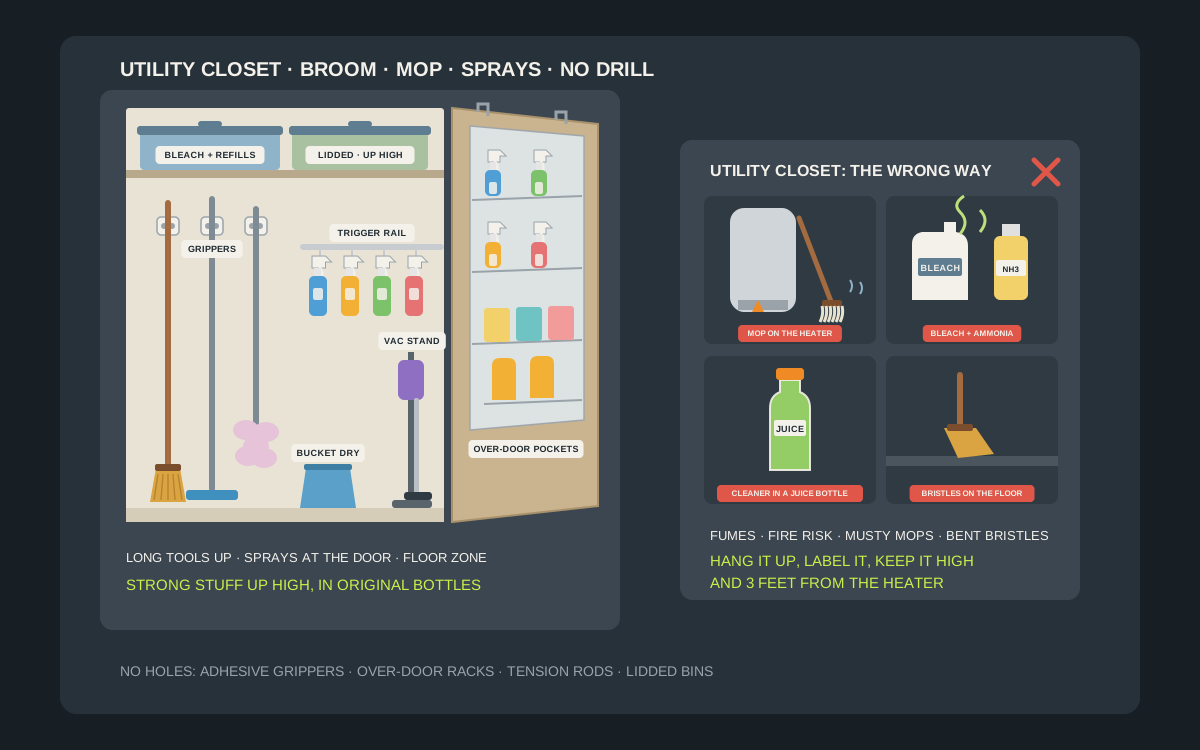
Every apartment has one: the narrow closet by the kitchen or in the hall where the broom, the mop, the bucket, the vacuum and a dozen bottles of cleaner all lean on each other. Open the door and the mop handle falls toward you. The spray you want is behind three you do not, the bleach is on the floor next to the bucket, and the dustpan has slid under everything. Because it is a rental, the obvious fix, a row of screwed-in hooks and a shelf, is off the table. The good news is that a utility closet is one of the easiest spaces in an apartment to organize without a drill. It has a door you can hang things on, two side walls a tension rod can span, smooth painted walls that suit adhesive grippers and usually a shelf you can make better use of. Put long tools upright and off the floor, the daily sprays where you can see them at the door, the refills and bleach up high in a closed bin, and the bucket and vacuum in a fixed spot at the bottom, and the whole closet works in about an hour. This guide covers which no-drill organizers suit each kind of cleaning gear, how to mount them so they actually hold, how to store cleaning chemicals safely in a small closet with children or pets in the home, and what to do if your utility closet also houses a water heater or a furnace. Everything here usually costs under $50, and a basic setup costs well under that.
Shop no-drill broom, mop and cleaning supply organizers on Amazon
Who this is for
- Renters with a hall, kitchen or laundry closet where the brooms, mops and cleaners have turned into one leaning pile
- Anyone who cannot drill into the walls but wants the mop and broom off the floor and the sprays where they can see them
- Households with small children or pets that need cleaning chemicals stored up high and out of reach
- People whose only utility closet also holds a water heater, furnace or electrical panel and who are not sure what can go in there
Quick answer
For most apartment utility closets, the best under-$50 setup is two or three adhesive broom and mop grippers on the back or side wall so the long tools hang upright with their heads off the floor, an over-door organizer with clear pockets or baskets for the daily sprays, cloths and gloves, and a lidded bin on the highest shelf for bleach, refills and anything you would not want a child to reach. If the closet is narrow, a tension rod across it holds spray bottles by their triggers, and if the walls are textured or freshly painted, an over-door broom rack or a freestanding broom stand replaces the grippers. Keep the bucket and vacuum on the floor in their own spot, keep cleaners in their original bottles, and keep everything that can burn well away from a water heater or furnace. Check handle diameters, door clearance and the weight ratings on the listing before you buy.
Quick comparison
| Organizer | Best for | How it holds | Trade-off |
|---|---|---|---|
| Adhesive broom and mop grippers | Brooms, flat mops and dusters on smooth painted walls | Spring or roller grip on a stick-on base; push the handle in | Check handle diameter and weight; no wallpaper or fresh paint |
| Over-door broom and mop rack | Closets with textured walls or no free wall | Hooks over the top of the door; grips, hooks and often a basket | Door must still latch; can rattle when the door swings |
| Over-door clear-pocket or basket organizer | Spray bottles, cloths, gloves and sponges | Hangs over the door or on a rail; pockets or wire baskets | Read per-basket weight ratings; not for gallon jugs |
| Tension rod across the closet | Spray bottles hung by their triggers, cloths on S-hooks | Spring or twist pressure between two side walls | Needs solid walls close together; light loads only |
| Freestanding broom and mop stand | Closets where nothing can stick to the walls | Weighted base with grips or slots for handles | Uses floor space; check that it is stable when loaded |
| Lidded bin or caddy on the top shelf | Bleach, drain cleaner, refills and laundry pods | Sits on the existing shelf; handle lifts it down | Needs a shelf; keep the heaviest bottles low in the bin |
| Slim rolling cart | Bulk refills, paper towels and the vacuum accessories | Rolls into a gap beside the tools; two to four tiers | Takes floor space; low tiers are within a child’s reach |
| Carry-along cleaning caddy | A ready kit for the bathroom or kitchen | Handle and divided compartments; lives on a shelf | Still needs a home; not a fix for long tools |
Adhesive broom & mop grippersOver-door cleaning supply organizersCleaning caddies with handles
What to look for
Grippers that fit your handles
Broom and mop grippers are sized for a range of handle diameters, and the range matters more than the brand. Command, for example, designs its Broom Gripper for handles of 0.8 to 1.0 inch and rates it to hold up to 4 pounds. Most household brooms, flat mops and dusters fall inside that range, but a thick wooden push-broom handle or a slim telescopic duster may not. Measure each handle with a ruler or a strip of paper before you buy, and check that the heaviest item, usually a wet string mop or a spin mop, is well under the stated weight.
A door that can carry weight and still close
The back of the closet door is the most useful storage space you have, but over-door organizers are only as good as the fit. The hooks have to be thin enough for the door to latch, the frame has to suit your door thickness, and the loaded rack must not stop the door from closing or hit the shelf behind it. Read the per-basket ratings, too. Smart Design, for example, rates the small baskets on its over-door organizer at 5 pounds and the large ones at 10 pounds, which is plenty for sprays and cloths but not for a gallon jug of floor cleaner.
Clear, open storage for the things you use every day
The sprays, cloths, gloves and sponges you reach for every week should be visible the moment the door opens. Clear vinyl pockets, open wire baskets and shallow bins let you see the label at a glance, so the bathroom spray does not get mistaken for the glass cleaner. Deep opaque bins on the floor are where cleaning products go to be forgotten and bought twice. Save the lidded, closed storage for the refills and the harsher products that should stay out of sight and reach.
A high, closed spot for the strong stuff
Bleach, drain cleaner, oven cleaner, laundry pods and refill jugs need somewhere higher than a child can reach and, ideally, behind a lid or a latch. The U.S. Poison Help program advises keeping household cleaners in locked cabinets or out of the reach of children and keeping laundry products locked up, high and out of reach. In most utility closets that means the top shelf, in a lidded bin with a handle, rather than the floor or the lowest pocket on the door.
A mounting method your walls and lease allow
No-drill organizers fall into four groups: adhesive grippers and hooks, over-door racks, tension rods and freestanding stands. Adhesives need smooth, clean, cured paint; Command says to wipe the wall with rubbing alcohol, press for 30 seconds, wait one hour before use and avoid wallpaper. Over-door racks need a door that fits. Tension rods need two solid, parallel walls close together. Freestanding stands need floor space. Look at your closet first, then pick the method, not the other way round.
Room for the awkward items
Every cleaning closet has a few things that fit nowhere: the bucket, the dustpan, the stick vacuum and its charger, the step stool and the bag of cloths waiting to be washed. Plan a floor zone for the bucket and vacuum, a hook for the dustpan and somewhere for the vacuum to charge. A setup that organizes the sprays beautifully but leaves the bucket in the doorway will be back to a pile within a month.
Plan the closet before you buy
Empty it and sort what you actually use
Take everything out and line it up in the hallway. Most cleaning closets hold three bottles of the same all-purpose spray, a mop nobody has used since the move and a dried-out sponge or two. Recycle empty bottles, take products you no longer use to a household hazardous waste collection if the label calls for it, and keep only what you clean with. Then sort the rest into four piles: long tools, everyday sprays and cloths, refills and harsh chemicals, and bulky floor items like the bucket and vacuum. Each pile gets its own zone.
Measure the door, the walls and the shelf
Write down the width and thickness of the door, the gap between the top of the door and the frame, the width between the side walls, the height of the shelf and the distance from the shelf to the back of the door when it is closed. Those five numbers decide almost everything: whether an over-door rack will let the door latch, which tension rod length you need, how long a mop can hang from a gripper without touching the floor and how deep the door organizer can be before it hits the shelf.
Map four zones from top to bottom
Think of the closet in layers. The top shelf is for closed storage of refills and the strongest chemicals. The upper half of the back and side walls is for long tools hung by their handles. The back of the door, from shoulder height down to about knee height, is for the daily sprays, cloths and gloves. The floor is for the bucket, the vacuum and anything heavy. Keeping each layer to one job is what stops the closet from sliding back into a pile.
Look at what else is in there
Many apartment utility closets also hold a water heater, a furnace or air handler, a washer and dryer or an electrical panel. That changes what you can store and where. Before you buy anything, note the appliances, any clearance or warning labels on them and where the shutoff valves and breaker panel are. The section on water heaters and furnaces below explains what has to stay clear.
Where each item belongs
Brooms, mops and dusters
Long tools belong upright, hung by the handle with the head off the floor. A broom stored on its bristles bends them until it sweeps crooked, and a mop head left sitting on the floor stays damp and starts to smell. Space grippers about 6 to 8 inches apart so the heads do not tangle, set them high enough that the longest tool clears the floor by a few inches, and put the tool you use most closest to the door. A flat mop with a removable pad can hang with its pad off, drying elsewhere.
Spray bottles and everyday cleaners
Spray bottles are the items you reach for most, so they go on the back of the door or on a tension rod at chest to waist height. Clear pockets or open baskets show the labels; trigger sprays can also hang by the trigger from a rod or a rail, which keeps them upright and leaves the shelf free. Group them by room, kitchen in one pocket and bathroom in another, so you can grab one set and go. Keep the caps and trigger locks closed when you put them away.
Bleach, drain cleaner and refills
Heavier, harsher and less frequently used products go up high in a lidded bin on the top shelf. That includes bleach, drain and oven cleaners, laundry pods, refill pouches and spare bottles. Stand bottles upright, close the caps tightly and keep acids and bleach-based products in separate bins so a leak from one cannot reach the other. A bin with a handle lets you lift the whole set down safely instead of reaching blindly over your head.
Cloths, sponges and gloves
Clean microfiber cloths, scrub sponges and rubber gloves take very little weight and fit in a shallow over-door pocket or a small basket at the front of the shelf. Keep a separate, open spot for used cloths waiting to go into the wash, such as a mesh bag on a hook, so damp cloths do not end up folded in with the clean ones. Gloves dry better hung by a cuff on a clip than balled up in a pocket.
Buckets, dustpans, vacuums and step stools
The bucket lives on the floor, upside down once it is dry, or nested with the mop wringer in one corner. A dustpan with a hang hole goes on a hook or gripper next to its broom. A stick vacuum needs either a freestanding stand or a spot beside an outlet where its charging base can sit on the floor; our guide to cordless vacuum wall mounts covers the screwed-in docks if your landlord allows them. A slim folding step stool can slide between the bucket and the wall.
Mounting it without drilling
Adhesive grippers, the way the maker says
Most adhesive grippers fail because of the prep, not the product. Command’s instructions for its Broom Gripper are a good template: clean the wall with rubbing alcohol rather than household cleaners, press the strip and gripper to the wall for 30 seconds and wait one hour before hanging anything. The irony of a cleaning closet is that the wall is often wiped with the very sprays stored there, which leave a residue adhesive does not like, so the alcohol step matters more here than anywhere. Use one gripper per tool.
Check the wall, the paint and the temperature
Command says not to use its broom grippers on wallpaper and to apply and use them between about 50 and 105 degrees Fahrenheit, and its general instructions add a wait of 7 days after painting. Textured, damp or dusty walls are a poor match for any adhesive. A closet beside an exterior wall or a laundry closet with a dryer running may also see big swings in temperature and humidity. If your wall fails any of these tests, switch to an over-door rack or a freestanding stand rather than gambling on the strips.
Over-door racks and organizers
Over-door broom racks and pocket organizers need no adhesive at all, which makes them the safest choice on textured or freshly painted walls. Before you buy, check that the hooks match your door thickness, that the door still latches with the hooks in place and that the loaded organizer does not hit the shelf or the frame when the door closes. Felt pads or rubber bumpers on the back of the rack stop it from scuffing the door and rattling every time someone shuts it.
Tension rods across the closet
A tension rod between the side walls of a narrow closet makes a quick rail for trigger sprays and S-hooks. It works best when the walls are solid and parallel and the rod is short; the wider the span, the less it holds. Fit it so it is firmly tight, set it below the shelf where the bottles are easy to grab, and keep the load light: a row of spray bottles and a few cloths, not jugs or the vacuum. Small rubber end pads protect the paint.
Freestanding stands and carts
If nothing can stick to the walls and the door is too thin or too busy, a freestanding broom and mop stand holds the long tools upright on a weighted base, and a slim rolling cart takes refills and paper towels. Both need floor space, so measure first and test that the stand does not tip when only one side is loaded. A cart’s lowest tier is within a toddler’s reach, so use it for paper goods and cloths rather than chemicals.
Taking it down when you move out
Adhesive strips come off cleanly only if they are removed the right way. Command’s broom gripper instructions say to hold the gripper gently, never pull the strip toward you and instead stretch it slowly straight down against the wall, at least 15 inches, until it releases. Pulling outward is what tears paint and drywall paper and costs you part of a deposit. Keep a photo of the instructions on your phone so the removal is as careful as the install.
Storing cleaning chemicals safely in a small closet
Keep everything in its original bottle
The label is your instructions, your first aid guide and the information a poison center needs in an emergency. Poison Control, the national poison center at poison.org, advises keeping cleaning products in their original containers and never storing them in food or drink containers, because a cleaner in a juice bottle looks like juice to a child and, in a hurry, to an adult. If you must decant a product into a smaller spray bottle, copy the original label onto it along with the poison center number, 1-800-222-1222, and never reuse a food or drink container.
Never mix products, and store incompatible ones apart
Poison Help, run by the U.S. Health Resources and Services Administration, says bleach should not be mixed with anything other than water, because mixing it with other cleaners can release chlorine gas. Indiana’s environmental agency gives the same warning about bleach with ammonia or vinegar. Storage matters too: a leaking bottle of bleach above a bottle of ammonia-based glass cleaner is a mix you did not choose. Keep bleach products in one lidded bin and acidic or ammonia-based products in another.
Up high and latched if children or pets are around
The U.S. Environmental Protection Agency recommends storing household cleaning products out of children’s reach, using childproof locks on low cabinets and keeping child-resistant caps in place. Poison Control adds that cleaners should be stored away from food and medicines and recommends child-resistant latches where children live. In a utility closet, that means no chemicals in the low door pockets, a lidded bin on the top shelf for the harshest products and a simple door latch if a toddler can open the closet.
Heat, sun and freezing
Clorox says its bleach lasts up to a year when stored properly away from heat and direct sunlight, and its label asks for upright storage with the cap tightly closed in a cool, dry place. Indiana’s environmental agency advises storing household products out of the sun and away from heat, sparks and flames, including pilot lights, and keeping most of them from freezing. An interior utility closet is usually ideal for this; a closet that shares a wall with a water heater or gets hot in summer is not.
Plan for leaks and spills
Bottles leak, especially old ones. A lidded plastic bin on the shelf doubles as a drip tray, and a cheap boot tray under the bucket catches the drips from a mop wringer. If a container starts to crack, Indiana’s guidance is to put the whole container in a plastic bucket surrounded by an absorbent such as cat litter. Keep a pair of gloves in the closet and the poison center number, 1-800-222-1222, on a label inside the door.
If your utility closet holds a water heater or furnace
Keep anything that can burn well clear
The U.S. Fire Administration advises keeping anything that can burn at least 3 feet from furnaces, water heaters and other heat-producing equipment. In a small apartment closet that often rules out most of the space around the appliance. Brooms, mops, cloths, paper towels and cardboard boxes all count as things that can burn, so if the closet is mainly a water heater or furnace closet, it is not your cleaning closet, whatever the floor plan says.
Gas appliances and cleaning vapors do not mix
Water heater makers are blunt about this. Rheem’s installation instructions for gas water heaters say they should not be installed where liquids that give off flammable vapors are used or stored, and ask that clothing, cleaning materials and rags be kept clear of the base. Aerosols and solvent-based products are the main concern, but the simplest rule is no cleaning products in a closet with a gas burner or pilot light. The NFPA fire code used for many buildings also says combustible material should not be stored in mechanical rooms.
Keep access to shutoffs and the breaker panel
A maintenance technician needs to reach the water heater, the furnace filter, the shutoff valves and the relief valve quickly, and you need to reach the breaker panel in a hurry. Fire safety advice is to keep the panel easy to reach at all times, and the electrical code requires a clear working space in front of panels, typically about 30 inches wide and 3 feet deep. Never hang an organizer over a panel door or lean a mop against a gas valve or water heater controls.
Where the cleaning gear goes instead
If the utility closet is really a mechanical closet, move the cleaning kit to the next best place: the back of a coat or linen closet door, a laundry closet, the cabinet under the kitchen sink or a slim cart beside the fridge. Brooms and mops can hang on adhesive grippers inside a coat closet or on an over-door rack on the pantry door. Our guides to over-washer shelves and tension-rod under-sink organizers cover those two spaces in detail.
Keep the tools clean and dry
Let mops dry before they go away
A wet mop put away in a closed closet is the fastest route to a musty smell. Rinse the head, wring it hard and let it dry with air around it before it goes back on its gripper, head down if it is a string mop so it drains, or with the pad removed if it is a flat mop. A mop that is still damp at bedtime can hang on the outside of the closet door overnight. Replace heads and pads that stay smelly after washing.
Wash microfiber pads and cloths properly
Microfiber pads and cloths work by trapping dust in their fibers, so they need washing rather than just rinsing. Follow the care label, wash them with other lint-free items and check whether the maker advises against fabric softener, which many do because it clogs the fibers. A mesh bag on a hook in the closet collects used pads and cloths until laundry day and keeps them separate from the clean stack.
Store brooms and dusters off their heads
A broom resting on its bristles slowly bends them sideways, and a duster stored head-down picks up the grime it is meant to remove. Hanging both by the handle keeps the working end clean and straight. Tap the broom out over a bin before you hang it, and give a duster a shake outdoors or a wash if its instructions allow.
Dry buckets upside down
Empty the bucket, rinse it and let it dry upside down, ideally slightly propped so air can get underneath. A bucket left with an inch of dirty water in the corner of a closet is a smell, a spill and, for small children, a drowning risk; the CPSC has long warned that young children can drown in buckets with even a small amount of liquid. Store the wringer and any scrub brush dry inside or beside it.
Three sample setups
Narrow hall closet, one person, no drilling
On the back wall, three adhesive grippers hold a broom, a flat mop and an extendable duster in a row, heads a few inches off the floor, with the dustpan on a small hook beside the broom. A clear-pocket organizer on the back of the door holds the kitchen and bathroom sprays, cloths and gloves. A lidded bin on the shelf keeps bleach and refills. The bucket sits upside down in the corner with a stick vacuum on a slim floor stand beside it.
Laundry closet shared with a washer and dryer
With no free wall, an over-door broom and mop rack with a basket holds the long tools and a few sprays on the inside of the bifold or swing door. A tension rod above the machines holds trigger sprays and stain removers by their necks, well clear of the dryer vent. Laundry pods and bleach go in a lidded bin on the highest shelf, and a slim rolling cart in the gap beside the washer takes paper towels and spare cloths.
Family apartment with a toddler and a cat
The utility closet gets a simple adhesive child latch on the door. Inside, the low door pockets hold only cloths, sponges and gloves, while every spray and refill lives in two lidded bins on the top shelf, one for bleach products and one for everything else. Brooms and mops hang high in grippers, the bucket is stored dry and upside down, and the poison center number is on a label inside the door. Cat litter supplies live elsewhere, so the cat never has a reason to go in.
How to set it up in an hour
- Empty the closet, recycle empties and keep only the products and tools you actually use.
- Check for a water heater, furnace or electrical panel, and move combustible supplies elsewhere if there is one.
- Measure the door, the gap above it, the wall-to-wall width and the shelf height and depth.
- Measure each tool handle and pick grippers, a door rack or a stand that fit them.
- Wipe the gripper spots with rubbing alcohol, mount them high enough for the longest tool to clear the floor, and wait an hour before loading.
- Hang the over-door organizer, check that the door still latches, and load the everyday sprays, cloths and gloves.
- Fit a tension rod for trigger sprays if the closet is narrow and the walls are solid.
- Put bleach, drain cleaner and refills in lidded bins on the top shelf, with incompatible products in separate bins.
- Give the bucket and vacuum a floor spot, add a label with the poison center number inside the door and add a latch if small children live with you.
Mistakes to avoid
- Leaning brooms and mops in a corner so they fall out every time the door opens.
- Sticking grippers to a wall that was just wiped with cleaning spray, without the rubbing alcohol step.
- Hanging a heavy wet mop from a gripper rated for less than it weighs.
- Buying an over-door organizer without checking that the door still latches.
- Storing bleach on the floor or in the lowest door pockets where a child can reach it.
- Pouring cleaner into an old drink bottle or an unlabeled spray bottle.
- Storing bleach beside ammonia or acidic cleaners where a leak could mix them.
- Using the water heater or furnace closet as a cleaning closet, or blocking the breaker panel.
Related guides
Browse the hub: No-drill apartment storage under $50 - all guides
- Best No-Drill Adhesive Broom and Mop Holders for Garages Under $50
- Best No-Drill Over-Washer Shelves for Apartment Laundry Closets Under $50
- Best Over-the-Door Organizers for Apartments Under $50
- Best Tension Rod Under-Sink Organizers for Apartments Under $50
- Best Tension Rod Shelves for Apartment Closets Under $50
- Best Cordless Vacuum Wall Mounts Under $50 for Garage Storage
- Best Adhesive Trash Bag Dispensers for Apartment Kitchens Under $50
- Best Adhesive Bathroom Squeegee Holders for Apartments Under $50
- Best Spring Cleaning Supply Wall Organizers Under $50 for Garage
FAQ
How do I organize a utility closet without drilling?
Hang long tools on adhesive broom and mop grippers or an over-door broom rack, put everyday sprays, cloths and gloves in an over-door pocket organizer, add a tension rod for trigger sprays if the closet is narrow, and keep bleach and refills in a lidded bin on the top shelf. Give the bucket and vacuum their own floor spot.
Will adhesive broom holders hold a mop?
Usually, if the mop is light and the handle fits. Command rates its Broom Gripper at up to 4 pounds for handles 0.8 to 1.0 inch thick. A dry flat mop is well within that, but a wet string mop or a spin mop may not be, so wring it out first or use an over-door rack or freestanding stand.
Where should cleaning chemicals be stored in an apartment?
In their original bottles, in a cool, dry place away from heat, sun, food and medicines, and up high or behind a latch if children or pets live with you. Poison Help advises keeping household cleaners locked up or out of children’s reach and keeping laundry products locked up, high and out of reach.
Can I store cleaning supplies in the water heater or furnace closet?
It is best not to. The U.S. Fire Administration advises keeping anything that can burn at least 3 feet from water heaters and furnaces, and gas water heater makers such as Rheem say products that give off flammable vapors should not be stored where the heater is installed. Use another closet, a door organizer or the space under the sink instead.
Is it safe to store bleach next to other cleaners?
Store it upright with the cap tightly closed, and keep it apart from ammonia-based and acidic cleaners so a leak cannot mix them. Poison Help warns that mixing bleach with other cleaners can release chlorine gas and says bleach should be mixed with nothing but water. Clorox says bleach lasts up to a year stored away from heat and sunlight.
How do I remove adhesive broom grippers without damaging the wall?
Hold the gripper gently and pull the strip straight down along the wall, slowly stretching it at least 15 inches until it releases, as Command’s instructions describe. Never pull it toward you, which is what tears paint and drywall paper. Take everything off the gripper first.
Bottom line
The best no-drill cleaning supply organizer for an apartment utility closet is a small system rather than one product: adhesive grippers or an over-door rack for the broom and mop, an over-door pocket organizer or a tension rod for the everyday sprays and cloths, a lidded bin up high for bleach and refills, and a fixed floor spot for the bucket and vacuum. Prep the wall the way the adhesive maker says, keep every cleaner in its original bottle, store incompatible products apart, and keep anything that can burn well away from a water heater or furnace. Measure your handles, your door and your closet, then check the grip size, weight ratings and current price on the listing before you buy.
Shop no-drill broom, mop and cleaning supply organizers on Amazon